Wildlife Guide · Indonesia & Malaysia
Rhinoceros Hornbill
Buceros rhinoceros
The forest's flying icon of Borneo and Sumatra, crowned by a casque shaped like a rhino's horn.
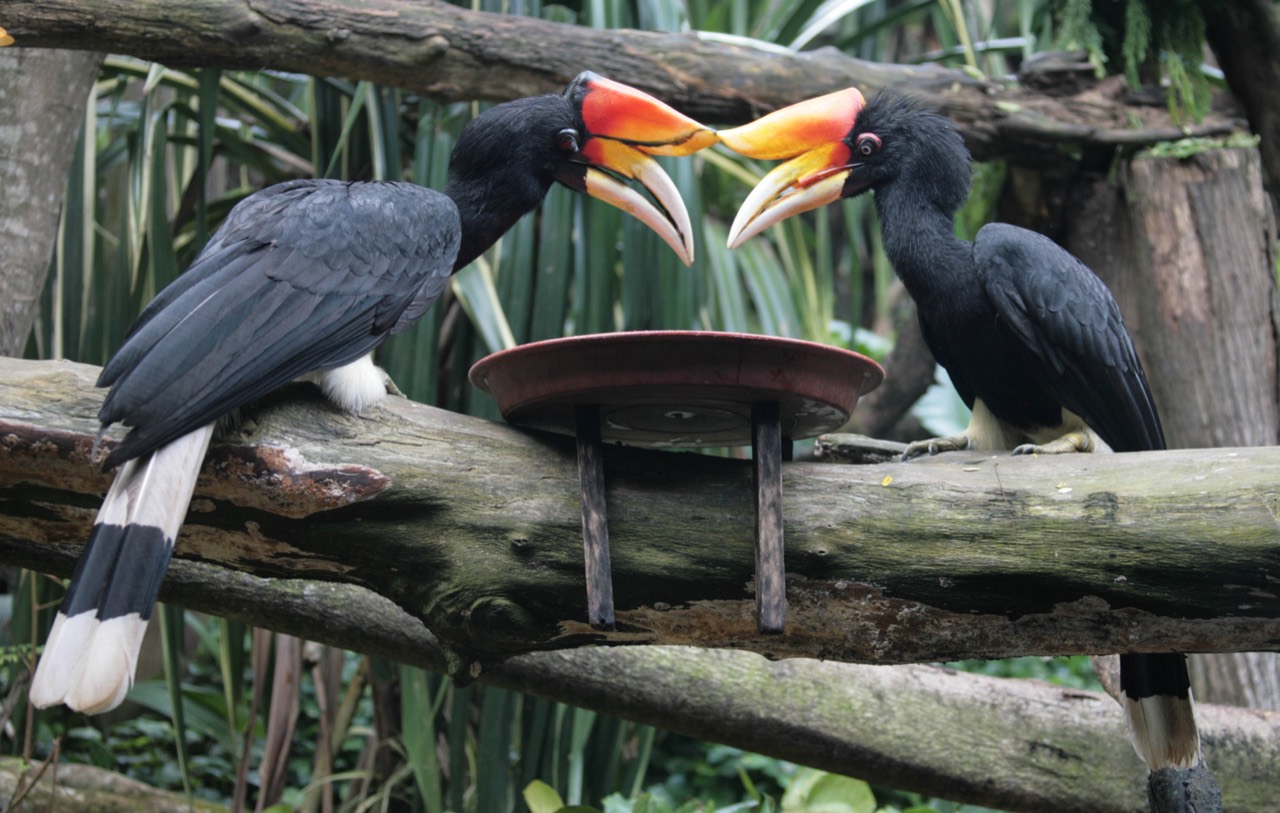
Source: Wikimedia Commons via Wikipedia “Rhinoceros hornbill”
In brief
A Rhinoceros Hornbill is a large black-and-white rainforest bird (Buceros rhinoceros) native to Southeast Asia, named for the big curved orange casque above its bill; the IUCN classes it as Vulnerable.
Also in Animals A to Z · Animals that start with R
How you can help
You can support the related appeal — read its purpose, recipient status and fund terms first — or give once to where it is needed most. Sharing accurate information helps too.
By WARN Research & Conservation TeamLast updated
The Rhinoceros Hornbill (Buceros rhinoceros) is a large fruit-eating bird of the lowland and hill rainforests of Southeast Asia, instantly recognised by the curved, upturned casque sweeping back over its bill. It is the state bird of Sarawak and the national bird of Malaysia, yet across Indonesia and Malaysia its forests are shrinking and hunting pressure is rising. The IUCN lists it as Vulnerable, with a population that is declining.
80–90 cm
Body length
~35 yrs
Lifespan
Vulnerable
IUCN status (2018)
Appendix II
CITES listing
Figures sourced from IUCN Red List — Buceros rhinoceros (2018 assessment), BirdLife International — Rhinoceros Hornbill species factsheet, IUCN Hornbill Specialist Group — Rhinoceros Hornbill and other references on this page.
Rhinoceros Hornbill: Quick Facts
| Lifespan | Up to ~35 years |
|---|---|
| Weight | Male 2,465–2,960 g; female 2,040–2,330 g |
| Length | 80–90 cm (31–35 in) |
| Diet | Frugivorous (figs); also insects, small reptiles, rodents, eggs |
| Incubation | About 37–46 days |
| Eggs per clutch | Usually 1–2 |
| Baby name | Chick |
| Group name | Flock |
| IUCN status | Vulnerable (2018) |
| CITES | Appendix II |
Scientific Classification
| Kingdom | Animalia |
|---|---|
| Phylum | Chordata |
| Class | Aves |
| Order | Bucerotiformes |
| Family | Bucerotidae |
| Genus | Buceros |
| Species | Buceros rhinoceros (Linnaeus, 1758) |
| Subspecies | Three recognised: B. r. rhinoceros, B. r. borneoensis, B. r. silvestris |
Conservation Status
- IUCN Status
- Vulnerable
- Population
- No reliable global estimate
- Trend
- Decreasing
- Assessed
- 2018
- CITES
- Appendix II
Uplisted from Near Threatened to Vulnerable in 2018 under criteria A3cd+4cd; the species is widespread but a large reduction is suspected over the next three generations due to habitat loss and hunting.
Did you know?
When she is ready to breed, the female Rhinoceros Hornbill seals herself inside a tree hollow behind a wall of mud, leaving only a narrow slit through which her mate feeds her for weeks.
Key Facts: Rhinoceros Hornbill
- The Rhinoceros Hornbill is listed as Vulnerable by the IUCN (assessed 2018), uplisted from Near Threatened, with a decreasing population trend.
- Its signature feature is the large keratin casque curving up over the bill; despite its size it is hollow and lightweight.
- It is the state bird of Sarawak and the national bird of Malaysia, and appears in the cultures of many Bornean Indigenous peoples.
- Breeding females seal themselves inside a tree-cavity nest behind a wall of mud and droppings, leaving only a slit through which the male delivers food.
- It is a fruit specialist that prefers figs, making it an important seed disperser across the rainforests of Indonesia and Malaysia.
- Habitat loss from logging and oil-palm conversion plus hunting for meat and ornaments are driving its decline; it is also shot in confusion with the prized Helmeted Hornbill.
Why it matters and why it is threatened
The Rhinoceros Hornbill depends on tall, mature rainforest with large trees that contain the natural cavities it needs to breed. As lowland forest across Indonesia and Malaysia is cleared for timber and oil-palm plantations, both food trees and nest sites disappear. The IUCN, which uplisted the species to Vulnerable in 2018, expects a large population reduction over the coming three generations driven by this habitat loss together with hunting. Because hornbills breed slowly and need old-growth trees, populations recover far more slowly than the forest is lost.
Behaviour and ecology
This is a fruit-loving bird that favours figs but will also take insects, small reptiles, rodents and the eggs or chicks of other birds. By swallowing fruit whole and travelling widely, it spreads seeds across the forest, helping the rainforest regenerate. Its breeding is extraordinary: the pair chooses a tree hollow, and the female walls herself inside using mud, fruit pulp and droppings until only a narrow slit remains. She incubates and broods there for weeks while the male passes food through the gap, a strategy that protects the eggs and chicks from predators.
Threats in close-up
Beyond forest clearance, the Rhinoceros Hornbill is hunted for its meat, and its casque, skull and tail feathers are taken for decoration and ceremony. A further danger is mistaken identity: poachers targeting the critically endangered Helmeted Hornbill, whose solid casque is carved like ivory, also shoot Rhinoceros Hornbills. Fragmented forests leave the remaining birds easier to find and more exposed, compounding the pressure on a species that already reproduces slowly.
What rescue and protection involve
Protecting this hornbill means keeping large tracts of lowland and hill rainforest standing and connected, safeguarding the old trees it nests in, and curbing illegal hunting and trade. On the ground that work looks like forest patrols, nest monitoring and artificial nest boxes, rehabilitation of confiscated or injured birds, and community education so that local people benefit from living forests rather than felled ones. Because the species ranges widely, durable gains come from supporting the local teams who do this day-to-day work.
Rhinoceros Hornbill vs. Helmeted Hornbill
| Feature | Rhinoceros Hornbill | Helmeted Hornbill |
|---|---|---|
| Scientific name | Buceros rhinoceros | Rhinoplax vigil |
| IUCN status | Vulnerable | Critically Endangered |
| Casque | Hollow, lightweight, curved upward | Solid keratin block, carved like ivory |
| Main extra threat | Habitat loss and general hunting | Targeted poaching for its solid casque |
| Range overlap | Borneo, Sumatra, Malay Peninsula | Borneo, Sumatra, Malay Peninsula |
What WARN Does
WARN publishes this guide for education and is developing support through assessed animal-welfare grants. A species range, source citation or photograph does not establish a recipient or funding agreement. Check /about/where-your-money-goes/#grant-register for published grant and payment records; records not yet published must not be read as zero activity. Browse /appeals/ for the purposes currently available to support.
Every gift to WARN helps fund the local partners protecting hornbill forests in Indonesia and Malaysia — keeping the big trees standing so the Rhinoceros Hornbill still has somewhere to nest.
How can I help save the rhinoceros hornbill?
Explore practical ways to support the rhinoceros hornbill, from everyday choices and sharing reliable information to reviewing a related appeal before giving.
Explore ways to support
Read the related appeal’s purpose, recipient status and fund terms. Choose an affordable gift after checking what is proposed and what has been reported.
Ease the pressures
Avoid the wildlife trade and souvenirs, never buy wild animals as pets, and choose sustainable, habitat-friendly products — the threats behind the rhinoceros hornbill's decline fall when demand does.
Spread the word
Share accurate, sourced information about the rhinoceros hornbill. Wider awareness is what turns concern into lasting protection.
Rhinoceros Hornbill: Frequently Asked Questions
How can I help save the rhinoceros hornbill?
How long do Rhinoceros Hornbills live?
What do Rhinoceros Hornbills eat?
How big is a Rhinoceros Hornbill?
Are Rhinoceros Hornbills dangerous to people?
How many Rhinoceros Hornbills are left?
Why is the Rhinoceros Hornbill endangered?
What is the casque on a Rhinoceros Hornbill?
Where do rhinoceros hornbills live?
Sources & References
Population figures, conservation status and biological facts on this page are drawn from authoritative scientific and intergovernmental sources.
Terms used on this page
Plain-English definitions, from our wildlife and conservation glossary.
Latest Rhinoceros Hornbill Stories
Quick, fact-checked reads on the rhinoceros hornbill — amazing facts, key questions and the threats it faces.
Species
12 Amazing Facts About the Rhinoceros Hornbill
From a mud-walled nursery to a horn-shaped crown that doubles as a loudspeaker, here are 12 standout facts about Southeast Asia's most charismatic rainforest bird.
Read the storySpecies
How Big Is a Rhinoceros Hornbill? Size, Weight and Lifespan Explained
Rhinoceros Hornbills are among the largest forest hornbills. Here is how their length, weight, casque and lifespan actually measure up.
Read the storySpecies
Rhinoceros Hornbill vs Helmeted Hornbill: Key Differences
They share the same forests and a horn-like crown, but one is hunted to the brink for its solid casque. Here is how to tell the Rhinoceros and Helmeted Hornbills apart.
Read the storyExplore more animals
Discover more animals, their habitats and their conservation status in the WARN wildlife-guide library.