Wildlife Guide · United Kingdom and Ireland & Continental Europe
European Robin
Erithacus rubecula
Britain's red-breasted garden favourite, the bird that sings through winter.
Source: Global Animal Guide (WARN)
In brief
A European robin (Erithacus rubecula) is a small Eurasian songbird with a distinctive orange-red face and breast, brown upperparts and a pale belly. Common in gardens, woods and hedgerows, it is famously territorial, sings year-round and is widely associated with British winters and Christmas.
Also in Animals A to Z · Animals that start with E
By WARN Research & Conservation TeamLast updated
The European robin (Erithacus rubecula) is a small, round garden bird famous for its bright orange-red face and breast, and for being one of the few birds in Europe to sing right through the depths of winter. Found across the UK, Europe, North Africa and into western Asia, it is the model for countless Christmas cards and a fixture of gardens, woodlands and hedgerows. Despite its tame, friendly reputation around gardeners and bird tables, the robin is fiercely territorial and will defend its patch with song and, sometimes, violence. Crucially, it is not the same bird as the American robin, a much larger and unrelated thrush that merely shares the name.
12.5-14 cm
Body length, roughly sparrow-sized
16-22 g
Typical adult weight
Year-round
One of few birds that sing all winter
Hundreds of millions
Estimated global population
Figures sourced from Wikipedia: European robin, IUCN Red List, Encyclopaedia Britannica: Robin and other references on this page.
European Robin: Quick Facts
| Common name | European robin (robin redbreast) |
|---|---|
| Scientific name | Erithacus rubecula |
| Family | Muscicapidae (Old World flycatchers) |
| Body length | 12.5-14 cm |
| Wingspan | 20-22 cm |
| Weight | 16-22 g |
| Diet | Insects and invertebrates, plus berries, fruit and seeds |
| Clutch | Usually 5-6 eggs, two or three broods a year |
| Typical lifespan | Around 1 year on average; much longer if it survives first winter |
| IUCN status | Least Concern |
Scientific Classification
| Kingdom | Animalia |
|---|---|
| Phylum | Chordata |
| Class | Aves |
| Order | Passeriformes |
| Family | Muscicapidae (Old World flycatchers) |
| Genus | Erithacus |
| Species | Erithacus rubecula |
Conservation Status
- IUCN Status
- Least Concern (IUCN Red List). The European robin has an extremely large range and a population estimated in the hundreds of millions, and is one of the most common and widespread songbirds in Europe.
- Population
- Estimated in the hundreds of millions globally
- Trend
- Stable
- Assessed
- Assessed by the IUCN as Least Concern (most recent assessment)
- CITES
- Not listed on CITES
As a secure, widespread species the robin is not a conservation priority, but it shares broad pressures such as habitat loss and declining insect populations with many species that are far more vulnerable.
Key Facts: European Robin
- The European robin is a small Eurasian songbird with an unmistakable orange-red face and breast.
- It is listed as Least Concern by the IUCN, with a large and widespread population.
- Robins are highly territorial and use their song to defend a patch all year, not just in spring.
- Both male and female robins look alike, so the sexes cannot be told apart by plumage alone.
- The American robin is an unrelated, larger thrush that only shares the name.
- It is not CITES-listed and faces no major global conservation threat, though it shares pressures like habitat loss with other wildlife.
What does a European robin look like?
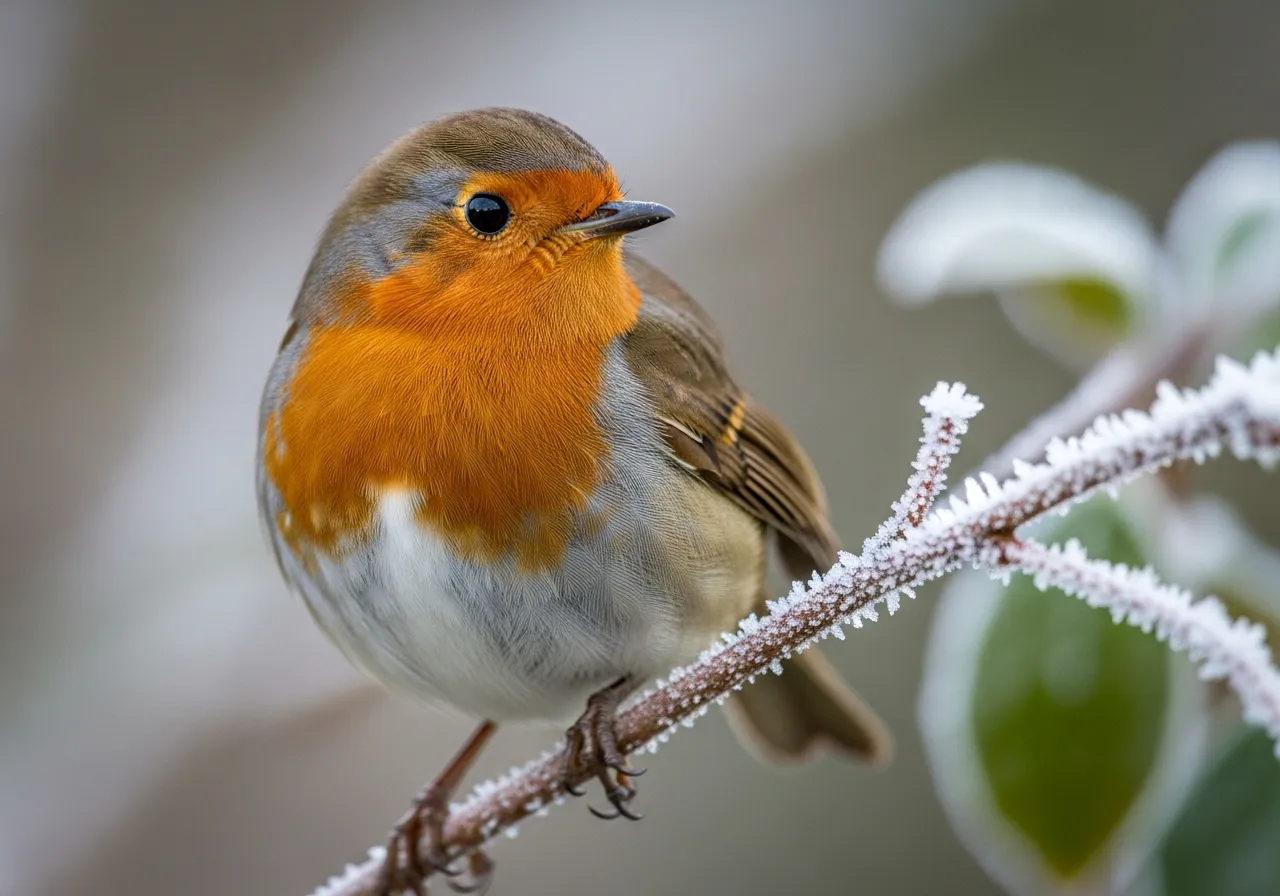
The European robin is a compact, plump-looking songbird, about 12.5 to 14 centimetres long with a wingspan of roughly 20 to 22 centimetres and a weight of 16 to 22 grams, making it a little smaller than a house sparrow. Its most striking feature is the warm orange-red wash that covers the face and breast, bordered by a soft blue-grey band along the sides of the head and chest. The upperparts are an olive-brown, the belly is whitish, and the bird has slender dark legs, a fine pointed beak and large dark eyes suited to feeding in low light. Males and females are essentially identical in plumage, so they cannot be reliably told apart by appearance alone. Young robins look quite different: they lack the red breast entirely and are instead heavily mottled and spotted in brown and buff, which helps camouflage them and avoids triggering the territorial aggression that the red breast provokes in adults. This rounded silhouette and bright breast make the robin one of the most instantly recognisable birds in Europe.
Why are robins so territorial?
For a bird with such a friendly public image, the robin is remarkably aggressive. Males, and often females in winter, hold individual territories which they defend vigorously throughout the year. The robin's song is its primary weapon: a clear, fluting, slightly melancholy warble used to advertise ownership and warn off rivals. The orange-red breast is also a signal of dominance, puffed out and displayed during confrontations. When display fails, robins will physically attack intruders, and disputes can occasionally escalate to the point of injury or death, an unusually high cost among small songbirds. This is why a robin reacts so strongly to its own reflection or even to a tuft of red feathers. The same boldness explains the robin's famous tameness around people: in Britain, robins learned to follow large animals, and later gardeners, to snap up insects and worms turned up by digging. What looks like affection is really an opportunistic feeding strategy, with the gardener standing in for the wild boar that once disturbed the soil.
Is the European robin the same as the American robin?
No, and the difference matters. The European robin (Erithacus rubecula) belongs to the Old World flycatcher family and is a small bird weighing well under 25 grams. The American robin (Turdus migratorius) is a true thrush, in the same genus as the blackbird and song thrush, and is far larger and heavier. The two are not closely related at all; they simply ended up sharing a name because early European settlers in North America saw a red-breasted bird and called it after the robin they knew from home. The resemblance is superficial, limited mainly to the reddish breast. In behaviour, song, size and family they are quite distinct. So when people picture a robin on a snowy branch on a Christmas card, that is the European robin, while the bird hopping across North American lawns pulling up worms in spring is the unrelated American robin.
European robin vs American robin
| Feature | European robin | American robin |
|---|---|---|
| Scientific name | Erithacus rubecula | Turdus migratorius |
| Family | Old World flycatchers | True thrushes (Turdidae) |
| Size | Small, 12.5-14 cm | Large, around 23-28 cm |
| Weight | 16-22 g | About 77 g |
| Red colour | Orange-red face and breast | Brick-red breast only |
| Range | Eurasia and North Africa | North America |
| Relationship | Not a thrush | A close relative of the blackbird |
What WARN Does
WARN does not run any field project specifically for the European robin, which is a widespread and secure species across Europe and lies outside the countries where WARN's partners work. This guide is part of WARN's free educational work, helping people understand and value the wildlife around them. The pressures robins ultimately share with many less fortunate species, such as habitat loss and the degradation of green spaces, are exactly the kinds of threats that do harm the animals WARN's partners protect.
If this guide deepened your appreciation of garden birds, you can help WARN keep producing free wildlife education and supporting the animals most in need.
European Robin: Frequently Asked Questions
Are male and female robins different colours?
Why do robins sing in winter?
What do European robins eat?
How long do robins live?
Are European robins endangered?
Why are robins associated with Christmas?
Where do european robins live?
Are european robins dangerous?
How big is an european robin?
Sources & References
Population figures, conservation status and biological facts on this page are drawn from authoritative scientific and intergovernmental sources.
Terms used on this page
Plain-English definitions, from our wildlife and conservation glossary.
Latest European Robin Stories
Quick, fact-checked reads on the european robin — amazing facts, key questions and the threats it faces.
Explore more animals
Discover more animals, their habitats and their conservation status in the WARN wildlife-guide library.