Wildlife Guide · North Atlantic — rivers of Europe and North America; ocean feeding grounds off Greenland
Salmon
Salmo salar (Linnaeus, 1758)
The leaping fish of Atlantic rivers — globally Least Concern, locally in crisis.
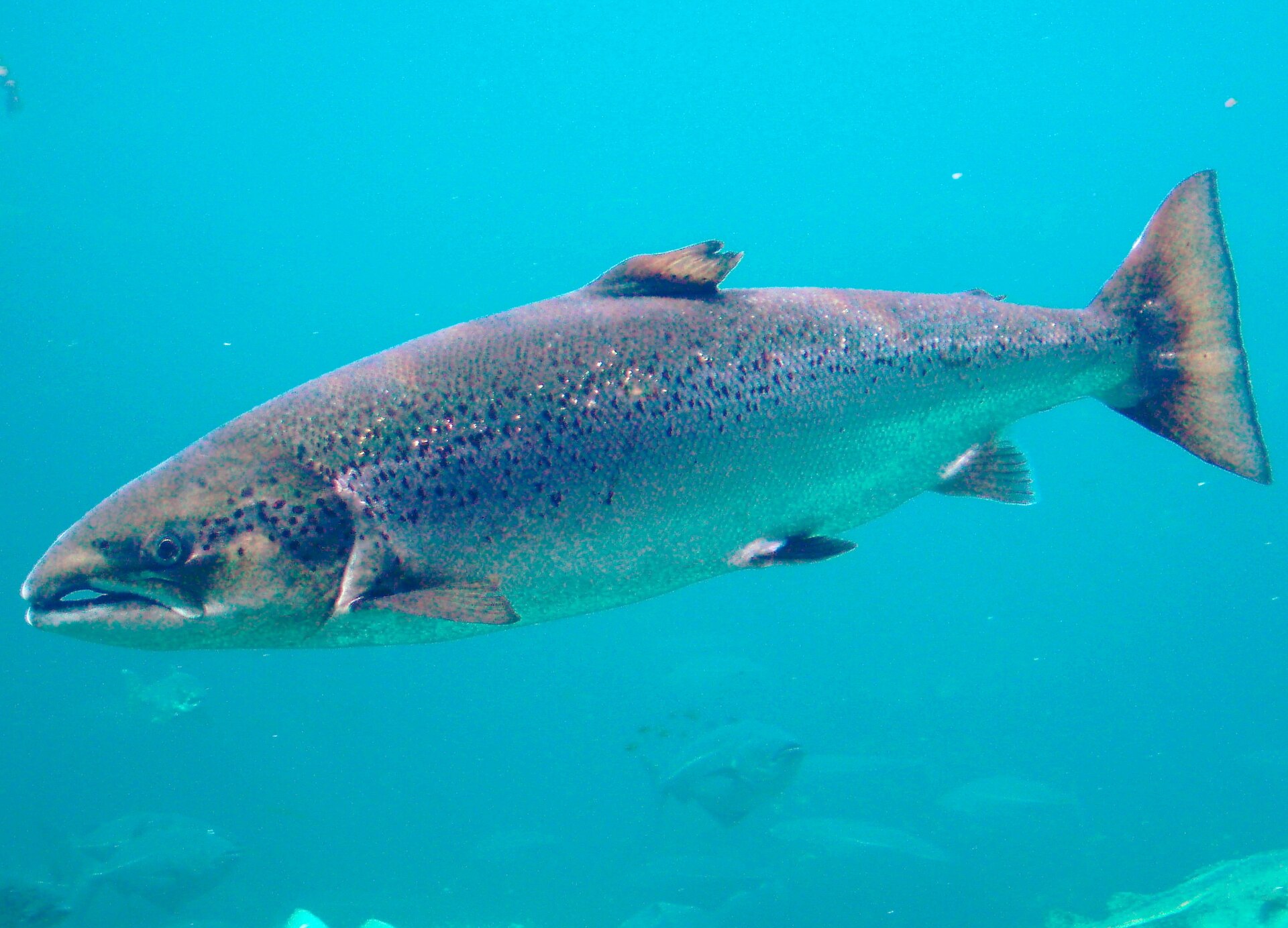
Photo: Hans-Petter Fjeld / Wikimedia Commons (CC BY-SA 2.5)
In brief
The Atlantic salmon (Salmo salar) is Least Concern globally but Endangered in much of its southern range; anadromous fish threatened by dams, aquaculture, sea lice, overfishing and river pollution.
Also in Animals A to Z · Animals that start with S
By WARN Research & Conservation TeamLast updated
Atlantic salmon are anadromous — born in rivers, migrating to sea to grow, returning to spawn in the streams where they hatched. Silver-scaled and powerful, they leap waterfalls and navigate by smell to find natal gravels. Listed as Least Concern globally, Atlantic salmon mask a conservation emergency: populations in England, Wales and the southern edge of their range are Endangered or Critically Endangered. Wild Scottish and Irish runs have halved since the 1970s. Dams, pollution, aquaculture disease, overfishing at sea and climate change threaten every stage of the life cycle. Pacific salmon species — sockeye, chinook, coho — face parallel pressures across North America and Asia.
Least Concern
IUCN global status (2018) — regional declines severe
50%+
Decline in many European river systems since 1970s
1,500 km
Maximum recorded migration in river and sea
Not listed
CITES status
Figures sourced from IUCN Red List — Salmo salar, Atlantic Salmon Trust, NASCO — North Atlantic Salmon Conservation Organization .
Salmon: Quick Facts
| Length | Up to 150 cm; typically 60–80 cm |
|---|---|
| Life cycle | Anadromous — river to sea and back |
| UK trend | 50%+ decline since 1970s |
| Sea feeding | North Atlantic — primarily off Greenland |
| Aquaculture threat | Sea lice, disease, escapes |
| CITES | Not listed |
Scientific Classification
| Kingdom | Animalia |
|---|---|
| Phylum | Chordata |
| Class | Actinopterygii |
| Order | Salmoniformes |
| Family | Salmonidae |
| Genus | Salmo |
| Species | Salmo salar (Linnaeus, 1758) |
Conservation Status
- IUCN Status
- Least Concern globally (IUCN, 2018). Endangered in England, Wales and southern Europe.
- Population
- Millions globally; wild runs declining in most European rivers
- Trend
- Decreasing across most of range
- Assessed
- 2018
- CITES
- Not listed under CITES
Key Facts: Salmon
- Atlantic salmon hatch in rivers, feed at sea and return to spawn in natal streams.
- Globally Least Concern but Endangered in England, Wales and southern Europe.
- Open-net salmon farms spread sea lice and disease to wild fish.
- Dams and weirs block upstream migration; bycatch in mixed fisheries kills adults.
- Salmon navigate by olfactory memory — pollution impairs homing ability.
- Dam removal and river restoration show measurable recovery in some systems.
River birth, ocean life
Atlantic salmon begin life as eggs laid in gravel redds — nests dug by females in clean, oxygenated stream beds. Eggs overwinter; alevins emerge with yolk sacs attached. As parr, they develop vertical bars and hold territories in freshwater for one to four years before smolting — transforming for sea entry.
Smolts migrate downstream, adjusting osmoregulation for salt water. They feed in the North Atlantic — primarily off Greenland — growing rapidly on crustaceans and fish. After one to three years at sea, adults return to natal rivers, often between June and November, navigating by olfactory memory of stream chemistry.
Spawning adults develop hooked jaws (kype) in males and darken. After spawning, most die — nutrients from their bodies fertilise headwater ecosystems. A small proportion may survive to spawn again.
Ecological keystone of rivers
Salmon transport marine nutrients into freshwater and forest ecosystems. Bears, otters, eagles and ospreys depend on salmon runs. Carcasses left by predators enrich stream banks with nitrogen and phosphorus, boosting tree growth and invertebrate production.
Declining salmon runs cascade through food webs. Pacific northwest forests show reduced growth rings correlated with collapsed salmon returns. In Scotland, otter and eagle populations track salmon abundance.
Clean, cold, fast-flowing water with gravel beds defines salmon habitat. Siltation from forestry and agriculture smothers eggs. Warm water from climate change and abstraction reduces oxygen and triggers stress.
Aquaculture, dams and bycatch
Open-net pen salmon farming — concentrated in Scotland, Norway, Chile and Canada — produces millions of tonnes annually but threatens wild fish. Sea lice from farms infest passing wild smolts and adults at lethal levels. Escaped farmed salmon interbreed with wild fish, reducing genetic fitness. Infectious salmon anaemia and other diseases spread from farms to wild populations.
Dams and weirs fragment rivers — the River Thames lost salmon entirely after weir construction. Fish passes help but rarely achieve full connectivity. Hydropower turbines kill downstream migrants.
At sea, salmon face mixed-stock fisheries — nets and longlines catching multiple populations indiscriminately. Bycatch in trawl fisheries for mackerel and herring adds mortality. Illegal fishing and unreported catch persist in some North Atlantic fisheries.
Conservation and recovery
The IUCN lists Atlantic salmon as Least Concern globally — a status critics argue masks regional collapse. UK populations are Endangered; southern European stocks Critically Endangered. North American runs vary from healthy in Alaska to Endangered in Maine.
Recovery tools include dam removal — the Penobscot River restoration in Maine reopened hundreds of kilometres of habitat — riparian planting, pollution control and transitioning aquaculture to closed containment systems. The NASCO convention coordinates North Atlantic management.
Anglers practice catch-and-release; some rivers are entirely protected. Hatchery supplementation remains controversial — hatchery fish may compete with or genetically dilute wild stocks.
Salmon and the future of rivers
Salmon embody the connection between ocean health and river integrity. Saving wild salmon requires action across the full life cycle — from headwater gravel to open-ocean feeding grounds.
Climate change shifts ocean productivity and river temperature regimes. Southern range edges may lose salmon entirely within decades. Northern rivers may gain suitability — but net global habitat is projected to shrink.
Readers can support salmon through sustainable seafood certification, advocacy for dam removal and river protection, and choosing farmed salmon only from closed-containment or land-based systems. WARN publishes this salmon guide as free public education about a species whose struggle defines Atlantic river conservation.
What WARN Does
WARN publishes this salmon guide as free public education. Free-flowing rivers and sustainable fisheries benefit salmon, eels and entire freshwater ecosystems.
If this guide helps you understand wildlife and the pressures it faces, a gift to WARN supports habitat protection and free public education in our partner countries.
Salmon: Frequently Asked Questions
Are salmon endangered?
Why do salmon return to the same river?
How does salmon farming affect wild salmon?
What is bycatch for salmon?
What do atlantic salmons eat?
Where do atlantic salmons live?
Are atlantic salmons dangerous?
How long do atlantic salmons live?
How big is an atlantic salmon?
Sources & References
Population figures, conservation status and biological facts on this page are drawn from authoritative scientific and intergovernmental sources.
Terms used on this page
Plain-English definitions, from our wildlife and conservation glossary.
Explore more animals
Discover more animals, their habitats and their conservation status in the WARN wildlife-guide library.