Wildlife Guide · India & Nepal
Sloth Bear
Melursus ursinus (Cuvier, 1793)
India's shaggy insect-eater — long-clawed, termite-loving and increasingly squeezed.
Source: Wikimedia Commons
In brief
The sloth bear (Melursus ursinus) is a Vulnerable myrmecophagous bear of India, Nepal, Sri Lanka and Bhutan — adapted for eating ants and termites with long claws and a tube-like muzzle, threatened by habitat loss and conflict.
Also in Animals A to Z · Animals that start with S
How you can help
You can support the related appeal — read its purpose, recipient status and fund terms first — or give once to where it is needed most. Sharing accurate information helps too.
By WARN Research & Conservation TeamLast updated
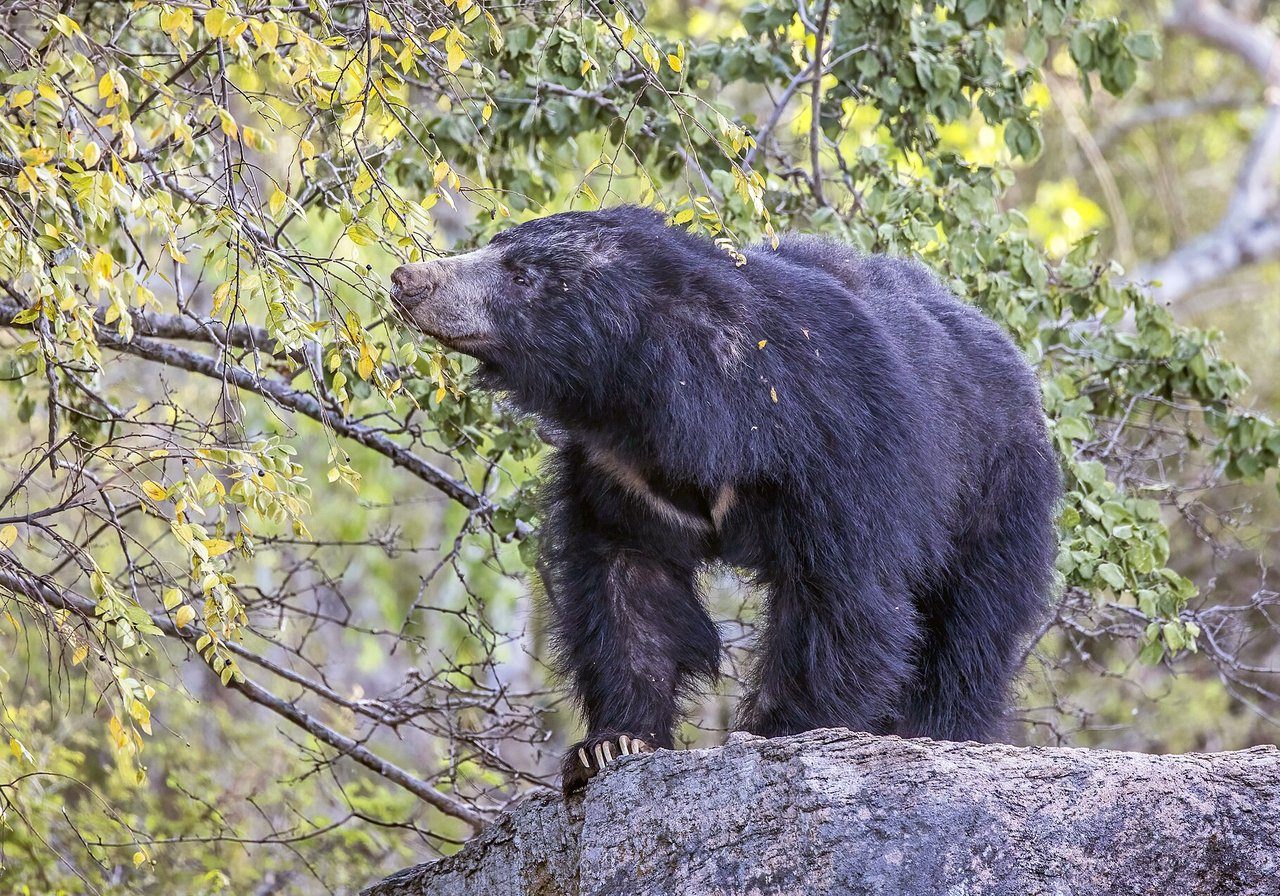
The sloth bear is the only bear species native to South Asia, found in India, Nepal, Sri Lanka and Bhutan. Unlike other bears, it is adapted for myrmecophagy — eating ants and termites — with long curved claws, a hairless muzzle that can be closed as a tube, and missing upper incisors that create a gap for sucking insects. Shaggy black fur, a whitish chest blaze and a slow shambling gait give sloth bears a distinctive appearance. Listed as Vulnerable by the IUCN, populations are declining from habitat loss, poaching for body parts and increasing human-bear conflict as forests fragment.
Vulnerable
IUCN Red List status (2016 assessment)
6,000–11,000
Estimated mature individuals
55–145 kg
Typical adult weight range
Appendix I
CITES listing — commercial trade banned
Figures sourced from IUCN Red List — Melursus ursinus, Wildlife SOS — sloth bear, Encyclopaedia Britannica — sloth bear .
Sloth Bear: Quick Facts
| Weight | 55–145 kg |
|---|---|
| Specialisation | Myrmecophagous — ants and termites |
| Distinctive feature | Long claws; chest blaze; tube-like muzzle |
| Range | India, Nepal, Sri Lanka, Bhutan |
| Population | Roughly 6,000–11,000 mature individuals |
| CITES | Appendix I |
Scientific Classification
| Kingdom | Animalia |
|---|---|
| Phylum | Chordata |
| Class | Mammalia |
| Order | Carnivora |
| Family | Ursidae |
| Genus | Melursus |
| Species | Melursus ursinus (Cuvier, 1793) |
Conservation Status
- IUCN Status
- Vulnerable (IUCN, 2016). Estimated 6,000–11,000 mature individuals.
- Population
- Roughly 6,000–11,000 mature individuals; ~90% in India
- Trend
- Decreasing
- Assessed
- 2016
- CITES
- Appendix I
Dancing bear practice banned in India; last street bears removed by 2009.
Key Facts: Sloth Bear
- Sloth bears are the only bear species native to South Asia.
- They specialise in eating ants and termites with long claws and a tube-like muzzle.
- Missing upper incisors create a gap for sucking insects — unique among bears.
- Sloth bears are more aggressive toward humans than most bear species.
- Dancing bears — cruel training for street performance — were banned in India in 1972.
- Habitat fragmentation drives increasing human-bear conflict across India.
A bear built for insects
The sloth bear belongs to the family Ursidae but occupies a unique ecological niche. Its long, curved claws — up to 8 cm — are designed for tearing open termite mounds and ant nests, not for climbing like other bears. The hairless muzzle can be closed to form a tube for sucking insects. Upper incisors are reduced or absent, creating a gap that channels termites and ants into the mouth.
Shaggy black or dark brown fur covers the body; a whitish or chestnut U-shaped or Y-shaped blaze marks the chest. Adults weigh 55–145 kg — smaller than most bear species. The name 'sloth bear' reflects early European observers who confused its slow gait and long claws with sloths.
Sloth bears are mainly nocturnal in human-disturbed areas, foraging alone except when females accompany cubs. They communicate through loud snorts, screams and grunts — vocalisations that can alarm people who encounter them at night.
Diet, range and behaviour
Termites and ants form the bulk of the diet, supplemented with fruit — especially figs and flowers of mahua trees — honey, eggs and occasional carrion. Sloth bears raid sugarcane fields and maize crops, drawing conflict with farmers. In Sri Lanka, they also eat yams and palmyra fruit.
The range spans lowland and montane forest, scrub and grassland across India, Nepal, Sri Lanka and Bhutan. India holds roughly 90% of the global population, with significant numbers in Madhya Pradesh, Karnataka, Maharashtra and the Western Ghats. Nepal's Chitwan and Bardia national parks support important populations. Sri Lankan sloth bears are isolated on the island.
Females give birth in dens — rock caves, burrows or hollow trees — typically to one or two cubs. Cubs ride on the mother's back for several months — a behaviour unique among bears. Cubs remain with mothers for up to two years.
Dancing bears and poaching
For centuries, sloth bear cubs were captured and trained as 'dancing bears' — a cruel practice where a hot rod or ring through the muzzle forced bears to rise on hind legs. India's Wildlife Protection Act of 1972 banned this practice. Wildlife SOS and government agencies confiscated the last dancing bears from streets by 2009, rehoming animals to sanctuaries.
Poaching for body parts — gall bladders, claws and bones — persists for traditional medicine markets. Sloth bear gall bladders are traded alongside those of other bear species across Asia. Anti-poaching patrols and CITES Appendix I protection aim to reduce illegal trade.
Human-bear conflict is the growing threat. As forests fragment, sloth bears enter villages at night to raid crops and encounter people. Startled bears attack defensively — sloth bears are among the most aggressive bear species toward humans. Retaliatory killing and accidental deaths from snares set for other animals reduce populations.
Conservation outlook
The IUCN lists the sloth bear as Vulnerable with an estimated population of roughly 6,000–11,000 mature individuals and a decreasing trend. Habitat loss from mining, agriculture, road construction and urban expansion removes forest cover. Protected areas in India — Kanha, Satpura, Tadoba and others — anchor populations but connectivity between reserves is poor.
Conservation priorities include maintaining forest corridors, reducing crop-raiding conflict through electric fencing and compensation schemes, anti-poaching enforcement and continuing sanctuary care for confiscated dancing bears. Community education in villages near bear habitat reduces surprise encounters.
Sri Lankan and Nepalese populations face similar pressures with smaller absolute numbers. Regional cooperation across South Asia benefits all bear populations and the forest ecosystems they require.
What WARN Does
WARN publishes this sloth bear guide as free public education. South Asia's only bear faces habitat loss and conflict — challenges that mirror forest conservation pressures in WARN partner countries Indonesia and Malaysia.
If this guide helps you understand wildlife and the pressures it faces, a gift to WARN supports habitat protection and free public education in our partner countries.
How can I help save the sloth bear?
Explore practical ways to support the sloth bear, from everyday choices and sharing reliable information to reviewing a related appeal before giving.
Explore ways to support
Read the related appeal’s purpose, recipient status and fund terms. Choose an affordable gift after checking what is proposed and what has been reported.
Ease the pressures
Avoid the wildlife trade and souvenirs, never buy wild animals as pets, and choose sustainable, habitat-friendly products — the threats behind the sloth bear's decline fall when demand does.
Spread the word
Share accurate, sourced information about the sloth bear. Wider awareness is what turns concern into lasting protection.
Sloth Bear: Frequently Asked Questions
How can I help save the sloth bear?
Why is it called a sloth bear?
Are sloth bears dangerous?
What do sloth bears eat?
Are sloth bears endangered?
What were dancing bears?
Where do sloth bears live?
How long do sloth bears live?
How big is a sloth bear?
Sources & References
Population figures, conservation status and biological facts on this page are drawn from authoritative scientific and intergovernmental sources.
Terms used on this page
Plain-English definitions, from our wildlife and conservation glossary.
Latest Sloth Bear Stories
Quick, fact-checked reads on the sloth bear — amazing facts, key questions and the threats it faces.
Explore more animals
Discover more animals, their habitats and their conservation status in the WARN wildlife-guide library.