Wildlife Guide · Pakistan
Snow Leopard
Panthera uncia
The pale ghost of the high mountains, hunting where the air runs thin.
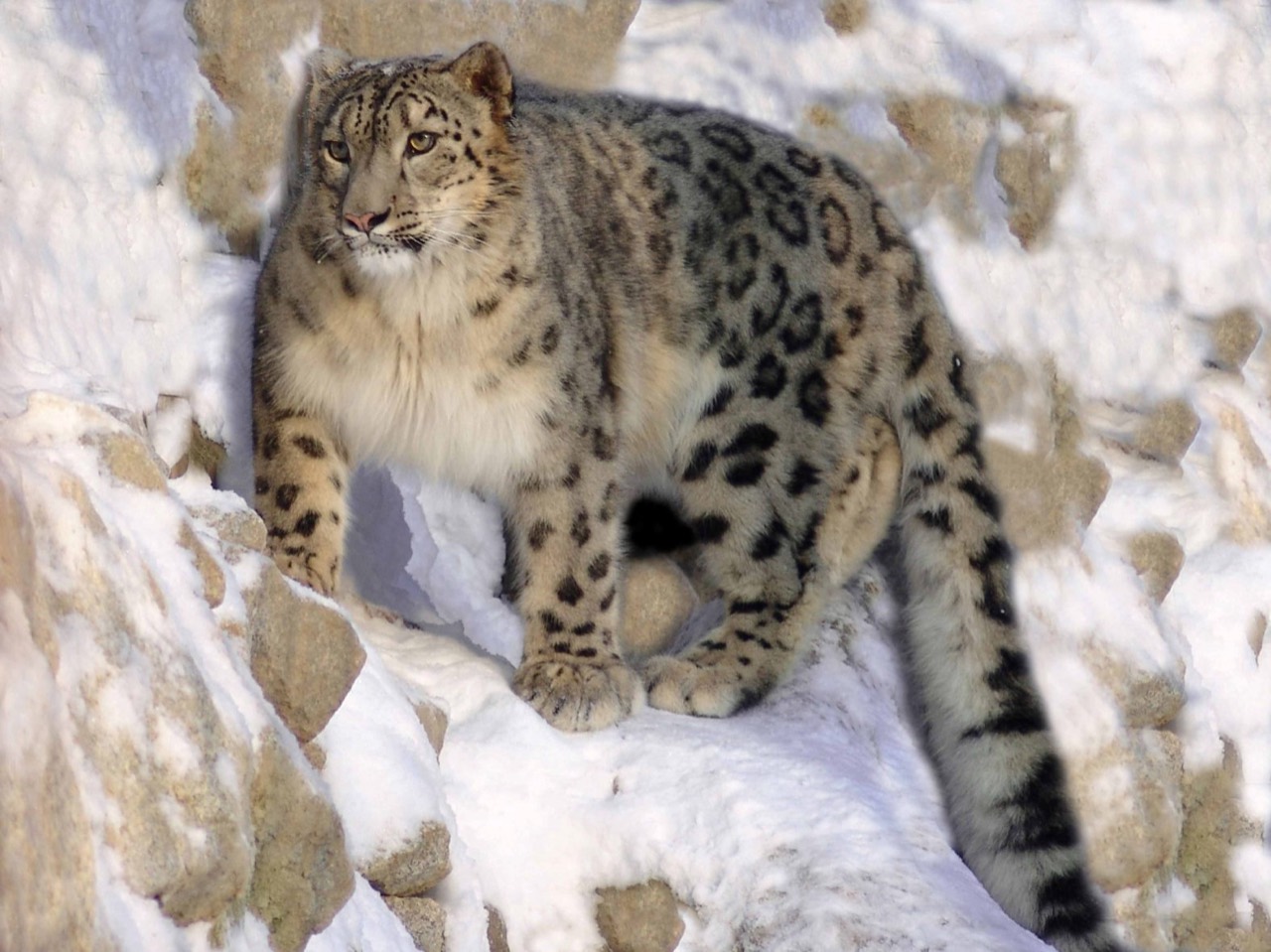
Source: Wikimedia Commons via Wikipedia “Snow leopard”
In brief
A snow leopard (Panthera uncia) is a large wild cat native to the high mountains of Central and South Asia, recognised by its pale grey rosette-patterned coat and very long tail, and listed as Vulnerable on the IUCN Red List.
Also in Animals A to Z · Animals that start with S
How you can help
You can support the related appeal — read its purpose, recipient status and fund terms first — or give once to where it is needed most. Sharing accurate information helps too.
By WARN Research & Conservation TeamLast updated
The snow leopard (Panthera uncia) is a large cat of the high mountains of Central and South Asia, built for life among bare rock, snow and altitude. Famously elusive, it haunts ridgelines from 3,000 metres upward, including the peaks of northern Pakistan. With fewer than 3,400 mature adults thought to remain across a vast but fragmented range, it is one of the world's least-seen big cats.
~7,400–8,000
Estimated wild snow leopards across 12 range countries (IUCN)
2,710–3,386
Mature breeding adults remaining (IUCN Red List)
12 countries
Mountain nations in its range, including Pakistan
Up to ~5,500 m
Altitude at which it has been recorded hunting
Figures sourced from IUCN Red List — Panthera uncia (Snow Leopard), taxon 22732, IUCN Cat Specialist Group — Snow Leopard species account, CITES — Snow Leopard (Appendix I) and other references on this page.
Snow Leopard: Quick Facts
| Lifespan | ~10–12 years in the wild; up to ~20 years in captivity |
|---|---|
| Weight | ~25–55 kg (about 55–120 lb) |
| Body length | ~90–120 cm head and body, plus an 80–100 cm tail |
| Diet | Carnivore — wild sheep and goats (blue sheep, ibex, markhor, argali), marmots, hares, game birds |
| Gestation | ~90–100 days |
| Young per birth | Usually 1–3 cubs |
| Baby name | Cub |
| Vocalisation | Cannot roar — chuffs, mews and growls instead |
| Range | 12 countries of Central and South Asia, including Pakistan |
| CITES | Appendix I (commercial international trade banned) |
Scientific Classification
| Kingdom | Animalia |
|---|---|
| Phylum | Chordata |
| Class | Mammalia |
| Order | Carnivora |
| Family | Felidae |
| Subfamily | Pantherinae |
| Genus | Panthera |
| Species | Panthera uncia (Schreber, 1775) |
Conservation Status
- IUCN Status
- Vulnerable
- Population
- ~7,400–8,000 individuals total; 2,710–3,386 mature adults (IUCN). Figures are uncertain — only a small fraction of the range has been reliably surveyed.
- Trend
- Decreasing
- Assessed
- 2017 assessment (downlisted from Endangered); retained as Vulnerable in current IUCN Red List
- CITES
- Appendix I
The 2017 move from Endangered to Vulnerable is contested by some specialists who argue the data are too sparse to justify downlisting. Pakistan is estimated to hold roughly 200–420 snow leopards, concentrated in its northern mountains.
Did you know?
A snow leopard's tail can be almost as long as its whole body — up to about a metre — and it doubles as a furry scarf the cat drapes over its face while resting in freezing wind.
Key Facts: Snow Leopard
- The snow leopard (Panthera uncia) is a high-altitude big cat of Central and South Asia, not a true subtype of the common leopard despite the shared name.
- The IUCN lists it as Vulnerable; it was downlisted from Endangered in 2017, a decision some scientists still contest given how little of its range has been reliably surveyed.
- Fewer than about 3,400 mature adults are estimated to survive, and the population trend is decreasing.
- Unlike lions and tigers, snow leopards cannot roar; their throat anatomy produces chuffs, mews and growls instead.
- Its enormous tail — almost as long as its body — aids balance on cliffs and wraps around the body as a built-in scarf in sub-zero cold.
- In northern Pakistan, retaliatory killing after livestock losses is a leading threat, making community coexistence work central to the cat's survival.
Why the snow leopard is threatened
The snow leopard is classified as Vulnerable by the IUCN, with a decreasing population trend and fewer than 3,400 mature adults estimated across its range. It was moved from Endangered to Vulnerable in 2017 because surveys suggested the global decline was slower than once feared, but the change remains debated: only a tiny fraction of the species' rugged range has ever been sampled with reliable methods, so all global figures carry real uncertainty. Threats are stacking up rather than easing. Wild prey such as blue sheep and ibex are being squeezed by competition with domestic herds and by poaching, pushing cats toward livestock. Retaliatory and opportunistic killing, the illegal trade in pelts and bones, infrastructure pushing into mountain valleys, and a warming climate shifting the treeline upward all chip away at habitat that is already naturally sparse and slow to recover.
Behaviour and mountain ecology
Snow leopards are solitary, mostly crepuscular hunters adapted to some of the harshest terrain any cat occupies. Dense, pale, rosette-marked fur, wide fur-covered paws that work like snowshoes, an enlarged nasal cavity that warms thin cold air, and a thick metre-long tail used for balance and warmth all equip them for cliffs and cold. They are ambush predators, using broken rock and ridgelines to stalk wild sheep and goats, supplementing larger kills with marmots, pikas, hares and game birds. Individuals range over very large territories — often hundreds of square kilometres in poor-prey areas — and communicate by scent-marking and scrapes rather than by roaring, which their anatomy does not allow.
Snow leopards in northern Pakistan
Pakistan's northern mountains — Gilgit-Baltistan, Khyber Pakhtunkhwa and adjoining ranges — hold an important slice of the global population, with national estimates commonly cited in the low hundreds of cats. Here the central conservation challenge is human-wildlife conflict. When a snow leopard enters a corral and kills sheep, goats or yaks, the loss can be financially devastating for a herding family, and the cat is sometimes killed in return. Effective responses pair predator-proof corrals, livestock insurance or compensation schemes, and community-based monitoring so that a living snow leopard becomes worth more to a valley than a dead one. This coexistence-first model is where local rescue and conservation partners do their most important work.
What rescue and protection involve
For a wide-ranging, low-density cat, real protection rarely looks like a cage. It looks like keeping wild prey abundant, securing livestock so conflict never starts, responding when an animal is injured or trapped, and intervening against the trade in skins and bones. Rescue partners train and equip herding communities, build predator-proof enclosures, run compensation funds that defuse the impulse to retaliate, and support rangers who monitor remote valleys. Because the snow leopard crosses national borders along the world's highest mountains, durable gains depend on local teams on the ground backed by sustained funding and cross-border cooperation.
Snow leopard vs common leopard: how to tell them apart
| Feature | Snow leopard (Panthera uncia) | Common leopard (Panthera pardus) |
|---|---|---|
| Coat | Pale smoke-grey to whitish with large open rosettes | Golden-buff with smaller, tighter rosettes |
| Habitat | High mountains, 3,000 m and above | Forests, savanna, scrub from lowlands upward |
| Tail | Very long and thick for balance and warmth | Long but proportionally shorter and slimmer |
| Roar | Cannot roar | Can roar |
| IUCN status | Vulnerable | Vulnerable (varies by subspecies) |
| Range overlap with Pakistan | Northern high mountains | Lower hills and forests |
What WARN Does
WARN publishes this guide for education and is developing support through assessed animal-welfare grants. A species range, source citation or photograph does not establish a recipient or funding agreement. Check /about/where-your-money-goes/#grant-register for published grant and payment records; records not yet published must not be read as zero activity. Browse /appeals/ for the purposes currently available to support.
In northern Pakistan a single snow leopard can be killed in retaliation for one night's lost livestock. Your gift helps WARN fund the Pakistani partner teams building predator-proof corrals and compensation schemes that let mountain communities and snow leopards survive side by side.
How can I help save the snow leopard?
Explore practical ways to support the snow leopard, from everyday choices and sharing reliable information to reviewing a related appeal before giving.
Explore ways to support
Read the related appeal’s purpose, recipient status and fund terms. Choose an affordable gift after checking what is proposed and what has been reported.
Ease the pressures
Avoid the wildlife trade and souvenirs, never buy wild animals as pets, and choose sustainable, habitat-friendly products — the threats behind the snow leopard's decline fall when demand does.
Spread the word
Share accurate, sourced information about the snow leopard. Wider awareness is what turns concern into lasting protection.
Snow Leopard: Frequently Asked Questions
How can I help save the snow leopard?
How long do snow leopards live?
What do snow leopards eat?
How big is a snow leopard?
Are snow leopards dangerous to humans?
How many snow leopards are left?
What is a baby snow leopard called?
Sources & References
Population figures, conservation status and biological facts on this page are drawn from authoritative scientific and intergovernmental sources.
- IUCN Red List — Panthera uncia (Snow Leopard), taxon 22732
- IUCN Cat Specialist Group — Snow Leopard species account
- CITES — Snow Leopard (Appendix I)
- Snow Leopard Trust — Statement on IUCN Red List status change
- WWF — Snow leopard
- Britannica — Snow leopard
- Dawn — Pakistan's snow leopards face alarming decline
Terms used on this page
Plain-English definitions, from our wildlife and conservation glossary.
Latest Snow Leopard Stories
Quick, fact-checked reads on the snow leopard — amazing facts, key questions and the threats it faces.
Species
12 Amazing Facts About the Snow Leopard, the Ghost of the Mountains
From a tail nearly as long as its body to leaps of up to 15 metres, here are 12 verified facts about the elusive snow leopard of Central and South Asia.
Read the storySpecies
How Big, Fast and Strong Is a Snow Leopard? The Numbers Behind a Mountain Hunter
A snow leopard weighs only 25–55 kg yet leaps up to 15 metres and kills prey three times its size. Here are the verified size, speed and strength figures.
Read the storySpecies
Snow Leopard vs Common Leopard: 6 Key Differences and How to Tell Them Apart
They share a name but are separate species. Coat, habitat, tail and even the ability to roar set the snow leopard apart from the common leopard.
Read the storyExplore more animals
Discover more animals, their habitats and their conservation status in the WARN wildlife-guide library.