Wildlife Guide · Worldwide — native to Europe, Asia and North Africa; introduced to Americas, Australasia and elsewhere
Sparrow
Passer domesticus (Linnaeus, 1758)
The garden companion — globally abundant yet vanishing from British towns.
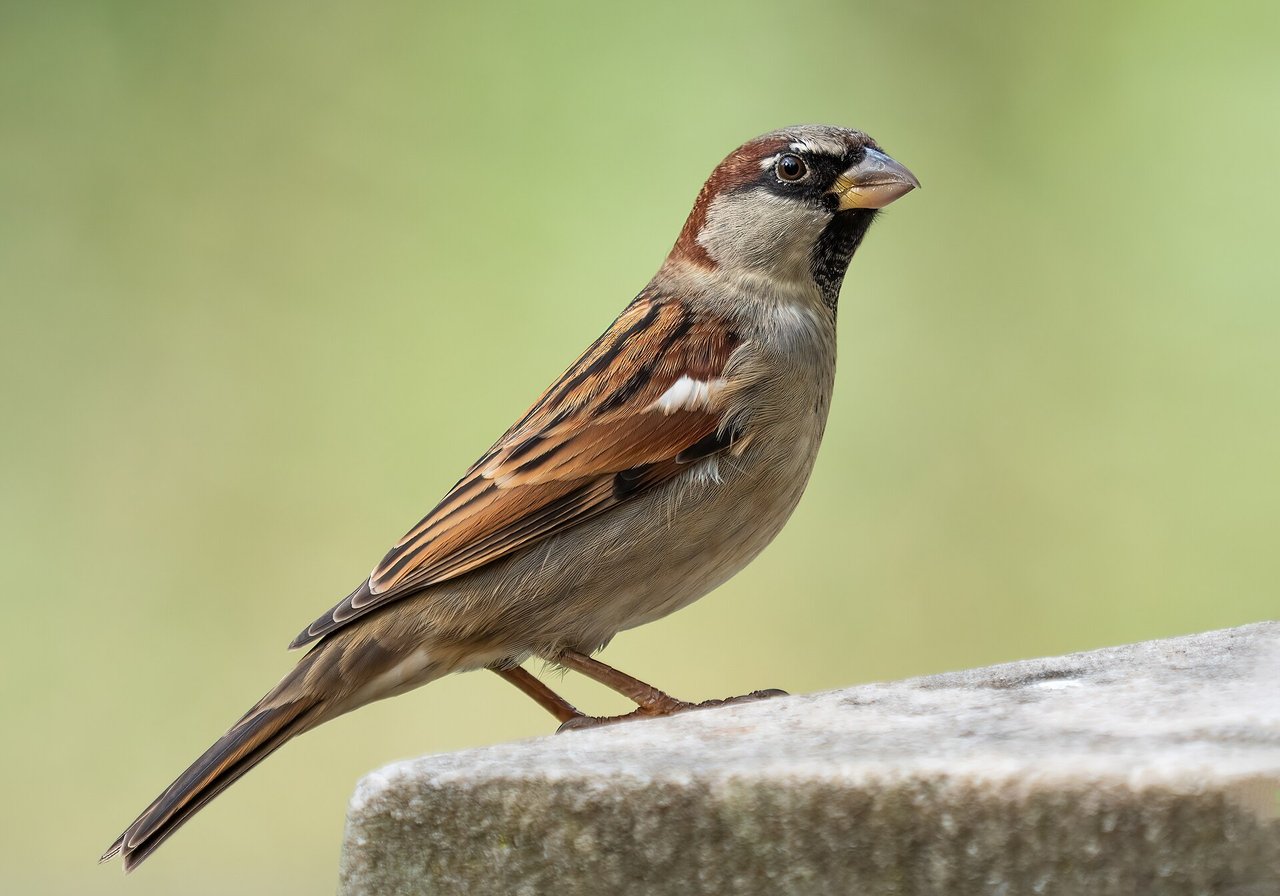
Source: Wikimedia Commons
In brief
The house sparrow (Passer domesticus) is a Least Concern passerine found on every continent except Antarctica; globally abundant but declined by over 70% in urban Britain since the 1970s.
Also in Animals A to Z · Animals that start with S
By WARN Research & Conservation TeamLast updated
The house sparrow is one of the world's most familiar birds — a small, chirping companion of farms, gardens and city streets. Males have a grey crown, chestnut nape and black bib; females are streaky brown. Native to Europe, Asia and North Africa, house sparrows were introduced to the Americas, Australasia and elsewhere and now occur on every continent except Antarctica. Listed as Least Concern globally, the species remains abundant worldwide, yet British and urban European populations have collapsed by over 70% since the 1970s — one of the steepest declines of any common bird. Causes include reduced insect food for chicks, pollution, habitat change and competition in modified landscapes.
Least Concern
IUCN Red List status (2018 assessment)
70%+
Decline in urban Britain since 1970s
540 million
Estimated global population
Not listed
CITES status
Figures sourced from IUCN Red List — Passer domesticus, RSPB — house sparrow, BirdLife International — Data Zone .
Sparrow: Quick Facts
| Length | 14–16 cm |
|---|---|
| Chick diet | Insects — aphids, caterpillars, spiders |
| Global population | Roughly 540 million |
| UK trend | 70%+ decline in urban areas since 1970s |
| Nesting | Cavities — eaves, boxes, street signs |
| CITES | Not listed |
Scientific Classification
| Kingdom | Animalia |
|---|---|
| Phylum | Chordata |
| Class | Aves |
| Order | Passeriformes |
| Family | Passeridae |
| Genus | Passer |
| Species | Passer domesticus (Linnaeus, 1758) |
Conservation Status
- IUCN Status
- Least Concern globally (IUCN, 2018). Red List species in Britain and parts of Europe.
- Population
- Roughly 540 million mature individuals globally
- Trend
- Stable globally; decreasing in urban Europe and parts of Asia
- Assessed
- 2018
- CITES
- Not listed under CITES
Key Facts: Sparrow
- House sparrows are globally Least Concern but declined over 70% in urban Britain.
- Chicks depend on insect food — reduced invertebrate abundance may drive decline.
- House sparrows nest in cavities — under eaves, in nest boxes and street signs.
- They are highly social, roosting and feeding in chattering flocks.
- Air pollution — especially nitrogen dioxide — correlates with sparrow decline in cities.
- Providing insect-rich gardens and nest boxes supports urban sparrow recovery.
A commensal of human settlement
House sparrows evolved alongside human agriculture in the Middle East and spread with farming across Eurasia. They thrive where grain is stored, livestock provide spilled feed and buildings offer nesting cavities. Introduction to North America in the 1850s, Australasia and other regions created vast new populations.
Sparrows are granivorous as adults but feed chicks almost exclusively on insects — aphids, caterpillars and spiders gathered within roughly 50 metres of the nest. This dual diet ties their breeding success to both seed availability and invertebrate abundance.
Social structure is gregarious. Flocks chatter in hedgerows; dust-bathing and squabbling at feeders are familiar behaviours. Males establish territories around nest sites, displaying their black bib — larger bibs signal dominance.
The mystery of urban decline
The house sparrow paradox defines modern conservation: globally abundant yet locally vanishing. London lost roughly 70% of its sparrows between 1994 and 2004. Similar declines hit Paris, Hamburg, Prague and Delhi. Rural populations in some regions remain stable.
Hypotheses include reduced insect prey for chicks — linked to pesticide use, habitat simplification and the loss of urban green space. Air pollution, particularly nitrogen dioxide, correlates with lower sparrow densities in European cities. Lead and other contaminants may reduce fertility.
Nest-site loss from building renovation — sealed eaves, removed roof spaces — removes breeding sites. Competition with feral pigeons and changed garden practices (fewer insects, more tidy lawns) may compound the problem. No single cause explains all declines.
Ecology and breeding
House sparrows breed from March to August in temperate regions, raising two to four broods. Nests are messy balls of grass and feathers in cavities — under roof tiles, in nest boxes, street signs and tree holes. Clutches contain three to five eggs; incubation lasts about 12 days.
Both parents feed chicks, making up to 400 insect trips per day during peak demand. Fledglings leave the nest at roughly 15 days but remain dependent for a further week.
Sparrows are sedentary in mild climates; northern populations move short distances in harsh weather. Lifespan is typically three to five years, though the oldest recorded wild bird exceeded 13 years.
Conservation and recovery
The IUCN lists the house sparrow as Least Concern globally with an estimated 540 million mature individuals. Red List status masks regional crises: the species is on the UK Red List of Birds of Conservation Concern. Similar concern applies in the Netherlands, Czech Republic and parts of India.
Recovery efforts focus on insect-rich gardens, native planting, nest boxes with 32 mm entrance holes and community monitoring through citizen science. The RSPB and local wildlife trusts run urban sparrow projects from London to Glasgow.
Research continues into pollution, disease and food supply. House sparrows serve as accessible indicators of urban ecosystem health — their return signals that a neighbourhood supports insects, clean air and nesting opportunity.
Sparrows in daily life
House sparrows appear in literature from Chaucer to Chekhov — background chirping of ordinary life. Their decline has silenced gardens that once rang with communal chatter, prompting public concern disproportionate to their global status.
Other sparrow species face distinct fates. The Eurasian tree sparrow occupies more rural niches. The Spanish sparrow and dead sea sparrow are range-restricted. The house sparrow's story teaches that Least Concern does not mean safe everywhere.
Readers can help by planting insect-friendly native species, installing nest boxes, avoiding pesticides and supporting urban green-space protection. WARN publishes this sparrow guide as free public education about a bird whose absence is felt even when its global numbers remain vast.
What WARN Does
WARN publishes this sparrow guide as free public education. Urban bird decline signals wider ecosystem stress — insect loss, pollution and habitat fragmentation affect wildlife and people alike.
If this guide helps you understand wildlife and the pressures it faces, a gift to WARN supports habitat protection and free public education in our partner countries.
Sparrow: Frequently Asked Questions
Why are sparrows disappearing in the UK?
Are house sparrows endangered?
What do house sparrows eat?
How can I help house sparrows?
Do sparrows migrate?
Where do house sparrows live?
Are house sparrows dangerous?
How long do house sparrows live?
How big is a house sparrow?
Sources & References
Population figures, conservation status and biological facts on this page are drawn from authoritative scientific and intergovernmental sources.
Terms used on this page
Plain-English definitions, from our wildlife and conservation glossary.
Explore more animals
Discover more animals, their habitats and their conservation status in the WARN wildlife-guide library.