Wildlife Guide · All deep oceans — from poles to equator
Sperm Whale
Physeter macrocephalus (Linnaeus, 1758)
Deep-sea hunters with the largest brain on Earth — masters of the abyss.
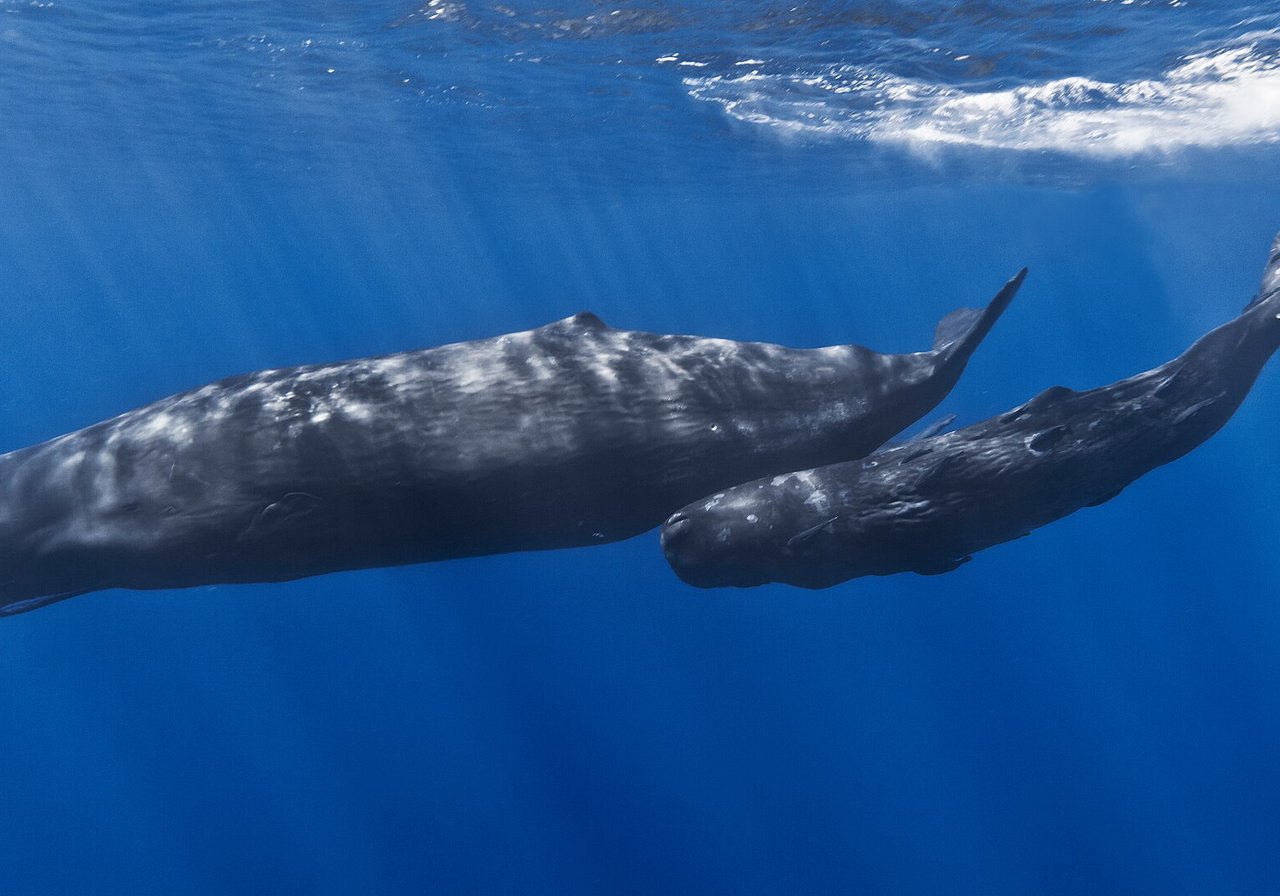
Source: Wikimedia Commons
In brief
The sperm whale (Physeter macrocephalus) is a Vulnerable deep-diving toothed whale — the largest brain of any animal — hunting squid in abyssal depths after centuries of commercial whaling depletion.
Also in Animals A to Z · Animals that start with S
By WARN Research & Conservation TeamLast updated
The sperm whale is the largest toothed predator on Earth, with males reaching 20 metres and 50 tonnes. Its enormous square head contains spermaceti organ once hunted for oil; wrinkled skin and a single blowhole angled left produce a distinctive blow. Sperm whales dive beyond 2,000 metres hunting giant squid in darkness, using echolocation clicks louder than a jet engine. Listed as Vulnerable globally, populations recover slowly from whaling; ship strikes and entanglement persist.
Vulnerable
IUCN Red List status
20 m
Maximum male length
2,000 m+
Routine dive depth
CITES I
International commercial trade prohibited
Figures sourced from IUCN Red List — sperm whale, Smithsonian Ocean — sperm whale, Encyclopaedia Britannica — sperm whale and other references on this page.
Sperm Whale: Quick Facts
| IUCN status | Vulnerable |
|---|---|
| Type | Largest toothed whale |
| Brain | Largest of any known animal |
| Dive depth | 2,000–3,000 m |
| Diet | Deep-sea squid and fish |
| CITES | Appendix I |
Scientific Classification
| Kingdom | Animalia |
|---|---|
| Phylum | Chordata |
| Class | Mammalia |
| Order | Artiodactyla |
| Family | Physeteridae |
| Species | Physeter macrocephalus |
Conservation Status
- IUCN Status
- Vulnerable globally due to historic whaling depletion; populations recovering slowly in some regions.
- Population
- Roughly 100,000–300,000 mature individuals
- Trend
- Increasing slowly in some areas; data poor globally
- Assessed
- 2008
- CITES
- Appendix I
Pre-whaling population may have exceeded one million individuals.
Key Facts: Sperm Whale
- Sperm whales have the largest brain of any known animal — up to nine kilograms.
- Moby-Dick immortalised sperm whaling; industrial hunting killed an estimated one million.
- Females live in lifelong social units; mature males roam solo or in bachelor groups.
- Echolocation clicks stun prey and communicate across kilometres.
- Deep-sea plastic and chemical pollution accumulates in long-lived predators.
- Whale-watching and conservation tourism support protection in Azores and Dominica.
Head, oil and deep diving
The sperm whale's head comprises up to one-third of body length, housing the spermaceti organ — a wax-filled chamber once mistaken for sperm. Whalers hunted sperm whales heavily for oil used in lamps and industry until petroleum replaced it.
Dives typically last 30 to 60 minutes, reaching depths where pressure exceeds 200 atmospheres. Collapsible lungs and rib cages prevent barotrauma. Prey includes giant squid, colossal squid and deep fish — often bearing circular sucker scars on whale skin.
The lower jaw is narrow and studded with conical teeth; suction feeding may supplement biting.
Whaling legacy and modern threats
Industrial whaling peaked in the nineteenth and twentieth centuries, removing perhaps one million sperm whales globally. The IUCN assessed the species as Vulnerable in 2008 with hundreds of thousands remaining — far below pre-whaling abundance.
Modern threats include ship strikes, entanglement in longline and gillnet gear, ingestion of marine debris and noise from seismic surveys interfering with echolocation.
International Whaling Commission moratoria protect sperm whales; Japan historically took limited numbers under objection provisions. CITES Appendix I bans commercial international trade.
Sperm whales and people
Literature, film and museum skeletons keep sperm whales in public imagination. Ethical whale-watching in the Azores, Dominica and Sri Lanka generates income when boats maintain respectful distance during nursing groups.
Deep-sea mining proposals threaten abyssal ecosystems sperm whales depend on — a frontier conservation issue.
Readers support sperm whales through marine protected areas, reduction of plastic pollution and advocacy against renewed commercial whaling.
What WARN Does
WARN's educational reach includes Brazil and Colombia — nations with Atlantic waters where sperm whales migrate. Free guides connect deep-ocean predators to the habitat protection mission shared across our partner countries.
If this guide helps you understand wildlife and the pressures it faces, a gift to WARN supports habitat protection and free public education in our partner countries.
Sperm Whale: Frequently Asked Questions
Are sperm whales endangered?
What do sperm whales eat?
Why is it called a sperm whale?
How deep do sperm whales dive?
Where do sperm whales live?
Is Moby Dick a sperm whale?
Are sperm whales dangerous?
How long do sperm whales live?
How big is a sperm whale?
Sources & References
Population figures, conservation status and biological facts on this page are drawn from authoritative scientific and intergovernmental sources.
Terms used on this page
Plain-English definitions, from our wildlife and conservation glossary.
Latest Sperm Whale Stories
Quick, fact-checked reads on the sperm whale — amazing facts, key questions and the threats it faces.
Explore more animals
Discover more animals, their habitats and their conservation status in the WARN wildlife-guide library.
Social structure and culture
Females and calves form clans of roughly 15 animals in tropical and subtropical waters, babysitting and nursing communally. Mature males migrate toward poles, growing far larger and eventually leaving natal units.
Clans share distinct click dialects — cultural markers passed socially. Some researchers argue sperm whale culture rivals cetacean complexity outside humans.
Stranding events sometimes involve entire family groups, suggesting strong social bonds that complicate rescue.