Wildlife Guide · Atlantic Ocean & Pacific Ocean
Squid
Order Teuthida
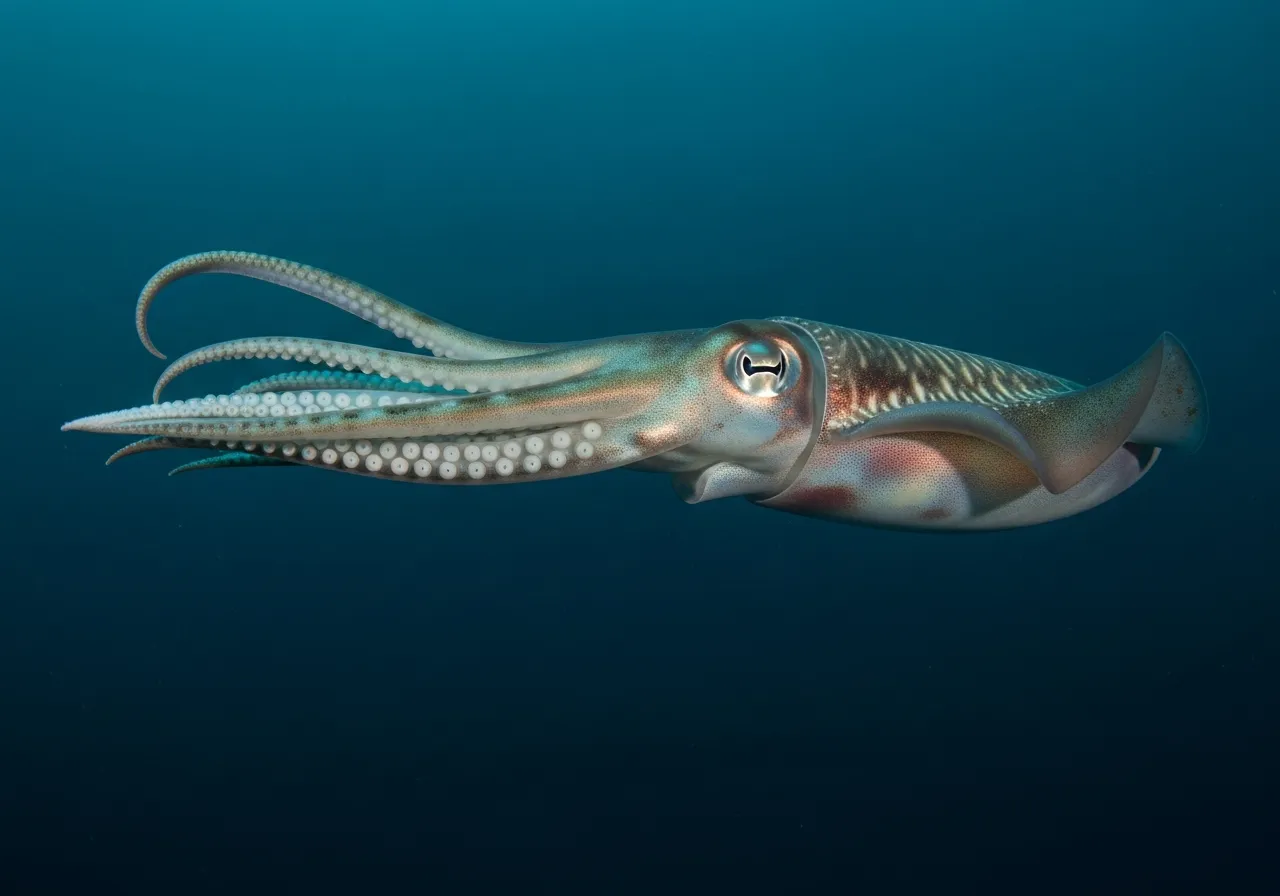
Jet-propelled cephalopods with colour-changing skin and the largest eyes on Earth.
Source: Global Animal Guide (WARN)
In brief
A squid is a fast-swimming cephalopod mollusc of the order Teuthida, related to octopuses and cuttlefish, with eight arms, two longer feeding tentacles, jet propulsion, ink defence and colour-changing skin; the order includes around 300 species, from tiny pygmy squid to the deep-sea giant squid.
Also in Animals A to Z · Animals that start with S
By WARN Research & Conservation TeamLast updated
Squid are fast-swimming marine molluscs of the order Teuthida, a group of roughly 300 cephalopod species closely related to octopuses and cuttlefish. They share the cephalopod toolkit of eight arms, jet propulsion, ink defence and skin that changes colour in an instant, yet squid add two long feeding tentacles and a streamlined, torpedo-shaped body built for open water. Most species are small, but the order also contains the giant squid (Architeuthis dux) and colossal squid (Mesonychoteuthis hamiltoni); the colossal squid carries the largest eyes known in the animal kingdom, and the giant squid's are among the largest. From shallow reefs to the deep sea, squid are key open-ocean predators and prey, helping move energy through marine food webs worldwide. This guide is educational; the World Animal Rescue Network does not run field projects for squid.
~300
Species in the order
8 + 2
Arms plus feeding tentacles
Up to ~13 m
Giant squid total length
1-3 yrs
Typical lifespan (many species)
Figures sourced from Wikipedia - Squid, Wikipedia - Giant squid (Architeuthis dux), Wikipedia - Colossal squid (Mesonychoteuthis hamiltoni) and other references on this page.
Squid: Quick Facts
| Common name | Squid |
|---|---|
| Scientific group | Order Teuthida |
| Class | Cephalopoda (cephalopod molluscs) |
| Number of species | Around 300 |
| Appendages | 8 arms plus 2 feeding tentacles |
| Movement | Jet propulsion and fin undulation |
| Key defences | Ink, colour change (chromatophores), speed |
| Diet | Carnivorous: zooplankton, fish, other squid |
| Typical lifespan | Often 1-3 years (many species) |
| Habitat | All oceans, from shallow seas to the deep |
Scientific Classification
| Kingdom | Animalia |
|---|---|
| Phylum | Mollusca |
| Class | Cephalopoda |
| Superorder | Decapodiformes |
| Order | Teuthida |
| Species | ~300 species across multiple families |
Conservation Status
- IUCN Status
- Conservation status varies by species. Most squid are assessed by the IUCN as Least Concern or remain Not Evaluated. The giant squid (Architeuthis dux) is listed as Least Concern, reflecting its wide oceanic range. No squid species is listed under CITES. The main pressures are large-scale commercial fishing and the effects of a warming, changing ocean rather than targeted persecution.
- Population
- No reliable global population estimate exists; abundance varies enormously between species and fluctuates year to year with ocean conditions.
- Trend
- Unknown / variable across species
- Assessed
- 2014 (giant squid, Architeuthis dux)
- CITES
- Not listed under CITES
Because most squid are short-lived and breed once, populations can rise and fall rapidly with sea temperature and currents, making science-based fishery limits and monitoring important.
Did you know?
Some flying squid escape predators by jetting out of the water and gliding through the air for distances of up to around 50 metres, briefly becoming airborne molluscs.
Key Facts: Squid
- Squid are cephalopod molluscs of the order Teuthida, closely related to octopuses and cuttlefish, with around 300 known species.
- They have eight arms plus two longer retractile feeding tentacles, and most carry an internal chitinous 'pen' (gladius) instead of a shell.
- Squid swim by jet propulsion, expelling water through a funnel, and can also undulate their fins for slower, precise movement.
- Their defences include a cloud of ink and chromatophores - pigment cells that allow rapid colour change for camouflage and signalling.
- The colossal squid has the largest eyes known in the animal kingdom and the giant squid's are among the largest, adaptations for the dark deep sea.
- Most squid are Least Concern or Not Evaluated and none are CITES-listed, but heavy commercial fishing makes monitoring important.
What is a squid?
Squid are marine cephalopods - the same molluscan class as octopuses, cuttlefish and the nautilus. The order Teuthida contains roughly 300 species, making it one of the most diverse cephalopod groups. A squid has a soft, elongated body enclosed by a muscular mantle, paired swimming fins, a distinct head with large eyes, and a parrot-like beak at the centre of its arms. Unlike most molluscs, squid have no external shell; instead they keep a small internal skeleton called a gladius or 'pen', made of chitin, which stiffens the body. Around the mouth sit eight arms lined with suckers, plus two longer, retractable feeding tentacles that shoot out to seize prey. Squid are more closely related to octopuses than to the so-called vampire squid, which despite its name sits closer to the octopuses.
How squid move, hunt and defend themselves
Squid are among the fastest invertebrates. They draw water into the mantle cavity and expel it in a powerful jet through a flexible funnel, rocketing backwards; some flying squid even glide above the surface for many metres to escape predators. For slower, controlled movement they ripple their fins. To hunt, a squid ambushes large zooplankton, fish and other squid, firing out its two tentacles and drawing prey to its beak. Defence relies on a trio of tricks: a cloud of melanin-rich ink to confuse attackers, jet-powered escape, and chromatophores - tiny muscle-controlled pigment sacs that let the skin change colour and pattern almost instantly for camouflage or communication. Many deep-sea species add bioluminescence, using light to hide their silhouette or lure prey.
Size, diversity and the giants of the deep
Most squid are modest in size, typically under 60 cm long, and some pygmy squid (Idiosepius) measure barely 1-2 cm. At the other extreme lie the legendary deep-sea giants. The giant squid (Architeuthis dux) can reach around 13 m in total length including its tentacles, while the colossal squid (Mesonychoteuthis hamiltoni) is shorter at around 4-5 m total length but far more heavily built, weighing up to roughly 500 kg - making it the heaviest squid known. The colossal squid carries the largest eyes recorded in the animal kingdom, measured at around 27 cm across, and the giant squid's eyes are among the largest too; both gather faint light in the lightless depths. Squid are generally short-lived: species such as Loligo live only one to three years, growing fast, breeding once and then dying. This rapid life cycle lets populations respond quickly to ocean conditions but also makes them sensitive to environmental change.
Squid in the ocean and human use
Squid occupy a central place in marine food webs, playing a role much like open-water fish: voracious predators of smaller animals, and essential prey for sharks, large fish, seabirds, seals and toothed whales - the sperm whale is a famous hunter of deep-sea squid. They are also one of the world's most heavily fished groups of invertebrates, supporting major commercial fisheries from Japan to the Mediterranean and South America. Because most squid are short-lived and their numbers swing with ocean temperature and currents, scientists emphasise careful, science-based catch limits and habitat protection. While individual squid species are mostly assessed as Least Concern or remain unevaluated, the scale of fishing and the influence of warming seas mean ongoing monitoring is wise.
What WARN Does
The World Animal Rescue Network does not run field rescue or conservation projects for squid. Our role here is educational: we publish sourced, accessible guides so readers understand cephalopod biology, the ocean food webs squid support, and the pressures these animals face from large-scale fishing and a changing climate.
If clear, science-based wildlife guides like this help you understand and care about ocean life, please consider supporting the World Animal Rescue Network's educational work so we can keep producing them.
Squid: Frequently Asked Questions
Is a squid a fish?
How many arms and tentacles does a squid have?
What is the difference between a squid and an octopus?
How do squid change colour?
How big can a squid get?
What do squids eat?
Where do squids live?
Are squids dangerous?
How long do squids live?
Sources & References
Population figures, conservation status and biological facts on this page are drawn from authoritative scientific and intergovernmental sources.
Terms used on this page
Plain-English definitions, from our wildlife and conservation glossary.
Latest Squid Stories
Quick, fact-checked reads on the squid — amazing facts, key questions and the threats it faces.
Explore more animals
Discover more animals, their habitats and their conservation status in the WARN wildlife-guide library.