Wildlife Guide · Russia & Kazakhstan
Sturgeon
Family Acipenseridae
Living fossils of the deep — and the most endangered group of animals on Earth
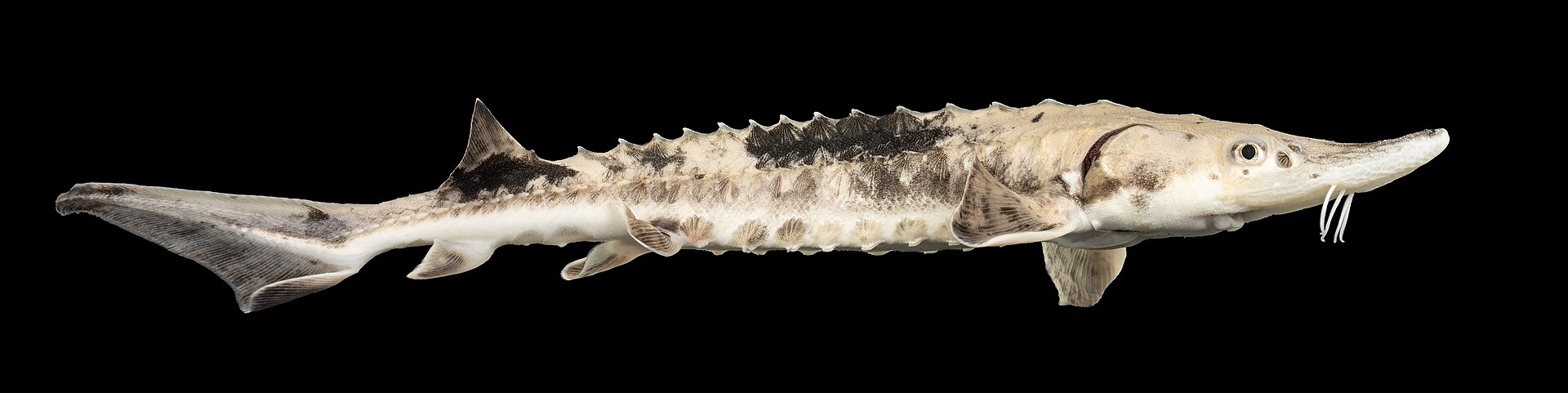
Photo: USFWS Mountain Prairie / Wikimedia Commons (Public domain)
In brief
Sturgeons (family Acipenseridae) are ancient, armoured freshwater and anadromous fish of the Northern Hemisphere; they are the most endangered group of animals on Earth, with 17 of 26 surviving species listed as Critically Endangered on the IUCN Red List, driven to the brink by poaching for caviar, dams that block migration, and widespread habitat loss.
Also in Animals A to Z · Animals that start with S
By WARN Research & Conservation TeamLast updated
Sturgeons are among the oldest vertebrates still swimming in our rivers and seas. Members of the family Acipenseridae, these armoured giants first appeared some 200–250 million years ago, surviving the mass extinction that ended the dinosaurs almost unchanged. Twenty-six species in the broader order Acipenseriformes survive today — one, the Chinese paddlefish, was declared extinct in 2022 — ranging from the diminutive sterlet (up to ~16 kg) to the colossal beluga, which can exceed 1,500 kg and live for over a century. Found across the rivers, lakes and coastal seas of the Northern Hemisphere, sturgeons are anadromous travellers, fattening in deep estuaries and open seas before ascending freshwater rivers to spawn. Yet despite their ancient resilience, sturgeons now carry the grim distinction of being the most threatened group of species on the planet, with every remaining species threatened by poaching, pollution, dams and climate change.
200–250 million
Years on Earth
94%
Population drop since 1970
17 of 26
Species Critically Endangered
$1,500+
Per pound of beluga caviar
Figures sourced from IUCN — Sturgeon more critically endangered than any other group of species (2022), IUCN Red List reassessment reveals further decline of sturgeons and paddlefishes (Oryx / Cambridge Core), CITES Appendices 2024 — Sturgeon listings and other references on this page.
Sturgeon: Quick Facts
| Number of species | 25 true sturgeons (family Acipenseridae); 26 surviving across order Acipenseriformes after 2022 Chinese paddlefish extinction |
|---|---|
| Largest species | Beluga (Huso huso) — up to 7 m, 1,571 kg (historic record) |
| Maximum lifespan | Over 150 years (lake sturgeon females) |
| Age of lineage | ~200–250 million years (Triassic) |
| Diet | Bottom-dwelling invertebrates, crustaceans, small fish |
| Spawning habitat | Fast-flowing gravel or cobble riverbeds |
| CITES listing | Appendix I (Acipenser sturio, A. brevirostrum) / Appendix II (all other species) |
Scientific Classification
| Kingdom | Animalia |
|---|---|
| Phylum | Chordata |
| Class | Actinopterygii |
| Order | Acipenseriformes |
| Family | Acipenseridae |
| Notable genera | Acipenser, Huso, Scaphirhynchus, Pseudoscaphirhynchus |
Conservation Status
- IUCN Status
- Varies — 17 of 26 species Critically Endangered
- Population
- No single global figure; populations down ~94% since 1970
- Trend
- Decreasing
- Assessed
- 2022
- CITES
- Appendix I (Acipenser sturio, A. brevirostrum) / Appendix II (all other species)
The 2022 IUCN reassessment confirmed sturgeons and paddlefish as the most threatened group of species ever evaluated; one species (Chinese paddlefish) declared extinct, one (Yangtze sturgeon) Extinct in the Wild. In June 2025, the first confirmed natural spawning of Yangtze sturgeon in the wild in decades was documented.
Did you know?
The beluga sturgeon is not only the world's largest freshwater fish but also one of the longest-lived vertebrates on Earth — individuals confirmed at over 100 years old have been found still carrying viable eggs, making a single female a century-long investment in the survival of her species.
Key Facts: Sturgeon
- Sturgeons have existed for over 200 million years, yet more than half of all surviving species could vanish within our lifetime.
- Wild populations have crashed by an estimated 94% since 1970, the most catastrophic decline of any vertebrate group.
- The primary driver is illegal poaching for caviar, with beluga caviar fetching over $1,500 per pound on luxury markets — wild black-market prices run far higher.
- Hydropower dams on rivers like the Danube and Volga block spawning migrations that can exceed 1,700 km, cutting fish off from the gravel beds they need to reproduce.
- Hatchery restocking programmes on the Danube are releasing hundreds of thousands of fingerlings annually, but natural reproduction remains critically rare.
- International trade in all sturgeon species is regulated under CITES, with two species — the Baltic sturgeon and the shortnose sturgeon — prohibited from commercial trade under Appendix I.
What is a sturgeon?
Sturgeons belong to the order Acipenseriformes and the family Acipenseridae, a lineage so ancient it predates the earliest flowering plants. Their body plan is strikingly primitive: a mostly cartilaginous skeleton, five rows of bony plates called scutes running the length of the body, a heterocercal tail in which the upper lobe is longer than the lower, and a flattened rostrum tipped with four sensitive barbels that trail just ahead of a toothless, protrusible mouth. That mouth works like a vacuum nozzle, hovering over riverbeds to suck up insect larvae, worms, crustaceans and small molluscs. Sturgeon range enormously in size. The sterlet (Acipenser ruthenus), the smallest of all sturgeon species, reaches a maximum of around 1.2 m and roughly 16 kg, while the beluga (Huso huso) is the world's largest freshwater fish and the third-most-massive living bony fish by weight, historically recorded at more than 7 m long and 1,571 kg. Lifespans are equally extraordinary: female lake sturgeon have been confirmed at 150 years of age, and beluga are known to exceed a century. Late sexual maturity — females may not spawn until they are 20–25 years old — makes each breeding adult irreplaceable, and population recovery from over-harvest agonisingly slow.
Where do sturgeon live?
The 26 surviving sturgeon and paddlefish species in the order Acipenseriformes divide their lives between saltwater feeding grounds and freshwater spawning rivers across the Northern Hemisphere. The greatest diversity sits in the Caspian and Black Sea basins, where beluga, Russian, Persian, stellate and other sturgeons once ascended the Volga, Ural, Don, Danube and Kuban rivers in colossal seasonal runs. The Amur River along the Russia–China border hosts Kaluga and Amur sturgeons, while North America supports white, lake, Atlantic, shortnose, green and gulf sturgeons across its major river systems from the St Lawrence to the Sacramento. European rivers historically carried eight species as far inland as Germany, though the Iron Gate dams on the Danube now cap upstream migration at roughly 860 km from the river mouth, confining fish to the lower stretch and cutting them off from historic breeding sites in Hungary, Austria and Germany. Most sturgeon are anadromous, spending years at sea before returning to the very river stretch where they hatched, guided by olfactory memory. Spawning habitat is highly specific: sturgeons need fast, oxygen-rich current over clean gravel or cobble substrate at precise temperature windows. Siltation from land runoff, dredging and mineral extraction can render entire river reaches functionally sterile for reproduction.
Why are sturgeon critically endangered?
The IUCN Red List assessment published in July 2022 confirmed that sturgeons are the most threatened group of species ever evaluated: 17 of 26 surviving species are Critically Endangered, one — the Yangtze sturgeon — is Extinct in the Wild, and the Chinese paddlefish was formally declared extinct. Global wild populations have collapsed by an estimated 94% since 1970. The drivers are mutually reinforcing and severe. Poaching and illegal caviar trade sit at the centre of the crisis. Beluga caviar can retail for over $1,500 per pound — and black-market prices run far higher — making a gravid female worth tens of thousands of dollars. From 2016 to 2022, 337 sturgeon wildlife crimes and nearly 1,000 seizures were recorded across the Lower Danube region alone. CITES regulates international trade in all species, with Baltic and shortnose sturgeons listed under Appendix I (commercial trade banned) and all others under Appendix II. But enforcement remains inconsistent: surveys in Bulgaria, Romania, Serbia and Ukraine found roughly one third of sturgeon products on sale were illegal. Hydropower dams compound the damage by cutting off migration routes; the Iron Gate complex on the Danube alone wiped out access to the upstream spawning beds that once sustained six species. Sand and gravel mining, agricultural runoff, river channelisation and warming water temperatures round out a pressures profile that offers sturgeons almost no refuge.
How do sturgeon reproduce and how long do they live?
Sturgeon reproduction is an event of biological extravagance and exquisite timing. Adults are triggered to migrate by rising spring water temperatures and flows, sometimes travelling more than 1,000 km to reach natal gravel beds. A large female beluga may carry 20–25% of her body weight in eggs — a single fish can yield 100 kg of roe — and she releases them across clean substrate where males fertilise them externally. Larvae hatch within a few days, are carried downstream to slower waters, and begin the decades-long journey to adulthood. The slow pace of maturation is the family's greatest vulnerability. Russian sturgeons in the Caspian do not reach sexual maturity until 10–16 years; beluga females may wait 20–25 years for their first spawn, and thereafter they do not breed every year. Lake sturgeon females in North America have been confirmed at 150 years of age. This life history strategy evolved in a world of stable, productive river systems where a fish could afford to grow slowly and breed repeatedly over a long lifetime. In a world of nets, dams and polluted rivers, it becomes a slow-motion path to local extinction, because the loss of a single adult female may represent two decades of vanished reproductive potential.
What conservation efforts are underway to save sturgeon?
Scientists and river managers have responded to the sturgeon crisis with a suite of interventions, though experts caution that none substitutes for addressing root causes. Hatchery programmes are the most widespread tool: in the Austrian Danube, 35,380 sterlets were released in 2024 alone, and a floating hatchery station in Vienna is now producing fish for the EU-funded LIFE-Boat4Sturgeon project, which runs to 2030 and targets four Danube species. In June 2025, over 1,500 young Russian sturgeons and 15 larger beluga were released into the Danube near Fetesti, Romania, in one of the most recent stocking efforts. Romania indefinitely banned wild-sturgeon fishing and trade in 2021 — a milestone legal protection on one of the last rivers with reproducing wild populations. Monitoring in 2024 detected juvenile sterlets in Lower Austria for the first time in over 40 years, raising cautious optimism that natural reproduction may be resuming. In a parallel breakthrough in June 2025, researchers witnessed the first confirmed natural spawning of the Yangtze sturgeon in the wild in decades, in a relatively undammed tributary of the upper Yangtze. Campaigns to restore fish-passage around major dams, reduce sand-dredging, and phase out illegal caviar supply chains are also underway. Internationally, IUCN's Sturgeon Specialist Group coordinates research and policy, while CITES trade reporting requirements provide a mechanism — if imperfectly enforced — to police the global caviar market.
What WARN Does
WARN does not currently run projects for sturgeon — their Northern Hemisphere river and sea range lies outside WARN's operational countries — and this guide is offered as free educational content. Understanding why an ancient lineage tips toward extinction, and how poaching for a luxury product can undo 200 million years of evolution, strengthens the public case for wildlife protection everywhere.
Every wildlife habitat protected — whether a river corridor, wetland or coastal estuary — is a lifeline for species fighting extinction. Supporting WARN's habitat protection work keeps ecosystems intact for the animals that depend on them most.
Sturgeon: Frequently Asked Questions
What is the most endangered sturgeon species?
Why is caviar so damaging to sturgeon populations?
Are any sturgeon species safe from extinction?
How do dams affect sturgeon?
What do sturgeons eat?
Where do sturgeons live?
Are sturgeons dangerous?
How long do sturgeons live?
How big is a sturgeon?
Sources & References
Population figures, conservation status and biological facts on this page are drawn from authoritative scientific and intergovernmental sources.
- IUCN — Sturgeon more critically endangered than any other group of species (2022)
- IUCN Red List reassessment reveals further decline of sturgeons and paddlefishes (Oryx / Cambridge Core)
- CITES Appendices 2024 — Sturgeon listings
- CITES — Sturgeons programme overview
- IUCN — Sturgeon conservation: releasing hope (2025)
- Danube Sturgeons — Poaching and illegal trade report
- LIFE-Boat4Sturgeon EU conservation project
- Chinese Academy of Sciences — Scientists witness first wild reproduction of Yangtze sturgeon (2025)
Terms used on this page
Plain-English definitions, from our wildlife and conservation glossary.
Latest Sturgeon Stories
Quick, fact-checked reads on the sturgeon — amazing facts, key questions and the threats it faces.
Species
Slow Loris vs Pygmy Slow Loris: 6 Key Differences
They look alike and share a venomous bite, but the pygmy slow loris now has its own genus. Here's how to tell these night-time primates apart.
Read the storySpecies
12 Amazing Facts About Giant Pandas (A Carnivore That Eats Bamboo)
A false thumb, a carnivore's gut on a plant diet, and cubs born the size of a stick of butter. Twelve verified giant panda facts.
Read the storySpecies
Are Giant Pandas Still Endangered? What Changed, and What Didn't
The IUCN downgraded the giant panda to Vulnerable in 2016. Here is what drove the recovery — and why fragmentation still threatens it.
Read the storyExplore more animals
Discover more animals, their habitats and their conservation status in the WARN wildlife-guide library.