Wildlife Guide · Indonesia & Malaysia
Sun Bear
Helarctos malayanus (Raffles, 1821)
The smallest bear on earth — kept in cages for bile, or taken as cubs for pets.
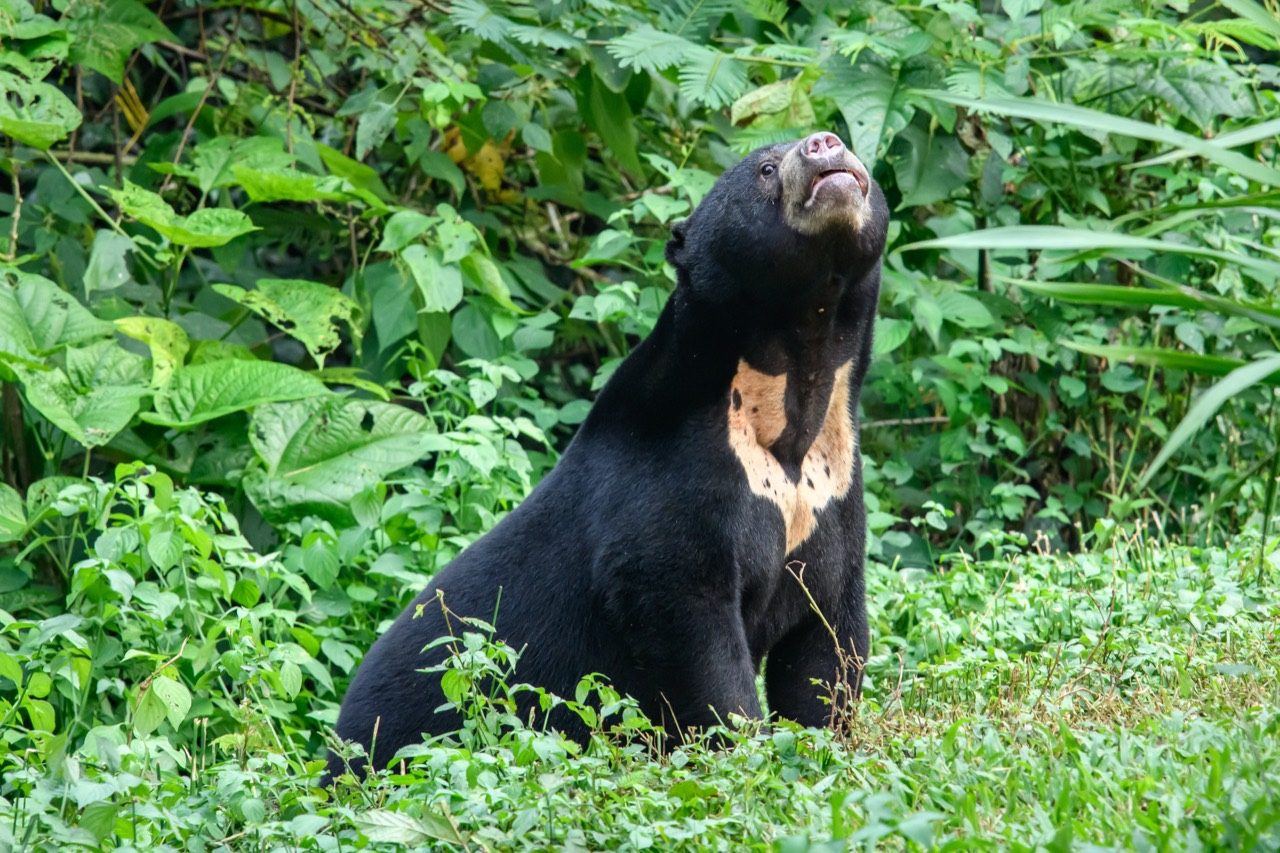
Source: Wikimedia Commons (Sun-bear.jpg)
In brief
Sun bears are the world's smallest bears, native to Southeast Asia, and are listed as Vulnerable by the IUCN; they are threatened by deforestation, the pet trade, and the bear bile industry, in which bears are caged for years and milked for bile used in traditional medicine.
Also in Animals A to Z · Animals that start with S
How you can help
You can support the related appeal — read its purpose, recipient status and fund terms first — or give once to where it is needed most. Sharing accurate information helps too.
By WARN Research & Conservation TeamLast updated
Sun bears are the smallest bears in the world, native to the tropical forests of Southeast Asia. They are threatened by deforestation, the illegal wildlife trade, and the bear bile industry — in which bears are kept in tiny cages, sometimes for decades, and milked for bile used in traditional medicine. Most farmed bile bears are Asiatic black bears (moon bears), with sun bears a smaller share. Sun bears are also taken from the wild as cubs to be sold as pets.
>30%
Population decline over the last three generations (~30 yrs)
20+
Years a bile bear may be caged
<200
Caged bile bears left in Vietnam (down from ~4,300 in 2005)
Appendix I
CITES listing — all commercial trade banned
Figures sourced from IUCN Red List — Helarctos malayanus (Scotson et al. 2017), CITES Appendices (Appendix I), IUCN/SSC Bear Specialist Group — Sun Bear (bearbiology.org) and other references on this page.
Sun Bear: Quick Facts
| Lifespan | Up to ~25 years in the wild; ~30+ years in captivity (one record ~36 years) |
|---|---|
| Weight | 25–65 kg (males up to ~one-third larger than females) — the smallest bear species |
| Body length | ~100–150 cm; shoulder height ~70 cm |
| Diet | Omnivore — termites, ants, beetle larvae, bees and honey, figs and other fruit |
| Tongue | Very long — roughly 20–25 cm — to extract honey and insects from deep cavities |
| Gestation | ~95 days (delayed implantation can extend apparent pregnancy to 174–240 days) |
| Young per birth | Usually 1, sometimes 2 cubs; no fixed breeding season near the equator |
| Baby name | Cub |
| Subspecies | Two — H. m. malayanus (mainland + Sumatra) and the smaller H. m. euryspilus (Borneo) |
| CITES | Appendix I — all international commercial trade prohibited |
Scientific Classification
| Kingdom | Animalia |
|---|---|
| Phylum | Chordata |
| Class | Mammalia |
| Order | Carnivora |
| Family | Ursidae |
| Genus | Helarctos (only living member) |
| Species | Helarctos malayanus (Raffles, 1821) |
Conservation Status
- IUCN Status
- Vulnerable
- Population
- No reliable global population estimate; numbers are declining across the range
- Trend
- Decreasing
- Assessed
- 2017
- CITES
- Appendix I
Population estimated to have declined by more than 30% over the last three generations (~30 years; generation length ~10 years).
Did you know?
A sun bear's tongue can extend roughly 20–25 cm — among the longest relative to body size of any bear — letting it reach honey, termites and grubs deep inside trees and nests, which is why it's also nicknamed the honey bear.
Key Facts: Sun Bear
- Sun bears are the smallest of the eight bear species, weighing 25–65 kg — comparable in size to a large dog.
- They act as keystone species in Southeast Asian forests, dispersing seeds and excavating tree cavities used by hornbills, flying squirrels and other wildlife.
- Bear bile farming — in which bears are kept in tiny "crush cages" and bile extracted through a fistula or catheter — remains legal only in China; Vietnam banned bile extraction in 2005, though a clandestine trade persists.
- Bear bile contains ursodeoxycholic acid, a genuine medicine, but a synthetic version has been produced since the 1950s — so there is no medical need for farmed bile.
- Sun bear cubs are frequently taken from the wild after their mothers are killed — either for the pet trade or for farming.
- Rescued sun bears are intelligent and need complex, enriched environments; recovery from years of cage confinement can take years, and most can never be released.
What Is Bear Bile Farming?
Bear bile farming is the practice of keeping bears in captivity and extracting bile from their gallbladders, typically through a permanently open hole (fistula) or a surgically implanted catheter. Farmed bears — overwhelmingly Asiatic black bears (moon bears), with sun bears a smaller minority — are often confined in "crush cages" so small they cannot stand upright or turn around. Some remain in these conditions for twenty years or more. The practice is now legal only in China, where bear bile is used in traditional medicine; Vietnam banned bile extraction in 2005, although a clandestine trade persists and the caged population there has collapsed from around 4,300 bears in 2005 to under 200 by 2024. Bile contains ursodeoxycholic acid, a compound with real applications in treating liver disease and gallstones — but synthetic ursodeoxycholic acid has been available since the 1950s, so no medical use requires farmed bile.
Sun Bear Habitat Loss
Sun bears depend on intact lowland tropical and montane forest. The conversion of Bornean and Sumatran forest to oil palm has eliminated vast areas of suitable habitat and brought bears into direct conflict with plantation workers, who frequently kill them as crop raiders. Across Cambodia, Vietnam, Thailand and Myanmar, forest clearance for agriculture and development is the primary driver of population decline. Sun bears are cryptic and elusive — often crepuscular or diurnal in undisturbed forest but more nocturnal near people — and they travel large home ranges, so population declines often go undetected until local extinction has already occurred.
Life After the Bile Farm
Bears rescued from bile farms are among the most challenging animals to rehabilitate. Years of physical constraint cause muscle atrophy, joint deformity and dental damage. Psychological trauma manifests as stereotypic behaviour — repetitive rocking, pacing and bar-biting — that can persist for years in sanctuary conditions. Enrichment programmes, social companionship and large naturalistic enclosures significantly improve outcomes, but the overwhelming majority of bile farm survivors cannot be released into the wild. They require lifetime care at specialist facilities.
Sun bear vs moon bear (Asiatic black bear) vs sloth bear
| Attribute | Sun bear | Moon bear | Sloth bear |
|---|---|---|---|
| Scientific name | Helarctos malayanus | Ursus thibetanus | Melursus ursinus |
| Typical weight | 25–65 kg (smallest bear) | ~65–150 kg | ~55–145 kg |
| Chest mark | Orange-cream crescent ('sun') | White V-shape ('moon') | Pale Y/U-shape |
| Coat | Short and sleek | Shaggy | Long and shaggy |
| IUCN status | Vulnerable | Vulnerable | Vulnerable |
| Main range | Tropical SE Asia | S/E Asia, Himalayas | Indian subcontinent |
| Role in bile trade | Smaller share of farmed bears | Large majority of farmed bears | Rarely farmed |
What WARN Does
WARN focuses current bear rescue funding on Indonesia and Malaysia, while keeping the wider China and Vietnam bile-farming context live to explain the welfare crisis and the search demand around it.
A sun bear pulled from a cage or the pet trade can't simply be released — recovering from years of confinement takes specialist veterinary care, enrichment and a forest-edge enclosure that may be needed for the rest of the bear's life. Your gift helps WARN fund local partners in Indonesia and Malaysia who do exactly this work, one bear at a time.
How can I help save the sun bear?
Explore practical ways to support the sun bear, from everyday choices and sharing reliable information to reviewing a related appeal before giving.
Explore ways to support
Read the related appeal’s purpose, recipient status and fund terms. Choose an affordable gift after checking what is proposed and what has been reported.
Ease the pressures
Avoid the wildlife trade and souvenirs, never buy wild animals as pets, and choose sustainable, habitat-friendly products — the threats behind the sun bear's decline fall when demand does.
Spread the word
Share accurate, sourced information about the sun bear. Wider awareness is what turns concern into lasting protection.
Sun Bear: Frequently Asked Questions
How can I help save the sun bear?
What is bear bile used for?
Is bear bile farming legal?
How small is a sun bear?
Can sun bears rescued from farms be released into the wild?
What do sun bears eat?
Where do sun bears live?
Are sun bears dangerous?
How long do sun bears live?
How big is a sun bear?
Sources & References
Population figures, conservation status and biological facts on this page are drawn from authoritative scientific and intergovernmental sources.
Terms used on this page
Plain-English definitions, from our wildlife and conservation glossary.
Latest Sun Bear Stories
Quick, fact-checked reads on the sun bear — amazing facts, key questions and the threats it faces.
Species
12 Amazing Facts About the Sun Bear, the World's Smallest Bear
From a record-breaking tongue to a chest patch as unique as a fingerprint, here are 12 things that make the sun bear one of Southeast Asia's most extraordinary — and threatened — animals.
Read the storySpecies
How Big Is a Sun Bear? Meet the World's Smallest Bear
Sun bears are the smallest of all eight bear species — about the size of a large dog. Here's exactly how much they weigh, how tall they stand, and how they compare with other bears.
Read the storySpecies
Sun Bear vs Moon Bear: 6 Key Differences (and Why It Matters)
Sun bears and moon bears are often confused — both are Asian bears caught up in the bile trade. Here's how to tell them apart by size, coat, chest mark and range.
Read the storyExplore more animals
Discover more animals, their habitats and their conservation status in the WARN wildlife-guide library.