Wildlife Guide · Tasmania & Australia
Tasmanian Devil
Sarcophilus harrisii
The world's largest carnivorous marsupial — fighting extinction one tumour at a time
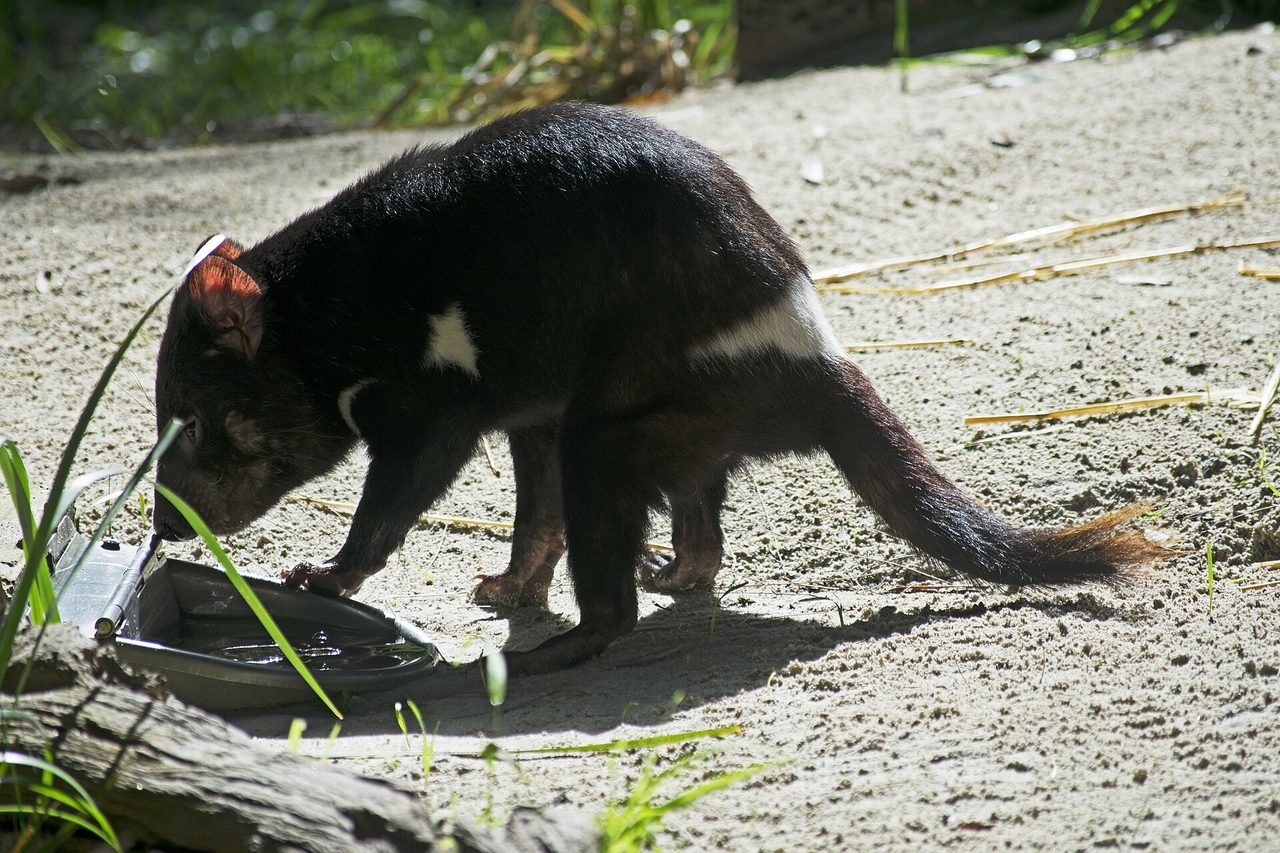
Photo: Ymblanter / Wikimedia Commons (CC BY-SA 4.0)
In brief
The Tasmanian devil (Sarcophilus harrisii) is an Endangered carnivorous marsupial found only in Tasmania, Australia, whose wild population has plummeted by around 80% since the 1990s due to a transmissible facial cancer called Devil Facial Tumour Disease (DFTD).
Also in Animals A to Z · Animals that start with T
How you can help
You can support the related appeal — read its purpose, recipient status and fund terms first — or give once to where it is needed most. Sharing accurate information helps too.
By WARN Research & Conservation TeamLast updated
The Tasmanian devil (Sarcophilus harrisii) is a stocky, jet-black marsupial and the largest carnivorous marsupial alive today, a title it inherited after the extinction of the thylacine in 1936. Found only on the island of Tasmania off Australia's southern coast, this dog-sized predator and scavenger is as ecologically vital as it is misunderstood. Its bone-crushing jaws — which produce a Bite Force Quotient of 181, the highest of any living mammalian carnivore — allow it to consume prey entirely, bones, fur and all, acting as a powerful clean-up crew across Tasmania's forests and coastlines. Despite its ferocious reputation, the Tasmanian devil is an Endangered species, its population decimated by a rare and horrifying transmissible cancer called Devil Facial Tumour Disease (DFTD). With fewer than 25,000 individuals estimated to remain in the wild, the species stands at a crossroads between adaptation and extinction.
< 25,000
Wild population estimate (mature individuals)
~80%
Population decline since mid-1990s
BFQ 181
Bite Force Quotient — highest of any living mammalian carnivore
8–12 kg
Adult male body weight
Figures sourced from IUCN Red List — Sarcophilus harrisii, Wikipedia — Tasmanian devil, Smithsonian's National Zoo — Tasmanian Devil and other references on this page.
Tasmanian Devil: Quick Facts
| Type | Marsupial mammal |
|---|---|
| Lifespan | 5–6 years in the wild; up to 8 in captivity |
| Body length | 57–65 cm (head–body, male) |
| Weight | 8–12 kg (male); 6–8 kg (female) |
| Diet | Carnivore / scavenger |
| Activity | Nocturnal and crepuscular |
| Gestation | 21 days |
| Litter size | Up to 4 surviving joeys per season |
| Habitat | Forests, heathlands, farmland fringes — Tasmania only |
Scientific Classification
| Kingdom | Animalia |
|---|---|
| Phylum | Chordata |
| Class | Mammalia |
| Order | Dasyuromorphia |
| Family | Dasyuridae |
| Genus | Sarcophilus |
| Species | Sarcophilus harrisii (Boitard, 1841) |
Conservation Status
- IUCN Status
- Endangered
- Population
- Fewer than 25,000 mature individuals
- Trend
- Decreasing
- Assessed
- 2020
- CITES
- Appendix I
Up-listed from Vulnerable to Endangered in 2008 following an approximately 80% population decline driven by Devil Facial Tumour Disease (DFTD). A second tumour strain, DFT2, discovered in southeast Tasmania in 2014 further complicates recovery.
Did you know?
A newborn Tasmanian devil weighs just 0.18–0.24 grams — roughly the same as a grain of rice — yet must crawl unaided to its mother's pouch within seconds of birth to survive.
Key Facts: Tasmanian Devil
- The Tasmanian devil is classified as Endangered on the IUCN Red List, with a wild population estimated at fewer than 25,000 mature individuals as of the 2020 assessment.
- Devil Facial Tumour Disease (DFTD) — a rare transmissible cancer spread through biting — has driven an estimated 80% population crash since it was first recorded in northeast Tasmania in 1996.
- The species holds the record for the highest Bite Force Quotient (181) of any living mammalian carnivore, allowing it to crush bones that larger predators leave behind.
- Tasmanian devils are critical ecosystem engineers: by consuming carcasses completely, they reduce disease reservoirs and help suppress invasive species such as feral cats.
- A second independent strain of the disease, DFT2, was discovered in southeast Tasmania in 2014, complicating vaccine and immunotherapy research efforts that remain ongoing.
- An insurance population established on mainland Australia and a government-backed conservation programme are the primary safety nets against total extinction.
What is a Tasmanian devil?
The Tasmanian devil is a marsupial mammal belonging to the order Dasyuromorphia and family Dasyuridae — a group that also includes quolls, dunnarts, and numbats. Its genus name, Sarcophilus, derives from the Greek for 'flesh lover,' a fitting description for one of nature's most dedicated carnivores. Males typically weigh 8–12 kg with a head-body length of 57–65 cm; females are smaller at 6–8 kg. Both sexes sport coarse black fur, often with a white chest patch, and a thickset neck and head that houses an extraordinary set of jaws. The jaw can open up to 75–80 degrees and exerts an absolute bite force of around 553 Newtons — giving the devil a Bite Force Quotient of 181, the highest recorded for any living mammalian carnivore, exceeding that of lions (112) and tigers (127) when adjusted for body size. This allows it to crush bones that other predators leave behind. Tasmanian devils are predominantly nocturnal and crepuscular, spending their nights roaming up to 16 km in search of food. They are largely solitary but gather at communal feeding sites where they communicate through a cacophony of screeches, growls, and snarls — sounds that earned them their dramatic name from early European settlers.
Where do Tasmanian devils live?
Tasmanian devils are found exclusively on the island of Tasmania, the southernmost state of Australia, separated from the Australian mainland by the Bass Strait. Fossil and historical evidence suggests they once roamed across the Australian continent, but the arrival of dingoes — which never reached Tasmania — combined with changes in climate and human population pressure likely contributed to their extinction on the mainland around 3,000 years ago. Within Tasmania, they occupy a wide range of habitats: dry sclerophyll forests, coastal heathlands, woodlands, and even the fringes of farmland and peri-urban areas. They show a preference for open country near dense bush, which offers both foraging ground and daytime shelter in hollow logs, dense vegetation, and burrows. Devils are not highly territorial and their home ranges can overlap considerably, covering anywhere from 4 to 20 square kilometres depending on food availability. They also occur on Robbins Island off the northwest Tasmanian coast. A small insurance population has been established on mainland Australia as a safeguard against catastrophic disease-driven extinction in the wild, representing the first time the species has lived on the mainland in millennia.
Why is the Tasmanian devil Endangered?
The Tasmanian devil was up-listed from Vulnerable to Endangered on the IUCN Red List in 2008 after Devil Facial Tumour Disease (DFTD) triggered population collapses across much of the island. DFTD is one of only a small number of known transmissible cancers in nature — the tumour cells themselves are the infectious agent, spreading when devils bite each other during social interactions and mating. The disease causes large, grotesque tumours to form around the face and neck, eventually preventing the animal from eating, and is fatal in virtually all cases within months of visible symptoms appearing. DFT1, the original strain, was first observed in northeast Tasmania in 1996 and has spread across the majority of the island. A second, independent strain — DFT2 — was discovered in the southeast in 2014, underscoring how vulnerable the species remains. The disease has reduced the overall wild population by approximately 80% since the mid-1990s. Secondary threats include vehicle strikes, persecution by farmers historically concerned about livestock, and habitat modification. Scientists have observed limited natural resistance to DFTD in some populations, sparking cautious optimism, and ongoing vaccine and immunotherapy trials aim to enhance immune response in wild and captive animals.
How do Tasmanian devils reproduce?
Tasmanian devils reach sexual maturity in their second year and typically breed between February and June, with peak activity in March. Mating is a fierce affair: males compete aggressively for females, and a successful male will guard his mate for days to ensure paternity. After a gestation of just 21 days — typical of marsupials — a female gives birth to 20–30 tiny joeys, each weighing barely 0.18–0.24 grams, roughly the size of a grain of rice. The newborns must make an unaided crawl from the birth canal to the mother's backward-opening pouch, where only four teats await. Only the first four joeys to latch on survive; the rest perish. This brutal reproductive bottleneck means that successful females raise at most four offspring per breeding season. The young remain in the pouch for approximately 100 days, after which they are too large to be contained and instead cling to the mother's back or are left in a den while she forages. Joeys become independent at around nine months of age. Wild devils typically live 5–6 years — a short window further compressed by DFTD, which disproportionately kills adults in their reproductive prime, disrupting population recovery.
What role do Tasmanian devils play in their ecosystem?
Tasmanian devils are apex scavengers and opportunistic predators whose ecological role extends far beyond their fearsome reputation. As consummate carrion cleaners — capable of devouring an entire carcass including bones, fur, and organs — they dramatically reduce the build-up of decomposing material that could otherwise harbour disease and attract invasive species such as feral cats and foxes. Studies conducted after localised DFTD-driven devil population declines found increases in feral cat activity, which in turn drove declines in small mammals and ground-nesting birds, illustrating the cascade effects that follow devil loss. Devils also prey on a wide variety of live species: small wallabies, wombats, possums, reptiles, birds, fish, and insects, contributing to the regulation of prey populations. Their scats distribute seeds and nutrients across the landscape. In 2020, 26 disease-free Tasmanian devils were reintroduced to a large fenced sanctuary in the Barrington Tops region of New South Wales — the first time the species has lived on the mainland in thousands of years — partly to restore a functional ecological role. Early results from that programme have shown devils helping to suppress overabundant kangaroo and wallaby numbers, demonstrating their capacity to restore ecosystem balance when given the chance.
What WARN Does
WARN publishes this guide for education and is developing support through assessed animal-welfare grants. A species range, source citation or photograph does not establish a recipient or funding agreement. Check /about/where-your-money-goes/#grant-register for published grant and payment records; records not yet published must not be read as zero activity. Browse /appeals/ for the purposes currently available to support.
Every animal that disappears leaves a gap in the ecosystems that sustain us all. While WARN's current conservation partners operate in its partner-network countries, the funds raised through our appeals support the kind of on-the-ground habitat and wildlife protection that gives threatened species — wherever they live — a fighting chance. If the plight of the Tasmanian devil moves you, consider supporting WARN's habitat work.
How can I help save the tasmanian devil?
Explore practical ways to support the tasmanian devil, from everyday choices and sharing reliable information to reviewing a related appeal before giving.
Explore ways to support
Read the related appeal’s purpose, recipient status and fund terms. Choose an affordable gift after checking what is proposed and what has been reported.
Ease the pressures
Avoid the wildlife trade and souvenirs, never buy wild animals as pets, and choose sustainable, habitat-friendly products — the threats behind the tasmanian devil's decline fall when demand does.
Spread the word
Share accurate, sourced information about the tasmanian devil. Wider awareness is what turns concern into lasting protection.
Tasmanian Devil: Frequently Asked Questions
How can I help save the tasmanian devil?
Is the Tasmanian devil really dangerous to humans?
Can Devil Facial Tumour Disease spread to other animals or humans?
How many Tasmanian devils are left in the wild?
Are there Tasmanian devils on mainland Australia?
What is being done to save the Tasmanian devil?
What does a Tasmanian devil eat?
Where do tasmanian devils live?
How long do tasmanian devils live?
How big is a tasmanian devil?
Sources & References
Population figures, conservation status and biological facts on this page are drawn from authoritative scientific and intergovernmental sources.
Terms used on this page
Plain-English definitions, from our wildlife and conservation glossary.
Latest Tasmanian Devil Stories
Quick, fact-checked reads on the tasmanian devil — amazing facts, key questions and the threats it faces.
Explore more animals
Discover more animals, their habitats and their conservation status in the WARN wildlife-guide library.