Wildlife Guide · Australia & New Guinea
Wallaby
Notamacropus spp. (and allied genera)
Australia's iconic hoppers — pocket-sized marvels of marsupial evolution
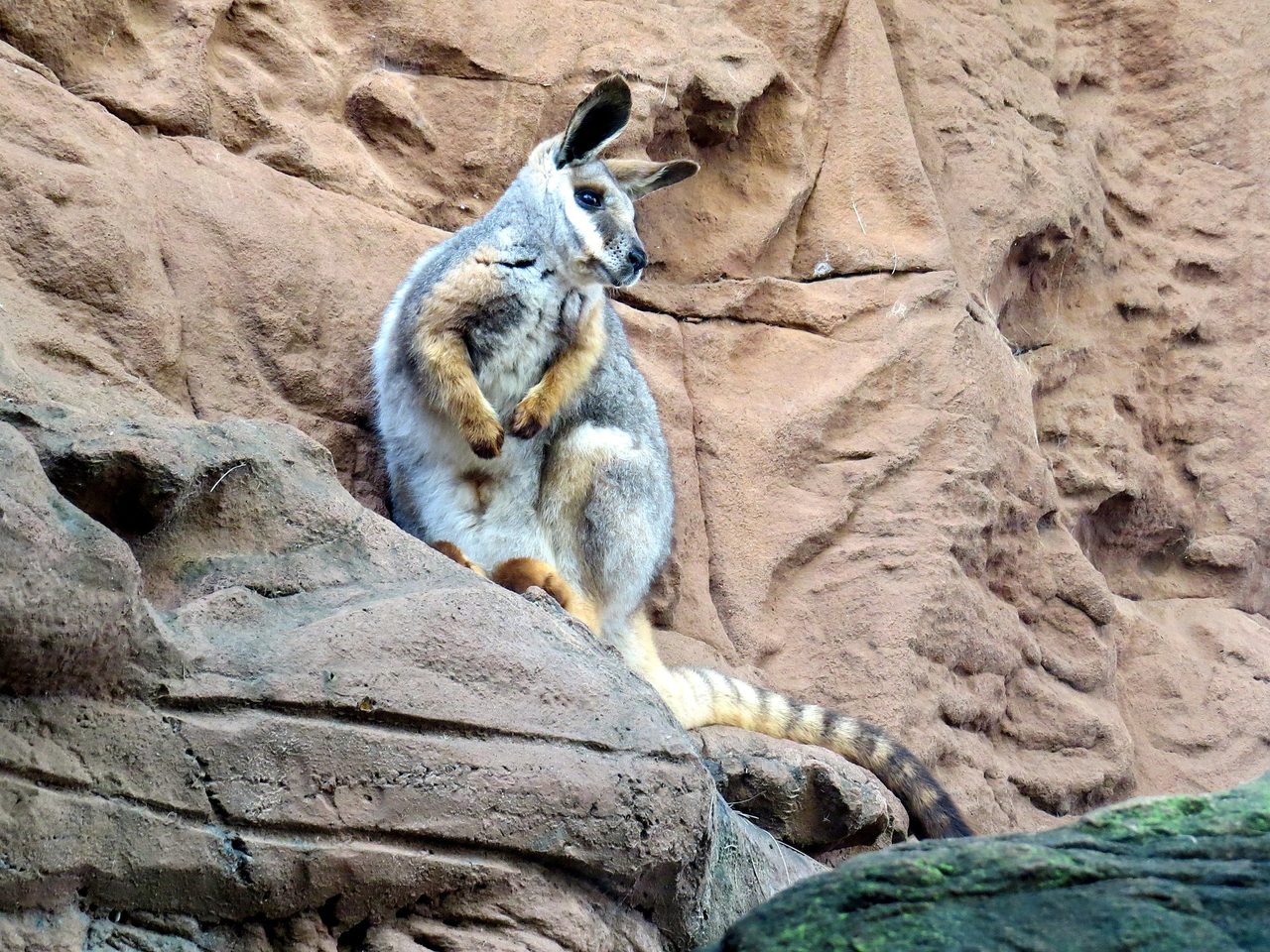
Photo: David Berkowitz / Wikimedia Commons (CC BY 2.0)
In brief
Wallabies are small-to-medium marsupials native to Australia and New Guinea, closely related to kangaroos, with more than 30 species ranging from common and widespread to Near Threatened, Vulnerable or Endangered depending on the species.
Also in Animals A to Z · Animals that start with W
By WARN Research & Conservation TeamLast updated
Wallabies are medium-to-small marsupials belonging to the family Macropodidae — the same family as kangaroos — and they are among the most recognisable symbols of Australian wildlife. Spread across more than 30 species in genera including Notamacropus, Petrogale, Wallabia, Thylogale, and Onychogalea, wallabies occupy an extraordinary range of habitats, from dense rainforest to sun-scorched rocky escarpments and coastal scrubland. Native to Australia and New Guinea, they have also been introduced to New Zealand, the United Kingdom, and Hawaii. Most species are thriving, yet some — such as the Parma wallaby and several rock-wallaby species — face serious pressure from habitat clearance and introduced predators. Understanding wallabies matters: these animals are ecological keystones, shaping vegetation through grazing and serving as prey for a web of native predators and scavengers.
30+
species of wallaby
48 km/h
top hopping speed
25–30 days
gestation period
9 months
time joey spends in the pouch
Figures sourced from IUCN Red List — Notamacropus rufogriseus (Red-necked Wallaby), IUCN Red List — Notamacropus parma (Parma Wallaby), CITES — Macropodidae species listings and other references on this page.
Wallaby: Quick Facts
| Type | Marsupial mammal |
|---|---|
| Size | 45–105 cm body length (species-dependent) |
| Weight | 4–26 kg |
| Diet | Herbivore — grasses, shrubs, herbs, leaves |
| Lifespan | 9–15 years in the wild |
| Gestation | 25–30 days; pouch development ~9 months |
| Top speed | ~48 km/h |
| Activity pattern | Crepuscular and nocturnal |
Scientific Classification
| Kingdom | Animalia |
|---|---|
| Phylum | Chordata |
| Class | Mammalia |
| Order | Diprotodontia |
| Family | Macropodidae |
| Genera | Notamacropus, Petrogale, Wallabia, Thylogale, Lagorchestes, Onychogalea (and others) |
Conservation Status
- IUCN Status
- Varies by species — most Least Concern (IUCN)
- Population
- Most common species number in the hundreds of thousands to millions; Parma wallaby estimated at 1,000–10,000 adults
- Trend
- Stable or increasing for common species; declining for several rock-wallaby and hare-wallaby species
- Assessed
- 2024
- CITES
- Most species not listed; rufous hare-wallaby (Lagorchestes hirsutus), banded hare-wallaby (Lagostrophus fasciatus), and bridled nail-tail wallaby (Onychogalea fraenata) listed on Appendix I
Several species benefit from active recovery programs including predator control and translocation
Did you know?
At slow walking speeds, a wallaby's tail generates more forward force than all four of its limbs combined — making it, in effect, the animal's most powerful leg.
Key Facts: Wallaby
- Wallabies are not a single genetic group but a collective term for more than 30 medium-to-small macropod species across multiple genera.
- Most common species such as the agile wallaby and red-necked wallaby are classified as Least Concern by the IUCN, but several rock-wallabies and hare-wallabies are Near Threatened, Vulnerable or Endangered.
- After a gestation of only 25–30 days, joeys are born the size of a jellybean and spend around nine months developing inside the mother's pouch.
- Female wallabies can suspend a pregnancy mid-development — a process called embryonic diapause — until conditions are right to continue.
- Introduced predators, especially red foxes and feral cats, are the leading conservation threat for vulnerable wallaby species across Australia.
- At slow speeds wallabies use 'pentapedal locomotion', walking on all four limbs plus the tail — generating more forward force with the tail than with any other limb.
What is a wallaby?
The word 'wallaby' does not describe a single species but rather a loose grouping of small-to-medium macropods that are typically smaller than kangaroos. Wallabies belong to the family Macropodidae — meaning 'big foot' in Greek — and are most closely related to kangaroos, wallaroos, and tree-kangaroos. They sit within several genera: Notamacropus covers the brush wallabies such as the agile wallaby and red-necked wallaby; Petrogale encompasses the rock-wallabies; Wallabia contains the distinctive swamp wallaby; and Lagorchestes, Onychogalea, and Thylogale cover hare-wallabies, nail-tail wallabies, and pademelons respectively. Like all marsupials, wallabies give birth to highly undeveloped young and complete development inside a pouch. Their defining physical traits include powerful elongated hind legs, a strong muscular tail that serves both as a counterbalance during hopping and as a fifth limb during slow locomotion, and compact forelimbs used for feeding and grooming. Adult body weights range from around 4–5 kg in smaller wallaby species such as the tammar wallaby up to 26 kg in a large male red-necked wallaby — a substantial variation that reflects the enormous diversity within the group.
Where do wallabies live?
Wallabies are native to Australia and the island of New Guinea, with naturalised populations established in New Zealand's South Island, parts of the United Kingdom, and some Pacific island groups. Within Australia they occupy almost every terrestrial biome. Swamp wallabies favour damp forests and wetland margins; agile wallabies thrive in the tropical savanna woodlands of northern Queensland and the Northern Territory; rock-wallabies cling to cliff faces, boulder piles, and rocky gorges across arid and semi-arid zones; while red-necked wallabies inhabit open eucalyptus forest and scrubland from southern Queensland down through New South Wales and into Tasmania. In general, wallabies prefer areas with cover — dense shrubs, tall grasses, or rocky outcrops — that provide shelter from predators and shade from heat. They are less commonly found on the open treeless plains of central Australia, which are better suited to the larger, faster kangaroos. Wallabies are predominantly crepuscular, resting in shade or dense vegetation during the hottest part of the day and emerging to feed at dawn and dusk.
How do wallabies reproduce?
Wallaby reproduction is one of the most remarkable systems in the mammal world, shaped by millions of years of evolution in an unpredictable, drought-prone environment. After a gestation of just 25 to 30 days — far shorter than almost any placental mammal of equivalent size — the mother gives birth to a joey that weighs less than one gram. This tiny, hairless, and blind newborn must immediately crawl unaided through its mother's fur and into the pouch, guided by scent and an instinctive pulling motion of its overdeveloped forelimbs. Once safely attached to a teat inside the pouch, the joey begins a development phase lasting approximately nine months. By five to six months it begins poking its head out to observe the world, and by seven months it takes short excursions outside before scrambling back to nurse. Full independence from the pouch comes at around eight to nine months, though young wallabies continue to suckle for a further several months. Perhaps the most astonishing adaptation is embryonic diapause: a female that mates shortly after giving birth can suspend the resulting embryo at an early stage of development, holding it dormant until the pouch joey is ready to leave. This means she can produce a succession of offspring with minimal delay, a critical advantage in boom-and-bust Australian conditions.
What threats do wallabies face?
While most common wallaby species remain abundant, a significant number — particularly rock-wallabies, hare-wallabies, and nail-tail wallabies — have experienced severe population declines since European settlement of Australia in the late 18th century. The primary driver is introduced predators. Red foxes, brought to Australia for sport hunting from 1855, and feral cats prey heavily on adults and joeys. Because wallabies evolved without these predators, many species lack effective avoidance behaviours. Predation pressure is compounded by competition from introduced grazers — sheep, cattle, and goats — which reduce the grasses and shrubs wallabies depend on and can force them into open areas where predation risk is higher. Land clearance for agriculture has also fragmented and reduced habitat, isolating populations and preventing genetic exchange. Climate change is an emerging multiplier: hotter, drier conditions drive more frequent and intense bushfires that can strip both shelter and food sources simultaneously. Vehicle strikes on roads bisecting wallaby habitat add further mortality. Some species, such as the Parma wallaby, were once believed extinct and were rediscovered in 1965 on Kawau Island, New Zealand, and confirmed on the Australian mainland in 1967; their populations are still estimated at 1,000–10,000 adults, making them genuinely vulnerable to any additional pressure. Three species — the rufous hare-wallaby, banded hare-wallaby, and bridled nail-tail wallaby — are listed on CITES Appendix I, reflecting the seriousness of trade threats for the rarest species.
What is being done to protect wallabies?
Conservation efforts for threatened wallaby species focus on three main strategies: predator control, habitat protection, and managed breeding. Predator control programs using baiting and trapping of foxes and feral cats have produced documented population recoveries for several rock-wallaby colonies. Fenced predator-free sanctuaries provide safe refuges where small founder populations can rebuild without fox or cat pressure. Translocation programs move wallabies from stable populations to restock areas where local extinction has occurred; the return of black-flanked rock-wallabies to Kalbarri National Park in Western Australia is one well-documented success. National recovery plans under Australia's Environment Protection and Biodiversity Conservation Act set species-specific actions for the most threatened species. Genetic management in managed collections helps maintain diversity that could be drawn upon for future reintroductions. Citizen science programs improve population monitoring by enabling trained volunteers to conduct standardised counts, addressing the longstanding challenge of inadequate survey coverage. Research into wallaby ecology continues to refine understanding of habitat requirements and minimum viable population sizes. At an international level, CITES Appendix I listings for the rufous hare-wallaby, banded hare-wallaby, and bridled nail-tail wallaby prohibit commercial trade. The single most important lever for long-term wallaby conservation remains controlling introduced predators at landscape scale — an ongoing challenge across Australia's vast and remote terrain.
What WARN Does
WARN does not currently run projects for wallabies, as our rescue and conservation partnerships are focused in its partner-network countries. This guide is offered as free educational content because public awareness of threats facing marsupials — from habitat loss to invasive predators — helps build the global support that conservation anywhere depends on.
Wallabies remind us how interconnected conservation challenges are — from invasive predators in Australia to habitat destruction worldwide. Supporting WARN's work in our partner countries helps protect the ecological systems and rescue networks that animals everywhere depend on.
Wallaby: Frequently Asked Questions
Are wallabies the same as kangaroos?
What do wallabies eat?
How fast can a wallaby hop?
How long do wallabies live?
Are wallabies endangered?
What is a group of wallabies called?
Where do wallabies live?
Are wallabies dangerous?
How big is a wallaby?
Sources & References
Population figures, conservation status and biological facts on this page are drawn from authoritative scientific and intergovernmental sources.
- IUCN Red List — Notamacropus rufogriseus (Red-necked Wallaby)
- IUCN Red List — Notamacropus parma (Parma Wallaby)
- CITES — Macropodidae species listings
- Animal Diversity Web — Notamacropus agilis (Agile Wallaby)
- ScienceDaily / ANU — Urgent action needed to protect the Parma wallaby (December 2024)
- National Geographic — Wallabies
Terms used on this page
Plain-English definitions, from our wildlife and conservation glossary.
Latest Wallaby Stories
Quick, fact-checked reads on the wallaby — amazing facts, key questions and the threats it faces.
Species
Why Are Dugongs Disappearing — and What's Being Done to Save Them?
Dugongs are vanishing from waters where they once thrived, declared functionally extinct in China and critically endangered in East Africa. Here's why — and the work that offers hope.
Read the storySpecies
12 Amazing Facts About Koalas (They Are Not Bears, and They Have Fingerprints)
Fingerprints indistinguishable from ours, 20 hours of sleep a day, and a diet that would poison most animals. Twelve koala facts.
Read the storySpecies
12 Amazing Facts About Kangaroos (They Cannot Walk Backwards)
Tendons that work like springs, a tail used as a fifth leg, and the ability to pause a pregnancy. Twelve verified kangaroo facts.
Read the storyExplore more animals
Discover more animals, their habitats and their conservation status in the WARN wildlife-guide library.