Wildlife Guide · Sub-Saharan Africa
Warthog
Phacochoerus africanus (Gmelin, 1788)
The kneeling grazer of the savanna — warts, tusks and surprising speed.
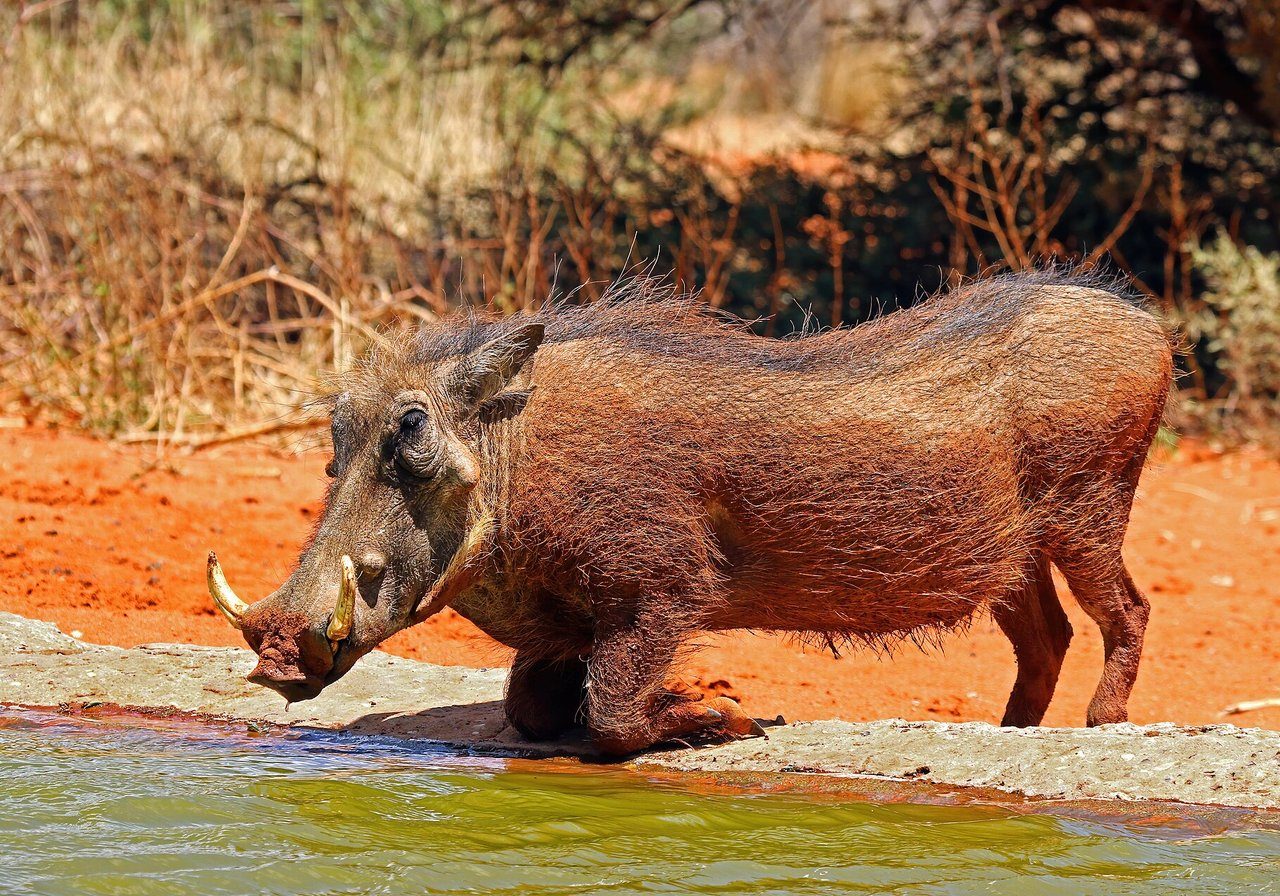
Source: Wikimedia Commons
In brief
The common warthog (Phacochoerus africanus) is a grazing wild pig of African savanna, listed as Least Concern; recognisable by facial warts and tusks, it kneels to graze and shelters in burrows when threatened.
Also in Animals A to Z · Animals that start with W
By WARN Research & Conservation TeamLast updated
The common warthog is a wild pig of African savanna and woodland, instantly recognisable by the facial 'warts' — thick skin pads — and the upward-curving tusks that protrude from its mouth. Warthogs kneel on their front wrists to graze close-cropped grass, a posture unique among African ungulates. They are fast runners, reaching 50 km/h, and retreat to burrows — often abandoned aardvark holes — when threatened. Made famous by the character Pumbaa in The Lion King, warthogs are ecologically important grazers and a prey species for lions, leopards and hyenas. Listed as Least Concern, they remain widespread but are hunted for bushmeat across much of their range.
Least Concern
IUCN Red List status (2016 assessment)
50 km/h
Top running speed
15 yr
Maximum lifespan in the wild
Not listed
CITES status
Figures sourced from IUCN Red List — Phacochoerus africanus, Encyclopaedia Britannica — warthog, San Diego Zoo Wildlife Alliance — warthog .
Warthog: Quick Facts
| Weight | 50–150 kg |
|---|---|
| Tusks | Upper and lower pairs; lower tusks curve upward |
| Diet | Grazer — short grass, roots, occasional fruit |
| Speed | Up to 50 km/h |
| Shelter | Burrows — usually abandoned aardvark holes |
| CITES | Not listed |
Scientific Classification
| Kingdom | Animalia |
|---|---|
| Phylum | Chordata |
| Class | Mammalia |
| Order | Artiodactyla |
| Family | Suidae (pigs) |
| Genus | Phacochoerus |
| Species | Phacochoerus africanus (Gmelin, 1788) |
Conservation Status
- IUCN Status
- Least Concern (IUCN, 2016). Stable across most of sub-Saharan Africa.
- Population
- No global estimate; abundant in protected areas
- Trend
- Stable or increasing in southern Africa; decreasing locally from bushmeat hunting
- Assessed
- 2016
- CITES
- Not listed under CITES
Key Facts: Warthog
- Warthogs kneel on their front wrists to graze — a distinctive feeding posture.
- Facial 'warts' are thick skin pads, not tumours — larger in males.
- They shelter in burrows, usually abandoned aardvark holes, entering tail-first.
- Warthogs can run at 50 km/h and are faster than they appear.
- Desert warthog of the Horn of Africa is a separate, less-known species.
- Bushmeat hunting is the main threat across much of their range.
Two warthog species
Two warthog species exist in the genus Phacochoerus.
The common warthog (P. africanus) ranges across sub-Saharan Africa in savanna, woodland and grassland. The desert warthog (P. aethiopicus) is restricted to the Horn of Africa — Somalia, Ethiopia and Kenya — and is less well studied. Both have the characteristic warthog profile: large head with facial warts, upward-curving lower tusks and downward-curving upper tusks, a sparse mane along the spine and a tufted tail held erect when running. Common warthogs weigh 50–150 kg; males carry larger warts and tusks.
Grazing, burrows and behaviour
Warthogs are primarily grazers, eating short grass, roots and occasionally fruit or carrion. They kneel on calloused front wrists to reach grass close to the ground — a behaviour that makes them efficient competitors in grazed savanna.
At night and during heat, warthogs retreat to burrows, entering backwards so tusks face the entrance. They often use burrows dug by aardvarks, though they can excavate their own. Family groups consist of a female and her offspring; males are usually solitary. Warthogs allow oxpeckers and mongooses to remove parasites from their skin — a mutualistic relationship.
Predators and defence
Lions, leopards, cheetahs, wild dogs and hyenas prey on warthogs, particularly piglets and subadults. Adult warthogs defend themselves with sharp lower tusks — males clash during the rut. Their speed — up to 50 km/h — and habit of retreating to burrows provide effective escape. Piglets are vulnerable during the first months; females give birth in burrows and the litter stays underground for several weeks. Warthog alarm calls — grunts and snorts — alert group members to danger.
Conservation status
The IUCN lists the common warthog as Least Concern with a stable or increasing population trend across most of its range. Warthogs are not listed under CITES. Bushmeat hunting with snares and guns reduces populations in Central and West Africa, where warthog is a valued food source. Habitat loss to agriculture affects local abundance. In southern and East African protected areas, warthog populations remain healthy. The desert warthog has a restricted range and may warrant separate assessment as data improve.
What WARN Does
WARN publishes this warthog guide as free public education. Bushmeat hunting that threatens warthog populations also devastates the predators and ecosystems of African savanna.
If this guide helps you understand wildlife and the pressures it faces, a gift to WARN supports habitat protection and free public education in our partner countries.
Warthog: Frequently Asked Questions
Why do warthogs have warts?
Why do warthogs kneel to eat?
What is the difference between a warthog and a wild boar?
Do warthogs live in burrows?
Are warthogs dangerous?
What do warthogs eat?
Where do warthogs live?
How long do warthogs live?
How big is a warthog?
Sources & References
Population figures, conservation status and biological facts on this page are drawn from authoritative scientific and intergovernmental sources.
Terms used on this page
Plain-English definitions, from our wildlife and conservation glossary.
Latest Warthog Stories
Quick, fact-checked reads on the warthog — amazing facts, key questions and the threats it faces.
Species
Tiger vs Lion: 7 Key Differences Between the Two Biggest Cats
Tigers are bigger, stripier and solitary; lions are social and live in prides. Here's how the two largest cats really differ in size, habitat and behaviour.
Read the storySpecies
12 Astonishing Facts About the Pangolin, the World's Only Scaly Mammal
From a tongue anchored near its pelvis to scales that weigh a fifth of its body, the pangolin is one of nature's strangest mammals. Here are 12 facts that explain why.
Read the storySpecies
How Big Is a Pangolin — and How Long Is Its Tongue?
Pangolins range from house-cat size to over 30 kg, and the largest have a tongue longer than their entire body. Here are the real numbers.
Read the storyExplore more animals
Discover more animals, their habitats and their conservation status in the WARN wildlife-guide library.