Wildlife Guide · Europe & Russia
Water Vole
Arvicola amphibius
The riverbank's "Ratty" — a chubby, plop-diving vole, not a rat, and one of Britain's fastest-vanishing mammals.
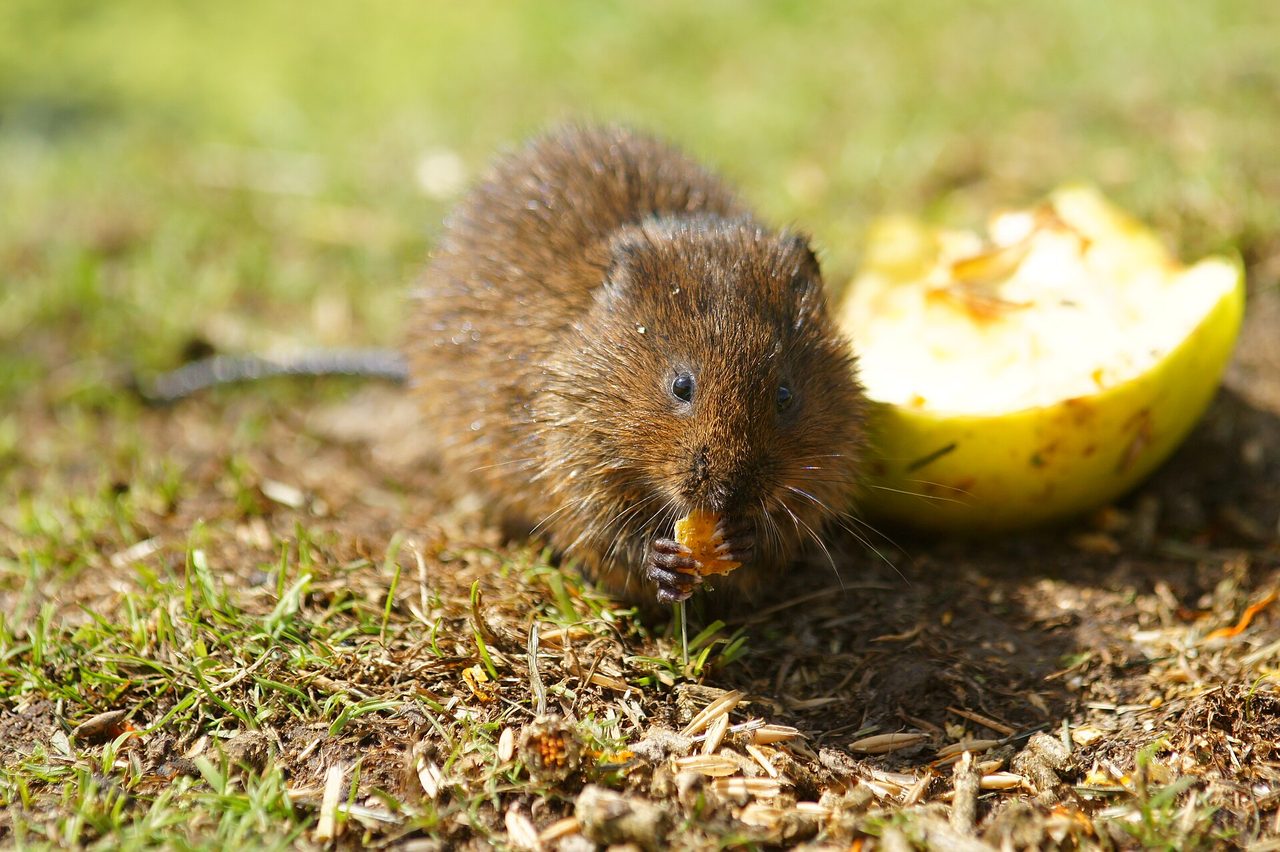
Photo: Peter Trimming / Wikimedia Commons (CC BY-SA 2.0)
In brief
A water vole (Arvicola amphibius) is a large, semi-aquatic rodent found along rivers, ditches and reed beds across Europe and western Asia. With chestnut fur, a blunt muzzle and a furry tail, it is a true vole — not a rat — and the inspiration for "Ratty" in The Wind in the Willows.
Also in Animals A to Z · Animals that start with W
By WARN Research & Conservation TeamLast updated
The water vole (Arvicola amphibius) is a large, semi-aquatic rodent of riverbanks, ditches and reed beds across Europe and into western Asia. With its rounded face, chestnut-brown fur, small hidden ears and furry tail, it is often mistaken for a brown rat — yet it is a true vole, and the real-life model for "Ratty" in The Wind in the Willows. Globally the species is listed as Least Concern, but in the United Kingdom it has become one of the fastest-declining mammals, hit hard by habitat loss and predation from invasive American mink. Listen by a quiet stream in summer and you may hear its tell-tale "plop" as it dives.
14-22 cm
Head-and-body length of an adult
~21 days
Gestation before a litter is born
Up to 8
Young per litter, several litters a year
Least Concern
Global IUCN status (assessed 2021)
Figures sourced from European water vole — Wikipedia, IUCN Red List — Arvicola amphibius, Water vole — Encyclopaedia Britannica and other references on this page.
Water Vole: Quick Facts
| Common name | Water vole (also "water rat") |
|---|---|
| Scientific name | Arvicola amphibius |
| Type | Semi-aquatic rodent (vole) |
| Head-and-body length | About 14-22 cm, plus a furry tail |
| Weight | Roughly 150-300 g in adults |
| Diet | Mostly vegetarian — grasses, sedges, rushes and roots |
| Habitat | Riverbanks, ditches, reed beds and wetlands |
| Range | Europe, Russia, West Asia and Kazakhstan |
| Lifespan | Usually a few months in the wild; up to ~2.5 years in captivity |
| Famous for | Being "Ratty" in The Wind in the Willows |
Scientific Classification
| Kingdom | Animalia |
|---|---|
| Phylum | Chordata |
| Class | Mammalia |
| Order | Rodentia |
| Family | Cricetidae |
| Genus | Arvicola |
| Species | Arvicola amphibius |
Conservation Status
- IUCN Status
- Globally assessed as Least Concern by the IUCN Red List, reflecting a very wide range across Europe and into Asia. In the United Kingdom, however, the water vole is one of the fastest-declining mammals and is strictly protected under wildlife law, having disappeared from much of its former range due to habitat loss and predation by invasive American mink.
- Population
- No reliable global total; the species is widespread but local populations, especially in Britain, are fragmented and have fallen sharply.
- Trend
- Stable globally, but steeply declining in the UK
- Assessed
- 2021
- CITES
- Not listed on the CITES Appendices
Globally Least Concern but a major conservation concern in Britain, where it and its burrows are legally protected and recovery focuses on restoring connected wetland habitat and controlling invasive mink.
Key Facts: Water Vole
- The water vole is a true vole, not a rat — note the blunt rounded muzzle, small ears almost hidden in fur, and short furry tail.
- It is the largest vole in Britain and the real-life inspiration for "Ratty" in Kenneth Grahame's The Wind in the Willows.
- Globally the species is assessed as Least Concern by the IUCN, with a wide range across Europe, Russia and western Asia.
- In the United Kingdom it is one of the fastest-declining mammals, driven by habitat loss and predation by the invasive American mink.
- Water voles are mainly vegetarian, grazing waterside grasses, sedges and rushes, and give themselves away with a distinctive "plop" as they dive.
- They are strictly protected in Britain, where their burrows and habitat are safeguarded by law.
What does a water vole look like and how is it different from a rat?
A water vole is a plump, round-bodied rodent measuring roughly 14-22 cm in head-and-body length, with a tail about half that again. Adults typically weigh between about 150 and 300 grams, making this the largest vole in Britain. Its fur is usually rich chestnut to dark brown, occasionally near-black in parts of Scotland. The features that distinguish it from the superficially similar brown rat are worth learning: the water vole has a blunt, rounded muzzle rather than a pointed snout, small ears that barely show above the fur, and a short, hair-covered tail instead of the rat's long, scaly, near-naked one. Its eyes are small and its overall silhouette is rounded and chubby. When alarmed it dives into the water with a characteristic "plop", a sound that often reveals its presence before it is seen. Because of this resemblance, and the famous character "Ratty", many people wrongly assume water voles are rats — but they are gentle, plant-eating voles.
Where do water voles live and what do they eat?
Water voles are semi-aquatic and tied to fresh water. Across their range they occupy the banks of slow-flowing rivers and streams, ditches, canals, marshes, reed beds and ponds, and in some upland areas they live in damp peatland and grassland away from open water. The species ranges widely across most of Europe, into Russia, parts of West Asia and Kazakhstan, and can be found from sea level up to around 1,000 metres in mountainous regions. They dig extensive burrow systems into soft, vegetated banks, with entrances at and below the waterline, and create networks of runs and feeding lawns through the surrounding vegetation. Their diet is overwhelmingly vegetarian: grasses, sedges, rushes, reeds and waterside herbs make up the bulk of it, supplemented by roots, bulbs, fruits, twigs and bark, especially in winter. Distinctively grazed grass stems cut at a neat 45-degree angle, along with latrines of small, rounded droppings, are classic field signs that water voles are present.
Why are water voles disappearing in Britain?
Although the water vole is globally Least Concern, in the United Kingdom it has suffered one of the most dramatic declines of any British mammal, vanishing from large parts of its former range over recent decades. Two pressures drive this. The first is habitat loss and fragmentation: the canalisation and dredging of watercourses, drainage of wetlands, intensive bankside farming and urban development have stripped away the lush, vegetated banks water voles depend on, leaving isolated populations cut off from one another. The second, and especially severe, factor is predation by the American mink — a non-native carnivore that escaped and was released from fur farms. Female mink are small enough to enter water vole burrows and can wipe out entire colonies, a pressure the voles have no evolved defence against. Because of these threats, water voles and their burrows are strictly protected under wildlife law in Britain, and recovery depends on restoring connected, well-vegetated waterways and controlling invasive mink.
How do water voles breed and how long do they live?
Water voles have a fast, prolific breeding strategy that helps offset high natural mortality. The breeding season runs from spring into late autumn, roughly March to October. After a gestation of about 21 days, a female gives birth to a litter of typically three to eight young in a nest within her burrow or, sometimes, woven among reeds. A female may produce several litters in a single season, and young from early litters can themselves breed before the year is out. The young are weaned and independent within a few weeks. Life is short and hazardous: most wild water voles live only a few months, and few survive more than two winters, as they are heavily preyed upon by herons, owls, stoats, pike and, where present, mink. This boom-and-bust pattern means healthy populations can bounce back quickly when habitat is good and predation is low — which is exactly why restoring riverbanks and tackling invasive predators can turn local fortunes around.
Water vole vs brown rat: how to tell them apart
| Feature | Water vole | Brown rat |
|---|---|---|
| Muzzle | Blunt and rounded | Pointed and long |
| Ears | Small, almost hidden in fur | Prominent and visible |
| Tail | Short and furry (about half body length) | Long, scaly and near-hairless |
| Body shape | Plump and rounded | Sleeker, more elongated |
| Diet | Almost entirely plants | Omnivorous, opportunistic |
| In the water | Dives with a clear "plop" | Swims but less specialised |
What WARN Does
WARN does not run field projects specifically for the water vole — the species lives mostly outside the countries where WARN's partners work, and this guide is part of WARN's free educational mission to help people understand and value wildlife. The threats that hit water voles hardest, however — habitat loss, drained and degraded wetlands, and pressure from invasive species — are exactly the kinds of pressures that bear down on the animals WARN's partners do protect.
If learning about the water vole sparked a little wonder, a small gift helps keep WARN's free wildlife guides growing and supports the animals our partners protect.
Water Vole: Frequently Asked Questions
Is a water vole a rat?
Why is the character "Ratty" in The Wind in the Willows a water vole?
What do water voles eat?
Are water voles endangered?
What is the main threat to water voles in the UK?
How long do water voles live?
Where do water voles live?
Are water voles dangerous?
How big is a water vole?
Sources & References
Population figures, conservation status and biological facts on this page are drawn from authoritative scientific and intergovernmental sources.
Terms used on this page
Plain-English definitions, from our wildlife and conservation glossary.
Latest Water Vole Stories
Quick, fact-checked reads on the water vole — amazing facts, key questions and the threats it faces.
Guides
UK Animal Charities Explained: A Friendly Guide to 10 of the Biggest, and How They Differ
Who does what across UK animal welfare? A neutral, supporter-friendly guide to ten of the biggest UK animal charities — RSPCA, Dogs Trust, Battersea, Cats Protection, Blue Cross, PDSA, The Donkey Sanctuary, Brooke, Wood Green and Mayhew — with each charity's own donate link, and an honest section on where international field rescue fits in.
Read the storyGuides
What Is an Animal Sanctuary? How Sanctuaries Work, Who They Help, and How to Support One
Animal sanctuary, animal shelter, animal rescue — the terms are often used interchangeably, but they mean different things. This guide explains the difference, what life inside a sanctuary looks like, and how you can support sanctuaries in the UK and internationally.
Read the storyGuides
Fostering a Rescue Dog in the UK: A Complete Guide for New and Experienced Foster Carers
Fostering a rescue dog gives a dog in a shelter or rescue centre a temporary home while they wait for adoption — and it can make an enormous difference to their behaviour, health and chances of finding a permanent family. This guide covers how dog fostering works, what to expect, and how to get started.
Read the storyExplore more animals
Discover more animals, their habitats and their conservation status in the WARN wildlife-guide library.