Wildlife Guide · Europe & Asia
Weasel
Mustela nivalis
The world's smallest carnivore, slim enough to chase a vole down its own burrow.
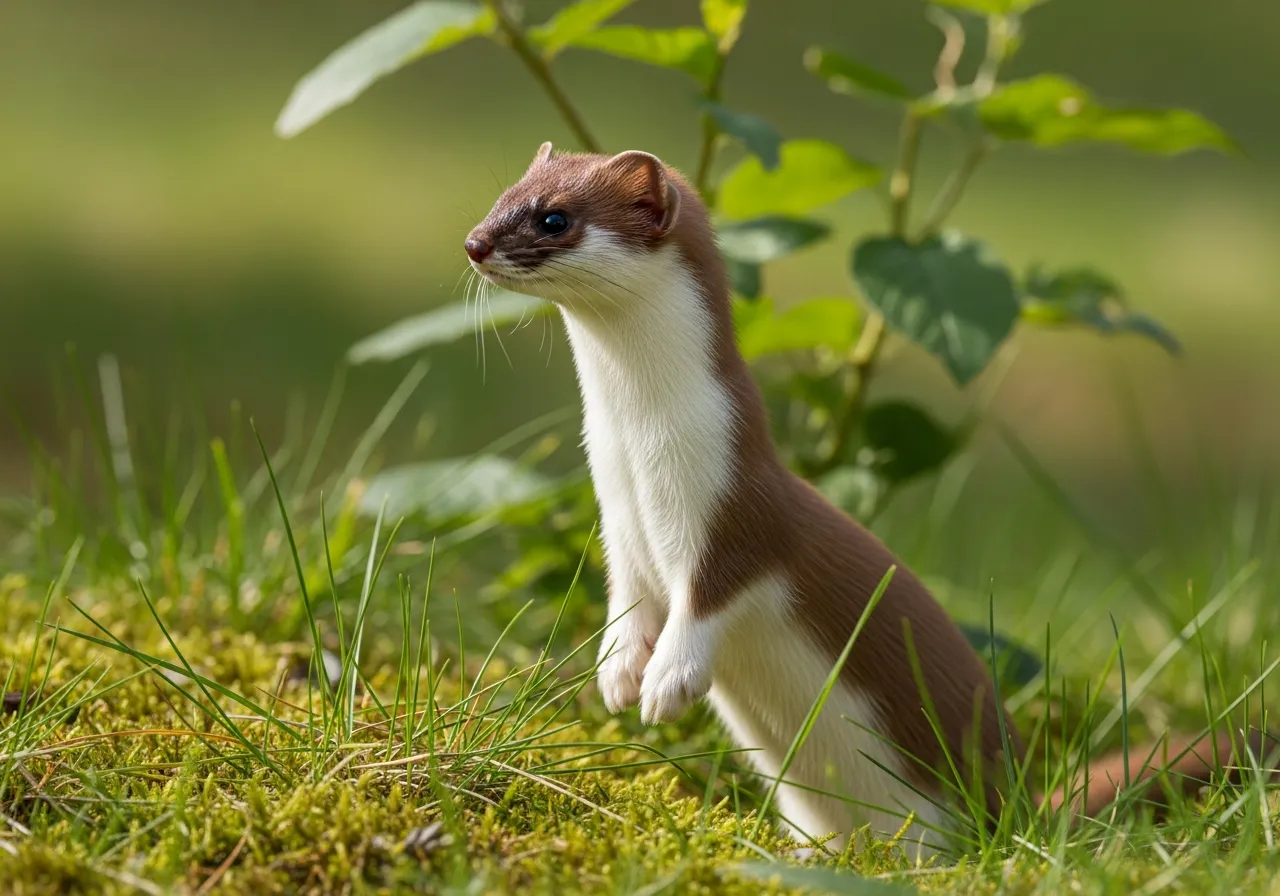
Source: Global Animal Guide (WARN)
In brief
A weasel (Mustela nivalis), or least weasel, is the world's smallest carnivorous mammal: a slim, agile, short-legged hunter with a brown back and pale belly. Found across Europe, Asia and North America, it preys mainly on mice and voles, chasing them into their own burrows.
Also in Animals A to Z · Animals that start with W
By WARN Research & Conservation TeamLast updated
The weasel (Mustela nivalis), known precisely as the least weasel, is the smallest member of the order Carnivora and the smallest true carnivore on Earth. This long, slender, short-legged hunter wears a russet-brown coat with a creamy-white underside, and in colder regions it may turn pure white in winter. Found across Europe, Asia, North America and North Africa, the weasel is a relentless predator of mice and voles, slim enough to pursue them straight into their tunnels. Despite its tiny size, it is bold, fast and ferociously energetic, needing to eat roughly a third of its body weight each day to fuel its racing metabolism. The IUCN lists it as Least Concern.
Smallest
carnivore on Earth, by species
~25-35 g
typical female body weight
~1/3
of body weight eaten daily
6
average kits per litter
Figures sourced from Least weasel - Wikipedia, IUCN Red List: Mustela nivalis, Weasel - Encyclopaedia Britannica and other references on this page.
Weasel: Quick Facts
| Common name | Least weasel (weasel) |
|---|---|
| Scientific name | Mustela nivalis |
| Family | Mustelidae (mustelids) |
| Size | Head-and-body roughly 11-26 cm; females smaller than males |
| Weight | Females often ~25-35 g; males larger |
| Diet | Mainly mice and voles; carnivorous |
| Distinction | World's smallest carnivore |
| Range | Europe, Asia, North America, North Africa |
| Litter size | Around 6 kits, usually one litter a year |
| Conservation | Least Concern (IUCN) |
Scientific Classification
| Kingdom | Animalia |
|---|---|
| Phylum | Chordata |
| Class | Mammalia |
| Order | Carnivora |
| Family | Mustelidae |
| Genus | Mustela |
| Species | Mustela nivalis |
Conservation Status
- IUCN Status
- Least Concern on the IUCN Red List. The least weasel has an extremely wide distribution across the Northern Hemisphere and a large global population, so it is not considered at risk of extinction. Local numbers can swing dramatically with rodent population cycles, and habitat loss, agricultural intensification and rodenticides can affect populations regionally.
- Population
- Not quantified globally; considered abundant and widespread across its very large range.
- Trend
- Stable (per IUCN assessment), with strong local fluctuations tied to rodent abundance.
- Assessed
- 2016
- CITES
- Not listed on CITES.
Because weasel numbers track those of their rodent prey, populations can boom in good vole years and crash when rodents are scarce, which is normal for the species rather than a sign of decline.
Key Facts: Weasel
- The least weasel (Mustela nivalis) is the smallest member of the order Carnivora and the smallest true carnivore in the world.
- Its long, thin body lets it follow mice and voles down their own burrows, but it loses body heat quickly and must hunt almost constantly.
- Weasels eat around a third of their body weight every day to fuel an extremely fast metabolism.
- In northern and high-altitude parts of its range, the coat turns pure white in winter for camouflage in snow.
- It ranges across Europe, Asia, North America and North Africa, and has been introduced to several islands including New Zealand.
- The IUCN classifies the least weasel as Least Concern, though local numbers swing with rodent population cycles.
What makes the weasel the world's smallest carnivore?
The least weasel holds the title of smallest carnivoran on the planet. Females are especially tiny, often weighing only around 25-35 grams and measuring roughly 11-20 cm in head-and-body length, with males somewhat larger. The smallest subspecies are smaller still. This diminutive size is not a weakness but a specialised tool: a weasel's body is so narrow that it can pursue voles, mice and other small rodents into the tunnels and runways where they live and breed, hunting prey that larger predators simply cannot reach. The trade-off is steep. A small, elongated body has a large surface area relative to its volume, so the weasel loses heat rapidly and burns energy at a furious rate. To stay alive it must hunt and feed almost around the clock, eating roughly a third of its own body weight each day. A weasel that goes without food for even a day or two can starve. This razor-thin energy budget shapes nearly everything about how it lives and moves.
What do weasels eat and how do they hunt?
Weasels are specialist small-mammal hunters, and across most of their range mice and voles form the bulk of the diet. A weasel kills with a precise bite to the back of the neck or base of the skull, dispatching prey that can be close to its own size. Its slim build, sharp senses and explosive bursts of speed make it a formidable hunter in dense cover, leaf litter, stone walls and rodent burrows. When prey is abundant, weasels will cache surplus kills to draw on during lean spells, a useful insurance policy given their high energy demands. Besides rodents, they take the occasional bird, egg, frog, or young rabbit when the chance arises. Because their fortunes rise and fall with rodent abundance, weasel numbers can boom in good vole years and crash when rodent populations collapse. This tight predator-prey link makes weasels valuable natural controllers of rodents in farmland, grassland and woodland, quietly suppressing populations of animals that would otherwise damage crops and stored food.
Where do weasels live, and do they turn white in winter?
The least weasel has one of the widest ranges of any carnivore, occurring naturally across Europe, much of Asia, North America and parts of North Africa, and it has been introduced to islands such as New Zealand, Malta and the Azores. It occupies a remarkable variety of habitats, from farmland, hedgerows and grassland to woodland, moorland and alpine meadows, generally wherever small rodents are plentiful. In the colder, northern and high-altitude parts of its range, the weasel undergoes a seasonal moult and its brown summer coat is replaced by a pure white winter coat, providing camouflage against snow. Further south, where snow is rare, animals usually stay brown all year. Weasels are largely solitary and active by day and night, defending territories that they patrol along familiar routes. They shelter in burrows, often those of the rodents they have eaten, lining the nest with fur and plant material. A single litter of around six kits is typically raised each year, with the young growing and dispersing quickly.
Weasel vs stoat: how to tell them apart
| Feature | Weasel (Mustela nivalis) | Stoat (Mustela erminea) |
|---|---|---|
| Size | Smaller; world's smallest carnivore | Larger and longer-bodied |
| Tail | Short, uniformly brown, no black tip | Longer, with a distinct black tip |
| Movement | Low, darting, close to the ground | Often bounding with an arched back |
| Winter coat | Turns white in cold regions | Turns white (called ermine) in cold regions |
| Black tail tip in winter | Absent | Retained even when coat is white |
What WARN Does
World Animal Rescue Network does not run dedicated field projects for the least weasel, which lives largely outside the countries where WARN and its partners work on the ground. This guide is part of WARN's free educational library, written to help people understand the wild animals that share our world. The habitat loss, rodenticide use and persecution that threaten small predators are the very same pressures that harm the animals WARN does protect, so understanding one helps protect many.
If clear, science-based wildlife guides like this one are useful to you, a small gift helps WARN keep them free and support the animals in its care.
Weasel: Frequently Asked Questions
Is a weasel the same as a stoat?
Are weasels dangerous to humans?
Why do weasels need to eat so much?
Do weasels turn white in winter?
What eats a weasel?
What do least weasels eat?
Where do least weasels live?
How long do least weasels live?
How big is a least weasel?
Sources & References
Population figures, conservation status and biological facts on this page are drawn from authoritative scientific and intergovernmental sources.
Terms used on this page
Plain-English definitions, from our wildlife and conservation glossary.
Latest Weasel Stories
Quick, fact-checked reads on the weasel — amazing facts, key questions and the threats it faces.
Species
Slow Loris: Why the Internet's Favourite Pet Is a Conservation Disaster
The slow loris looks like a cartoon character — and that has nearly destroyed the species. Here is the truth behind the viral videos.
Read the storySpecies
The Snow Leopard: Why the Ghost of the Mountains Is Still Vulnerable
The snow leopard is one of the most elusive big cats on earth, with an estimated 4,000-6,500 individuals across twelve range states — including Pakistan, where WARN is preparing to operate. This briefing explains why the species was downlisted from Endangered to Vulnerable in 2017 and why that is not the success story it sounds like.
Read the storyGuides
Sun Bear vs Moon Bear: The Two Most Trafficked Asian Bears
The sun bear and the Asiatic black bear (moon bear) are the two most commonly trafficked bears in Asia — for the pet trade, for traditional medicine and for bear-bile farming. Here is how to tell them apart.
Read the storyExplore more animals
Discover more animals, their habitats and their conservation status in the WARN wildlife-guide library.