Wildlife Guide · East Africa & Southern Africa
Wildebeest
Connochaetes taurinus (Burchell, 1823)
The gnu of the Great Migration — a million hooves shaping the savanna.
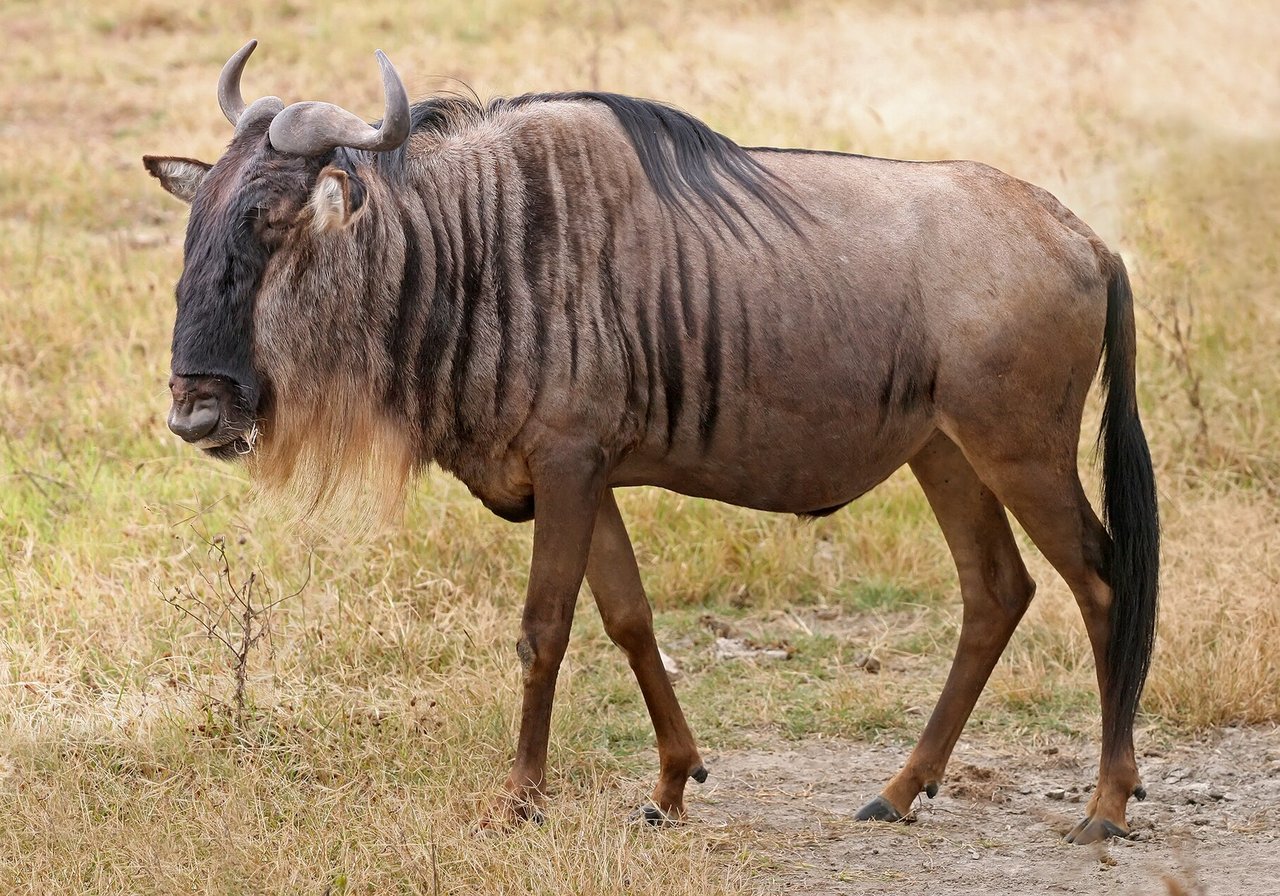
Source: Wikimedia Commons
In brief
The blue wildebeest (Connochaetes taurinus) is a gregarious grazing antelope of African savanna, central to the Great Migration of over a million animals between Serengeti and Maasai Mara; listed as Least Concern but declining outside protected areas.
Also in Animals A to Z · Animals that start with W
By WARN Research & Conservation TeamLast updated
The blue wildebeest — also called the brindled gnu — is one of Africa's most iconic grazing antelopes and the dominant species in the Great Migration of the Serengeti–Mara ecosystem. More than a million wildebeest, together with zebra and gazelle, circulate annually between Tanzania's Serengeti and Kenya's Maasai Mara in the largest terrestrial mammal migration on Earth. Wildebeest are gregarious, forming herds of thousands, and are a keystone prey species for lions, hyenas, crocodiles and wild dogs. Listed as Least Concern globally, wildebeest numbers remain substantial in protected areas but have declined where fencing, agriculture and poaching fragment their range.
1.5 million
Wildebeest in the Serengeti–Mara ecosystem
Least Concern
IUCN Red List status (2016 assessment)
250 km
Round-trip migration distance
Appendix II
CITES listing (South African population Appendix III)
Figures sourced from IUCN Red List — Connochaetes taurinus, Serengeti National Park — migration, CITES — Checklist of CITES Species .
Wildebeest: Quick Facts
| Weight | 118–270 kg |
|---|---|
| Herd size | Thousands to over a million in migration |
| Diet | Grazer — short green grass |
| Migration | ~800 km circular route annually |
| Calving | ~500,000 calves in a few weeks (Serengeti) |
| CITES | Appendix II |
Scientific Classification
| Kingdom | Animalia |
|---|---|
| Phylum | Chordata |
| Class | Mammalia |
| Order | Artiodactyla |
| Family | Bovidae |
| Genus | Connochaetes |
| Species | Connochaetes taurinus (Burchell, 1823) |
Conservation Status
- IUCN Status
- Least Concern (IUCN, 2016). Stable in protected areas; declining outside reserves.
- Population
- Roughly 1.55 million blue wildebeest globally
- Trend
- Stable in Serengeti–Mara; decreasing in some regions
- Assessed
- 2016
- CITES
- Appendix II
Key Facts: Wildebeest
- Blue wildebeest drive the Great Migration — the largest terrestrial mammal migration on Earth.
- More than 1.5 million wildebeest circulate between Serengeti and Maasai Mara annually.
- Calving season sees roughly 500,000 calves born in a few weeks on the southern Serengeti plains.
- Wildebeest are keystone prey for lions, hyenas, crocodiles and wild dogs.
- Black wildebeest of southern Africa is a separate, smaller species.
- Fencing, agriculture and poaching threaten populations outside major reserves.
Two wildebeest species
Two wildebeest species exist in the genus Connochaetes.
The blue wildebeest (C. taurinus) — also called the brindled or common wildebeest — ranges across East and southern Africa and forms the mega-herds of the Great Migration. Five subspecies are recognised, including the western white-bearded wildebeest of Tanzania and Kenya. The black wildebeest (C. gnou) is smaller, darker and confined to southern Africa, where it was hunted nearly to extinction before recovering through conservation. Both species have a heavy front end, slender hindquarters, a shaggy mane and curved horns — the Afrikaans name 'wildebeest' means 'wild cattle'.
The Great Migration
The Serengeti–Mara wildebeest migration is driven by rainfall and grass quality. Roughly 1.5 million blue wildebeest, accompanied by hundreds of thousands of zebra and Thomson's gazelle, follow a circular route of about 800 km. Calving occurs on the short-grass plains of the southern Serengeti in February, when up to 500,000 calves are born within a few weeks — a strategy that overwhelms predators.
The herds then move northward, crossing the Grumeti and Mara rivers where crocodiles take a toll. This migration is the defining ecological event of East African savanna and supports an entire predator community.
Ecology and behaviour
Wildebeest are selective bulk grazers, preferring short green grass. Their large herds offer safety in numbers against predators, though lions and hyenas still take significant numbers — particularly calves and weak adults during river crossings. Wildebeest communicate through grunts, snorts and scent marking. Rutting males defend temporary territories on leks during the breeding season. They require access to water and cannot survive in arid zones without regular drinking. As a keystone prey species, wildebeest abundance directly affects predator populations across the ecosystem.
Conservation challenges
The IUCN lists the blue wildebeest as Least Concern with an estimated 1.55 million individuals and a stable trend in protected areas. However, populations outside major reserves have declined due to agricultural expansion, fencing that blocks migration routes, poaching for bushmeat and competition with livestock. The black wildebeest recovered from near extinction to Least Concern through reintroduction in South Africa. Maintaining open migration corridors between Serengeti and Maasai Mara is critical — border fencing or land conversion could collapse the migration. CITES Appendix II regulates international trade.
What WARN Does
WARN publishes this wildebeest guide as free public education. The Great Migration depends on connected savanna habitat — the same landscape-scale protection that benefits all African wildlife.
If this guide helps you understand wildlife and the pressures it faces, a gift to WARN supports habitat protection and free public education in our partner countries.
Wildebeest: Frequently Asked Questions
What is the Great Migration?
What is the difference between blue and black wildebeest?
Why do wildebeest cross rivers?
Are wildebeest endangered?
What do wildebeests eat?
Where do wildebeests live?
Are wildebeests dangerous?
How long do wildebeests live?
How big is a wildebeest?
Sources & References
Population figures, conservation status and biological facts on this page are drawn from authoritative scientific and intergovernmental sources.
Terms used on this page
Plain-English definitions, from our wildlife and conservation glossary.
Latest Wildebeest Stories
Quick, fact-checked reads on the wildebeest — amazing facts, key questions and the threats it faces.
Species
Why Are Dugongs Disappearing — and What's Being Done to Save Them?
Dugongs are vanishing from waters where they once thrived, declared functionally extinct in China and critically endangered in East Africa. Here's why — and the work that offers hope.
Read the storySpecies
12 Amazing Facts About Meerkats (They Teach Their Pups, With Live Scorpions)
Rotating sentries, immunity to scorpion venom, and one of the few documented cases of animal teaching. Twelve facts.
Read the storyExplore more animals
Discover more animals, their habitats and their conservation status in the WARN wildlife-guide library.