Wildlife Guide · Australia & Tasmania
Wombat
Family Vombatidae (Vombatus ursinus, Lasiorhinus latifrons, Lasiorhinus krefftii)
Australia's underground architects — stocky, cube-pooping marsupials that reshape entire ecosystems from below.
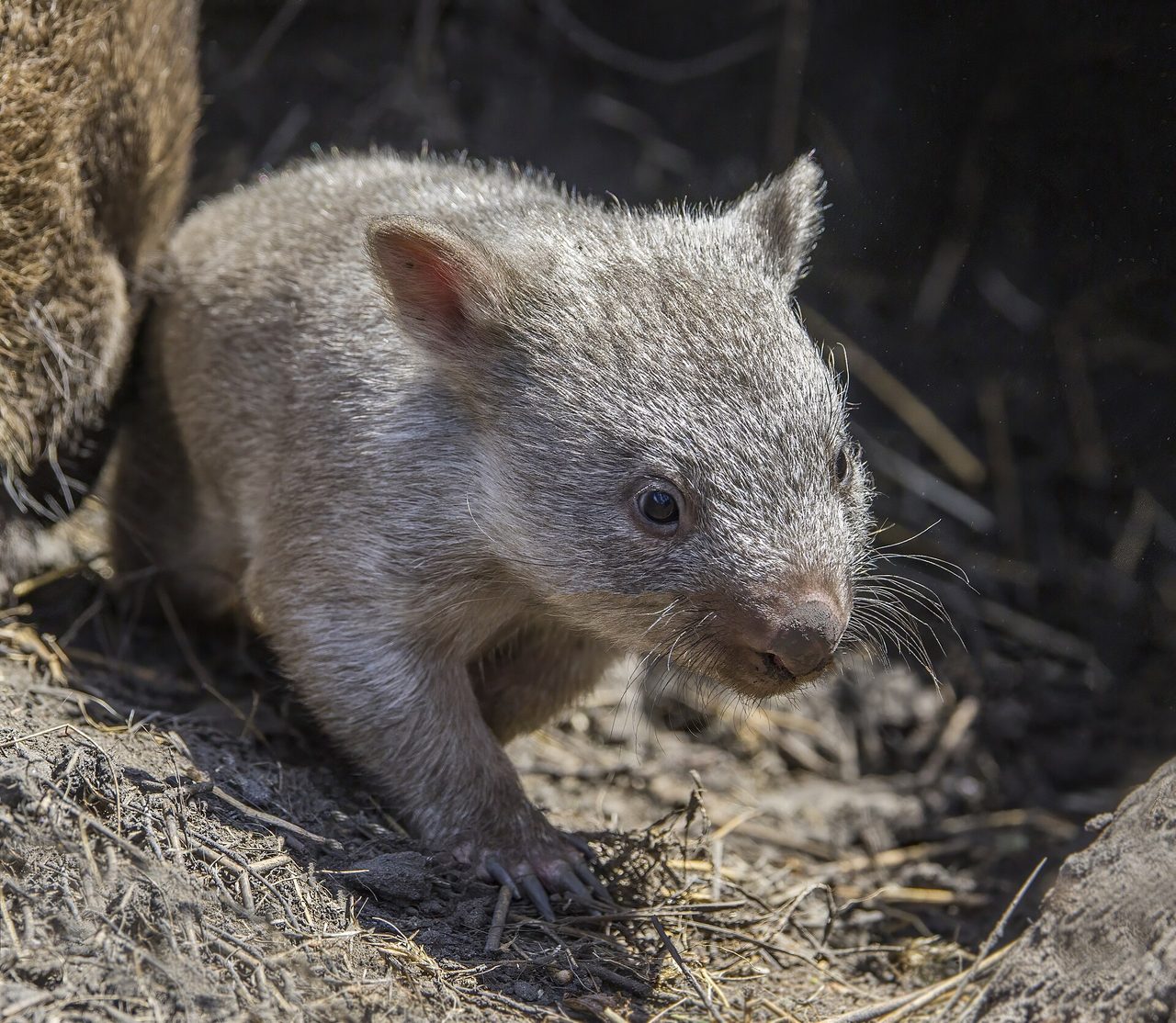
Photo: Charles J. Sharp / Wikimedia Commons (CC BY-SA 4.0)
In brief
Wombats are stocky Australian marsupials in the family Vombatidae; the common wombat is Least Concern on the IUCN Red List, while the northern hairy-nosed wombat is Critically Endangered with fewer than 400 individuals surviving in Queensland.
Also in Animals A to Z · Animals that start with W
By WARN Research & Conservation TeamLast updated
Wombats are barrel-bodied marsupials found only in Australia and Tasmania, instantly recognisable by their low-slung silhouette, powerful digging claws, and famously cube-shaped droppings. Three species make up the family Vombatidae: the common wombat (Vombatus ursinus), the southern hairy-nosed wombat (Lasiorhinus latifrons), and the critically endangered northern hairy-nosed wombat (Lasiorhinus krefftii). Adults typically weigh 20–35 kg and measure around one metre in length, with a stubby tail almost invisible beneath thick fur. Despite their rounded, placid appearance, wombats can sprint up to 40 km/h in short bursts and defend themselves with a cartilage-reinforced rump that doubles as a burrow plug. Nocturnal and largely solitary, they are also exceptional ecosystem engineers whose burrow networks sustain entire communities of other wildlife.
~40 km/h
Top sprint speed
Up to 100
Cubic scats per day
8–14 days
Digestion time
<400
Northern hairy-nosed wombats remaining
Figures sourced from IUCN Red List — Vombatus ursinus (Common Wombat), IUCN Red List — Lasiorhinus latifrons (Southern Hairy-nosed Wombat), CITES — Vombatidae taxonomy and listings and other references on this page.
Wombat: Quick Facts
| Type | Marsupial mammal |
|---|---|
| Weight | 20–35 kg (44–77 lb) |
| Length | ~100 cm (about 1 metre) |
| Lifespan (wild) | Up to 15 years |
| Lifespan (captivity) | Up to 34 years recorded |
| Diet | Herbivore — grasses, sedges, roots, bark |
| Gestation | ~20–30 days; joey develops in pouch 6–7 months |
| Pouch orientation | Backward-facing (keeps dirt out while digging) |
| Top speed | ~40 km/h (25 mph) in bursts |
| Habitat | Forests, heathlands, grasslands, semi-arid scrubland |
| Range | Australia (endemic); Tasmania |
| Active period | Predominantly nocturnal |
Scientific Classification
| Kingdom | Animalia |
|---|---|
| Phylum | Chordata |
| Class | Mammalia |
| Infraclass | Marsupialia |
| Order | Diprotodontia |
| Family | Vombatidae |
| Genera | Vombatus, Lasiorhinus |
| Species | V. ursinus, L. latifrons, L. krefftii |
Conservation Status
- IUCN Status
- Varies: Least Concern (common wombat); Critically Endangered (northern hairy-nosed wombat)
- Population
- Common wombat: hundreds of thousands (V. u. tasmaniensis ~840,000 in Tasmania alone, 2023); Northern hairy-nosed wombat: ~400 individuals (June 2024)
- Trend
- Common wombat: stable to declining in some regions; Northern hairy-nosed wombat: increasing due to intensive management
- Assessed
- Common wombat: 2024 (IUCN); Northern hairy-nosed wombat: 2015 (IUCN)
- CITES
- Lasiorhinus krefftii (northern hairy-nosed wombat) is listed on CITES Appendix I. Common wombat and southern hairy-nosed wombat are not CITES-listed.
The northern hairy-nosed wombat rebounded from approximately 35 individuals in the 1980s to over 400 by mid-2024, almost entirely due to a predator-proof fence at Epping Forest National Park and active translocation to additional sites in Queensland.
Did you know?
Wombats are the only animals in the world known to produce cubic faeces — and they can produce up to 100 cubic pellets in a single day, stacking them on rocks and logs like tiny brown building blocks to mark their territory.
Key Facts: Wombat
- Wombats are the only animals known to produce cube-shaped faeces, a trait caused by uneven elasticity in the walls of the large intestine.
- The northern hairy-nosed wombat is one of the rarest land mammals on Earth, with the entire wild population restricted to a handful of sites in Queensland.
- Wombat burrows act as firebreaks and refuges; post-megafire research published in the Journal of Mammalogy (2024) found they are hotspots for small vertebrate survival.
- All three wombat species are endemic to Australia — they occur nowhere else on Earth.
- Sarcoptic mange, spread by foxes and domestic dogs, can kill entire wombat colonies and is among the most severe health threats the animals face.
- The northern hairy-nosed wombat has rebounded from roughly 35 individuals in the 1980s to over 400 by mid-2024, thanks to predator-proof fencing and active management.
What is a wombat?
Wombats are large, herbivorous marsupials belonging to the family Vombatidae, one of only a handful of marsupial families found exclusively in Australia. Three living species are recognised: the common or bare-nosed wombat (Vombatus ursinus), the southern hairy-nosed wombat (Lasiorhinus latifrons), and the northern hairy-nosed wombat (Lasiorhinus krefftii). All share a stocky, muscular body plan optimised for digging — short, powerful limbs armed with long flat claws, a broad head with ever-growing rodent-like incisors, and a rump reinforced with four fused bony plates surrounded by cartilage. This cartilaginous rump has remarkably few nerve endings, allowing a wombat to block its burrow entrance and absorb bites or scratches from pursuing predators with little pain. Wombats are classified within the order Diprotodontia alongside kangaroos and koalas, and their closest living relative is the arboreal koala. Despite their chunky appearance, wombats can reach sprint speeds of approximately 40 km/h over short distances, and captive individuals have lived beyond 30 years, with one recorded at 34 years.
Where do wombats live?
Common wombats occupy the cooler, more humid forests, heathlands, and alpine meadows of southeastern Australia and Tasmania, including Flinders Island and the Bass Strait islands. Southern hairy-nosed wombats favour the semi-arid scrublands and grasslands of South Australia and adjacent parts of Western Australia, relying on hard, dry soils ideal for their warrens. The critically endangered northern hairy-nosed wombat is now confined primarily to Epping Forest National Park in central Queensland, with small translocated populations at Richard Underwood Nature Refuge and the newly established Powrunna State Forest site in Queensland, giving the species three known populations for the first time in recorded history. All three species are profoundly terrestrial and burrowing; a single wombat can excavate up to 3 feet of soil in one night using its powerful forelimbs. Burrows reach several metres underground, maintaining stable temperatures and humidity, and are used across generations. Their range has contracted significantly since European settlement, with the common wombat absent from much of its historical extent across southeastern mainland Australia due to habitat clearing and persecution.
What do wombats eat and how do they digest food?
Wombats are strict herbivores, feeding primarily on native grasses, sedges, roots, bark, and herbs. Adults consume roughly 0.9 kg of vegetation per night during their nocturnal foraging bouts. One of their most extraordinary biological traits is an exceptionally slow metabolic rate: food takes between 8 and 14 days to pass through the digestive tract — among the longest digestion times recorded for any mammal of comparable size. This slow throughput allows wombats to extract maximum nutrients and water from tough, low-quality plant material, making them highly adapted to drought-prone environments. Their unique cubic faeces — of which a wombat may produce up to 100 pellets per day — result from uneven elasticity in the walls of the large intestine, a mechanism described in detail by researchers at Georgia Tech and published in 2021. The cubes stack reliably on rocks and logs rather than rolling away, serving as highly effective territorial scent markers. Southern hairy-nosed wombats in particular can survive extended dry periods without free water by obtaining moisture almost entirely from their food, a critical adaptation in the arid South Australian scrubland where temperatures routinely exceed 35 °C.
Why is the northern hairy-nosed wombat Critically Endangered?
The northern hairy-nosed wombat (Lasiorhinus krefftii) is listed as Critically Endangered on the IUCN Red List (assessed 2015), making it one of the rarest land mammals on the planet. The species was once widespread across much of inland Queensland, New South Wales, and Victoria, but by the 1980s the entire global wild population had been reduced to an estimated 35 individuals at a single location — Epping Forest National Park. The primary drivers of decline were habitat clearing for cattle grazing, competition for grass with livestock and rabbits, and predation by dingoes. A predator-proof fence enclosing the Epping Forest colony, completed in 2000, proved transformative: numbers climbed to around 113 individuals by 2003, approximately 230 by 2015, over 300 by 2021, and above 400 by June 2024 — a remarkable 40-year recovery story. Critically, around 95 percent of the global population still exists at a single site, meaning any localised catastrophe — disease outbreak, extreme drought, or wildfire — could be catastrophic. The IUCN criteria that triggered the Critically Endangered listing remain relevant: extreme small population size and extreme restriction of range, with fewer than 50 breeding females recorded historically. Active monitoring, genetic management, and further translocations to new sites are the conservation priorities.
How do wombat burrows benefit other Australian wildlife?
Wombats are widely described as ecosystem engineers — species whose physical activities substantially modify habitats in ways that benefit many other organisms. By excavating extensive, multi-entrance burrow systems up to 30 metres long and two metres deep, wombats aerate soil, increase water infiltration after rainfall, cycle nutrients, and disperse fungal spores. Their diggings also create critical microhabitats: lizards, frogs, small mammals, invertebrates, and even echidnas regularly shelter in wombat burrows. A 2024 study published in the Journal of Mammalogy examined wombat burrows in landscapes scorched by the Black Summer megafires of 2019–2020 and found that burrows functioned as refuge hotspots for small vertebrates, supporting significantly higher species diversity than surrounding fire-affected ground. Wombat dung, rich in nitrogen and phosphorus, fertilises soils and promotes new plant growth. Their grazing behaviour also shapes grassland structure. As Australia faces more frequent and intense bushfire seasons linked to climate change, the ecological value of wombat burrows as refugia for other threatened species is increasingly documented. Losing wombats from a landscape therefore carries cascading consequences that extend far beyond the animals themselves, affecting biodiversity, soil health, and post-fire ecosystem recovery across the Australian continent.
What WARN Does
WARN does not currently run field projects for wombats, as WARN's active rescue and conservation partnerships are focused in its partner-network countries. This guide is offered as free educational content because understanding iconic species like wombats — and the science of ecosystem engineering and marsupial conservation — strengthens the global culture of wildlife protection that benefits animals everywhere.
The forces driving wildlife loss — habitat clearing, invasive predators, disease, and climate-driven drought — threaten animals across every continent, not just Australia. Supporting WARN helps fund the ground-level rescue and habitat protection work that keeps vulnerable species from crossing the line into extinction.
Wombat: Frequently Asked Questions
Are wombats dangerous to humans?
Why do wombats produce cube-shaped poo?
How long do wombats live?
What is sarcoptic mange and how does it affect wombats?
How many wombat species are there?
Can wombats run fast?
What do wombats eat?
Where do wombats live?
How big is a wombat?
Sources & References
Population figures, conservation status and biological facts on this page are drawn from authoritative scientific and intergovernmental sources.
- IUCN Red List — Vombatus ursinus (Common Wombat)
- IUCN Red List — Lasiorhinus latifrons (Southern Hairy-nosed Wombat)
- CITES — Vombatidae taxonomy and listings
- Animal Diversity Web — Vombatus ursinus
- Animal Diversity Web — Lasiorhinus krefftii
- Smithsonian Magazine — How wombats produce cubic faeces
- Journal of Mammalogy — Wombat burrows as post-gigafire hotspots (2024)
- WWF Australia — Wombat species guide
- Queensland Government — Northern hairy-nosed wombat conservation
- San Diego Zoo Wildlife Alliance Library — Wombats Fact Sheet
Terms used on this page
Plain-English definitions, from our wildlife and conservation glossary.
Latest Wombat Stories
Quick, fact-checked reads on the wombat — amazing facts, key questions and the threats it faces.
Explore more animals
Discover more animals, their habitats and their conservation status in the WARN wildlife-guide library.