Wildlife Guide · Europe & Asia
Woodpecker
Picidae
The forest's carpenters: built to hammer, climb and probe.
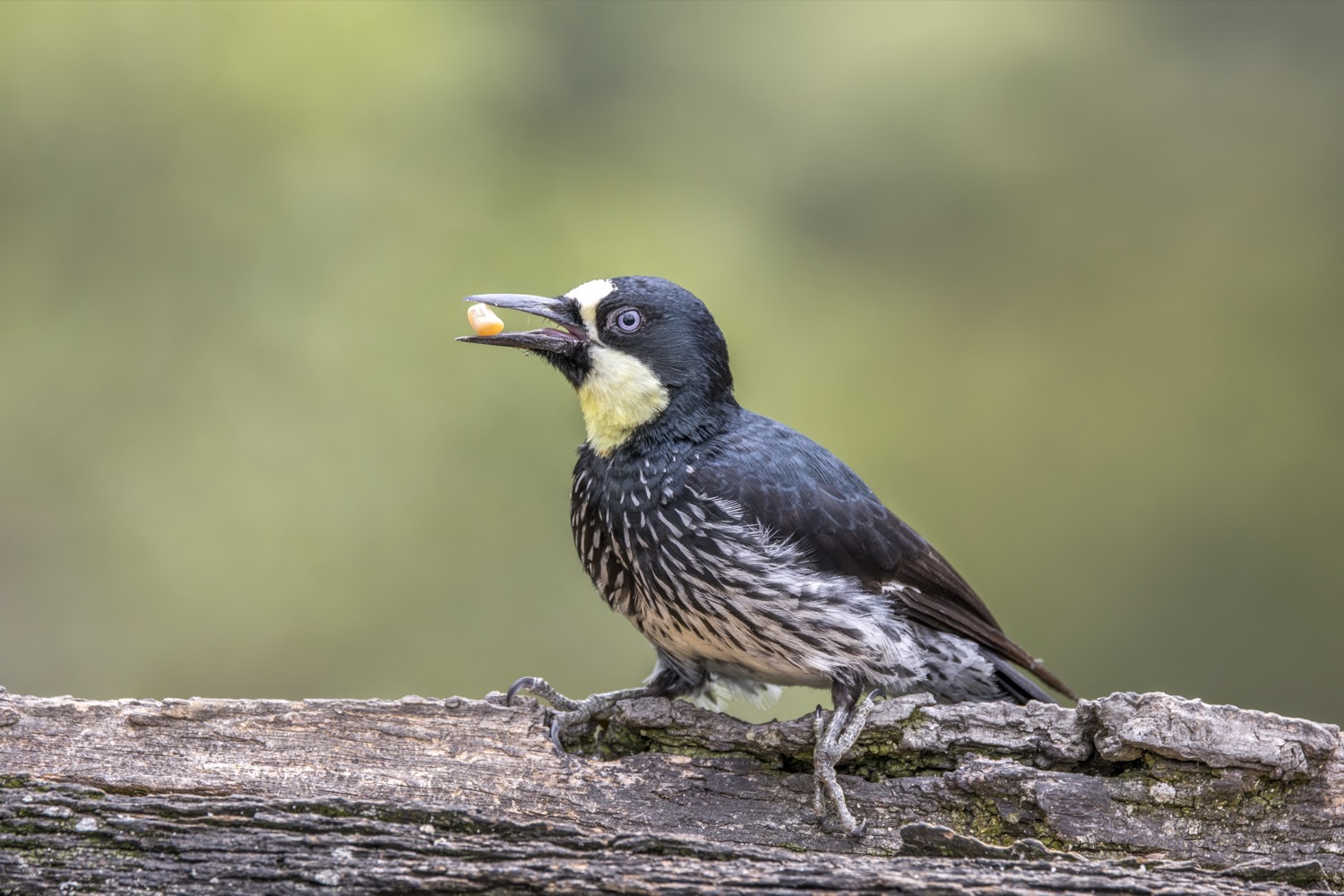
Source: Wikimedia Commons — “Acorn woodpecker (Melanerpes formicivorus flavigula) female Las Tangaras” by Charles J. Sharp, CC BY-SA 4.0
In brief
A woodpecker is a tree-climbing bird of the family Picidae, with around 240 species worldwide. It uses a chisel-like bill to drum and excavate wood, aided by a shock-absorbing skull, gripping zygodactyl feet, a stiff propping tail and a long, barbed tongue for extracting insects.
Also in Animals A to Z · Animals that start with W
By WARN Research & Conservation TeamLast updated
Woodpeckers are tree-climbing birds of the family Picidae, found across most of the world's forests and woodlands. Roughly 240 species share a remarkable toolkit: a chisel-like bill, a shock-absorbing skull, gripping zygodactyl feet, a stiffened propping tail and an extraordinarily long, barbed tongue for extracting insects from wood. Their rhythmic drumming and excavating shape woodlands, creating nest holes later used by many other animals. Most woodpeckers are common and classified as Least Concern, but a handful tied to old-growth forest are Endangered or feared extinct. This guide explains what makes a woodpecker, how it survives repeated head-hammering, and why these birds matter for healthy forests.
~240
Species in family Picidae
Up to ~20x/sec
Pecking strikes during drumming
7.5-55 cm
Length range, piculet to great slaty
5 continents
Found nearly worldwide except a few regions
Figures sourced from Woodpecker - Wikipedia, Woodpecker - Encyclopaedia Britannica, IUCN Red List and other references on this page.
Woodpecker: Quick Facts
| Common name | Woodpecker |
|---|---|
| Family | Picidae |
| Order | Piciformes |
| Number of species | About 240 |
| Size range | ~7.5 cm (piculets) to 45-55 cm (great slaty woodpecker) |
| Diet | Mainly insects and larvae; also fruit, nuts, seeds and sap |
| Distribution | Most of the world except Australasia, Madagascar and polar regions |
| Key adaptations | Chisel bill, shock-absorbing skull, zygodactyl feet, stiff tail, long barbed tongue |
| Behaviour | Drumming and excavating wood; cavity-nesting |
| Conservation | Most Least Concern; some old-growth species threatened or likely extinct |
Scientific Classification
| Kingdom | Animalia |
|---|---|
| Phylum | Chordata |
| Class | Aves |
| Order | Piciformes |
| Family | Picidae |
| Subfamilies | Jynginae, Picumninae, Sasiinae, Picinae |
| Species | ~240 in ~35 genera |
Conservation Status
- IUCN Status
- Varies by species. As a family, woodpeckers are not threatened: most of the roughly 240 species are assessed by the IUCN as Least Concern. A minority tied to mature or old-growth forest are Vulnerable, Endangered or Critically Endangered. The ivory-billed and imperial woodpeckers are Critically Endangered and possibly extinct, and the Bermuda flicker is extinct.
- Population
- No single figure; varies enormously by species, from abundant and widespread to a handful of individuals or none for the rarest forms.
- Trend
- Stable or increasing for many common species; declining for forest specialists affected by habitat loss.
- Assessed
- Assessed per species by the IUCN Red List (ongoing).
- CITES
- Most species are not listed on CITES; certain rare woodpeckers may receive national or regional legal protection.
Loss of mature trees and standing deadwood is the chief threat to vulnerable woodpeckers. Retaining old trees and dead timber in managed forests is a key conservation measure.
Key Facts: Woodpecker
- Woodpeckers form the family Picidae, with about 240 species spread across most of the world's wooded regions.
- Their skull combines spongy bone and a wraparound hyoid apparatus that helps cushion repeated high-impact pecking.
- Zygodactyl feet (two toes forward, two back) and stiff tail feathers let them climb and brace on vertical trunks.
- A long, often barbed and sticky tongue probes deep into wood and bark to extract insects and larvae.
- Drumming on resonant surfaces is non-vocal communication used to defend territory and attract mates.
- Most species are Least Concern, but old-growth specialists such as the ivory-billed woodpecker are critically threatened or likely extinct.
What makes a bird a woodpecker?
Woodpeckers belong to the family Picidae, which also includes the closely related piculets and wrynecks. The family contains roughly 240 species in about 35 genera, and is absent only from a few areas such as Australia, New Guinea, New Zealand, Madagascar and the extreme polar regions. What unites them is a suite of adaptations for life on tree trunks. Most have a strong, straight, chisel-tipped bill for excavating wood, and feet that are typically zygodactyl, with two toes pointing forward and two back to grip bark securely; a few species have only three toes. Stiffened, pointed tail feathers act as a prop, forming a stable tripod with the feet against a vertical surface. Inside the skull, an extraordinarily long hyoid apparatus supports a tongue that can extend far beyond the bill tip, often barbed and coated in sticky saliva. Sizes range widely, from tiny piculets around 7.5 cm long to the great slaty woodpecker, which can reach 45-55 cm. Many species show bold black-and-white patterning with patches of red or yellow.
How do woodpeckers survive constant head-banging?
Repeatedly striking wood at speed would concuss most animals, so woodpeckers rely on several structural features. The skull contains spongy, plate-like bone, concentrated at the forehead and the back of the head, which helps distribute and absorb impact forces. The hyoid bone, which anchors the tongue, loops up and around the back of the skull, and is thought to act partly as a restraint and cushion for the braincase. The brain itself is small and packed tightly within the skull, and the bird tends to strike in near-straight lines to limit twisting forces. Strong neck muscles drive and control each blow. Researchers continue to study exactly how these features combine, and recent work suggests the head behaves more like a stiff hammer than a shock absorber, with the small brain tolerating the brief decelerations involved. Specialised nasal feathers and a protective membrane that can cover the eye during impact help keep out flying debris. Together these adaptations let a woodpecker hammer many times each second without obvious harm.
Why do woodpeckers matter for forests?
Woodpeckers are widely described as ecosystem engineers. By excavating nest and roost cavities in dead and living wood, they create holes that many other species cannot make for themselves. Once a woodpecker moves on, its old cavities are reused by owls, other birds, bats, small mammals and insects, so a single pair can support a wider web of woodland life. Their constant foraging also helps regulate populations of wood-boring beetles and other insects, including some that damage trees. Because many woodpeckers depend on mature trees, standing deadwood (snags) and continuous forest, they are sensitive indicators of woodland health: where large old trees and decaying timber are removed, woodpeckers decline. This is why old-growth specialists are among the most threatened members of the family. Conserving the messy, deadwood-rich forests that woodpeckers need therefore benefits countless other species, from fungi and insects to the birds and mammals that shelter in abandoned woodpecker holes.
What WARN Does
World Animal Rescue Network does not run field projects specifically for woodpeckers, which live mainly outside the countries where WARN's partners work. This guide is part of WARN's free educational programme, helping people understand and value wildlife. The threats that endanger rarer woodpeckers, above all the loss of mature forest and deadwood, are the same pressures of habitat destruction that harm many of the animals WARN does directly protect.
If learning about these forest carpenters brightened your day, a small gift helps keep WARN's free wildlife education and its hands-on animal rescue work going.
Woodpecker: Frequently Asked Questions
How fast and how often do woodpeckers peck?
Why do woodpeckers peck wood at all?
Do woodpeckers get headaches or brain damage?
Where do woodpeckers live?
What do woodpeckers eat?
Are woodpeckers endangered?
Sources & References
Population figures, conservation status and biological facts on this page are drawn from authoritative scientific and intergovernmental sources.
Terms used on this page
Plain-English definitions, from our wildlife and conservation glossary.
Latest Woodpecker Stories
Quick, fact-checked reads on the woodpecker — amazing facts, key questions and the threats it faces.
Species
Slow Loris: Why the Internet's Favourite Pet Is a Conservation Disaster
The slow loris looks like a cartoon character — and that has nearly destroyed the species. Here is the truth behind the viral videos.
Read the storySpecies
The Snow Leopard: Why the Ghost of the Mountains Is Still Vulnerable
The snow leopard is one of the most elusive big cats on earth, with an estimated 4,000-6,500 individuals across twelve range states — including Pakistan, where WARN is preparing to operate. This briefing explains why the species was downlisted from Endangered to Vulnerable in 2017 and why that is not the success story it sounds like.
Read the storyGuides
Sun Bear vs Moon Bear: The Two Most Trafficked Asian Bears
The sun bear and the Asiatic black bear (moon bear) are the two most commonly trafficked bears in Asia — for the pet trade, for traditional medicine and for bear-bile farming. Here is how to tell them apart.
Read the storyExplore more animals
Discover more animals, their habitats and their conservation status in the WARN wildlife-guide library.