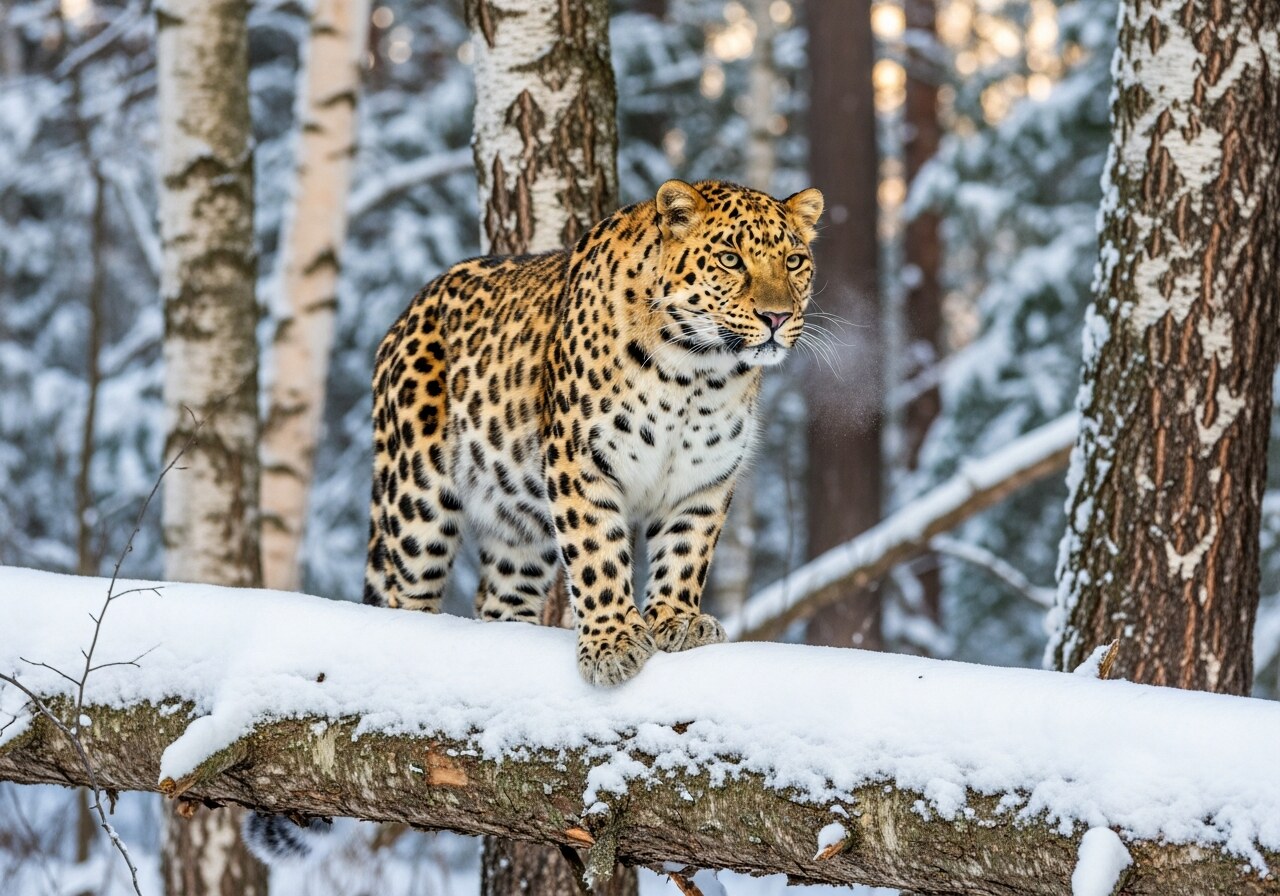
The Amur leopard (Panthera pardus orientalis) is the rarest big cat in the world. Fewer than 130 are estimated to remain in the wild, almost all of them in a single protected area in the Russian Far East and a small adjacent population in northeast China. It is one of the most striking and most quietly hopeful stories in modern wildlife conservation.
WARN is preparing to operate in ten countries — Indonesia, Malaysia, Vietnam, Thailand, Cambodia, Pakistan, Colombia, Peru, Kenya and Tanzania. Russia and China are not on that list, and we do not currently fund work on Amur leopards. We are writing this briefing for two honest reasons: because the species is one of the most-searched endangered animals on the internet and we want our supporters to find accurate information when they look it up, and because the same threats that almost wiped the Amur leopard out — poaching, snaring, habitat loss — are exactly the threats our appeals in Cambodia, Kenya and Tanzania are designed to fight.
What the Amur leopard actually is
The Amur leopard is one of nine recognised subspecies of leopard (Panthera pardus). It evolved in the temperate broadleaf-and-conifer forests of the Russian Far East and is the only leopard subspecies adapted to live in deep winter snow. Compared with African and Indian leopards, it has:
- A pale cream-gold coat that turns thicker and almost silvery in winter.
- Widely-spaced, large dark rosettes — distinctive enough that individual cats can be identified from camera-trap photos.
- Longer legs for moving through snow.
- A heavier coat and a layer of body fat that lets it survive temperatures below -30°C.
Adults typically weigh 30-50 kg, with males larger than females. They are solitary, mostly nocturnal, and territorial — a male's range can cover 250-500 km² of forest.
Where it lives
Today the entire global wild population is concentrated in a single region: the Land of the Leopard National Park and surrounding protected areas in Primorsky Krai, Russia, with a small population spilling across the border into Jilin and Heilongjiang provinces in northeast China. This is a tiny range for a big cat — less than 5,000 km² of effective habitat. The Korean peninsula population, which historically connected the Russian and Chinese populations, is functionally gone.
Why the Amur leopard is Critically Endangered
The IUCN lists the Amur leopard as Critically Endangered. The drivers are well documented:
- Poaching. Amur leopards are killed for their spotted coats — one of the most desirable furs in the illegal trade — and for body parts used in some traditional medicine markets.
- Snaring. Wire snares set for deer (the leopard's main prey) and wild boar regularly catch leopards as bycatch. This is the same threat WARN is funding work against in Cambodia and Kenya.
- Prey depletion. Subsistence and commercial hunting of sika deer, roe deer and wild boar reduces the leopard's food base.
- Habitat loss. Logging, road construction and fires fragment the leopard's remaining range.
- Inbreeding. A wild population of around 130 animals is genetically tiny. Inbreeding depression — reduced cub survival, immune-system problems — is a real and measurable risk.
The hopeful part: the Amur leopard population is recovering
This is the part of the story that gets less coverage than it deserves. In the 1990s, formal surveys put the entire wild Amur leopard population at roughly 30 individuals. By the early 2010s, the number had climbed past 50. The most recent multi-year camera-trap surveys put the figure at around 100-130 wild individuals. The population has more than tripled in roughly two decades.
What changed:
- The Land of the Leopard National Park was established in 2012, consolidating several smaller protected areas.
- Anti-poaching ranger patrols were significantly expanded.
- Snare removal across the core range became a routine, year-round operation.
- Prey populations rebounded as deer and boar hunting was restricted inside the park.
- Cross-border cooperation with China protected key corridors.
None of this means the species is safe. A population of around 130 animals is still one disease outbreak, one major fire or one bad winter away from a serious setback. But the trajectory is a real, measurable success — and it is the strongest evidence we have that endangered big cat populations can recover when the right work is funded for long enough.
How this connects to WARN's work
WARN does not fund Amur leopard work. We do, however, fund frontline work against the same threats in our ten countries:
- Snare removal — our Elephant Appeal supports ranger patrols in Kenya and Tanzania that remove wire snares from protected areas, the same intervention that helped save the Amur leopard.
- Big cat rescue — our Tiger appeal supports rescue and rehabilitation for Sumatran, Malayan and Indochinese tigers and rescued circus tigers in Southeast Asia.
- Sanctuary care — partner sanctuaries that take in confiscated big cats need long-term funding for veterinary care, enrichment and species-appropriate enclosures.
How you can help
If you want to support Amur leopard work specifically, there are well-established organisations operating in Russia and northeast China that do exactly that — and we encourage you to back them. If you want to support the same kind of work for the big cats in WARN's ten working countries, a donation to WARN goes directly towards getting frontline animal rescue and animal sanctuary capacity on the ground.
Sources
- IUCN Red List — Amur leopard (Panthera pardus orientalis) assessment.
- CITES — Appendix I listing for Panthera pardus.
- Land of the Leopard National Park — published camera-trap survey results.
- UNODC — World Wildlife Crime Report, big cat trafficking chapters.
We need your support to make this happen
World Animal Rescue Network is at the launch stage of this work. We do not yet have rescue numbers to share — and that is exactly why your support matters now. Every donation helps us put trained teams on the ground, secure veterinary supplies and equipment, and reach the first animals before they are lost.
Donate today to fund our first deployments, or sponsor an animal to back a specific species through rehabilitation. You can also join the network as a volunteer, fundraiser, or monthly supporter.