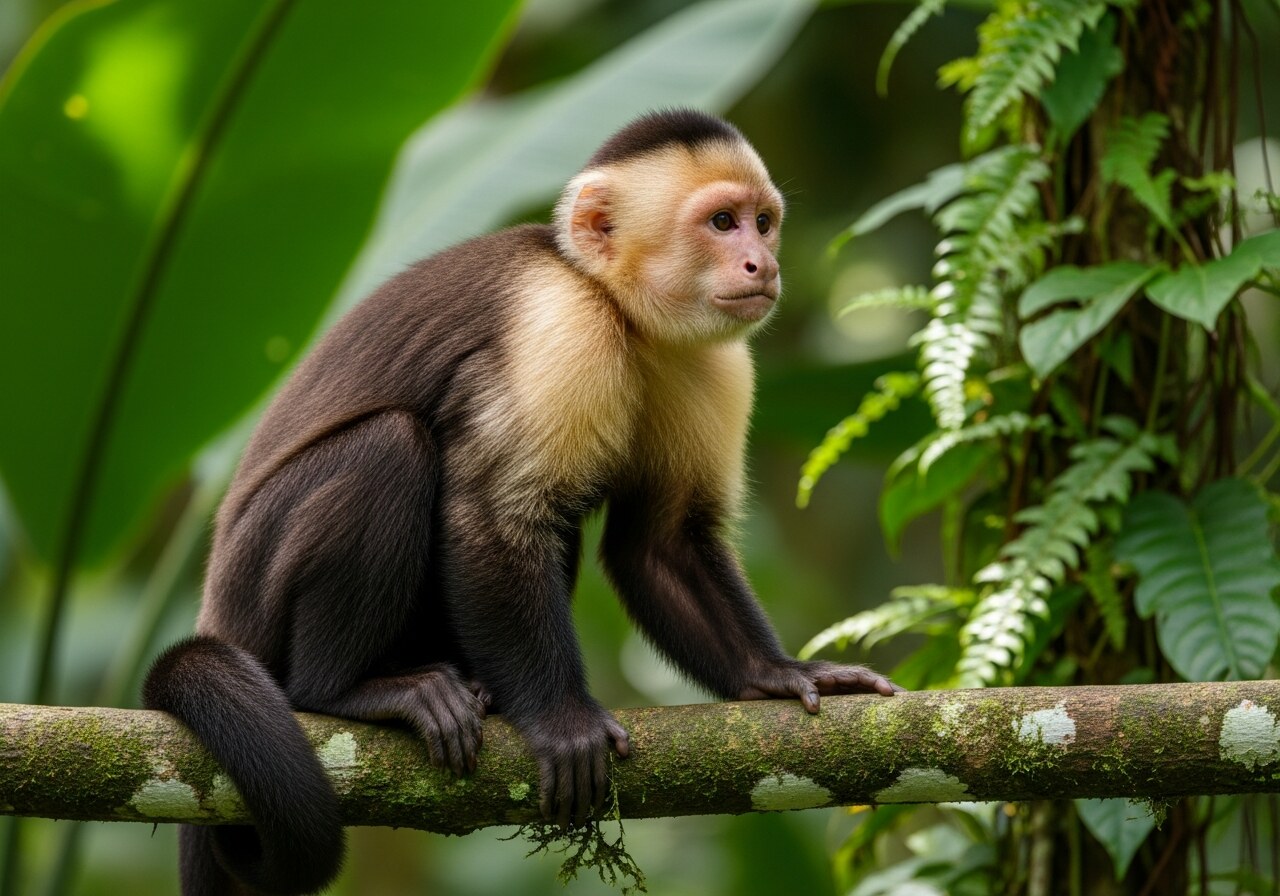
Capuchin monkeys are small, highly intelligent primates native to the forests of Central and South America. They are some of the most familiar monkeys to anyone who has seen wildlife footage from the Amazon, and they are also among the most commonly trafficked. WARN is preparing to operate in Colombia and Peru — two countries that hold significant capuchin populations and that handle a large share of South America's confiscated-primate caseload. This briefing explains what the species are, why they are in trouble, and where frontline rescue and sanctuary work fits in.
What capuchin monkeys actually are
"Capuchin" is a common name covering two related genera of New World monkeys:
- Cebus — the "gracile" or untufted capuchins, including white-faced (white-fronted) capuchins. They are slimmer, with cream-coloured faces and dark caps.
- Sapajus — the "robust" or tufted capuchins, including the bearded capuchin and the black-striped capuchin. They have heavier builds and characteristic tufts of hair on top of the head.
Adult capuchins typically weigh 1.5-4 kg, with a body length of 30-55 cm and a long, semi-prehensile tail roughly equal in length to the body. They are highly social, living in troops of 10-35 individuals led by an alpha pair, and they are active during the day in the middle and upper levels of the forest canopy.
Why capuchins are remarkable
Capuchins have repeatedly surprised scientists with what they can do. Wild bearded capuchins in South America have been documented using stones as hammers and anvils to crack open hard-shelled nuts — a feat of tool use comparable to anything seen outside the great apes. They have also been observed using sticks to extract insects, applying medicinal plants to their fur, and showing complex social behaviours including food sharing, alliance formation and what researchers describe as a fairness response. Their brain-to-body ratio is one of the highest among non-ape primates.
Where they live in WARN countries
Colombia and Peru together hold multiple capuchin species:
- Colombian white-faced capuchin (Cebus capucinus) — Colombia.
- Ecuadorian (Colombian) white-fronted capuchin (Cebus aequatorialis) — Critically Endangered, very limited range.
- Guianan weeper capuchin (Cebus olivaceus) — northern Amazonia.
- Large-headed capuchin / Peruvian black capuchin (Sapajus macrocephalus) — Peruvian and Colombian Amazon.
- Brown / tufted capuchin (Sapajus apella) — widespread across the Amazon basin.
Other capuchin species range across Brazil, Ecuador, Venezuela and the Guianas, with the highly threatened Cebus aequatorialis being one of the most endangered primates in the Americas.
Why capuchin monkeys are in trouble
The illegal pet trade
Capuchins are one of the most commonly trafficked primates in South America. They are small, intelligent and appear "cute" to buyers — a deadly combination from the animals' perspective. The trade works like this: hunters shoot adult females in the forest canopy, and the orphaned infants — often clinging to their dying mothers — are taken to be sold. For every infant capuchin that reaches a market alive, multiple adults are dead. UNODC's World Wildlife Crime Report documents the South American primate trade as one of the largest illegal wildlife flows on the continent.
Once taken, captive capuchins suffer enormously. They are social animals who need their troop. Isolated as pets, they develop severe stereotypic behaviours, aggression and chronic stress. Most pet capuchins are abandoned, surrendered or confiscated within a few years — and that is where rescue centres pick up the caseload.
Habitat loss
Capuchins are canopy specialists. Deforestation in the Amazon and Andean foothills — driven by cattle, mining and small-scale agriculture — removes the forest connectivity they need to maintain breeding populations.
Conflict with farmers
Where forest is fragmented, capuchin troops sometimes raid crops, and farmers respond with shooting and trapping. This is a classic human-wildlife conflict where the long-term solution is habitat restoration and conflict mitigation, not lethal control.
What animal rescue work for capuchins looks like
- Triage. Confiscated infant capuchins arrive at rescue centres dehydrated, malnourished and often suffering from human-transmitted diseases (capuchins are vulnerable to influenza, herpes and tuberculosis from human contact).
- Long rehabilitation. Rehab is measured in years, not months. Orphans need to be raised, socialised with other capuchins, taught to forage and reintegrated into a functional troop before any release can be considered.
- Soft release where possible. Where viable habitat exists, rehabilitated troops can be soft-released back to the forest. Where it does not, sanctuary care for life is the alternative.
- Sanctuary capacity. A significant fraction of confiscated capuchins cannot be released and need lifetime sanctuary placement in species-appropriate enclosures with companionship.
Where WARN fits in
World Animal Rescue Network is preparing to back partner rescue centres in Colombia and Peru that handle the full primate caseload — capuchins, spider monkeys, woolly monkeys, tamarins and titi monkeys among them. Veterinary care, enrichment, enclosure expansion and soft-release programmes all cost money, and rescue centres in source countries are chronically underfunded. We are a launch-stage charity, so this work depends on supporter funding to begin.
If this briefing has changed how you think about the South American pet trade, the most useful thing you can do is back our launch with a donation. Every gift goes towards getting animal rescue and animal sanctuary capacity on the ground in the countries where capuchins and other trafficked primates need it most.
Sources
- IUCN Red List — assessments for Cebus and Sapajus species discussed.
- CITES — Appendix I and II listings.
- UNODC — World Wildlife Crime Report, primate trafficking chapters.
- WOAH — zoonotic disease risk from human-primate contact.
We need your support to make this happen
World Animal Rescue Network is at the launch stage of this work. We do not yet have rescue numbers to share — and that is exactly why your support matters now. Every donation helps us put trained teams on the ground, secure veterinary supplies and equipment, and reach the first animals before they are lost.
Donate today to fund our first deployments, or sponsor an animal to back a specific species through rehabilitation. You can also join the network as a volunteer, fundraiser, or monthly supporter.