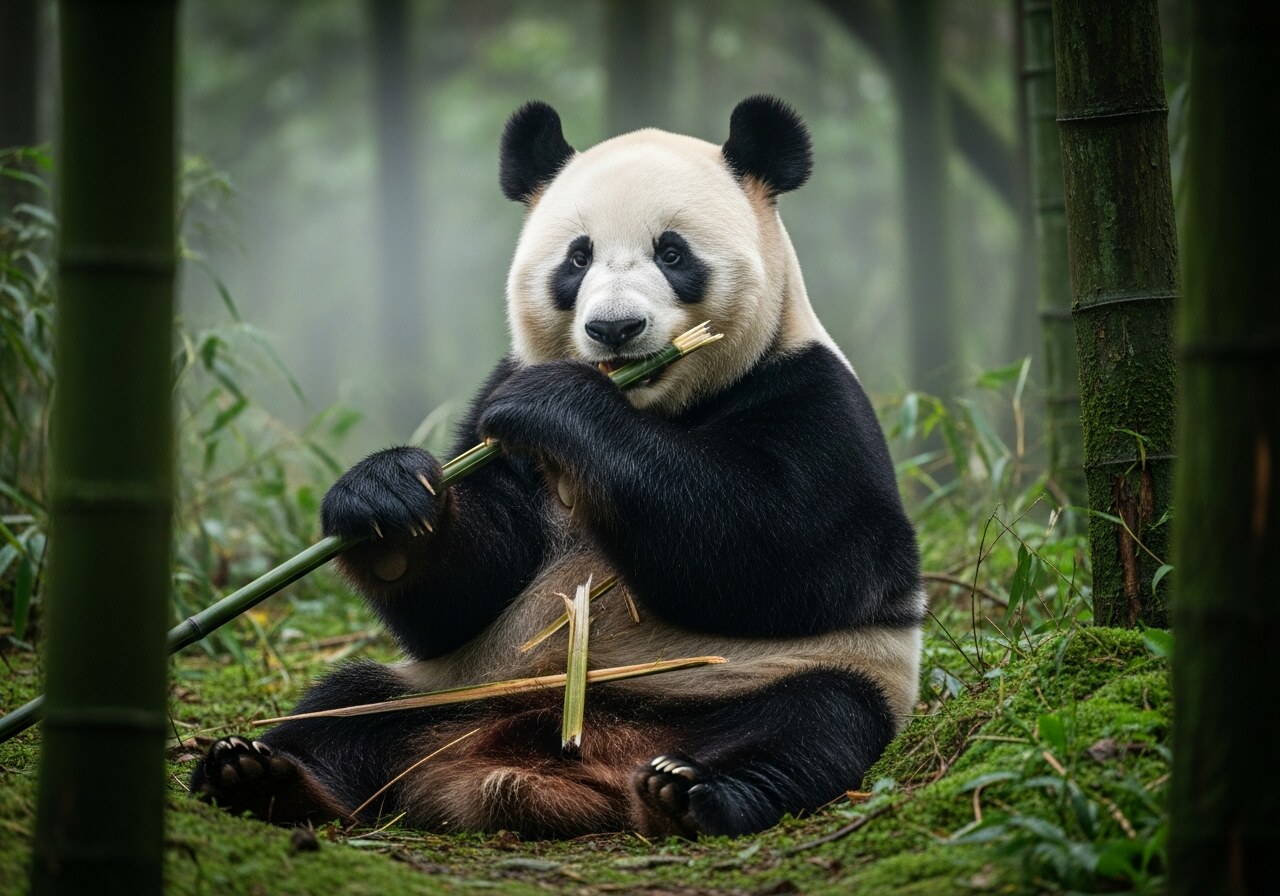
The giant panda (Ailuropoda melanoleuca) is one of the most recognisable animals on Earth and one of the clearest examples of what long-term endangered-species work can achieve. It is also one of the most-searched wildlife topics on the internet — and one of the most misunderstood. This briefing summarises what the giant panda is, what its conservation status actually means, and what its recovery story tells us about the kind of work WARN funds elsewhere in the world.
WARN is preparing to operate in ten countries: Indonesia, Malaysia, Vietnam, Thailand, Cambodia, Pakistan, Colombia, Peru, Kenya and Tanzania. China is not on that list and we do not currently fund any work on giant pandas. We are publishing this briefing for two honest reasons: because pandas are one of the most-searched endangered species globally and we want our supporters to find accurate information when they look the species up, and because the panda's recovery is the strongest available evidence that the kind of long-term, sustained rescue and habitat protection work we are building WARN to fund actually works.
What the giant panda actually is
The giant panda is a bear — a member of the family Ursidae — and one of only eight bear species in the world. It is most closely related to the spectacled bear of South America (the species WARN's Andean Bear appeal is being built to support). Adults typically weigh 70-125 kg, with males larger than females. The black-and-white coat is unique among bears.
Physiologically, the giant panda is one of the strangest animals on Earth. It still has the short, simple digestive tract of a carnivore — its evolutionary ancestors ate meat. But its diet is roughly 99% bamboo. It compensates for this poor match between gut and diet by eating enormous quantities of bamboo every day (12-38 kg) and spending 10-16 hours a day feeding. To handle the bamboo stalks, pandas have evolved an enlarged wrist bone that functions as a "false thumb", letting them grip stems while they strip the leaves.
Where pandas live
Wild giant pandas are found only in a relatively small area of the temperate broadleaf-and-bamboo forests of central China — primarily in Sichuan province, with smaller populations in Shaanxi and Gansu. The total area of suitable habitat is estimated at roughly 25,000 km². Within that, pandas are concentrated in the higher-elevation bamboo forests between roughly 1,500 and 3,000 metres above sea level.
What "Vulnerable" really means
Giant pandas were formally downlisted from Endangered to Vulnerable on the IUCN Red List in 2016. This is a downgrading of extinction risk, not a removal of it. Vulnerable still means the species faces a high risk of extinction in the wild — it is just one category lower than Endangered. The downlisting happened because successive national surveys in China showed a real, measurable population increase: from roughly 1,100 wild pandas in the late 1970s, to around 1,600 by 2004, to roughly 1,800 by 2014 (the most recent comprehensive national survey).
The downlisting was controversial. Chinese authorities at the time noted that climate change projections for the panda's bamboo habitat were a major concern, and the species' very narrow habitat band makes it vulnerable to any shift in mountain ecology. Most independent biologists agree the recovery is real but fragile.
What made the recovery possible
This is the part of the story that matters most for everyone who works on endangered species elsewhere in the world. The giant panda's recovery was not a single intervention — it was the result of decades of sustained effort across several different fronts:
- Habitat protection. By the time of the 2014 survey, China had established more than 60 panda reserves covering most of the species' remaining range, with a national park unifying many of them in 2021.
- Logging restrictions. A 1998 ban on commercial logging in much of the panda's range removed one of the biggest threats to its bamboo forests.
- Anti-poaching. Pandas have been protected from hunting in China since the 1960s; enforcement has tightened steadily.
- Captive breeding and reintroduction. Captive breeding programmes in China produce cubs that, in some cases, are now successfully reintroduced to the wild — a milestone that took decades to achieve.
- Bamboo corridor restoration. Replanting bamboo to reconnect fragmented panda habitats was one of the slowest-paying but most consequential investments.
What this tells us about saving other endangered species
The single most important takeaway from the giant panda's story is that endangered species recovery takes decades and requires sustained, multi-track work. There is no single intervention that saves a species. The panda recovery worked because habitat protection, anti-poaching, reintroduction and bamboo restoration all happened together, and all were funded for long enough to compound.
The animals WARN is being built to support — orangutans, tigers, pangolins, spectacled bears, elephants, parrots — face the same structural problem. Each of them needs sustained multi-track work for decades, not single-issue campaigns. Our appeals are designed to fund that long arc of work, not headline-driven moments.
How you can help
If you want to support giant panda work specifically, there are well-established Chinese and international organisations that fund it directly, and we encourage you to back them. If you want to support the same kind of long-term, multi-track endangered-species work in the ten countries WARN is preparing to operate in, a donation to WARN goes directly towards funding it.
Sources
- IUCN Red List — giant panda (Ailuropoda melanoleuca) 2016 reassessment.
- CITES — Appendix I listing.
- Published Chinese national panda surveys (1977, 1985, 2004, 2014).
- UN Environment Programme — habitat-corridor reporting for the giant panda range.
We need your support to make this happen
World Animal Rescue Network is at the launch stage of this work. We do not yet have rescue numbers to share — and that is exactly why your support matters now. Every donation helps us put trained teams on the ground, secure veterinary supplies and equipment, and reach the first animals before they are lost.
Donate today to fund our first deployments, or sponsor an animal to back a specific species through rehabilitation. You can also join the network as a volunteer, fundraiser, or monthly supporter.