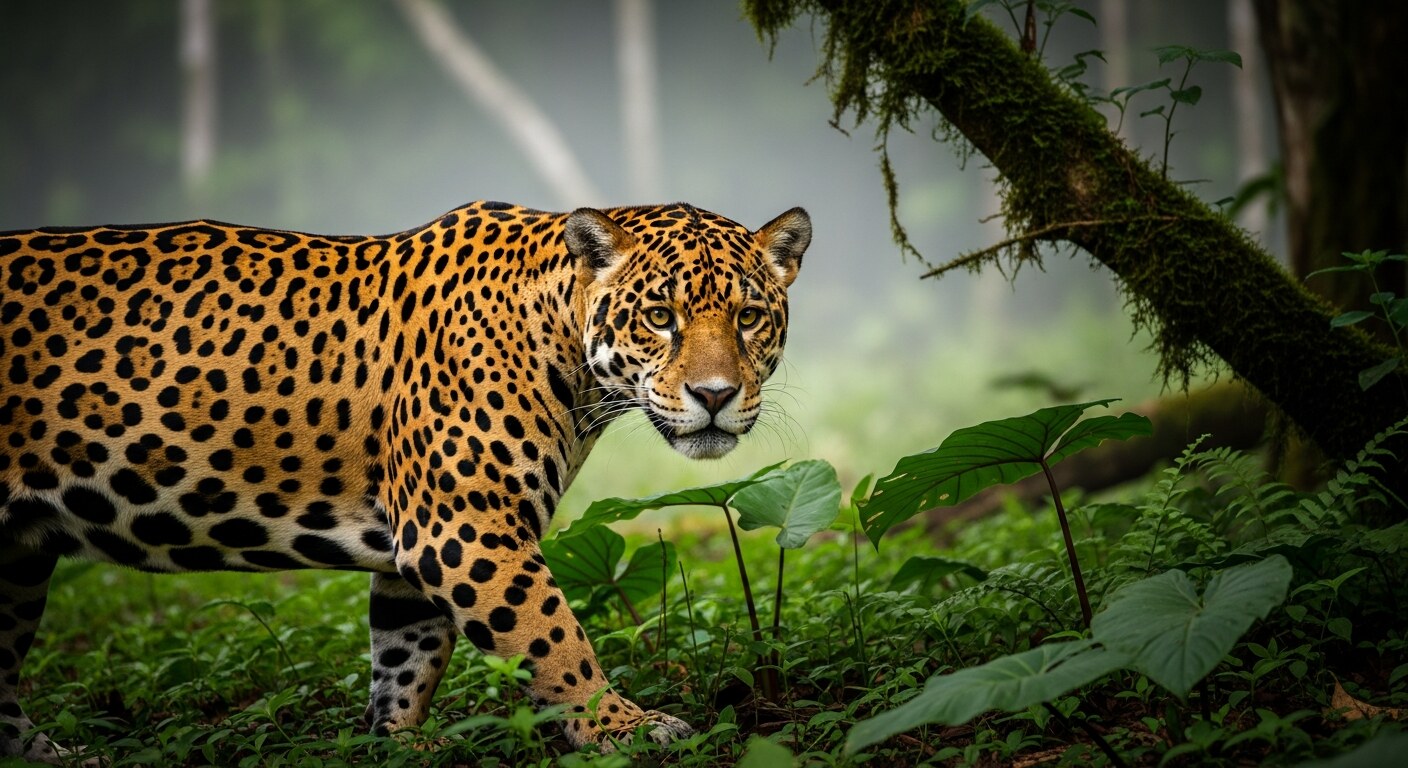
The jaguar (Panthera onca) is the largest big cat in the Americas and one of only two true big cats outside Africa and Asia. It is also, increasingly, a CITES enforcement story. Over the last decade, the UN Office on Drugs and Crime has flagged a rising international trade in jaguar parts — fangs, claws, skins and bones — much of it routed from Latin America towards Asian markets, in part as a substitute for tiger parts as wild tiger populations have collapsed.
The legal and conservation status
The legal picture is clear, even if the enforcement picture is not.
- Jaguars are listed on CITES Appendix I. All commercial international trade in jaguar parts is prohibited.
- The IUCN Red List assesses the jaguar as Near Threatened, with a decreasing population trend.
- Jaguars are present across most of South and Central America, with the largest remaining populations in the Amazon basin — including parts of Colombia, Peru, Brazil, Bolivia and the Guianas.
The trade UNODC has flagged
UNODC's World Wildlife Crime Report series has progressively documented the rise of an international market for jaguar parts. The pattern UNODC describes is consistent with what has been seen for other big cats: fangs and claws sold as ornaments and traditional-medicine ingredients, skins moved as trophies, and bones reportedly moved into supply chains that historically used tiger bone. As wild tiger numbers have fallen and tiger-bone supply has tightened, demand has displaced onto other large felids — including the jaguar.
This is not a hypothetical concern. CITES Parties have raised jaguar trafficking explicitly at recent Conferences of the Parties, and several Latin American countries have stepped up co-operation with CITES management authorities and customs services as a result. But the enforcement environment across thousands of kilometres of Amazon frontier is extremely difficult.
The drivers on the ground
IUCN assessments identify three principal pressures on jaguar populations, all of which interact:
- Habitat loss and fragmentation. Deforestation, road-building and agricultural expansion reduce both the prey base and the range jaguars need.
- Retaliatory killing. Jaguars sometimes predate on cattle in frontier areas. Without functioning livestock-protection programmes, retaliation by farmers is a documented cause of mortality.
- Trafficking. The trade in jaguar parts adds a third pressure on top of those — including, in some regions, jaguars killed specifically for trafficking rather than opportunistically.
Why this matters for rescue
The jaguar trade is, at root, an enforcement and habitat issue. But rescue and rehabilitation play a specific, indispensable role. When CITES management authorities, national park services or customs teams intercept a trafficked live jaguar — particularly a cub — that animal needs a licensed, species-appropriate facility with the veterinary capacity to take it in. Without that facility, the seizure is incomplete: the animal either dies or ends up in inappropriate captivity. The same is true for jaguars rescued from human-wildlife conflict situations.
Specialist big cat rehabilitation is not work an external charity can do directly. It has to be done by nationally-licensed facilities working under national wildlife law and reporting to national CITES management authorities. Where international funding makes a difference is in supporting those facilities — quarantine pens, veterinary triage, prey provisioning, and the slow process of building a soft-release pathway for animals that can be returned to protected forest.
What WARN is preparing to do
WARN's planned Latin America wildlife programme will support partner licensed wildlife rescue and rehabilitation centres in Colombia and Peru — countries where we are already preparing to work for spectacled bears, macaws, and howler monkeys. Jaguar response is the natural extension of that footprint: shared veterinary infrastructure, shared CITES partnerships, and shared on-the-ground teams. We are launching this work in 2026 and we need supporter funding to begin.
Sources
- UN Office on Drugs and Crime (UNODC) — World Wildlife Crime Report series, including chapters on big cat trafficking.
- CITES — Appendix I listing for Panthera onca, plus CoP discussion documents on jaguar trafficking.
- IUCN Red List — assessment of Panthera onca as Near Threatened.
- National CITES management authorities in Colombia and Peru.
We need your support to make this happen
World Animal Rescue Network is at the launch stage of this work. We do not yet have rescue numbers to share — and that is exactly why your support matters now. Every donation helps us put trained teams on the ground, secure veterinary supplies and equipment, and reach the first animals before they are lost.
Donate today to fund our first deployments, or sponsor an animal to back a specific species through rehabilitation. You can also join the network as a volunteer, fundraiser, or monthly supporter.