White tigers are some of the most photographed animals on the planet — and some of the most misunderstood. They are not a separate species. They are not a subspecies. They are not "magic", "spiritual" or "rare in the wild" in any meaningful sense. They are colour-morph Bengal tigers, produced today almost exclusively by deliberate inbreeding for the entertainment industry. This briefing summarises what the science actually says, and where the global response — including WARN's tiger work in Southeast Asia — fits in.
What the white tiger actually is
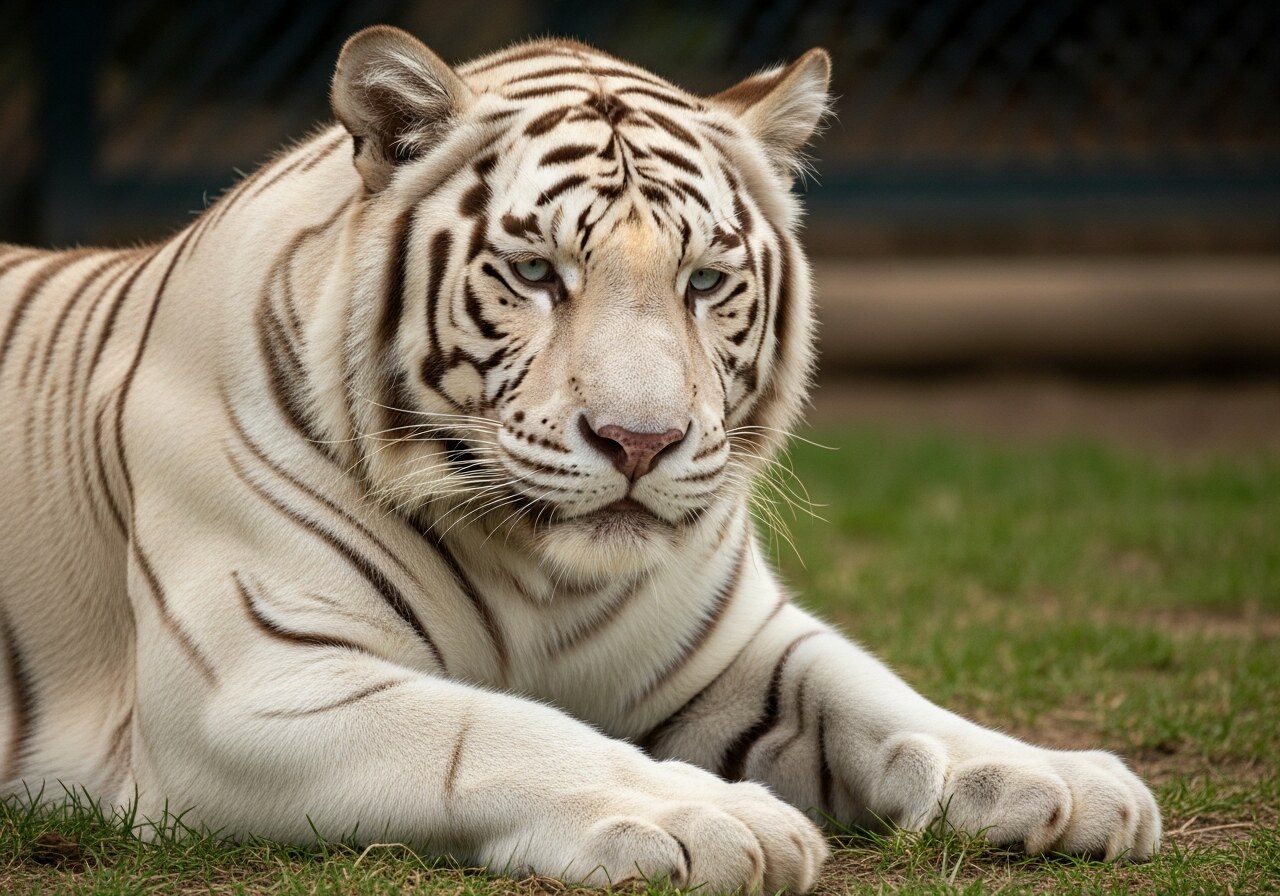
White tigers are Bengal tigers (Panthera tigris tigris) carrying two copies of a recessive gene that disrupts the production of orange pigment (pheomelanin). The result is a pale cream-to-white coat with dark brown or black stripes, pink nose pads and pale ice-blue eyes. The genetic mutation involved has been identified — it is a single point mutation in the SLC45A2 gene. It is the same kind of recessive colour variation that produces white morphs in many other species.
The white-tiger gene has always existed in low frequency in wild Bengal tiger populations in India. But because two copies of the gene are needed to produce a white cub, and because tiger populations are spread thinly across forest, wild white tigers were always rare — and they are now functionally absent. The last verified wild white tiger sighting was in central India in the 1950s. The entire global captive white tiger population today descends from a single male cub, "Mohan", captured by the Maharaja of Rewa in 1951 and subsequently bred to his own offspring.
Why white tigers are a welfare problem, not a conservation success
This is the part of the story that often gets lost. White tigers are sometimes marketed as "endangered" or "needing to be saved". They are not. The IUCN Cat Specialist Group and the major zoo accreditation bodies — including the American Association of Zoos and Aquariums — have explicitly stated that:
- White tigers have no conservation value — they are not a distinct conservation unit and saving them does not help save wild tigers.
- Their breeding is only achievable through inbreeding, because the small founding population means almost all white tigers alive today are closely related.
- The inbreeding causes serious, documented welfare problems.
Documented welfare problems in white tigers include
- Stillbirth and infant mortality. Survival rates for white tiger cubs are significantly lower than for normal-coloured Bengal tigers, with some independent reviews citing stillbirth and early-death rates approaching 80% in heavily-inbred lines.
- Cleft palate — a serious craniofacial deformity that often requires hand-rearing and lifelong veterinary support.
- Scoliosis and other skeletal deformities.
- Crossed eyes (strabismus) — present in a very high proportion of white tigers because the white-coat gene is linked to optic-nerve development abnormalities.
- Immune system problems and reduced disease resistance.
- Behavioural and neurological disorders — including cases of mental retardation and movement disorders documented in multiple captive populations.
The "normal-coloured" siblings of white tigers — born to the same inbred parents — typically suffer the same problems. The visible "white" cubs are simply the ones that have value in the entertainment industry and are kept alive.
Where white tigers live today
There are several hundred white tigers alive today, almost entirely in captivity. They are concentrated in roadside attractions, private collections, breeding facilities, "cub-petting" tourism operations and a small number of accredited zoos that hold older animals from historical breeding programmes. Sanctuaries that take in confiscated and abandoned white tigers are an important part of the global big cat rescue network — these are animals that cannot be released, cannot safely be bred again, and need decades of lifetime sanctuary care.
How WARN's tiger work fits in
WARN is preparing to operate in ten countries — Indonesia, Malaysia, Vietnam, Thailand, Cambodia, Pakistan, Colombia, Peru, Kenya and Tanzania. India is not on that list and we do not directly fund white tiger work. Our Tiger appeal supports rescue and sanctuary work in Southeast Asia, where the surviving wild tiger subspecies — the Critically Endangered Sumatran tiger in Indonesia, the Critically Endangered Malayan tiger, and the Endangered Indochinese tiger across Thailand, Vietnam and Cambodia — face acute threats from poaching, snaring and the illegal trade in tiger parts.
The connection between white tigers and our work is the global big cat captive welfare problem. Tigers used in entertainment — including white tigers, cub-petting tigers and circus tigers — eventually need somewhere to go. Sanctuary capacity for confiscated and surrendered big cats is one of the most consistently underfunded parts of the global tiger response, and our partner-network work in Southeast Asia is being built to support exactly this kind of placement.
How you can help
If you want to help tigers in general, the most useful things you can do are:
- Do not pay for tiger experiences. Cub-petting, tiger selfies and "swim with tigers" attractions exist because of paying customers. The supply chain for those experiences is the same one that produces white tigers.
- Support frontline anti-poaching and sanctuary work. Wild tiger recovery in Southeast Asia depends on snare removal, ranger patrols and sanctuary capacity for confiscated animals.
- Back WARN's Tiger appeal — or make an unrestricted donation — to help us fund this work in our ten operating countries.
Sources
- IUCN Red List — Bengal tiger (Panthera tigris tigris) assessment.
- IUCN Cat Specialist Group — published statements on the white tiger and the conservation value of colour morphs.
- CITES — Appendix I listing for Panthera tigris.
- Published veterinary literature on inbreeding-related disorders in captive tigers.
- UNODC — World Wildlife Crime Report, tiger trafficking chapters.
We need your support to make this happen
World Animal Rescue Network is at the launch stage of this work. We do not yet have rescue numbers to share — and that is exactly why your support matters now. Every donation helps us put trained teams on the ground, secure veterinary supplies and equipment, and reach the first animals before they are lost.
Donate today to fund our first deployments, or sponsor an animal to back a specific species through rehabilitation. You can also join the network as a volunteer, fundraiser, or monthly supporter.