Wildlife Guide · United Kingdom & Scandinavia and northern Europe
Adder
Vipera berus
Britain's only venomous snake — a shy, cold-tolerant viper marked by an unmistakable zigzag.
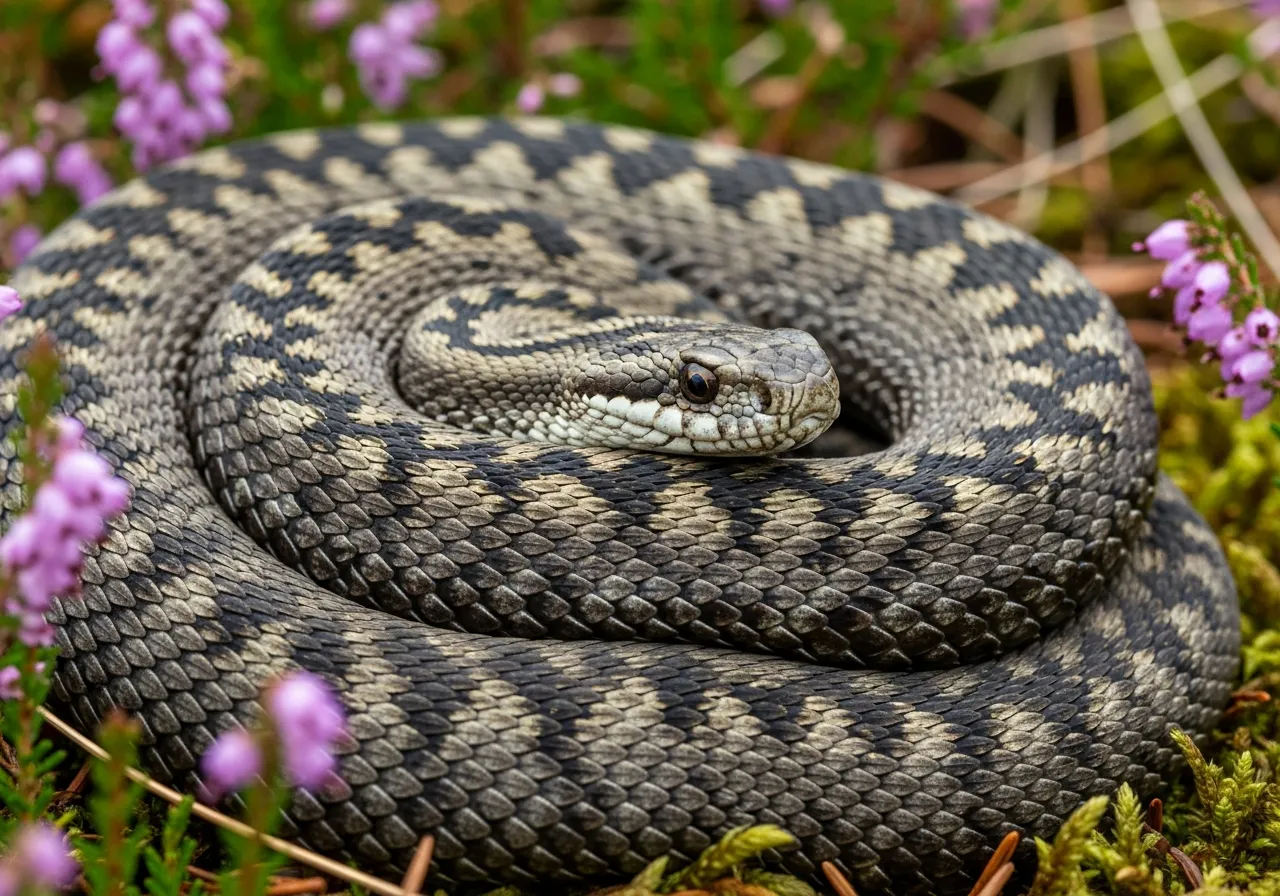
Source: Global Animal Guide (WARN)
In brief
An adder (Vipera berus) is a small venomous snake of Europe and Asia, identified by a dark zigzag stripe along its back. It is Britain's only venomous snake, hunts small mammals and lizards, and is shy, biting humans only in defence.
Also in Animals A to Z · Animals that start with A
By WARN Research & Conservation TeamLast updated
The adder (Vipera berus), also called the European viper, is a small venomous snake famous for the bold zigzag stripe running down its back. It is the only venomous snake native to Britain and the only snake found inside the Arctic Circle, ranging from western Europe across Russia to the Pacific coast of Asia. Adders favour heathland, moorland, woodland edges and coastal dunes, where they bask to warm up and hunt small mammals, lizards and amphibians. Though its venom can give a painful, occasionally serious bite, the adder is shy and bites only defensively. Globally it is classed as Least Concern, but in the UK it is declining and legally protected.
~90 cm
Maximum length (most adders are shorter, around 60-70 cm)
3-20
Live young per litter, born in late summer
1
Britain's only venomous snake species
2021
Year of its most recent IUCN Least Concern assessment
Figures sourced from Wikipedia — Vipera berus (adder), IUCN Red List — Vipera berus, Encyclopaedia Britannica — adder and other references on this page.
Adder: Quick Facts
| Common name | Adder (European viper) |
|---|---|
| Scientific name | Vipera berus |
| Typical length | 60-70 cm (up to ~90 cm) |
| Venomous | Yes — mildly, rarely dangerous to healthy adults |
| Diet | Small mammals, lizards, amphibians, occasionally birds |
| Reproduction | Ovoviviparous; 3-20 live young in late summer |
| Habitat | Heath, moor, bog, woodland edge, dunes |
| Range | Europe and Asia; the world's most northerly snake |
| UK status | Declining; protected under the Wildlife and Countryside Act 1981 |
| IUCN status | Least Concern (2021) |
Scientific Classification
| Kingdom | Animalia |
|---|---|
| Phylum | Chordata |
| Class | Reptilia |
| Order | Squamata |
| Family | Viperidae |
| Genus | Vipera |
| Species | Vipera berus |
Conservation Status
- IUCN Status
- Globally Least Concern on the IUCN Red List, reflecting the adder's very large range across Europe and Asia. Despite this, the species is declining in parts of its range, and in the United Kingdom it is a conservation concern: populations are fragmented and shrinking, driven by habitat loss, fragmentation and disturbance. It is legally protected in the UK under the Wildlife and Countryside Act 1981, which prohibits killing, injuring or selling adders.
- Population
- No reliable global total; the population is large but unquantified. UK populations are localised and many are small and isolated.
- Trend
- Stable to decreasing globally; declining in the UK and several European countries.
- Assessed
- 2021
- CITES
- Not listed on CITES Appendices.
Local declines are largely driven by the loss and fragmentation of heath, moor and other open habitats, plus human disturbance — the same habitat pressures affecting many other reptiles.
Did you know?
The adder is the only snake on Earth found inside the Arctic Circle — its tolerance of cold, helped by giving birth to live young rather than laying eggs, lets it survive farther north than any other snake species.
Key Facts: Adder
- The adder is Britain's only venomous snake and the only snake whose range crosses into the Arctic Circle.
- Its trademark dark zigzag stripe down the back makes it one of the easiest European snakes to identify.
- Adders give birth to live young rather than laying eggs, an adaptation to cool northern climates.
- Bites are rarely dangerous to healthy adults but are painful and always need prompt medical attention.
- Globally the adder is Least Concern, but UK populations are declining and are protected by law.
- Adders are shy and will retreat if given the chance; almost all bites happen when a snake is trodden on or handled.
What does an adder look like and how do you identify it?
The adder is a stocky, modest-sized snake, usually 60-70 cm long, with the largest individuals — most often females in the north of the range — exceeding 90 cm. Its most reliable feature is the continuous dark zigzag stripe running the length of the back, set against a paler ground colour. Males tend to be grey or whitish with a black zigzag, while females are typically brown or reddish with a darker brown pattern. The head carries a distinctive V- or X-shaped marking, and the eyes have vertical, cat-like pupils with a red or coppery iris. Some adders are entirely black (melanistic), which can make the zigzag hard to see — these are more common in cooler, upland areas where dark skin helps absorb heat. In Britain the adder can be confused with the harmless grass snake and the legless slow worm, but neither has the bold zigzag, and the grass snake instead shows a yellow-and-black collar behind the head. The adder's short, slightly upturned snout and relatively chunky build also help separate it from Britain's slimmer non-venomous reptiles.
Where do adders live and what do they eat?
Vipera berus has one of the largest ranges of any terrestrial snake, stretching from Britain and western Europe across Scandinavia, Russia and northern Asia to the Pacific. Remarkably, it lives farther north than any other snake and is the only species found inside the Arctic Circle, thanks to its tolerance of cold. Adders favour habitats with a mix of open basking spots and dense cover: heathland, moorland, bogs, woodland rides, hedgerows, rough grassland and coastal dunes. They are cold-blooded and spend much of the day regulating their temperature, basking in the morning sun before becoming active hunters. The diet is mostly small mammals such as voles, mice and shrews, along with lizards (including common lizards and slow worms), amphibians like frogs and newts, and occasionally nestling birds. Prey is killed with a quick venomous bite, then released and tracked by scent until the venom takes effect. In the cooler parts of their range adders hibernate through winter, often communally in shared underground refuges called hibernacula, emerging in early spring to bask and breed.
Are adder bites dangerous to humans?
Adder venom is medically significant but, compared with many of the world's vipers, relatively mild. The snake is not aggressive: it relies on camouflage and will almost always slip away if given the chance, biting only when trodden on, cornered or handled. A bite is painful and typically causes swelling, bruising and sometimes nausea, dizziness or a drop in blood pressure; serious systemic reactions are uncommon but possible, especially in children, older people or those with allergies. Fatalities are very rare — in Britain only a small number of deaths have been recorded over more than a century. Even so, every adder bite should be treated as a medical emergency: keep the affected limb still and below heart level, remove rings or tight clothing, and seek hospital care promptly, as antivenom may be given in severe cases. Dogs are bitten more often than people, usually on the face or paws while investigating a basking snake, and also need veterinary attention. The sensible response to meeting an adder is simply to step back and leave it alone — it poses no threat to anyone who keeps their distance.
How do adders breed and survive cold climates?
The adder's reproduction is closely shaped by its cold northern home. Rather than laying eggs, females are ovoviviparous: the eggs develop inside the body and the young are born live, typically 3 to 20 at a time in late summer or early autumn. This strategy lets the mother carry her developing young to warmer basking sites, giving the embryos enough heat to develop in climates where eggs left in the ground might never hatch. Breeding is demanding, so females in cooler regions often reproduce only once every two or three years, recovering condition in between. In spring, males emerge from hibernation first and perform a 'dance of the adders', a ritualised wrestling contest in which rival males rear up and try to push each other down to win access to females. Adders are long-lived for a small snake, and hibernation is a dangerous period — a significant proportion of juveniles and some adults do not survive the winter. These slow life-history traits, combined with the loss and fragmentation of heath and moorland, help explain why UK adder populations are sensitive to disturbance and slow to recover.
Adder vs grass snake: telling Britain's snakes apart
| Feature | Adder (Vipera berus) | Grass snake (Natrix helvetica) |
|---|---|---|
| Venomous | Yes (mild) | No |
| Back pattern | Bold dark zigzag stripe | No zigzag; plain with dark bars on flanks |
| Head marking | V or X on head; yellow/orange collar absent | Bright yellow-and-black collar behind head |
| Pupils | Vertical, cat-like | Round |
| Typical length | 60-70 cm (up to ~90 cm) | Often 90-120 cm, longer than the adder |
| Behaviour if threatened | Retreats; bites only in defence | Often flees to water; may play dead or release foul musk |
What WARN Does
The World Animal Rescue Network does not run field projects specifically for the adder — its native range lies well outside the countries where WARN's partners work partner countries — so this guide is part of WARN's free educational work to help people understand and respect wildlife. The pressures that threaten adders, above all the loss and fragmentation of habitat, are the same forces that endanger the animals WARN does protect, which is why sharing accurate, calm information about misunderstood species like venomous snakes matters.
If clear, fear-free wildlife guides like this one are useful to you, a small gift helps WARN keep producing them and supports the animals in our care.
Adder: Frequently Asked Questions
Is the adder the only venomous snake in the UK?
How dangerous is an adder bite?
What does an adder look like?
Where do adders live?
Do adders lay eggs?
Are adders endangered?
What does an adder eat?
How long do adders live?
How big is an adder?
Sources & References
Population figures, conservation status and biological facts on this page are drawn from authoritative scientific and intergovernmental sources.
Terms used on this page
Plain-English definitions, from our wildlife and conservation glossary.
Latest Adder Stories
Quick, fact-checked reads on the adder — amazing facts, key questions and the threats it faces.
Guides
UK Animal Charities Explained: A Friendly Guide to 10 of the Biggest, and How They Differ
Who does what across UK animal welfare? A neutral, supporter-friendly guide to ten of the biggest UK animal charities — RSPCA, Dogs Trust, Battersea, Cats Protection, Blue Cross, PDSA, The Donkey Sanctuary, Brooke, Wood Green and Mayhew — with each charity's own donate link, and an honest section on where international field rescue fits in.
Read the storyGuides
What Is an Animal Sanctuary? How Sanctuaries Work, Who They Help, and How to Support One
Animal sanctuary, animal shelter, animal rescue — the terms are often used interchangeably, but they mean different things. This guide explains the difference, what life inside a sanctuary looks like, and how you can support sanctuaries in the UK and internationally.
Read the storyGuides
Fostering a Rescue Dog in the UK: A Complete Guide for New and Experienced Foster Carers
Fostering a rescue dog gives a dog in a shelter or rescue centre a temporary home while they wait for adoption — and it can make an enormous difference to their behaviour, health and chances of finding a permanent family. This guide covers how dog fostering works, what to expect, and how to get started.
Read the storyExplore more animals
Discover more animals, their habitats and their conservation status in the WARN wildlife-guide library.