Wildlife Guide · Central America & South America
Giant Anteater
Myrmecophaga tridactyla
The world's most extraordinary insect-eating machine — now fighting for survival
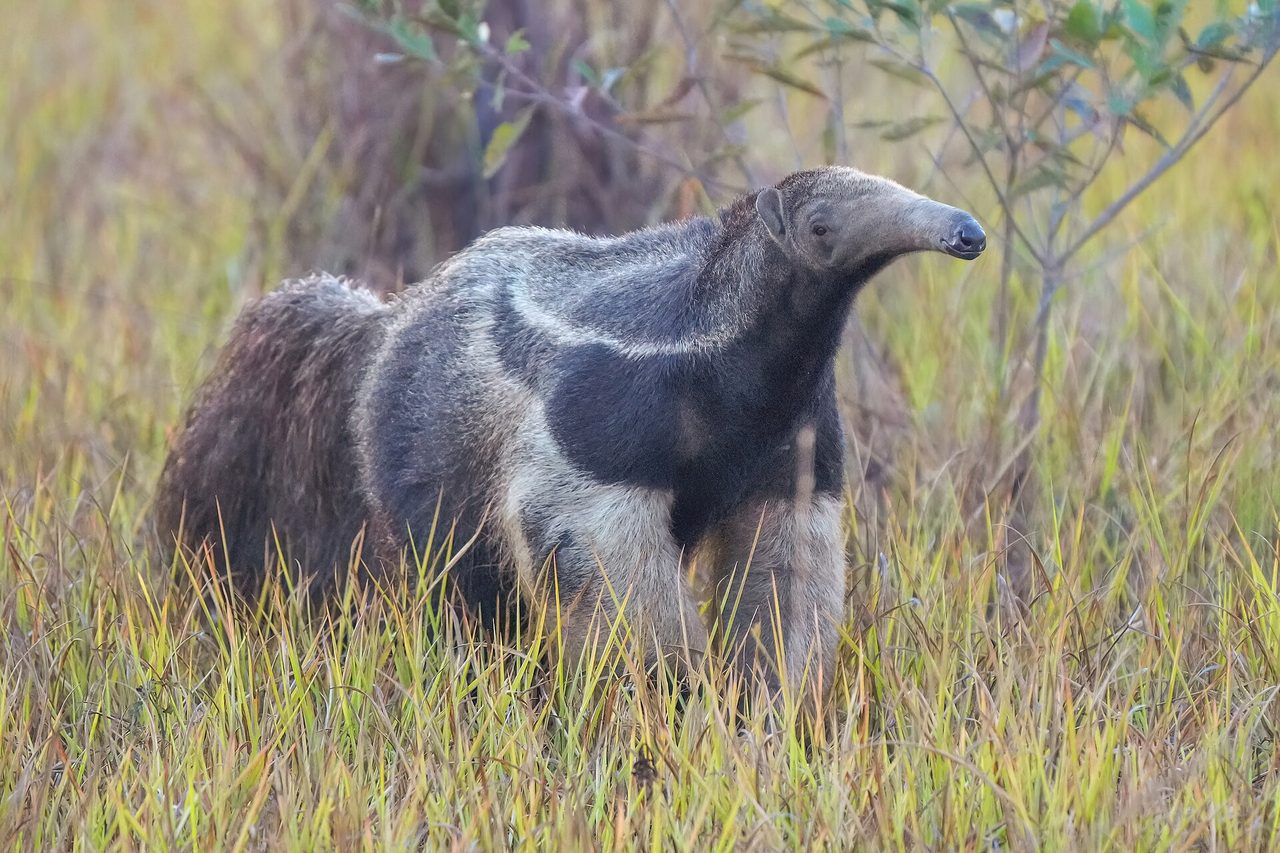
Photo: Giles Laurent / Wikimedia Commons (CC BY-SA 4.0)
In brief
The giant anteater is a large, toothless mammal of Central and South America listed as Vulnerable by the IUCN, with populations declining by at least 30% over the past three generations due to habitat loss, fire, and road mortality.
Also in Animals A to Z · Animals that start with G
How you can help
You can support the related appeal — read its purpose, recipient status and fund terms first — or give once to where it is needed most. Sharing accurate information helps too.
By WARN Research & Conservation TeamLast updated
The giant anteater (Myrmecophaga tridactyla) is the largest of the four living anteater species and one of the most architecturally bizarre mammals on Earth. Stretching up to 2.2 metres from snout tip to tail and weighing as much as 50 kilograms, it has no teeth, the lowest confirmed body temperature of any placental mammal (32.7 °C), and a tongue that can flick in and out up to 150 times per minute to harvest tens of thousands of ants and termites in a single day. Found across savannas, grasslands, and tropical forests from Honduras to northern Argentina, it once ranged across much of the Americas. Today, classified as Vulnerable on the IUCN Red List, the giant anteater has vanished from large swathes of its former range, driven out by habitat loss, uncontrolled fire, and collisions with vehicles on Brazil's expanding highway network.
2.2 m
Maximum body length (nose to tail)
150×/min
Maximum tongue flick rate when feeding
35,000
Ants and termites consumed per day
≥30%
Population decline over ~21 years (3 generations)
Figures sourced from IUCN Red List — Myrmecophaga tridactyla (2025, assessed 2024), CITES species listing — Myrmecophaga tridactyla, Animal Diversity Web — Myrmecophaga tridactyla and other references on this page.
Giant Anteater: Quick Facts
| Body length | 1.8–2.2 m (nose to tail) |
|---|---|
| Body weight | 27–50 kg (males up to 50 kg) |
| Lifespan (wild) | 10–14 years |
| Gestation | 170–190 days; single pup |
| Diet | Ants, termites, and soft insect larvae |
| Body temperature | 32.7 °C — lowest of any placental mammal |
| Home range | 2.7–32.5 km² depending on habitat |
| CITES appendix | Appendix II |
Scientific Classification
| Kingdom | Animalia |
|---|---|
| Phylum | Chordata |
| Class | Mammalia |
| Superorder | Xenarthra |
| Order | Pilosa |
| Suborder | Vermilingua |
| Family | Myrmecophagidae |
| Genus | Myrmecophaga |
| Species | Myrmecophaga tridactyla (Linnaeus, 1758) |
Conservation Status
- IUCN Status
- Vulnerable
- Population
- No reliable global total; at least 30% decline documented over ~21 years
- Trend
- Decreasing
- Assessed
- 2024
- CITES
- Appendix II
Assessed under criterion A2cd (May 2024, published IUCN Red List 2025); extirpated from most of Central America and the southern parts of its South American range.
Did you know?
A giant anteater never destroys a colony outright — it spends just 30–40 seconds at each mound before moving on, allowing the insects to recover. Over time, it revisits the same mounds on a loose rotation, essentially farming its food supply across a territory it maintains for years.
Key Facts: Giant Anteater
- The giant anteater holds the record for the lowest body temperature of any placental mammal — just 32.7 °C — a metabolic adaptation to its low-calorie, insect-only diet.
- Its tongue, which can reach 60 cm in length and flick up to 150 times per minute, is coated in tiny backward-facing spines and sticky saliva to trap insects.
- The IUCN assessed the species as Vulnerable in 2024 (published in the 2025 Red List), noting a suspected population decline of at least 30% over the last three generations (roughly 21 years) driven by habitat loss and direct mortality.
- Road collisions are a leading cause of death in Brazil, where giant anteaters are among the top species killed on highways; population viability modelling shows road mortality can halve the stochastic growth rate of local populations.
- Females carry a single pup on their back for up to a year, perfectly camouflaging it by aligning the pup's fur pattern with their own markings — an extraordinary example of visual deception.
- The species has been extirpated from most of Central America, including Guatemala, El Salvador, and Belize, where it is now considered the most threatened large mammal in the subregion.
What is a giant anteater?
The giant anteater belongs to the superorder Xenarthra — the same ancient lineage as armadillos and sloths — and is the sole member of the genus Myrmecophaga. It is unmistakable: a tube-like elongated skull and snout, a shaggy coat patterned in charcoal black and silver-grey, a broad diagonal shoulder stripe, and a magnificent bushy tail that fans out almost as wide as the animal is long. Males are slightly larger than females, typically weighing 33–50 kg compared with 27–47 kg for females. Unlike virtually all other mammals, giant anteaters possess no teeth whatsoever. Instead, the mouth opens to a small circular aperture barely wide enough to admit a pencil, through which the ribbon-like tongue — capable of extending 60 cm beyond the snout — darts in and out at astonishing speed. The animal crushes its prey not with molars but with a muscular, ridged stomach, sometimes assisted by small stones swallowed as gizzard-stones. With a basal metabolic rate only about 34% of that predicted for its body mass, the giant anteater is physiologically built for a lifestyle of slow, energy-careful foraging across vast landscapes.
Where do giant anteaters live?
Giant anteaters are found across a broad arc of Central and South America, from Honduras and Nicaragua in the north to Bolivia, Paraguay, and northern Argentina in the south. Their stronghold today lies in Brazil, particularly in the Cerrado — the vast tropical savanna that covers roughly a quarter of Brazil's land surface — as well as in the Pantanal wetlands and parts of the Amazon basin. Populations also persist in Colombia's Llanos grasslands and in Venezuela, Guyana, and Suriname. The species tolerates a surprisingly wide variety of habitats: open grasslands, dry and moist forests, swamps, mangroves, and even modified agricultural landscapes where prey colonies remain accessible. What the giant anteater cannot tolerate is the destruction of ant and termite mounds at scale or the removal of the scattered shade trees and dense vegetation it uses for resting. Individual animals require large home ranges — studies record territories ranging from 2.7 km² in Brazil's Serra da Canastra National Park to 32.5 km² in Argentina's Iberá wetlands — meaning that landscape connectivity is essential for viable populations. Historically present as far north as Mexico and Guatemala, the giant anteater has been extirpated from most of Central America, including Guatemala, El Salvador, and Belize, and from the southern parts of its South American range.
Why is the giant anteater Vulnerable?
The IUCN assessed the giant anteater as Vulnerable (criterion A2cd), with the assessment conducted in May 2024 and published in the 2025 Red List update, reflecting a suspected population decline of at least 30% but less than 50% over three generations, estimated at approximately 21 years. No reliable global population total exists, but the cumulative weight of regional extirpations, fire mortality data, and road-kill surveys points to a species under severe and ongoing pressure. The primary drivers are interlinked. Habitat loss from soy and cattle expansion, particularly across the Cerrado, removes the open foraging grounds and ant-rich soils that anteaters depend upon. Deliberate burning of grasslands and sugar-cane fields is a catastrophic threat: a single 1994 wildfire at Brazil's Emas National Park killed an estimated 340 giant anteaters. Because the animals move slowly and cannot escape fast-moving fires, burn mortality can be devastating in isolated protected areas. Road mortality is the third major threat and is particularly severe in Brazil, where the species consistently ranks among the top mammals killed on highways. A population viability analysis published in Perspectives in Ecology and Conservation found that road mortality can halve the stochastic growth rate of local giant anteater populations. Hunting pressure, though lower than in some other large mammals, persists in parts of Bolivia and the Chaco. Attacks by domestic and feral dogs add localised mortality near human settlements. The species' naturally low reproductive rate — one pup per year, with young remaining dependent for up to ten months — means populations recover slowly from any source of increased mortality.
How does a giant anteater find and eat its food?
Feeding is the central drama of every giant anteater's day. The animal relies almost entirely on its sense of smell — estimated to be 40 times more acute than a human's — to locate ant and termite colonies beneath soil and inside hard-mound structures. Once a mound is located, the anteater uses the large, curved claws of its forefeet — the third claw alone can reach 10 cm in length — to tear open the outer casing. The claws are so formidable that the animal walks on its knuckles to keep the tips sharp, producing a distinctive gait with the claws folded inward. Having breached the mound, the anteater plunges its snout into the opening and begins working its tongue at up to 150 flicks per minute. The tongue, coated in minute backward-pointing spines and thick, viscous saliva produced by enlarged salivary glands, sweeps insects into the mouth by the thousand. Up to 35,000 ants and termites can be consumed in a single day. The anteater avoids triggering a full defensive response from the colony by spending only 30–40 seconds at each mound — just long enough to gather a profitable meal before the soldier ants and termites can mount a serious attack. It then moves on, allowing the colony to partially recover before returning in future days. This strategy of sustainable extraction means anteaters are rarely destructive in the long-term ecological sense: a carefully managed mound is a larder that keeps refilling.
How do giant anteaters raise their young?
Giant anteaters reproduce slowly, which is one reason the species struggles to recover from elevated mortality. Females give birth to a single pup after a gestation period of 170–190 days. Birth occurs while the mother stands upright, and the newborn, weighing around 1–2 kg, is immediately capable of climbing onto her back, where it will spend the next several months. The pup's fur pattern is arranged so that when it rides on the mother's back, its own shoulder stripe aligns almost perfectly with hers, providing remarkable camouflage against predators such as pumas and jaguars. The mother nurses the pup for up to six months, and the youngster remains dependent on her for up to ten months after birth. Pup mortality in the first three months is around 50%, attributable largely to predation and the dangers of fire events that the mother cannot outrun while encumbered. Young anteaters do not reach sexual maturity until 2.5–4 years of age, meaning a female may produce only one surviving offspring every two to three years across a wild lifespan of 10–14 years. This slow reproductive pace, entirely normal for a large Xenarthra, makes population recovery from habitat loss or road mortality a generational challenge rather than a short-term bounce-back.
What WARN Does
WARN runs active rescue and conservation projects in Brazil and Colombia — two of the giant anteater's most important remaining strongholds. Brazil's Cerrado holds the densest known populations of the species, while Colombia's Llanos grasslands support significant numbers. Public understanding of the threats facing giant anteaters directly supports the case for protecting the open savanna and forest habitats where WARN's in-network partners operate. Even where project work is focused on other species, the landscapes overlap — conserving connected grasslands in Brazil and Colombia benefits giant anteaters alongside every other species sharing those ecosystems.
Giant anteaters depend on connected stretches of savanna and forest — the same landscapes in Brazil and Colombia where WARN's conservation partners work. Supporting habitat protection in these countries helps secure the open ground that anteaters, and hundreds of other species, need to survive.
How can I help save the giant anteater?
Explore practical ways to support the giant anteater, from everyday choices and sharing reliable information to reviewing a related appeal before giving.
Explore ways to support
Read the related appeal’s purpose, recipient status and fund terms. Choose an affordable gift after checking what is proposed and what has been reported.
Ease the pressures
Avoid the wildlife trade and souvenirs, never buy wild animals as pets, and choose sustainable, habitat-friendly products — the threats behind the giant anteater's decline fall when demand does.
Spread the word
Share accurate, sourced information about the giant anteater. Wider awareness is what turns concern into lasting protection.
Giant Anteater: Frequently Asked Questions
How can I help save the giant anteater?
Are giant anteaters dangerous to humans?
How long is a giant anteater's tongue?
What do giant anteaters eat besides ants and termites?
Why do giant anteaters have such a low body temperature?
Is the giant anteater endangered?
How many giant anteaters are left in the wild?
Where do giant anteaters live?
How long do giant anteaters live?
How big is a giant anteater?
Sources & References
Population figures, conservation status and biological facts on this page are drawn from authoritative scientific and intergovernmental sources.
- IUCN Red List — Myrmecophaga tridactyla (2025, assessed 2024)
- CITES species listing — Myrmecophaga tridactyla
- Animal Diversity Web — Myrmecophaga tridactyla
- Smithsonian's National Zoo — Giant Anteater
- IUCN SSC Anteater, Sloth and Armadillo Specialist Group — Giant Anteater
- Pinto et al. (2018) — Giant anteater conservation in Brazil: fragmentation and road mortality, Biological Conservation
- Population viability analysis as a tool for giant anteater conservation — Perspectives in Ecology and Conservation (2020)
- PMC — Threats to giant anteaters in the Cerrado biome
- Wikipedia — Giant anteater
Terms used on this page
Plain-English definitions, from our wildlife and conservation glossary.
Latest Giant Anteater Stories
Quick, fact-checked reads on the giant anteater — amazing facts, key questions and the threats it faces.
Briefings
The Pink River Dolphin: Why the Amazon's Most Unusual Mammal Is Endangered
The pink river dolphin — the boto — is one of only a handful of freshwater dolphin species left on Earth. It lives in the rivers of Colombia and Peru, and it is now formally listed as Endangered on the IUCN Red List. A briefing on what it is, why it is in trouble, and what frontline rescue work can still do.
Read the storyBriefings
The Kinkajou: The Rainforest Mammal Most People Have Never Heard Of
The kinkajou is a small, golden-brown rainforest mammal with a prehensile tail and enormous dark eyes. It lives in the forests of Colombia and Peru. Its biggest threats are habitat loss and the exotic pet trade — and that is exactly where rescue and sanctuary work can help.
Read the storyBriefings
The Capuchin Monkey: The Tool-Using Primate at the Heart of the South American Pet Trade Problem
Capuchin monkeys are among the most intelligent primates in the Americas — and one of the most heavily trafficked. They live across the forests of Colombia and Peru, and they are a regular caseload at rescue centres dealing with the South American illegal pet trade.
Read the storyExplore more animals
Discover more animals, their habitats and their conservation status in the WARN wildlife-guide library.