Wildlife Guide · Mexico
Axolotl
Ambystoma mexicanum
The eternal baby salamander that regrows its own limbs
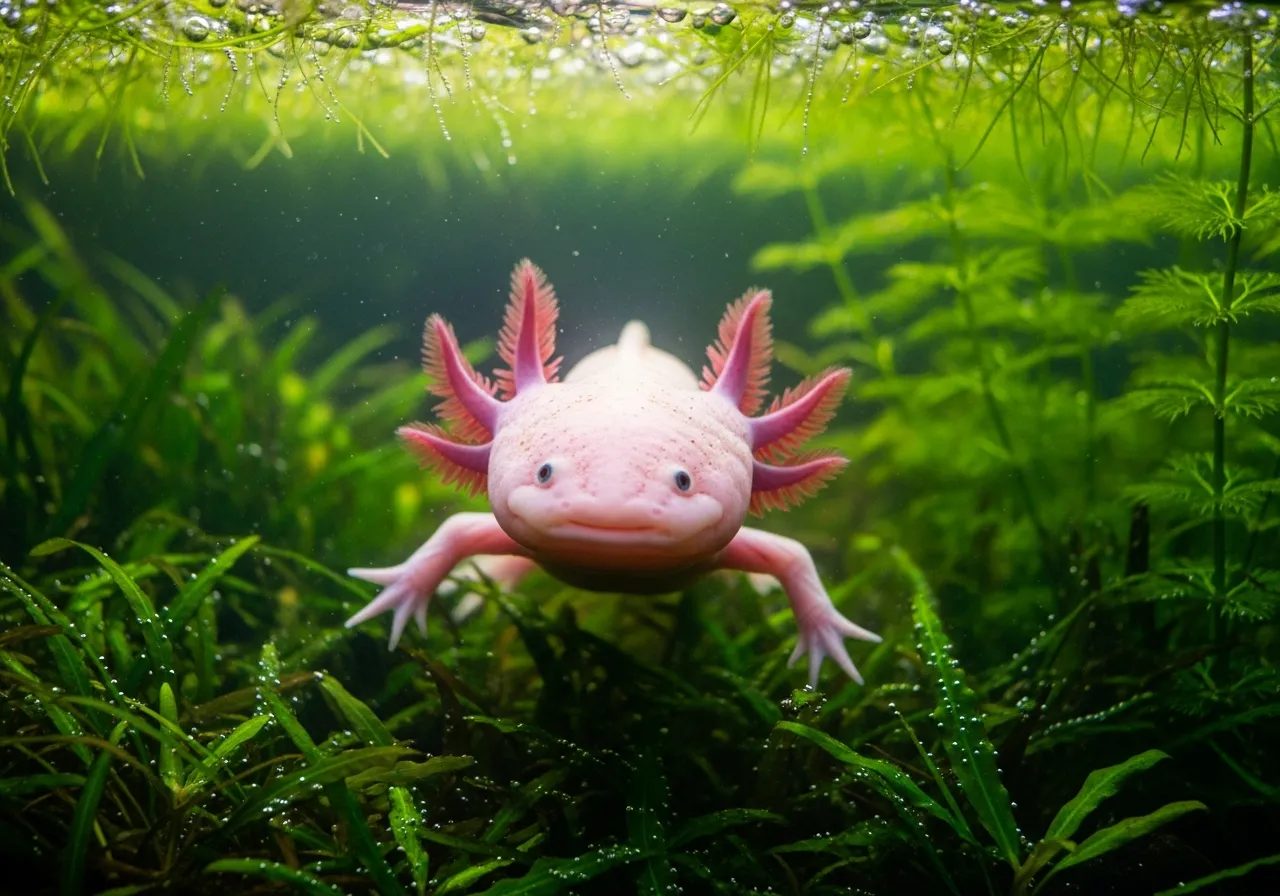
Source: Global Animal Guide (WARN)
In brief
An axolotl (Ambystoma mexicanum) is a neotenic salamander from the Xochimilco canals near Mexico City that stays aquatic and larval-looking for life, keeping external gills. Famous for regenerating limbs, organs and brain tissue, it is Critically Endangered in the wild yet common in captivity.
Also in Animals A to Z · Animals that start with A
How you can help
You can support the related appeal — read its purpose, recipient status and fund terms first — or give once to where it is needed most. Sharing accurate information helps too.
By WARN Research & Conservation TeamLast updated
The axolotl (Ambystoma mexicanum) is a neotenic salamander native only to the canal system of Xochimilco, near Mexico City. Unlike most amphibians, it never fully metamorphoses: it keeps its feathery external gills, stays aquatic for life and breeds while still in a larval-looking form. It is world-famous for an extraordinary ability to regenerate amputated limbs, parts of its heart, spinal cord and even portions of its brain. The axolotl is also a striking conservation paradox. It is one of the most abundant amphibians on Earth in laboratories, classrooms and home aquariums, yet it is Critically Endangered in the wild, where only a few hundred or fewer may survive.
~32B
genome base pairs
<1k
wild adults remaining
23 cm
typical adult length
10-15
years lifespan
Figures sourced from Axolotl - Wikipedia, IUCN Red List: Ambystoma mexicanum, CITES Appendix II listing and other references on this page.
Axolotl: Quick Facts
| Scientific name | Ambystoma mexicanum |
|---|---|
| Common name | Axolotl (Mexican walking fish, though it is not a fish) |
| Size | Typically ~23 cm; range about 15-45 cm |
| Lifespan | Around 10-15 years |
| Diet | Carnivore: worms, insects, crustaceans, molluscs, small fish |
| Habitat | Freshwater canals and wetlands |
| Range | Xochimilco, Mexico City (historically also Lake Chalco) |
| Reproduction | Egg-laying; females can lay hundreds of eggs per clutch |
| Notable trait | Neoteny; regenerates limbs, organs and brain tissue |
| CITES | Appendix II |
Scientific Classification
| Kingdom | Animalia |
|---|---|
| Phylum | Chordata |
| Class | Amphibia |
| Order | Urodela (Caudata) |
| Family | Ambystomatidae |
| Genus | Ambystoma |
| Species | Ambystoma mexicanum |
Conservation Status
- IUCN Status
- Critically Endangered in the wild (IUCN Red List). Abundant in captivity, but its only natural population, in the Xochimilco canals near Mexico City, has collapsed to perhaps a few hundred or fewer individuals, with some surveys finding almost none.
- Population
- Fewer than ~1,000 mature individuals in the wild (estimates vary; some surveys find very few)
- Trend
- Decreasing
- Assessed
- 2020
- CITES
- Appendix II
Threatened by urbanisation, water pollution, drainage of wetlands and invasive fish such as tilapia and carp. Conservation focuses on water-quality improvement, invasive-fish-free refuges and traditional chinampa farming in Xochimilco.
Did you know?
Despite being one of the most familiar amphibians on the planet in aquariums and labs, the wild axolotl is so rare that some recent surveys of its only native habitat have struggled to find a single one.
Key Facts: Axolotl
- The axolotl is a salamander that stays aquatic and larval-looking for life, a trait called neoteny.
- It is native only to the Xochimilco canal system near Mexico City, historically also Lake Chalco.
- It can regenerate limbs, parts of the heart, spinal cord and even brain tissue, making it a key research animal.
- It is Critically Endangered in the wild yet abundant in captivity, a stark conservation paradox.
- Its main threats are urbanisation, water pollution and invasive fish such as tilapia and carp.
- It is listed on CITES Appendix II, regulating international trade.
What makes the axolotl unique
The axolotl's defining feature is neoteny: it reaches sexual maturity and reproduces while retaining the body of a larva. Where most salamanders absorb their gills, climb onto land and breathe air as adults, the axolotl keeps its three pairs of feathery external gills, its broad tail fin and its fully aquatic lifestyle throughout its roughly 10-to-15-year life. Most individuals stop developing because their bodies produce very little thyroid hormone, the chemical signal that normally triggers metamorphosis. Wild axolotls are usually dark and mottled, providing camouflage among canal sediment and plants. The pale pink and white animals familiar from aquariums and photographs are largely the result of captive breeding for leucistic and albino colour forms, which are rare or absent in the wild. Adults most commonly measure around 23 cm long, though sizes from roughly 15 to 45 cm are recorded. Their permanently upturned mouths give them a distinctive smiling appearance that has made them a global internet and pop-culture icon.
Regeneration and scientific importance
The axolotl is one of the most studied animals in regenerative biology. It can regrow entire amputated limbs, complete with bone, muscle, nerves and skin, in a matter of weeks, and it can repair its heart, spinal cord, retina and parts of its brain rather than forming scar tissue. After injury, cells near the wound form a structure called a blastema, which rebuilds the missing part in the correct shape and orientation. Researchers study this process to understand why mammals, including humans, cannot regenerate in the same way. The axolotl has also become important in developmental biology, cancer resistance research and tissue-engineering studies. Its genome is enormous, around 32 billion base pairs, roughly ten times the size of the human genome and one of the largest animal genomes ever sequenced. Because the species breeds readily in captivity and tolerates laboratory conditions well, hundreds of thousands of axolotls now live in research facilities and homes worldwide, descended largely from a small number of founder animals.
The wild axolotl in peril
The contrast between the captive and wild axolotl is dramatic. In its only natural home, the canals and wetlands of Xochimilco on the southern edge of Mexico City, the species has collapsed. Surveys over recent decades have recorded sharp declines, and some find almost no animals at all; estimates suggest only a few hundred or fewer remain in the wild, leading the IUCN to list it as Critically Endangered. The causes are tied to the growth of one of the world's largest urban areas. Wetlands have been drained and built over, and remaining waterways suffer from sewage, agricultural run-off and pollution. Invasive fish introduced for food and the aquarium trade, particularly tilapia and carp, eat axolotl eggs and young and compete for food. Restoration efforts in Xochimilco focus on improving water quality, creating refuges free of invasive fish and working with local chinampa farmers who maintain the area's traditional floating gardens, on which the canals depend.
Axolotl vs typical salamander
| Feature | Axolotl | Typical salamander (e.g. tiger salamander) |
|---|---|---|
| Adult form | Stays larval and aquatic (neoteny) | Metamorphoses into land-dwelling adult |
| Gills | Keeps external feathery gills for life | Loses gills, breathes with lungs/skin |
| Habitat as adult | Fully aquatic | Often terrestrial or semi-aquatic |
| Regeneration | Exceptional: limbs, heart, spinal cord, brain | Limited |
| Conservation | Critically Endangered in the wild | Varies; many species Least Concern |
What WARN Does
WARN does not currently run a dedicated field project for the axolotl, which lives only in a small area of central Mexico, outside the countries where WARN's partners work partner countries. This guide is part of WARN's free educational and awareness work, helping people understand a species whose wild survival hangs in the balance. The same pressures that threaten the axolotl, habitat loss, water pollution and invasive species, also harm the wetland and freshwater animals WARN does protect elsewhere.
If you value clear, science-based wildlife guides like this one, a small gift helps fund WARN's habitat and freshwater conservation work for animals facing the very same threats.
How can I help save the axolotl?
Explore practical ways to support the axolotl, from everyday choices and sharing reliable information to reviewing a related appeal before giving.
Explore ways to support
Read the related appeal’s purpose, recipient status and fund terms. Choose an affordable gift after checking what is proposed and what has been reported.
Ease the pressures
Avoid the wildlife trade and souvenirs, never buy wild animals as pets, and choose sustainable, habitat-friendly products — the threats behind the axolotl's decline fall when demand does.
Spread the word
Share accurate, sourced information about the axolotl. Wider awareness is what turns concern into lasting protection.
Axolotl: Frequently Asked Questions
How can I help save the axolotl?
Are axolotls endangered?
Can axolotls really regrow their limbs?
Why do axolotls stay babies their whole lives?
Where do axolotls live in the wild?
What do axolotls eat?
What is the difference between an axolotl and a salamander?
Are axolotls dangerous?
How long do axolotls live?
How big is an axolotl?
Sources & References
Population figures, conservation status and biological facts on this page are drawn from authoritative scientific and intergovernmental sources.
Terms used on this page
Plain-English definitions, from our wildlife and conservation glossary.
Latest Axolotl Stories
Quick, fact-checked reads on the axolotl — amazing facts, key questions and the threats it faces.
Explore more animals
Discover more animals, their habitats and their conservation status in the WARN wildlife-guide library.