Wildlife Guide · North America & United States
American Bison
Bison bison
Once numbering 60 million, the mighty American bison now depends on careful management to survive — a cautionary tale and a conservation triumph.
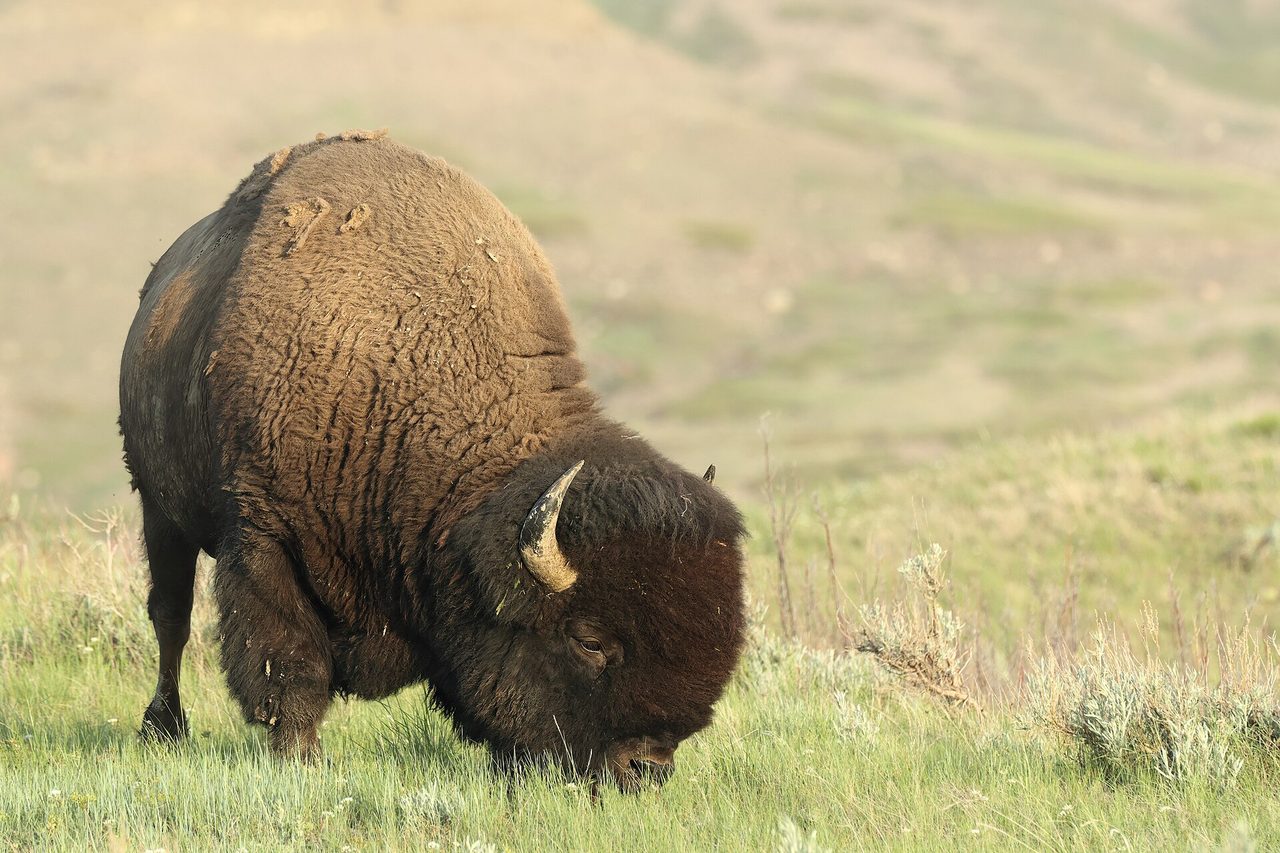
Photo: Cephas / Wikimedia Commons (CC BY-SA 4.0)
In brief
The American bison is the largest land mammal in North America, listed as Near Threatened by the IUCN with an estimated 15,000 truly wild individuals remaining after a dramatic near-extinction in the 19th century.
Also in Animals A to Z · Animals that start with A
How you can help
You can support the related appeal — read its purpose, recipient status and fund terms first — or give once to where it is needed most. Sharing accurate information helps too.
By WARN Research & Conservation TeamLast updated
The American bison (Bison bison), often called the buffalo, is the largest land mammal in North America and one of the most ecologically significant animals on Earth. Adult bulls can tip the scales at more than 900 kg and stand nearly two metres at the shoulder, their enormous shaggy heads lending them an unmistakable silhouette against the open prairie sky. Once thundering across the continent in herds estimated at 30 to 60 million individuals, bison were hunted to the brink of extinction by the late nineteenth century, leaving fewer than 600 animals alive by 1889. A century of painstaking conservation work has brought the species back to roughly 500,000 individuals today, though only around 15,000 are considered truly wild and free-ranging. The IUCN currently lists the American bison as Near Threatened.
~15,000
Wild free-ranging bison
~500,000
Total managed population
541
Animals alive in 1889
Near Threatened
IUCN Red List status
Figures sourced from IUCN Red List – Bison bison (assessed 2016, published 2017): e.T2815A45156541, Animal Diversity Web – Bison bison, Smithsonian's National Zoo – American Bison and other references on this page.
American Bison: Quick Facts
| Weight (bull) | Up to 900 kg (1,984 lb) |
|---|---|
| Shoulder height | 1.67–1.86 m (5.5–6.1 ft) |
| Lifespan | 15–20 years |
| Gestation | ~285 days; single calf |
| Top speed | ~55 km/h (34 mph) |
| IUCN status | Near Threatened (assessed 2016) |
| Wild population | ~15,000 free-ranging |
| Subspecies | Plains bison; Wood bison |
Scientific Classification
| Kingdom | Animalia |
|---|---|
| Phylum | Chordata |
| Class | Mammalia |
| Order | Artiodactyla |
| Family | Bovidae |
| Subfamily | Bovinae |
| Genus | Bison |
| Species | Bison bison (Linnaeus, 1758) |
Conservation Status
- IUCN Status
- Near Threatened
- Population
- ~15,000 wild free-ranging; ~500,000 total including managed/commercial herds
- Trend
- Stable
- Assessed
- 2016
- CITES
- Neither plains bison (B. b. bison) nor wood bison (B. b. athabascae) is currently listed on any CITES appendix. Wood bison was listed on CITES Appendix II from 1997 until 2017, when it was delisted at CoP17 following demonstrated population recovery.
Only five bison populations are considered ecologically viable. The IUCN notes the species would likely qualify as threatened if active conservation management ceased.
Did you know?
A bison bull can weigh as much as a small car yet sprint faster than most horses over short distances — making it one of the most deceptively powerful animals on the planet.
Key Facts: American Bison
- American bison were reduced from an estimated 30–60 million animals to just 541 by 1889, one of the most dramatic wildlife collapses in recorded history.
- The IUCN lists the species as Near Threatened (assessed 2016, published 2017), with only five populations considered ecologically viable and population trend assessed as stable.
- Bison are a keystone species: their grazing, wallowing, and dung deposition shape soil, water, and plant biodiversity across the Great Plains.
- Cattle hybridization has introduced domestic cattle genes into the majority of plains bison herds, posing a long-term genetic integrity concern.
- Brucellosis, a bacterial disease shared with domestic cattle and elk, remains a flashpoint for bison culling and herd management disputes.
- Wood bison (Bison bison athabascae), the larger northern subspecies, was once listed on CITES Appendix II but was successfully delisted in 2017 following population recovery; neither subspecies is currently listed on any CITES appendix.
What is an American bison?
The American bison (Bison bison) is the largest terrestrial mammal native to North America, a member of the family Bovidae and one of only two surviving bison species on Earth — the other being the European wisent (Bison bonasus). Two subspecies are recognised: the plains bison (B. b. bison), the more numerous and smaller of the two, and the wood bison (B. b. athabascae), a larger, taller-humped form found in northern Canada and Alaska. Adult plains bison bulls reach lengths of 3.6–3.8 metres and can weigh up to 900 kg; females are noticeably smaller at 400–550 kg. Their most recognisable features are the massive, low-slung, shaggy head, a pronounced shoulder hump supported by elongated vertebral spines, and a coat of dark brown woolly fur that thickens dramatically through winter and is shed in large clumps each spring. Despite their bulk, bison are surprisingly athletic — they can sprint at up to 55 km/h and are strong swimmers. Both sexes carry short, curved black horns that grow throughout life. Calves are born a distinctive reddish-orange colour, earning them the nickname "red dogs," before gradually darkening to adult brown within a few months.
Where do American bison live?
Historically, American bison ranged across virtually the entire North American interior — from the boreal forests of Canada's Northwest Territories south to northern Mexico, and from the eastern woodlands to the Rocky Mountain foothills. The species is most strongly associated with the Great Plains, a vast expanse of mixed-grass and shortgrass prairie spanning ten U.S. states and the Canadian provinces of Alberta, Saskatchewan, and Manitoba. Today, bison occupy a tiny fraction of that original range. Free-roaming herds persist primarily in protected areas including Yellowstone National Park (the only continuously wild herd in the contiguous United States), the Henry Mountains in Utah, and various national parks in Canada such as Wood Buffalo National Park. Bison thrive in open grasslands, semi-arid prairies, and savanna-parkland habitats where they follow seasonal forage. When unimpeded by fencing, they perform migrations of up to 240 km between winter and summer territories in boreal parkland habitats. Their seasonal movement patterns track the flush of new grass growth, a behaviour that once made them a defining feature of the North American interior but which is now constrained almost everywhere by fences, roads, and developed land.
Why is the American bison Near Threatened?
The IUCN Red List's 2016 assessment (published 2017) places the American bison as Near Threatened, citing three core concerns: dependence on ongoing conservation management (without which the species would likely qualify as Vulnerable or worse within five years), the very small number of ecologically viable wild populations — only five globally — and the fragmented, isolated nature of most surviving herds, thirteen of which contain fewer than 400 individuals. That isolation limits natural gene flow, increases inbreeding risk, and reduces the species' capacity to adapt. A further complication is genetic purity: the vast majority of plains bison carry at least some domestic cattle DNA, a legacy of 19th-century crossbreeding experiments carried out by ranchers who were among the first to save bison from extinction. This introgression is not universally harmful, but it complicates efforts to restore genetically authentic wild herds. Brucellosis — a bacterial disease (Brucella abortus) shared among bison, elk, and domestic cattle — is another persistent threat. Bison testing positive for brucellosis exposure in the Greater Yellowstone Area are often culled when they wander beyond park boundaries, a practice that caps the size and range of the Yellowstone herd. Habitat fragmentation, agricultural encroachment, and historical overhunting have collectively prevented bison from re-establishing across most of their original range.
How do bison shape the prairie ecosystem?
American bison are a textbook keystone species — animals whose impact on an ecosystem is disproportionately large relative to their abundance. As bulk grazers, bison consume primarily grasses and sedges, trimming tall vegetation and stimulating fresh regrowth. Their selective grazing creates a mosaic of short and tall grass patches that supports far greater plant diversity than ungrazed prairie, and provides varied habitat for ground-nesting birds, small mammals, and insects. Wallowing — the behaviour in which bison repeatedly roll in loose soil to dislodge parasites and shed winter fur — creates bowl-shaped depressions that fill with rainwater after storms, providing temporary wetland habitat for amphibians and drinking water for dozens of other species. Each wallow is ecologically distinct, and researchers have documented thousands of them across Yellowstone study areas alone. Bison dung enriches the soil with nitrogen and phosphorus, disperses seeds, and supports entire communities of dung beetles and flies that form the base of broader food webs. Before European settlement, the mass seasonal migrations of bison were a continental-scale ecological process, moving nutrients and disturbing soils across millions of hectares. The loss of this process impoverished the Great Plains in ways that ecologists are only beginning to quantify, and the restoration of bison to larger landscapes is now recognised as a powerful tool for grassland recovery.
What does bison conservation look like today?
The recovery of the American bison from 541 animals in 1889 to roughly 500,000 today is one of wildlife conservation's most celebrated turnarounds. Landmark early work by figures such as William Hornaday, who spearheaded organised recovery efforts beginning in 1905, established the framework for modern bison management. Today, bison are managed across a patchwork of national parks, tribal lands, private ranches, and government reserves in the United States, Canada, and Mexico. However, the total of approximately 500,000 includes around 400,000 animals managed largely as livestock on private commercial operations; genuine conservation herds number closer to 30,000, and truly wild, free-roaming bison account for only around 15,000 individuals. Expanding wild herds requires political will, land, and resolution of livestock-bison conflicts, particularly over brucellosis management. Tribal nations across the Great Plains have become increasingly central to bison restoration, recognising the animal's deep cultural and spiritual significance. Wood bison (B. b. athabascae) were once listed on CITES Appendix II, but were successfully delisted in 2017 following demonstrated population recovery; reintroduction programmes have since re-established small populations in Canada and Alaska. The species' fate rests on continued management, habitat connectivity, and the political resolve to allow bison to reclaim a meaningful portion of their original range.
What WARN Does
WARN does not currently run projects for the American bison, and this guide is offered as free educational content. WARN's active conservation partnerships focus on wildlife in its partner-network countries. Understanding the near-extinction and slow recovery of iconic species like the bison helps build the global awareness that supports habitat protection everywhere — including the threatened grasslands and forests where WARN's partners work.
The comeback of the American bison shows what determined conservation can achieve — but thousands of species across the globe still face the same desperate odds the bison did in 1889. Supporting WARN helps fund the on-the-ground habitat protection work that gives wildlife a fighting chance before populations fall that low.
How can I help save the american bison?
Explore practical ways to support the american bison, from everyday choices and sharing reliable information to reviewing a related appeal before giving.
Explore ways to support
Read the related appeal’s purpose, recipient status and fund terms. Choose an affordable gift after checking what is proposed and what has been reported.
Ease the pressures
Avoid the wildlife trade and souvenirs, never buy wild animals as pets, and choose sustainable, habitat-friendly products — the threats behind the american bison's decline fall when demand does.
Spread the word
Share accurate, sourced information about the american bison. Wider awareness is what turns concern into lasting protection.
American Bison: Frequently Asked Questions
How can I help save the american bison?
Is an American bison the same as a buffalo?
How many American bison are left in the wild?
What caused the near-extinction of bison in the 19th century?
Are American bison dangerous to humans?
What do American bison eat?
What is the difference between plains bison and wood bison?
Where do American bison live?
How long do American bison live?
How big is an American bison?
Sources & References
Population figures, conservation status and biological facts on this page are drawn from authoritative scientific and intergovernmental sources.
- IUCN Red List – Bison bison (assessed 2016, published 2017): e.T2815A45156541
- Animal Diversity Web – Bison bison
- Smithsonian's National Zoo – American Bison
- National Park Service – Bison Bellows: Keystone Species
- San Diego Zoo Wildlife Alliance Library – American Bison Fact Sheet
- CITES CoP17 Decisions on Amendment Proposals – Wood Bison Delisting
Terms used on this page
Plain-English definitions, from our wildlife and conservation glossary.
Latest American Bison Stories
Quick, fact-checked reads on the american bison — amazing facts, key questions and the threats it faces.
Explore more animals
Discover more animals, their habitats and their conservation status in the WARN wildlife-guide library.