Wildlife Guide · Sub-Saharan Africa & Southern Africa
Black Mamba
Dendroaspis polylepis
Africa's fastest and most feared snake — yet a vital guardian of the savanna.
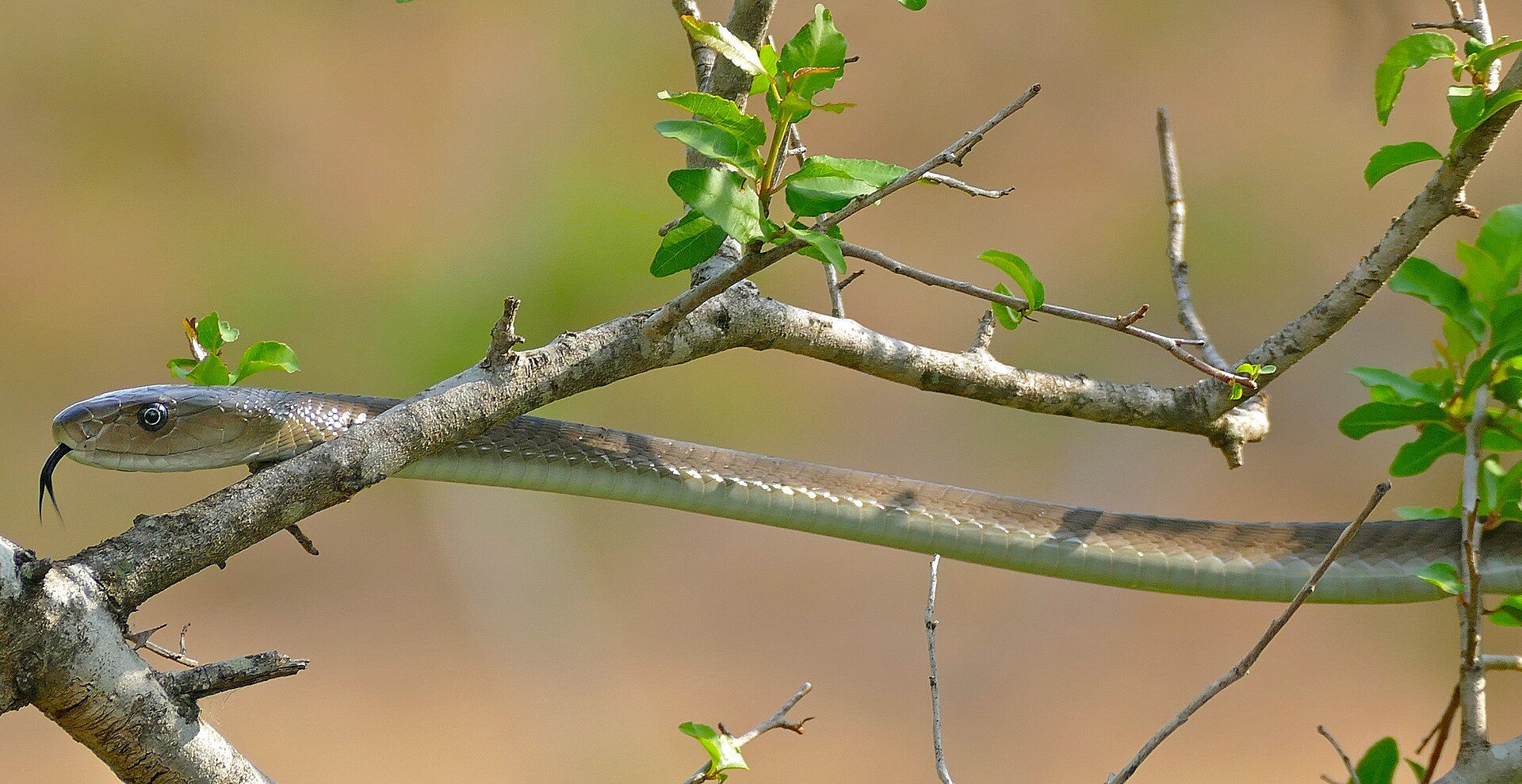
Photo: Bernard DUPONT / Wikimedia Commons (CC BY-SA 2.0)
In brief
The black mamba (Dendroaspis polylepis) is the longest venomous snake in Africa, capable of speeds up to 19 km/h, with a potent neurotoxic venom that is nearly 100% fatal if untreated — yet it is listed as Least Concern by the IUCN and remains ecologically important as a predator of rodents and small mammals across sub-Saharan Africa.
Also in Animals A to Z · Animals that start with B
By WARN Research & Conservation TeamLast updated
The black mamba (Dendroaspis polylepis) is Africa's longest venomous snake and one of the most mythologised reptiles on Earth. Despite its fearsome reputation, this sleek elapid is not black at all — its common name refers to the inky-dark interior of its open mouth, a threat display it uses before striking. Adults typically reach 2–2.5 metres, with exceptional individuals recorded at up to 4.3 metres. Found across the savannas, rocky hillsides, and woodland edges of sub-Saharan Africa, the black mamba is a fast-moving, predominantly diurnal predator that helps control rodent populations across some of the continent's most biodiverse ecosystems. Understanding this snake — its biology, its venom, and its true temperament — is the first step toward human-wildlife coexistence in the regions where it lives.
Up to 4.3 m
Maximum recorded length
16–19 km/h
Top speed (world's fastest land snake)
~100%
Untreated bite fatality rate
6–17 eggs
Typical clutch size per season
Figures sourced from IUCN Red List — Dendroaspis polylepis, Animal Diversity Web — Dendroaspis polylepis, Wikipedia — Black mamba and other references on this page.
Black Mamba: Quick Facts
| Average adult length | 2–2.5 m (up to 4.3 m) |
|---|---|
| Top speed | 16–19 km/h — world's fastest land snake (Guinness World Records) |
| Venom type | Neurotoxic (dendrotoxins + alpha-neurotoxins) |
| Clutch size | 6–17 eggs per season |
| Lifespan | ~11 years wild; 20+ years captivity |
| Primary prey | Rodents, birds, small mammals |
| Activity pattern | Diurnal (active by day) |
| IUCN status | Least Concern — population stable |
Scientific Classification
| Kingdom | Animalia |
|---|---|
| Phylum | Chordata |
| Class | Reptilia |
| Order | Squamata |
| Suborder | Serpentes |
| Family | Elapidae |
| Genus | Dendroaspis |
| Species | Dendroaspis polylepis (Günther, 1864) |
Conservation Status
- IUCN Status
- Least Concern
- Population
- No global estimate; locally common across sub-Saharan Africa
- Trend
- Stable
- Assessed
- 2021
- CITES
- Not listed
Faces localised pressure from habitat fragmentation and persecution; antivenom scarcity in rural range areas makes bites disproportionately fatal for communities living alongside this species.
Did you know?
Despite its reputation, a black mamba travels at 16–19 km/h — yet it almost never uses that speed to chase humans. When given the choice, it will always try to flee rather than fight, and most bites happen because someone accidentally blocked its escape route.
Key Facts: Black Mamba
- The black mamba is named for the dark interior of its open mouth, not its skin colour — its body is typically olive, grey, or brownish.
- It is the world's fastest land snake, capable of reaching 16–19 km/h according to Guinness World Records, though it uses speed primarily to flee rather than to pursue prey.
- Venom is predominantly neurotoxic, containing dendrotoxins and alpha-neurotoxins; without prompt antivenom treatment, a bite is considered almost universally fatal.
- Black mambas are shy and prefer to escape confrontation — the vast majority of bites occur when a snake is cornered, handled, or accidentally stepped on.
- The species plays a critical ecological role as a top predator controlling rodent and small-mammal populations throughout sub-Saharan savannas.
- Snakebite is a WHO-recognised Neglected Tropical Disease; antivenom shortages in sub-Saharan Africa mean that even survivable bites regularly cause preventable deaths.
What is the black mamba and how is it identified?
The black mamba (Dendroaspis polylepis) is a large, fast-moving, highly venomous snake belonging to the family Elapidae — the same group that includes cobras, mambas, and coral snakes. Its scientific name translates loosely to 'many-scaled tree asp', though adult black mambas are largely terrestrial. The common name is genuinely misleading: the snake's dorsal scales range from uniform olive and grey to brownish-khaki, occasionally with faint blue-grey iridescence. The characteristic 'blackness' is exclusively the dark blue-black lining of the open mouth — a dramatic gape used as a warning display when the snake feels threatened.
Adults average 2–2.5 metres in length, but specimens up to 4.3 metres have been recorded, making it the longest venomous snake native to Africa and the second longest in the world after the king cobra. The body is slender and slightly compressed, with a distinctive coffin-shaped head, smooth scales, and alert, round, medium-sized eyes. Black mambas lack a hood and do not rear up dramatically at rest; instead, they hold the front third of the body erect when threatened, mouth agape, before either fleeing or striking. The tail is long and tapers to a fine point. Juveniles are paler than adults and often have a greenish hue that darkens with age.
Where do black mambas live and what is their habitat?
Black mambas have one of the widest distributions of any African venomous snake, inhabiting a large arc of sub-Saharan Africa. Their confirmed range runs from Burkina Faso in West Africa through the horn of Africa — including Ethiopia, Somalia, and Kenya — and southward through Tanzania, Mozambique, Zimbabwe, Botswana, and into South Africa and Namibia. They are most abundant in southern and eastern Africa; presence further west, including unconfirmed historical sightings from Senegal, remains disputed.
Habitat preferences are varied but the species strongly favours open or semi-open environments: dry savanna, rocky hillsides, woodland edges, dense scrub, and bushy vegetation. The snake is largely terrestrial but is an adept climber and will ascend rocky outcrops, low trees, and tall shrubs in pursuit of prey or when seeking shelter. Unlike the more arboreal green mambas, the black mamba typically hunts on the ground.
Black mambas are strongly site-faithful: individuals return repeatedly to the same shelter — a rock crevice, a termite mound, or a hollow log — and may occupy the same retreat for years. Home ranges vary with habitat quality. In agricultural landscapes and areas of expanding human settlement, preferred habitat is being steadily fragmented, forcing snakes into contact with people more often. Elevation range extends from sea level to over 1,000 metres in suitable habitat across East Africa.
How dangerous is the black mamba's venom?
The black mamba's venom is among the most complex and rapidly acting of any snake. It is predominantly neurotoxic, composed of multiple components — principally dendrotoxins (which block voltage-gated potassium channels, causing sustained neuronal firing and involuntary muscle contractions) and alpha-neurotoxins (which block neuromuscular junctions, producing flaccid paralysis). A single defensive bite can deliver 100–120 mg of venom (dry weight), with very large individuals capable of delivering substantially more across repeated strikes.
Symptoms onset rapidly: tingling, sweating, hypersalivation, and abdominal pain can appear within ten minutes of a significant bite. Neurological collapse — confusion, ptosis, difficulty swallowing, and progressive respiratory paralysis — typically follows within 30–60 minutes. Without antivenom or mechanical ventilation, death from respiratory failure can occur in as few as 7 to 15 hours. Untreated black mamba envenomation is considered to carry a near-100% case fatality rate.
Antivenom is effective if given promptly and in adequate quantities, but in many rural areas of sub-Saharan Africa it remains dangerously scarce. The WHO designated snakebite envenoming a Neglected Tropical Disease in 2017 and set a target of halving global snakebite deaths and serious injuries by 2030. In sub-Saharan Africa alone, estimates suggest approximately 500,000 snakebite envenomings occur annually, resulting in around 20,000–32,000 deaths. The black mamba, as one of the continent's most medically significant species, sits at the heart of this public-health challenge.
What does the black mamba eat and how does it hunt?
The black mamba is a generalist carnivore and an efficient sit-and-ambush predator, though it will actively forage when prey density is low. Its diet consists primarily of warm-blooded vertebrates — small mammals including rodents, shrews, bats, and rock hyraxes, plus birds such as nestlings and fledglings raided from low vegetation. Hatchlings and juveniles begin with smaller lizards and small rodents, shifting toward larger prey as they grow.
The species is predominantly diurnal, hunting during daylight hours and returning to its shelter before nightfall. When prey is detected by its acute vision and chemosensory (Jacobson's organ) system, the mamba delivers a rapid, pre-emptive strike — often multiple strikes in quick succession — injecting venom before retreating. The fast-acting neurotoxin incapacitates prey within seconds, allowing the snake to track and swallow the animal headfirst without a prolonged struggle.
The black mamba's ecological role as a rodent predator is significant. In agricultural zones across southern and eastern Africa, mambas help limit populations of crop-raiding and disease-carrying rodents. Removing them from an ecosystem — as frequently occurs through persecution — can lead to rodent population spikes, with knock-on effects for both crops and zoonotic disease transmission. This makes the black mamba, despite its fearsome reputation, an ecologically valuable member of savanna and woodland communities.
What are the main threats facing the black mamba today?
The IUCN classifies the black mamba as Least Concern, reflecting its wide distribution and stable population trend across most of sub-Saharan Africa. However, localised pressures are eroding populations in certain parts of its range and warrant ongoing attention.
Habitat loss and fragmentation rank as the primary structural threat. Expanding agricultural land, urban growth, and road networks in southern and eastern Africa are steadily reducing the areas of intact savanna and rocky scrub that black mambas depend on. Habitat fragmentation also increases human-snake contact, which in turn elevates persecution risk.
Fear-driven killing is the most direct human threat. Black mambas near homesteads or farmland are routinely killed on sight, often by communities with good reason to be cautious about their venom but limited access to information about the snake's behaviour. Education programmes that teach people how to identify mambas, avoid bites, and respond appropriately to encounters reduce both human fatalities and retaliatory killings.
Road mortality, incidental capture in snare-based bushmeat hunting, and very limited use in traditional medicine represent additional, more minor pressures. The species is not currently the subject of significant commercial trade, and no CITES listing applies to it. The greatest near-term conservation concern is ensuring that antivenom access and snakebite education keep pace with human population growth in mamba-range countries.
What WARN Does
WARN does not currently run field projects for the black mamba, and this guide is offered as free educational content to support broader wildlife literacy. Understanding Africa's most misunderstood snake — and reducing fear-driven persecution through knowledge — is a conservation goal that benefits entire ecosystems. WARN's active rescue and conservation partnerships focus on its partner-network countries, but the organisation believes that public education about any threatened or ecologically critical species makes a meaningful difference wherever people care enough to read about them.
Wild Africa's ecosystems depend on predators like the black mamba to keep rodent populations in check — yet fear and misinformation mean thousands are killed every year. Supporting WARN helps fund the kind of wildlife education that turns fear into understanding, reducing persecution of misunderstood species the world over.
Black Mamba: Frequently Asked Questions
Is the black mamba really black?
How fast can a black mamba move?
What should you do if you are bitten by a black mamba?
Are black mambas aggressive toward humans?
What do black mambas eat?
Is the black mamba endangered?
Where do black mambas live?
How long do black mambas live?
How big is a black mamba?
Sources & References
Population figures, conservation status and biological facts on this page are drawn from authoritative scientific and intergovernmental sources.
- IUCN Red List — Dendroaspis polylepis
- Animal Diversity Web — Dendroaspis polylepis
- Wikipedia — Black mamba
- Guinness World Records — Fastest land snake
- Nature Communications — In vivo neutralization of dendrotoxin-mediated neurotoxicity (2018)
- Britannica — Black mamba
- National Geographic — Black Mamba facts and photos
- WHO — Snakebite envenoming fact sheet
- PMC — WHO strategy for prevention and control of snakebite envenoming: sub-Saharan Africa plan
Terms used on this page
Plain-English definitions, from our wildlife and conservation glossary.
Latest Black Mamba Stories
Quick, fact-checked reads on the black mamba — amazing facts, key questions and the threats it faces.
Species
Tiger vs Lion: 7 Key Differences Between the Two Biggest Cats
Tigers are bigger, stripier and solitary; lions are social and live in prides. Here's how the two largest cats really differ in size, habitat and behaviour.
Read the storySpecies
Snow Leopard vs Common Leopard: 6 Key Differences and How to Tell Them Apart
They share a name but are separate species. Coat, habitat, tail and even the ability to roar set the snow leopard apart from the common leopard.
Read the storySpecies
12 Astonishing Facts About the Pangolin, the World's Only Scaly Mammal
From a tongue anchored near its pelvis to scales that weigh a fifth of its body, the pangolin is one of nature's strangest mammals. Here are 12 facts that explain why.
Read the storyExplore more animals
Discover more animals, their habitats and their conservation status in the WARN wildlife-guide library.