Wildlife Guide · Brazil & Colombia
Capybara
Hydrochoerus hydrochaeris
The world's largest rodent — a gentle, water-loving giant of South America's wetlands.
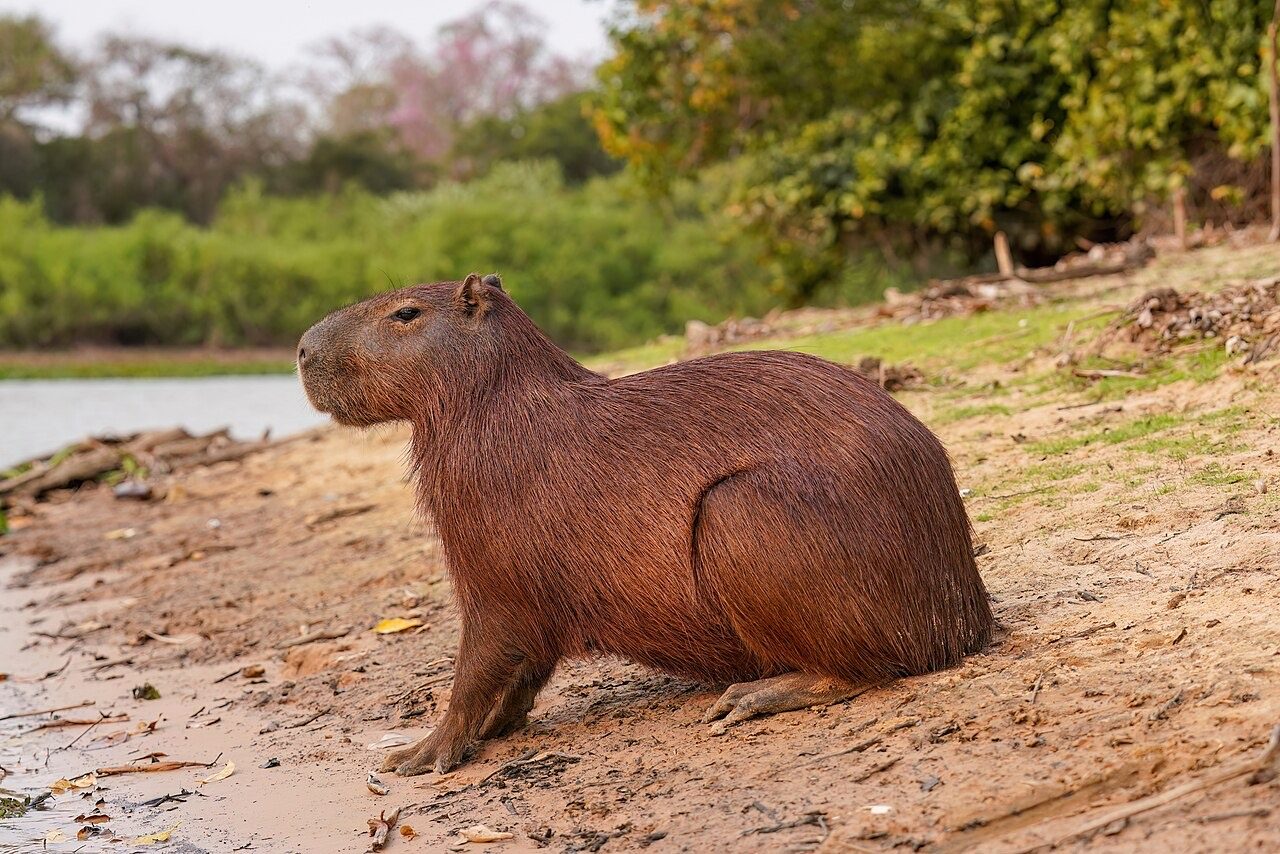
Source: Wikimedia Commons via Wikipedia “Capybara”
In brief
A capybara is the world's largest rodent, a semi-aquatic, plant-eating mammal native to South America that can weigh up to about 65 kilograms (140 pounds) and lives in social groups near rivers, lakes and wetlands.
Also in Animals A to Z · Animals that start with C
By WARN Research & Conservation TeamLast updated
The capybara (Hydrochoerus hydrochaeris) is the largest living rodent on Earth, a barrel-bodied, semi-aquatic mammal native to the wetlands, rivers and flooded grasslands of South America. Highly social, it lives in groups that graze on grasses and aquatic plants and dives into water to escape predators. Though listed by the IUCN as Least Concern across its wide range, capybaras are still heavily hunted for meat and hide in some regions and caught up in the exotic-pet trade.
~65 kg
Maximum weight — the heaviest of all rodents
Up to ~1.3 m
Body length of a large adult
~5 min
Time it can stay submerged underwater
Least Concern
IUCN Red List status (assessed 2016, population stable)
Figures sourced from IUCN Red List — Hydrochoerus hydrochaeris (Capybara), IUCN Red List assessment PDF — Capybara, Animal Diversity Web — Hydrochoerus hydrochaeris and other references on this page.
Capybara: Quick Facts
| Lifespan | ~8-10 years in the wild; up to ~12 in captivity |
|---|---|
| Weight | ~35-66 kg (77-146 lb) |
| Body length | ~106-134 cm (up to ~1.3 m) |
| Height at shoulder | ~50-62 cm |
| Diet | Herbivore — grasses, aquatic plants, fruit, bark |
| Gestation | ~130-150 days |
| Young per birth | ~4 pups (range 1-8) |
| Baby name | Pup |
| Group name | Herd / group (often 10-20 animals) |
| CITES | Not listed on CITES appendices |
Scientific Classification
| Kingdom | Animalia |
|---|---|
| Phylum | Chordata |
| Class | Mammalia |
| Order | Rodentia |
| Family | Caviidae |
| Genus | Hydrochoerus |
| Species | Hydrochoerus hydrochaeris (Linnaeus, 1766) |
Conservation Status
- IUCN Status
- Least Concern
- Population
- No reliable global estimate; population presumed large and widely distributed
- Trend
- Stable
- Assessed
- 2016
- CITES
- Not listed on the CITES appendices
Globally Least Concern, but some local populations are depleted by over-hunting for meat and hide and by wetland loss; the species is also taken for the exotic-pet trade.
Did you know?
Capybaras can sleep in water, keeping just their nose above the surface, and can hold their breath and stay fully submerged for up to about five minutes to hide from predators.
Key Facts: Capybara
- The capybara is the largest rodent in the world, with big adults reaching around 1.3 m long and up to roughly 65 kg.
- It is semi-aquatic: webbed feet make it a strong swimmer, and it can stay submerged for up to about five minutes to hide from predators.
- Capybaras are highly social, living in groups of around 10-20 animals (occasionally up to 50-100 in the dry season).
- They are herbivores that graze on grasses and aquatic plants, and like other rodents have continuously growing teeth.
- The IUCN lists the species as Least Concern with a stable population, but local populations decline where hunting and habitat loss are intense.
- Main pressures are hunting for meat and hide, wetland habitat loss to agriculture, and capture for the exotic-pet trade.
Behaviour and ecology
Capybaras are built for life around water. Their eyes, ears and nostrils sit high on the head so they can stay alert while mostly submerged, and partially webbed feet make them powerful swimmers that can stay underwater for several minutes to escape jaguars, caimans, anacondas and eagles. They are social grazers, feeding mainly on grasses and aquatic plants during cooler parts of the day and wallowing in water through the midday heat. Groups are typically led by a dominant male and structured around females and young; like other caviids they communicate with a range of barks, whistles, purrs and clicks. As bulk grass-eaters they practice coprophagy (re-ingesting their own droppings) to extract more nutrients from fibrous plants.
Reproduction and young
Capybaras can breed year-round where conditions are good, often peaking with the rains. After a gestation of roughly 130-150 days, a female gives birth to a litter that averages about four pups but can range from one to eight. The young are precocial — born well-developed, eyes open and able to walk, swim and nibble vegetation within hours — and are often cared for communally, nursing from several females in the group. In the wild many capybaras live only a few years because of heavy predation, though survivors and captive animals can reach roughly 8-12 years.
Conservation status and threats
Across its large South American range the capybara is assessed by the IUCN as Least Concern, with a population that is large, widely distributed and overall stable. That headline can be misleading at the local scale: the species is hunted intensively for its meat and leather in parts of its range, and some local populations have been depleted by over-hunting and by the draining and conversion of wetlands for agriculture and cattle. Capybaras are also captured for the exotic-pet trade. The species is not listed on the CITES appendices, so international trade is not controlled at the species level — meaning local management and habitat protection do most of the conservation work.
What rescue and protection involve
Protecting capybaras is mostly about protecting wetlands and managing hunting sustainably rather than captive breeding. On-the-ground work includes safeguarding rivers, lakes and seasonally flooded grasslands, reducing illegal and unsustainable hunting, rehabilitating animals seized from the pet trade, and easing conflict where capybaras graze on farmland. Because the species shares its wetlands with many others — fish, caimans, water birds and aquatic plants — keeping capybara habitat healthy benefits whole ecosystems, which is why habitat-focused conservation is the most effective lever for this species.
Capybara vs lesser capybara: how to tell them apart
| Feature | Capybara (Hydrochoerus hydrochaeris) | Lesser capybara (Hydrochoerus isthmius) |
|---|---|---|
| Maximum size | Up to ~1.3 m long; up to ~65 kg | Up to ~0.9 m long; up to ~28 kg |
| Coat | Reddish-brown to grey-brown | Generally darker brown |
| Main range | Most of South America east of the Andes, including Brazil and Colombia | East Panama, western Colombia and Venezuela, west of the Andes |
| IUCN status | Least Concern (2016) | Data Deficient |
| Status note | World's largest rodent; widespread and stable | Smaller, less-studied species split off in the 1980s |
What WARN Does
WARN publishes this guide for education and is developing support through assessed animal-welfare grants. A species range, source citation or photograph does not establish a recipient or funding agreement. Check /about/where-your-money-goes/#grant-register for published grant and payment records; records not yet published must not be read as zero activity. Browse /appeals/ for the purposes currently available to support.
Across Brazil and Colombia, healthy wetlands are what keep capybaras — and the rivers, birds and fish around them — thriving. A gift to WARN helps fund the local partners protecting that habitat and caring for animals rescued from the pet trade in the capybara's home range.
Capybara: Frequently Asked Questions
How long do capybaras live?
What do capybaras eat?
How big do capybaras get?
Are capybaras dangerous to humans?
How many capybaras are left in the wild?
What is a baby capybara called?
Where do capybaras live?
Sources & References
Population figures, conservation status and biological facts on this page are drawn from authoritative scientific and intergovernmental sources.
Terms used on this page
Plain-English definitions, from our wildlife and conservation glossary.
Latest Capybara Stories
Quick, fact-checked reads on the capybara — amazing facts, key questions and the threats it faces.
Species
12 Amazing Facts About the Capybara, the World's Largest Rodent
From holding its breath underwater to napping with just its nose above the surface, here are 12 surprising, well-sourced facts about the gentle giant of South America's wetlands.
Read the storySpecies
How Big Is a Capybara? Size, Weight and How It Swims
A capybara can reach the size of a large dog and the weight of an adult human. Here is how big the world's largest rodent really gets, with verified measurements.
Read the storySpecies
Are Capybaras Dangerous? Bites, Behaviour and Safe Encounters
Capybaras can bite. Learn how to observe wild animals, assess captive encounters and respond appropriately if someone is injured.
Read the storyExplore more animals
Discover more animals, their habitats and their conservation status in the WARN wildlife-guide library.