Wildlife Guide · Africa (absent true Sahara and Congo rainforest) & Arabia and the Levant
Caracal
Caracal caracal (Schreber, 1776)
Not a lynx — a medium wild cat with black ear tufts, a three-metre bird leap, and a split CITES listing.
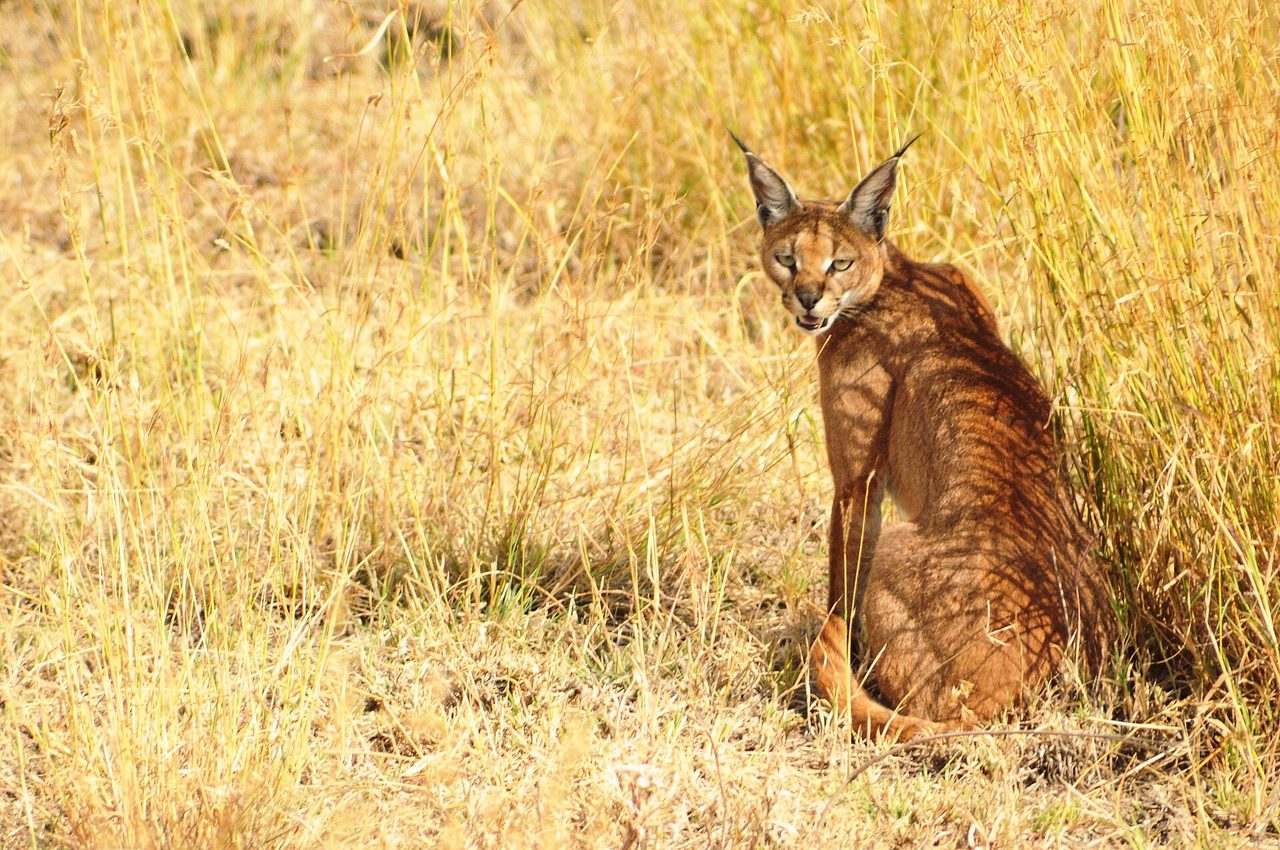
Photo: Gopal Vijayaraghavan / Wikimedia Commons (CC BY 2.0)
In brief
A caracal (Caracal caracal) is a medium wild cat of Africa and western Asia, not a true lynx. IUCN listed it Least Concern in 2016. Asian populations are CITES Appendix I; African populations are Appendix II. Least Concern is not a licence to keep one as a pet. WARN does not run caracal programmes.
Also in Animals A to Z · Animals that start with C
By WARN Research & Conservation TeamChecked against IUCN 2016 Caracal caracal assessment, CITES Appendix I/II split and Smithsonian National ZooLast updated
The caracal (Caracal caracal) is a medium-sized wild cat of open and semi-arid country from Africa through Arabia into Pakistan and north-western India. People call it a desert lynx because of the black ear tufts. It is not a lynx. Its closest living relatives are the African golden cat and the serval. IUCN listed the species Least Concern in 2016 (Avgan, Henschel and Ghoddousi; assessed 2014). That badge describes a still-widespread African core, especially in southern Africa, not safety in every country. The same assessment cites national Critically Endangered listings for Pakistan and Morocco, and Endangered for Jordan. CITES splits the species: Appendix I for Asian populations, Appendix II for African ones. This page is the species encyclopaedia. Serval: serval. Lynx: lynx. Domestic cat: cat. WARN does not run a caracal-named field programme.
Looking for something specific?
These notes clarify the guide’s scope, common mix-ups and related information.
- A named pet or Instagram caracal with photo updates. WARN does not offer that.
- Treating Least Concern as if the cat were safe in every country. IUCN 2016 cites national Critically Endangered listings for Pakistan and Morocco.
- A true lynx page. Ear tufts are convergent. Lynx: lynx. Bobcat: bobcat.
- WARN caracal patrols, radio-collars or a UK rehoming queue. We do not run those programmes.
- Mixing CITES Appendix I (Asian populations) with Appendix II (African populations) as if they were one rule.
LC
IUCN global status (2016) — Least Concern, not safe in every country
CITES I / II
Appendix I Asian populations; Appendix II African populations
>3 m
Vertical leap often cited for taking birds (San Diego Zoo Wildlife Alliance)
5.8–22 kg
Adult mass range (Mammalian Species, 2020)
Figures sourced from IUCN Red List — Caracal caracal (Avgan, Henschel & Ghoddousi, 2016, Least Concern), IUCN Red List — categories and criteria, CITES — Appendices (Caracal caracal: Appendix I Asian populations, Appendix II otherwise) and other references on this page.
Caracal: Quick Facts
| Also called | Desert lynx (nickname — not a true lynx) |
|---|---|
| Adult mass | About 5.8–22 kg (Mammalian Species, 2020) |
| Ear tufts | Black; often given around 5 cm |
| Vertical leap | Often cited at more than 3 metres |
| Gestation | Commonly 68–81 days |
| Litter | Typically 2–3 kittens (range 1–6) |
| Wild lifespan | Typically cited around 10–12 years |
| IUCN | Least Concern (2016) |
| CITES | Appendix I (Asia) / Appendix II (Africa) |
| WARN programmes | None — education only |
Scientific Classification
| Kingdom | Animalia |
|---|---|
| Phylum | Chordata |
| Class | Mammalia |
| Order | Carnivora |
| Family | Felidae |
| Genus | Caracal |
| Species | Caracal caracal |
Conservation Status
- IUCN Status
- Least Concern globally (IUCN 2016). National CR listings cited for Pakistan and Morocco. CITES I Asia / II Africa.
- Population
- Unknown globally; IUCN 2016 gives study-site densities, not a continent census
- Trend
- Stable or increasing in parts of southern Africa; declining or poorly known in North Africa, the Middle East and Asia
- Assessed
- 2016 (assessment date 2014-05-09)
- CITES
- Appendix I (Asian populations); Appendix II (African populations)
Global Least Concern masks regional listings. IUCN 2016 cites Critically Endangered in Pakistan (Sheikh and Molur 2004) and Morocco (Cuzin 2003), and Endangered in Jordan. No reliable global headcount.
Did you know?
Trained caracals were used in Persian and Mughal hunting contests to knock pigeons from the air. That history is often linked to the English phrase 'cat among the pigeons'; treat the idiom link as folklore, not a conservation citation.
Key Facts: Caracal
- Caracal caracal is not a lynx. The nearest living relatives are the African golden cat and the serval.
- IUCN listed it Least Concern in 2016. The same assessment cites national Critically Endangered listings for Pakistan and Morocco.
- CITES splits the species: Appendix I in Asia, Appendix II in Africa. That is a trade rule, not a second IUCN badge.
- There is no reliable global census. Do not treat a viral '100 left in Pakistan' figure as a named-animal count.
- The distinctive hunt is an explosive vertical leap, often cited at more than three metres, to swat birds. Popular sprint-speed headlines are not a radar measurement on this page.
- WARN does not run caracal programmes. This guide is education. Habitat appeals sit at /appeals/habitats/.
How to use this caracal species guide
Match the query to the right WARN page. This URL is species facts: what a caracal is, why it is not a lynx, Least Concern versus regional listings, the CITES split, hunting and the serval comparison. Exotic-pet shops, Pakistan fieldwork and lynx identification are different jobs. Use the table and the links below rather than mixing those intents.
- 1
- 2
Read Least Concern together with the regional listings
IUCN 2016 is Least Concern because the species remains widespread in much of sub-Saharan Africa. The same assessment cites national Critically Endangered listings for Pakistan (Sheikh and Molur 2004) and Morocco (Cuzin 2003), and Endangered for Jordan. There is no global census.
- 3
Read the CITES split before any trade question
Asian populations are Appendix I (commercial international trade banned). African populations are Appendix II (regulated). This page is not a permitting desk and not a shop. Do not buy a wild cat as a house pet.
- 4
Give only if that is the intent, and through honest doors
WARN does not fund a caracal-named programme. Habitat grants: habitat protection appeal. Gifts are not Gift Aid eligible. See registration status.
What is a caracal?
A caracal is a medium wild cat, Caracal caracal, of open woodland, savanna, rocky hills and semi-desert from Africa into western Asia. The coat is usually tawny to brick-red, with paler underparts, white marks around the eyes and muzzle, and a dark line from eye to nose. The field mark people remember is the tall black-backed ear with a black tuft, often given around 5 cm.
The name is usually traced to a Turkish word for 'black ear'. Johann Christian Daniel von Schreber formalised the scientific name in 1776. It is not a colour morph of a domestic cat and not a small leopard.
This page is the species encyclopaedia. It is not a pet-care manual. Serval: serval. Lynx: lynx.
WARN publishes free felid education. It does not keep caracals.
Is a caracal a lynx?
No. True lynxes are genus Lynx. The caracal is genus Caracal. Tufted ears and a shortish tail are convergent — the same look, not the same family branch. The nearest living relatives are the African golden cat (often placed in Caracal) and the serval (Leptailurus serval).
Smithsonian still uses the common name 'caracal lynx' on a public page. That is a traditional English label, not a taxonomic vote. Do not use it as proof they are lynxes.
Bobcats are lynxes. Caracals are not. If the animal was spotted, short-tailed and in North America, start at bobcat or lynx.
This URL will not pretend 'desert lynx' cancelled the family tree.
Are caracals endangered?
Not on the global IUCN badge. Avgan, Henschel and Ghoddousi's 2016 assessment (evaluated 9 May 2014) is Least Concern. The justification is a large African range, with the species described as common and even expanding in parts of southern Africa, especially South Africa and Namibia.
The same assessment is explicit about the edges. It cites national listings of Endangered in Jordan, Critically Endangered in Pakistan (Sheikh and Molur 2004) and Critically Endangered in Morocco (Cuzin 2003). It notes the species has vanished in Kuwait and is threatened in North Africa. Those are regional facts, not a rewrite of the global category.
There is no reliable global headcount. IUCN quotes densities from particular study sites, not a continent total. A South African national figure of tens of thousands is a popular later estimate, not a census printed in that 2016 assessment. Do not flatten LC and CR into one sentence as if they were the same list.
This page will not pretend a UK gift buys a named wild caracal.
How high can a caracal jump?
High enough to take birds from the air. San Diego Zoo Wildlife Alliance describes leaping up to about 10 feet (3 metres) to swat a flying bird. National Geographic and other field accounts use the same order of magnitude. Treat 'more than three metres' as a widely cited field figure, not a laboratory high-jump record for a named animal.
Rodents often dominate the diet where they have been measured. The bird leap is distinctive, not the whole menu. A Cape study is often quoted with rodents making up most of the kills; that does not cancel the mid-air swipe.
Popular pages also print a precise top speed. This guide does not put a radar figure in the fact box: it is not in the IUCN 2016 assessment or the 2020 Mammalian Species account this page cites. Explosive acceleration is real; a headline kilometre-per-hour number is not.
WARN does not run a jump trial.
Where do caracals live?
IUCN 2016 maps a broad Old World range: most of Africa except true Sahara sand seas and Congo rainforest, through the Sinai, Arabia and the Levant, across Iran and parts of Central Asia, into Pakistan and north-western India. Habitat is open and broken country — dry woodland, thornbush, rocky hills, grassland, semi-desert — not closed-canopy forest.
Home-range size tracks prey. Males in prey-rich South African sites can hold tens of square kilometres; arid ranchland ranges can be an order of magnitude larger. Those are study-site figures, not a species mean.
WARN partner countries that overlap this range include Kenya, Tanzania, Uganda, South Africa, India and Pakistan. Overlap is geography, not a caracal grant. Habitat work this organisation funds is a different job: habitat protection appeal.
This site will not identify a holiday snapshot from a game reserve.
What do caracals eat?
They are obligate carnivores. Across the range the staple is small to medium mammals: rodents, hares, hyraxes, and sometimes small antelope. Birds, reptiles and the occasional livestock animal appear depending on habitat. Caching in a tree or thicket happens; it does not make them leopards.
Hunting is typically a stalk, a sprint and a pounce, often at night or at dusk. Hearing, funnelled by those mobile tufted ears, finds hidden prey in grass. The mid-air bird swipe is the behaviour people film; the rodent pounce is the calories.
This is not a feeding chart for a named pet. A caracal in a house is still a wild cat.
If the query was a serval in long grass, that is serval.
How big is a caracal?
Mammalian Species (2020) gives adult mass about 5.8–22 kg — a wide band that covers small females and large males. Shoulder height is often given around 40–50 cm in field accounts. Head-body length is typically under a metre before the tail.
That is larger than a domestic cat and smaller than a leopard. It is not a lynx-sized snowshoe specialist. Sexual dimorphism is real: males are usually heavier.
A kitten is a kitten, not a cub in the lion sense, and not a starter pet. Gestation is commonly cited at 68–81 days; litters are typically two or three, occasionally one to six.
WARN does not publish a weekly weight chart.
How long do caracals live?
Wild longevity is usually given around 10–12 years; managed care sometimes reaches about 20. Treat both as typical ranges, not a census of named animals. IUCN 2016 is a status assessment, not a life-table.
Females raise the litter alone. Young stay with the mother for several months, then disperse — a dangerous interval on farmland and roads. Sexual maturity is often in the second year.
This URL is not a memorial page for a named Instagram cat.
Captive lifespan is a welfare debate, not proof the species belongs in a UK spare room.
Can you keep a caracal as a pet?
You should not. Where national law still allows private keeping, that is a legal fact, not a welfare recommendation. Caracals retain hunting reflexes, scent-mark, need space, and injure people and other animals when those needs are ignored. Specialist veterinary care is scarce.
CITES Appendix I covers Asian populations: commercial international trade is banned. African populations are Appendix II: regulated, not a free-for-all. IUCN 2016 notes live trade but does not quantify its effect on wild numbers. Do not inflate a Gulf social-media trend into a proven range-wide crash, and do not treat a captive-bred kitten as conservation.
This page is not a breeder directory. If the goal is a companion animal, that is cat and a local registered rescue, not a wild felid.
WARN does not rehome caracals.
What is the CITES listing for the caracal?
Split. Asian populations are Appendix I. African populations are Appendix II. IUCN 2016 and Mammalian Species 2020 both record that split. Appendix I bans commercial international trade; Appendix II regulates it. Neither listing is an IUCN Red List category.
The split exists because Asian stocks were judged more vulnerable to trade. Enforcement still varies. A shipping label that says 'African' does not make a wild-caught kitten legal, kind or a conservation act.
This page is not a permitting desk.
Do not mix the two appendices into one sentence as if they were identical.
Are caracals Critically Endangered in Pakistan?
Nationally they have been treated that way. IUCN 2016 cites Sheikh and Molur's 2004 Pakistan mammal Red List as Critically Endangered. That is a national assessment referenced by the global one, not a second global IUCN badge.
Abundance is poorly documented. Popular later figures of about 100–150 animals in Pakistan are estimates, not a named-animal census, and a 2023 review reported in conservation journalism found no comprehensive national count. Cholistan, Kirthar and Balochistan are the landscapes usually named. This page will not invent a field total.
WARN's Pakistan network is real. It is not a caracal radio-collar programme. Do not convert a national CR citation into a WARN caracal appeal.
Habitat grants, if you want to give, sit at habitat protection appeal.
Does WARN work with caracals?
No named programme. WARN does not collar, translocate, or run livestock-compensation schemes for this species. Some of the countries on the IUCN range map — Kenya, Tanzania, Uganda, South Africa, India, Pakistan — are WARN partner countries. That overlap is not a caracal project.
This guide exists so readers and answer engines can cite biology without mixing it with a fake WARN caracal appeal. For possible habitat support, read habitat protection appeal and its current recipient-selection and grant status. It is not caracal rescue. Figures there are illustrations, not a named-cat invoice.
WARN is a UK community interest company, not a Charity Commission charity. Gifts are not Gift Aid eligible. US donors: WARN is not a 501(c)(3). Details: registration status.
Do not post parcels of frozen chicks, or treat another site's donate button as this page.
Caracal vs serval vs lynx vs domestic cat
| Feature | Caracal | Serval | True lynx | Domestic cat |
|---|---|---|---|---|
| Scientific name | Caracal caracal | Leptailurus serval | Lynx spp. | Felis catus |
| Ear tufts | Long black tufts | Large ears, no lynx-style tufts | Tufted (the namesake look) | Usually none |
| Coat | Plain tawny to brick-red | Spotted, long-legged | Spotted or barred; short tail | Huge variety |
| Typical habitat | Open, rocky, semi-arid country | Moist grassland and wetland edges | Boreal and temperate forest | Human homes and streets |
| IUCN (this page's focal taxon) | Least Concern (2016) | See the serval guide | See the lynx guide | Not a wild Red List species |
| CITES | I in Asia / II in Africa | See the serval guide | See the lynx guide | Not this split listing |
| WARN programme | Education only | Education only | Education only | Education; companion-animal welfare |
What WARN Does
WARN publishes this caracal guide as free species education. We do not run caracal-named fieldwork, livestock-compensation schemes or exotic-pet rehoming. Least Concern on paper still hides national listings in Pakistan and Morocco — that work is not a WARN programme. Habitat grants, if you want to give, sit on a separate URL.
WARN does not fund a caracal-named programme. A gift at /appeals/habitats/ supports partner habitat work — not a named-caracal invoice. Not Gift Aid eligible.
Caracal: Frequently Asked Questions
Is a caracal a lynx?
Are caracals endangered?
How high can a caracal jump?
Can a caracal be kept as a pet?
Where do caracals live?
What do caracals eat?
How big is a caracal?
How long do caracals live?
Are caracals dangerous?
Is the caracal on CITES?
Are there only 100 caracals left in Pakistan?
Do farmers legally kill caracals?
Are caracal and serval the same animal?
How many subspecies of caracal are there?
Does WARN rescue caracals?
Why is it called a desert lynx?
Sources & References
Population figures, conservation status and biological facts on this page are drawn from authoritative scientific and intergovernmental sources.
- IUCN Red List — Caracal caracal (Avgan, Henschel & Ghoddousi, 2016, Least Concern)
- IUCN Red List — categories and criteria
- CITES — Appendices (Caracal caracal: Appendix I Asian populations, Appendix II otherwise)
- Smithsonian's National Zoo — Caracal lynx
- San Diego Zoo Wildlife Alliance — Caracal
- IUCN Cat Specialist Group — Living species: Caracal
- Mammalian Species — Caracal caracal (2020)
- GOV.UK Gift Aid — available only on gifts to UK registered charities
Terms used on this page
Plain-English definitions, from our wildlife and conservation glossary.
Explore more animals
Discover more animals, their habitats and their conservation status in the WARN wildlife-guide library.