Wildlife Guide · Madagascar & Sub-Saharan Africa
Chameleon
Chamaeleonidae
Independently swivelling eyes, a tongue faster than a blink, and colour change that talks rather than hides.
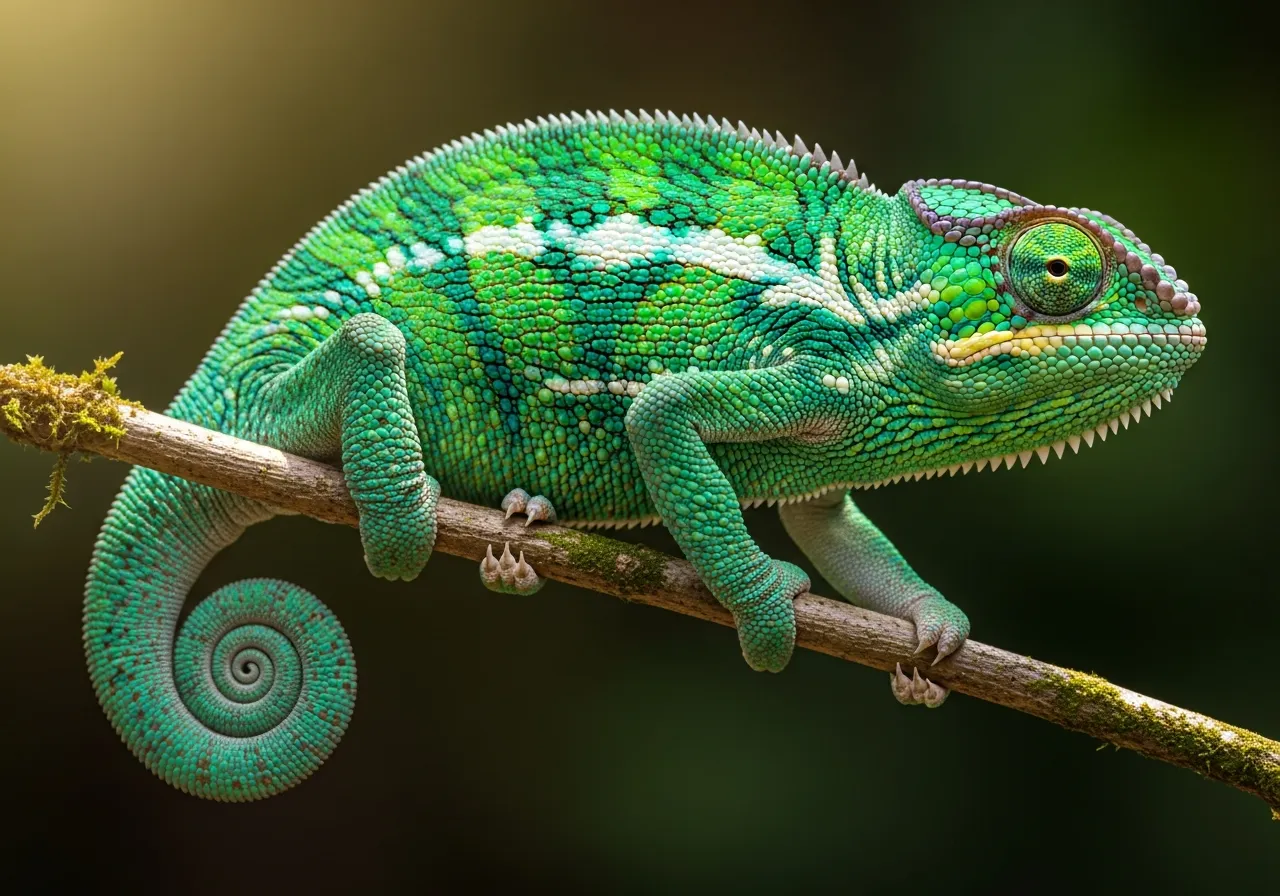
Source: Global Animal Guide (WARN)
In brief
A chameleon is an arboreal lizard of the family Chamaeleonidae, with around 200 species, about half found only in Madagascar. They are known for independently moving eyes, a fast projectile tongue, gripping feet, a prehensile tail and colour change used mainly for communication and temperature control.
Also in Animals A to Z · Animals that start with C
By WARN Research & Conservation TeamLast updated
Chameleons are a distinctive family of mostly tree-dwelling lizards (Chamaeleonidae) famous for changing colour, swivelling each eye independently and firing a long, sticky tongue to catch prey. Around 200 species have been described, ranging from a thumbnail-sized leaf-litter dweller to a lizard nearly 70 cm long. Roughly half of all species live only in Madagascar, with most of the rest across mainland Africa and a handful reaching southern Europe, the Middle East, India and Sri Lanka. Specialised for life in branches, they have gripping, pincer-like feet and a prehensile tail. Their famous colour change is used mainly to communicate mood and to control body temperature, not chiefly as camouflage.
~200
described species
~50%
found only in Madagascar
0.07s
tongue strike to prey
360°
independent eye vision
Figures sourced from Chameleon - Wikipedia, IUCN Red List (search Chamaeleonidae), CITES Appendices and other references on this page.
Chameleon: Quick Facts
| Scientific name | Chamaeleonidae (family) |
|---|---|
| Number of species | ~200, in about 10-12 genera |
| Size | From ~22 mm (Brookesia nana) to ~68.5 cm (Furcifer oustaleti) |
| Lifespan | Varies by species, roughly 3-10+ years |
| Diet | Mainly insects; larger species also take small vertebrates and some plants |
| Habitat | Rainforest, cloud forest, dry woodland, scrub; mostly arboreal |
| Range | Madagascar, sub-Saharan Africa, southern Europe, Middle East, South Asia |
| Reproduction | Most lay eggs; some montane species give birth to live young |
| Tongue strike | As little as 0.07 seconds to reach prey |
| Vision | Eyes move independently for near-360° view |
Scientific Classification
| Kingdom | Animalia |
|---|---|
| Phylum | Chordata |
| Class | Reptilia |
| Order | Squamata |
| Suborder | Iguania |
| Family | Chamaeleonidae |
| Genera | ~10-12 (e.g. Chamaeleo, Furcifer, Calumma, Brookesia) |
Conservation Status
- IUCN Status
- Varies by species across the ~200-species family. Many are of lower concern, but a substantial number of narrow-range species, especially in Madagascar and African montane forests, are assessed as threatened, some Critically Endangered. Habitat loss is the principal threat, with the pet trade affecting some species.
- Population
- No family-wide estimate; assessed species by species on the IUCN Red List
- Trend
- Declining for many species, driven mainly by habitat loss
- Assessed
- Assessed per species; family-wide figure not applicable
- CITES
- Most species listed on CITES Appendix II
Because many chameleons depend on small areas of specialised forest, clearing that habitat can threaten an entire species at once, making forest protection central to their survival.
Did you know?
A chameleon's tongue can hit its target in about 0.07 seconds - so quick that, relative to its weight, its strike out-accelerates a fighter jet, exceeding 40 G.
Key Facts: Chameleon
- Chameleons (family Chamaeleonidae) number around 200 species, roughly half of which live only in Madagascar.
- Their colour change mainly signals mood and regulates temperature, rather than hiding them from predators.
- Each eye moves independently for near-360° vision, then both lock forward for stereoscopic aim before a strike.
- The projectile tongue can reach prey in as little as 0.07 seconds and extend well beyond body length.
- Gripping, pincer-like feet and a prehensile tail make them superb climbers in trees and shrubs.
- Conservation status varies by species; habitat loss and collection for the pet trade threaten many, and most are CITES-listed.
How chameleons change colour - and why
Chameleons change colour using layers of specialised skin cells. Beneath the pigment-bearing cells lie nanocrystal-packed cells called iridophores; by actively spacing or tightening these crystals, a chameleon shifts which wavelengths of light are reflected, sweeping its skin from greens and blues toward yellows, oranges and reds. Pigment movement adds further tones. Contrary to popular belief, the primary purpose is not camouflage. Colour change is chiefly a language: males flush bright, bold patterns to display dominance or court mates, and turn dark when submitting or stressed. It also helps with thermoregulation, as a chameleon can darken to absorb more warmth in cool conditions or pale to reflect heat. Many species do rest in greens and browns that blend with foliage, so background-matching plays a supporting role, but the showiest changes are about signalling and body temperature, not invisibility. The speed and vividness vary widely between species, with some of the most dramatic displays seen in larger Madagascan and African chameleons.
Built for the branches: eyes, tongue and grip
Few animals are as specialised for ambush hunting in trees as a chameleon. Its eyes sit in cone-shaped, scaly turrets that rotate independently, giving an almost complete field of view so it can scan for insects and predators at once. Once prey is spotted, both eyes converge to judge distance with precise stereoscopic vision. Then comes the tongue: a muscular, spring-loaded structure that launches faster than the eye can follow, striking prey in as little as 0.07 seconds and, in small species, extending more than twice the body length. A sticky, suction-like tip secures the catch and reels it back. Underpinning all this is a body made for climbing. The toes are fused into opposing bundles, two against three, forming pincers that clamp around twigs, while the prehensile tail coils like a fifth limb for extra anchorage. Most chameleons move slowly and deliberately, sometimes rocking as they walk to mimic a leaf swaying in the breeze.
Where chameleons live and what they eat
Chameleons are overwhelmingly Old World animals. Madagascar is their heartland, home to about half of all species, with many found nowhere else on Earth. The remainder occur across sub-Saharan Africa, with a single species reaching southern Europe and a few extending through the Middle East to India and Sri Lanka; introduced populations also persist in places such as Hawaii and Florida. They occupy habitats from rainforest and montane cloud forest to dry woodland and even semi-desert scrub, and a few tiny species live in leaf litter rather than trees. Most are insectivores, picking off grasshoppers, crickets, flies and other invertebrates, though the largest species will take small birds, lizards and even the occasional fruit or leaf. Reproduction varies: many lay eggs, burying clutches in soil, while some montane species give birth to live young. Lifespans differ by species, commonly spanning roughly three to about ten years, with smaller species tending to live shorter lives.
Why chameleons are under pressure
There is no single conservation status for chameleons, because the family spans roughly 200 species with very different fortunes. Some are widespread and of low concern, while others, particularly narrow-range species in Madagascar and Africa's montane forests, are assessed as threatened or even Critically Endangered. The overriding problem is habitat loss: forests are cleared for farmland, fuel and timber, and because so many chameleons live only in small patches of specialised habitat, losing those forests can imperil an entire species at once. Collection for the international pet trade adds further pressure on some sought-after species, which is why most chameleons are listed on CITES Appendix II to regulate cross-border trade. Climate change compounds the risk for cool, high-altitude specialists with nowhere cooler to go. Because they depend so completely on intact forest, chameleons are useful indicators of habitat health: protecting the forests they need also safeguards countless other species that share those landscapes.
Chameleon vs typical lizard: what sets chameleons apart
| Feature | Chameleon | Typical lizard |
|---|---|---|
| Eyes | Move independently in turrets; near-360° vision | Move together; fixed forward field |
| Tongue | Projectile, strikes in ~0.07s, longer than body | Short; not projectile |
| Feet | Toes fused into opposing pincers for gripping | Separate clawed toes |
| Tail | Prehensile, used as a fifth limb | Usually not prehensile |
| Colour change | Active, for signalling and temperature | Limited or none in most species |
| Lifestyle | Mostly slow, arboreal ambush hunters | Often fast, ground-dwelling |
What WARN Does
World Animal Rescue Network does not currently run field projects specifically for chameleons, which live mainly outside the countries where WARN's partners work partner countries. This guide is part of WARN's free educational and awareness work, helping people understand and value lesser-known wildlife. The same pressures that threaten chameleons - especially habitat loss - also affect the animals WARN does protect, so supporting habitat and wildlife work has benefits that reach far beyond any single species.
If you would like to help, supporting WARN's habitat and wildlife work is a gentle way to stand up for the forests and the creatures, large and small, that depend on them.
Chameleon: Frequently Asked Questions
Why do chameleons change colour?
How fast is a chameleon's tongue?
Where do chameleons live?
How many species of chameleon are there?
What do chameleons eat?
Are chameleons endangered?
Are chameleons dangerous?
How long do chameleons live?
How big is a chameleon?
Sources & References
Population figures, conservation status and biological facts on this page are drawn from authoritative scientific and intergovernmental sources.
Terms used on this page
Plain-English definitions, from our wildlife and conservation glossary.
Latest Chameleon Stories
Quick, fact-checked reads on the chameleon — amazing facts, key questions and the threats it faces.
Species
Tiger vs Lion: 7 Key Differences Between the Two Biggest Cats
Tigers are bigger, stripier and solitary; lions are social and live in prides. Here's how the two largest cats really differ in size, habitat and behaviour.
Read the storySpecies
How Big Is a Markhor? Size, Weight and Those Giant Corkscrew Horns
The markhor is the largest wild goat on Earth. Here is exactly how big it gets — height, weight and the record-setting spiral horns.
Read the storySpecies
Markhor vs Ibex: How to Tell These Wild Mountain Goats Apart
Both are wild mountain goats with impressive horns, but the markhor and the ibex differ in size, horn shape and range. Here's how to tell them apart.
Read the storyExplore more animals
Discover more animals, their habitats and their conservation status in the WARN wildlife-guide library.