Wildlife Guide · North America & Asia
Chipmunk
Tamias striatus (eastern); Neotamias spp. (western); Eutamias sibiricus (Siberian)
Nature's underground seed-banker — tiny, tireless, and essential to forest renewal
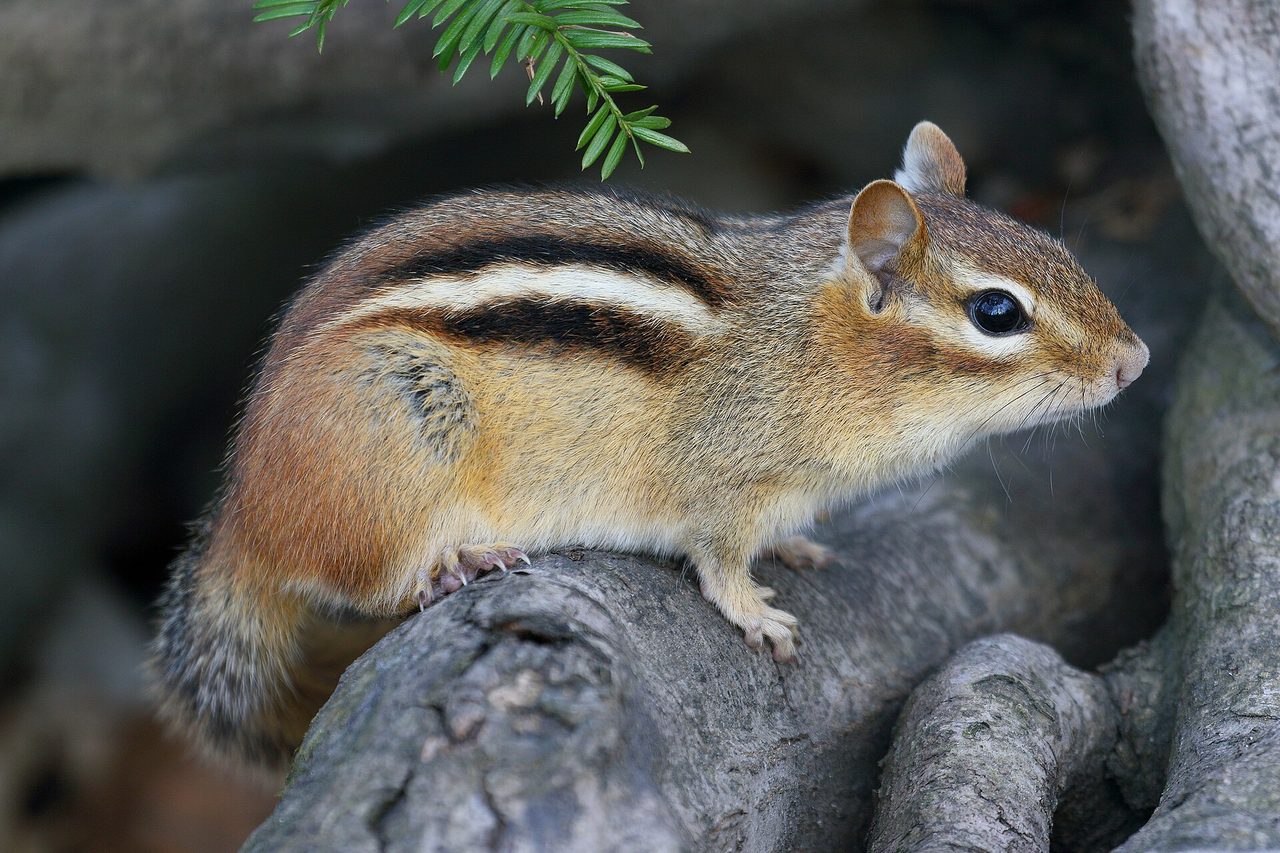
Photo: Cephas / Wikimedia Commons (CC BY-SA 4.0)
In brief
Chipmunks are small striped rodents of the subtribe Tamiina — found across North America and in one Asian species — that are mostly Least Concern on the IUCN Red List, though one New Mexico subspecies was listed as Endangered under the US Endangered Species Act in December 2024.
Also in Animals A to Z · Animals that start with C
By WARN Research & Conservation TeamLast updated
Chipmunks are small, ground-dwelling squirrels belonging to the subtribe Tamiina within the tribe Marmotini. Three living genera comprise the group: Tamias (eastern chipmunk, eastern North America), Neotamias (roughly 23 western North American species), and Eutamias (the Siberian chipmunk, ranging from Russia across to Japan). They are instantly recognisable by the bold pattern of alternating dark and pale stripes running from snout to tail base — a pattern unique among North American rodents. Weighing just 30–150 g and measuring 10–20 cm in body length, chipmunks punch well above their ecological weight. They are prolific seed-cachers whose forgotten winter stores germinate into trees, dispersers of mycorrhizal fungal spores, and a critical prey base for hawks, foxes, and weasels across temperate and boreal forests.
~25
living species
165
acorns gathered per day
~3.6 kg
food stored in burrow
31 days
gestation period
Figures sourced from IUCN Red List — Tamias striatus (Eastern Chipmunk), IUCN Red List — Eutamias sibiricus (Siberian Chipmunk), Animal Diversity Web — Tamias striatus and other references on this page.
Chipmunk: Quick Facts
| Body length | 10–20 cm (4–8 in) |
|---|---|
| Weight | 30–150 g (1–5.3 oz) |
| Top speed | Up to 21 mph (34 km/h) |
| Lifespan (wild) | 2–5 years |
| Litter size | 2–8 young; average 4–5 |
| Gestation | ~31 days |
| Activity pattern | Diurnal; most active mid-morning and mid-afternoon |
| Burrow length | Up to 9 m (30 ft) |
Scientific Classification
| Kingdom | Animalia |
|---|---|
| Phylum | Chordata |
| Class | Mammalia |
| Order | Rodentia |
| Family | Sciuridae |
| Subfamily | Xerinae |
| Tribe | Marmotini |
| Subtribe | Tamiina |
| Genera | Tamias, Neotamias, Eutamias |
Conservation Status
- IUCN Status
- Least Concern
- Population
- No global estimate; abundant and widespread for most species
- Trend
- Stable (most species); declining (some montane and isolated subspecies)
- Assessed
- 2016 (T. striatus IUCN); 2024 (Peñasco subspecies US ESA listing)
- CITES
- Not listed on any CITES Appendix
The Peñasco least chipmunk (T. m. atristriatus) was listed as Endangered under the US Endangered Species Act in December 2024 with approximately 4,386 acres of critical habitat designated in Lincoln County, New Mexico.
Did you know?
A single eastern chipmunk can stuff up to 70 sunflower seeds into its cheek pouches in one go — pouches that can expand to three times the width of the animal's own head — and can collect around 165 acorns in a single day.
Key Facts: Chipmunk
- Chipmunks belong to three distinct genera — Tamias, Neotamias, and Eutamias — with about 25 living species spread across North America and northern Asia.
- Rather than fattening up like true hibernators, chipmunks cache up to 3.6 kg of seeds and nuts in their burrows and enter repeated bouts of torpor throughout winter, waking to feed every few days.
- Their expandable cheek pouches can hold up to 70 sunflower seeds or 12 acorns at once, tripling the apparent size of the head and enabling a single chipmunk to collect around 165 acorns in a day.
- By burying and frequently forgetting food caches, chipmunks act as unintentional foresters, germinating oaks, maples, and other tree species across vast stretches of North American woodland.
- The Peñasco least chipmunk (Tamias minimus atristriatus), an isolated New Mexico subspecies, was federally listed as Endangered in December 2024, with only a few dozen animals surviving in the Sacramento Mountains.
- Climate change poses a growing threat to several western chipmunk species, altering food-plant phenology, shrinking alpine habitat, and reducing genetic diversity in isolated montane populations.
What is a chipmunk?
Chipmunks are small, diurnal, ground-dwelling members of the squirrel family Sciuridae, grouped within the subtribe Tamiina of the tribe Marmotini. Three genera hold all living species: Tamias, represented solely by the eastern chipmunk (T. striatus) in eastern North America; Neotamias, encompassing roughly 23 species of western North American chipmunks; and Eutamias, containing the Siberian chipmunk (E. sibiricus), the one Asian representative, which ranges from European Russia across Siberia, China, Korea, and northern Japan.
The taxonomy has been debated for decades. Through most of the twentieth century many authorities lumped all chipmunks into a single genus (Tamias), but mitochondrial DNA studies conducted between 2000 and 2010 confirmed that the genetic divergence between the three groups is comparable to the gap between marmots and ground squirrels — supporting recognition of three separate genera. The word 'chipmunk' is thought to derive from the Odawa term 'jidmoonh', meaning 'red squirrel'.
All chipmunks share the same immediately recognisable hallmark: bold alternating dark-brown and white or pale-buff stripes running from the nose, over the crown, and down the back to the tail base. Body length ranges from about 10 cm in the smallest least chipmunks to 20 cm in the eastern chipmunk, with bushy tails adding a further 7–12 cm. Weight spans roughly 30 g to 150 g. Running speed can reach up to 21 mph (34 km/h) — impressive for an animal the size of a human fist.
Where do chipmunks live?
The geographic range of chipmunks is centred on North America, which holds 24 of the approximately 25 known living species. Eastern chipmunks occupy a broad band from the Atlantic coast west to the Great Plains and from southern Canada to the Gulf states, thriving in deciduous and mixed woodland with abundant ground cover. The western North American species of Neotamias occupy a dizzying variety of habitats: dense coniferous forests, chaparral, alpine meadows, sagebrush flats, and rocky canyons across the Rocky Mountains, Sierra Nevada, Cascades, and coastal ranges. The least chipmunk (N. minimus) has the widest range of any chipmunk, stretching from Yukon to Michigan and down through the Great Basin.
The Siberian chipmunk extends the family's footprint into Asia, occupying coniferous and mixed forest from the Ural Mountains through Siberia to Sakhalin, the Kuril Islands, northern China, Korea, and Hokkaido, Japan. Its extraordinary thermal tolerance — surviving ambient temperatures from −65 °C to +30 °C — makes it the most climatically resilient of all chipmunks. Introduced populations of Siberian chipmunks also exist in parts of Europe, established from the pet trade in the 1960s.
At the local scale, chipmunks are edge-habitat specialists. They favour areas where dense understorey shrubs, fallen logs, and rocky outcrops provide cover adjacent to open foraging ground. Burrow systems can extend more than 9 metres horizontally, with separate chambers for sleeping, food storage, and waste, sited to avoid flooding and maximize concealment.
How do chipmunks behave and survive winter?
Chipmunks are solitary and strongly territorial around their burrow entrance, defending a radius of roughly 15 metres against same-species rivals, yet allowing home ranges — which span 0.1 to 0.5 acres — to overlap considerably in resource-rich areas. They are strictly diurnal, most active in mid-morning and mid-afternoon, and disappear underground during rain, extreme heat, or the approach of a predator.
The defining survival strategy is food caching. Throughout summer and autumn a chipmunk makes hundreds of foraging trips daily, filling its remarkable cheek pouches — which can stretch to three times the width of the animal's head — with seeds, nuts, berries, fungi, and the occasional insect or bird's egg. Up to 3.6 kg of provisions may be amassed in the larder chamber of the burrow, enough to sustain the animal through a long winter. A single chipmunk can collect around 165 acorns per day; at peak capacity the pouches hold 32 beechnuts or 70 sunflower seeds.
Despite popular belief, chipmunks do not hibernate in the true physiological sense. Instead they enter repeated bouts of torpor, during which the heart rate drops from around 350 to just 4 beats per minute and body temperature falls to the mid-4 °C range. They rouse every few days to feed from their cache, then return to torpor — a pattern that continues until warming spring temperatures signal a permanent emergence. This cache-dependent strategy distinguishes them from fat-storing true hibernators such as ground squirrels and bears.
What role do chipmunks play in the ecosystem?
Chipmunks are keystone contributors to forest health at three distinct ecological levels. First, as scatter-hoarders they are among the most important seed dispersers in temperate North American woodlands. When a chipmunk buries a nut and then fails to retrieve it — either because it died, forgot the cache's location, or simply stored more than it needed — that seed germinates. Studies in New England forests document chipmunks as major vectors in the regeneration of oak, maple, and beech stands. A single eastern chipmunk may bury several thousand seeds in a season, a meaningful proportion of which become new trees.
Second, chipmunks are potent vectors for mycorrhizal fungi. They consume subterranean fruiting bodies (truffles) and disperse fungal spores through their droppings across large areas. Mycorrhizal networks are essential to tree growth — the symbiotic fungi extend root systems and improve nutrient uptake — so chipmunk-mediated spore dispersal has cascading benefits for forest productivity.
Third, chipmunks form a vital link in predator food webs. Red-tailed hawks, Cooper's hawks, great horned owls, American kestrels, foxes, coyotes, weasels, domestic cats, and a range of snake species all prey on chipmunks. Population cycles of these predators can follow chipmunk abundance, and in some study areas chipmunks constitute 20–30 % of the diet of certain raptor pairs during the breeding season. Their role as 'prey glue' helps sustain the trophic diversity of temperate forest systems.
What threats do chipmunks face?
Most chipmunk species remain abundant and are listed as Least Concern by the IUCN, but the group is not without conservation concerns. The most pressing recent development is the December 2024 listing of the Peñasco least chipmunk (Tamias minimus atristriatus) as Endangered under the US Endangered Species Act. This isolated New Mexico subspecies is now thought to number only a few dozen individuals in the Sacramento Mountains of Lincoln County. Its precipitous decline stems from a combination of habitat encroachment from forest succession into sub-alpine meadows, livestock grazing, feral hog predation, ski resort operations, and — crucially — increasing drought and wildfire driven by climate change. The US Fish and Wildlife Service designated approximately 4,386 acres of critical habitat alongside the listing.
More broadly, climate change is altering phenological timing across chipmunk ranges. A 2024 study in the Journal of Mammalogy found that the alpine chipmunk (N. alpinus) in the Sierra Nevada has shifted its range upslope by around 500 metres over the past century in response to warming, contracting its available habitat and reducing genetic diversity. Similar range-contraction pressures are documented for other montane specialist species.
Habitat fragmentation from roads, urban expansion, and agricultural clearing isolates chipmunk populations, reducing gene flow and resilience. Predation from feral and free-roaming domestic cats — which kill billions of small mammals annually across North America — also acts as a significant, often underappreciated, mortality source for chipmunks living near human settlements.
What WARN Does
WARN does not currently run field projects for chipmunks — their range is centred on North America and Siberian Asia, outside WARN's active conservation network. This guide is offered as free educational content because understanding the ecological value of small mammals, wherever they live, builds the public awareness that supports wildlife protection everywhere.
Small mammals like chipmunks are the unsung architects of healthy forests — their seed-caching and fungal-spore dispersal quietly rebuilds woodland year after year. WARN's habitat-protection partners work to keep wild spaces intact for animals great and small. If this guide sparked your curiosity, consider supporting that work.
Chipmunk: Frequently Asked Questions
Are chipmunks rodents?
Do chipmunks hibernate?
How many chipmunk species are there?
Are any chipmunks endangered?
What do chipmunks eat?
How long do chipmunks live?
Where do chipmunks live?
Are chipmunks dangerous?
How big is a chipmunk?
Sources & References
Population figures, conservation status and biological facts on this page are drawn from authoritative scientific and intergovernmental sources.
- IUCN Red List — Tamias striatus (Eastern Chipmunk)
- IUCN Red List — Eutamias sibiricus (Siberian Chipmunk)
- Animal Diversity Web — Tamias striatus
- Animal Diversity Web — Tamias sibiricus
- US Fish & Wildlife Service — Peñasco Least Chipmunk Endangered Listing (2024)
- Britannica — Chipmunk
- Wikipedia — Chipmunk
- Internet Center for Wildlife Damage Management — Chipmunk Biology
Terms used on this page
Plain-English definitions, from our wildlife and conservation glossary.
Latest Chipmunk Stories
Quick, fact-checked reads on the chipmunk — amazing facts, key questions and the threats it faces.
Species
Slow Loris: Why the Internet's Favourite Pet Is a Conservation Disaster
The slow loris looks like a cartoon character — and that has nearly destroyed the species. Here is the truth behind the viral videos.
Read the storySpecies
The Snow Leopard: Why the Ghost of the Mountains Is Still Vulnerable
The snow leopard is one of the most elusive big cats on earth, with an estimated 4,000-6,500 individuals across twelve range states — including Pakistan, where WARN is preparing to operate. This briefing explains why the species was downlisted from Endangered to Vulnerable in 2017 and why that is not the success story it sounds like.
Read the storyGuides
Sun Bear vs Moon Bear: The Two Most Trafficked Asian Bears
The sun bear and the Asiatic black bear (moon bear) are the two most commonly trafficked bears in Asia — for the pet trade, for traditional medicine and for bear-bile farming. Here is how to tell them apart.
Read the storyExplore more animals
Discover more animals, their habitats and their conservation status in the WARN wildlife-guide library.