Wildlife Guide · South America & Andes Mountains
Condor
Vultur gryphus (Andean) / Gymnogyps californianus (California)
The largest flying land birds in the Western Hemisphere — ancient scavengers whose fate hangs on the choices humanity makes
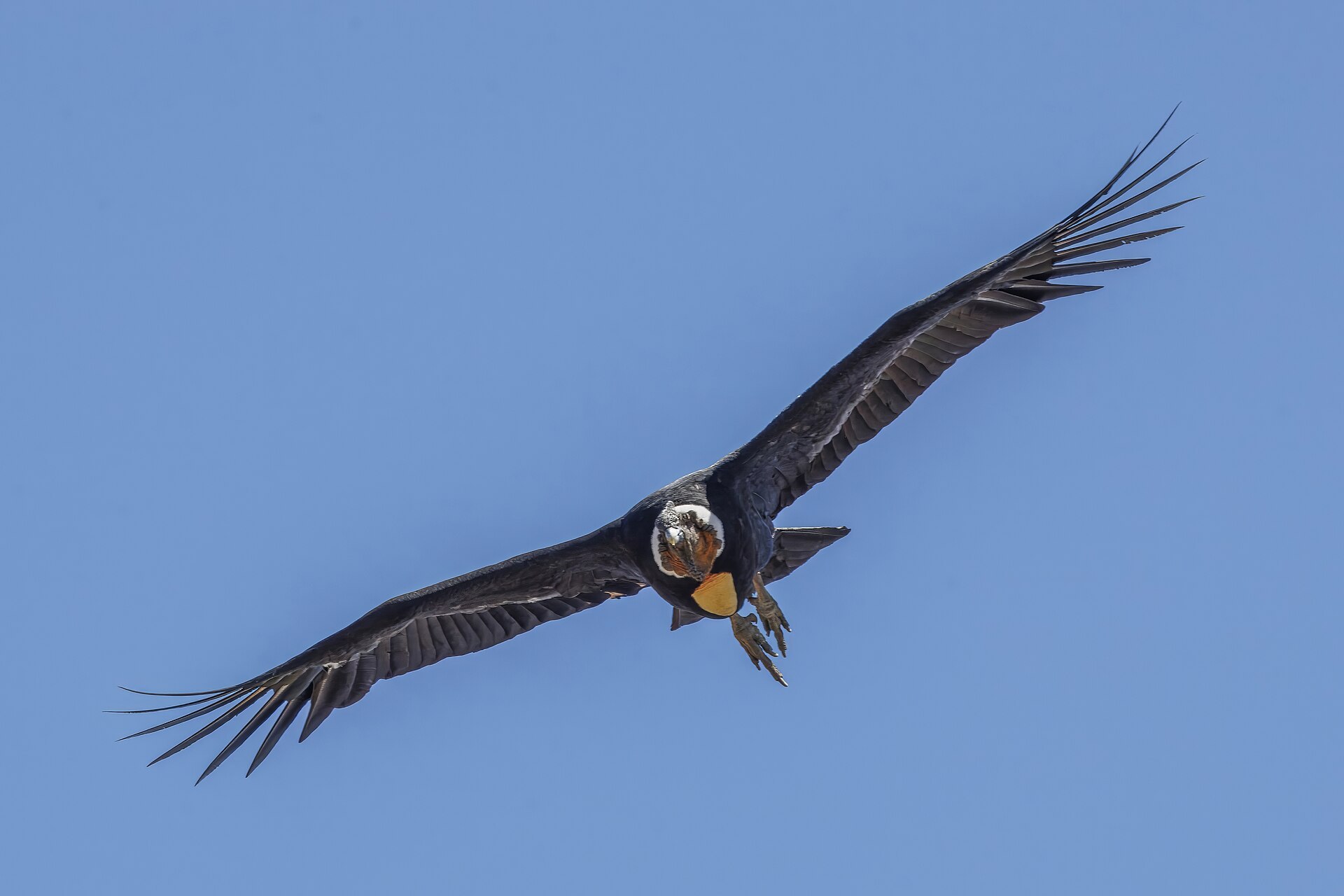
Photo: Charles J. Sharp / Wikimedia Commons (CC BY-SA 4.0)
In brief
Condors are the largest flying land birds in the Western Hemisphere: the Andean condor (Vultur gryphus) is listed as Vulnerable by the IUCN with roughly 6,700 mature individuals remaining, while the California condor (Gymnogyps californianus) is Critically Endangered but recovering, with approximately 607 birds alive as of 2025 thanks to an intensive captive-breeding and reintroduction programme that saved it from a low of just 22 birds in 1982.
Also in Animals A to Z · Animals that start with C
How you can help
You can support the related appeal — read its purpose, recipient status and fund terms first — or give once to where it is needed most. Sharing accurate information helps too.
By WARN Research & Conservation TeamLast updated
Condors are among the most awe-inspiring birds on Earth. The Andean condor (Vultur gryphus) and the California condor (Gymnogyps californianus) are the two living New World condors — massive, bald-headed vultures whose wingspans exceed those of any other land bird alive today. Riding invisible columns of warm air called thermals, an Andean condor can travel more than 160 kilometres in a single day without once flapping its wings. Despite their power and grandeur, both species face serious threats from human activity, above all the insidious danger of lead poisoning from ammunition fragments left in carcasses. The California condor declined to just 22 individuals by 1982 before an emergency captive-breeding programme began reversing its collapse, with the last wild bird brought into captivity in 1987. Understanding these birds — their biology, their ecological role and the pressures they face — is the first step towards ensuring they still circle the sky a century from now.
3.2 m
Andean condor maximum wingspan
607
California condors alive (wild + captive, 2025)
~6,700
Andean condors (mature individuals, IUCN 2020)
1%
Flight time spent flapping wings
Figures sourced from IUCN Red List — Andean Condor (Vultur gryphus), IUCN Red List — California Condor (Gymnogyps californianus), BirdLife DataZone — Andean Condor and other references on this page.
Condor: Quick Facts
| Type | Bird (New World Vulture) |
|---|---|
| Andean condor wingspan | Up to 3.2 m (10 ft 6 in) |
| California condor wingspan | Up to 2.9 m (9 ft 6 in) |
| Andean condor weight | 8–15 kg (males larger) |
| Lifespan | Up to 70+ years (Andean, captivity); 45+ years (California, captivity) |
| Diet | Obligate scavenger (carrion only) |
| Incubation period | 54–58 days (California); 58–62 days (Andean) |
| Breeding frequency | 1 chick every 2–3 years |
| Flight time flapping | Approximately 1% |
| Andean condor IUCN status | Vulnerable (assessed 2020) |
| California condor IUCN status | Critically Endangered |
Scientific Classification
| Kingdom | Animalia |
|---|---|
| Phylum | Chordata |
| Class | Aves |
| Order | Cathartiformes |
| Family | Cathartidae |
| Genus (Andean) | Vultur |
| Species (Andean) | Vultur gryphus |
| Genus (California) | Gymnogyps |
| Species (California) | Gymnogyps californianus |
Conservation Status
- IUCN Status
- Varies: Andean Condor Vulnerable; California Condor Critically Endangered
- Population
- ~6,700 mature Andean condors; ~607 California condors (wild + captive, 2025)
- Trend
- Andean condor: decreasing. California condor: increasing (under intensive management)
- Assessed
- 2020 (Andean condor, IUCN); California condor status ongoing review
- CITES
- Appendix I (both species)
California condor declined to 22 individuals in 1982; the last wild bird entered captivity in 1987. By end of 2025 the total population reached 607 through captive breeding and reintroduction. Andean condor is Critically Endangered at national level in Colombia and Ecuador.
Did you know?
An Andean condor tracked by researchers once flew more than 160 kilometres in a single outing without flapping its wings once — and across more than 250 hours of recorded flight, eight condors spent just one percent of their total airborne time flapping.
Key Facts: Condor
- Condors are obligate scavengers that clean ecosystems by consuming carcasses, preventing disease spread and recycling nutrients back into the soil.
- The California condor declined to just 22 individuals in 1982 and was fully taken into captivity by 1987; today more than 600 birds exist — one of conservation's most dramatic recoveries.
- Lead poisoning from ammunition fragments in hunted carcasses remains the single greatest threat to California condors, responsible for an estimated 60 percent of deaths.
- The Andean condor is a sacred symbol across seven South American nations — a national symbol in Argentina, Bolivia, Chile, Colombia, Ecuador, Peru and Venezuela — and features on the coats of arms of Bolivia, Chile, Colombia and Ecuador, embedded in Andean cosmology for at least 4,500 years.
- Both condor species reproduce exceptionally slowly — a pair raises only one chick every two to three years — making every individual death a significant population setback.
- In Colombia, the Andean condor is considered Critically Endangered at the national level, with fewer than 130 individuals estimated in the wild there.
What is a condor, and how does it differ from other vultures?
Condors are New World vultures belonging to the family Cathartidae, a lineage distinct from the Old World vultures of Africa and Eurasia despite superficial similarities. Two species exist: the Andean condor (Vultur gryphus), which holds the record for the largest wingspan of any raptor and is among the heaviest flying birds on Earth, and the California condor (Gymnogyps californianus), the largest flying land bird in North America. Both are obligate scavengers — they do not kill prey — and they locate food primarily by sight, scanning vast landscapes from great altitude. Andean condors can weigh up to 15 kg, with males notably larger than females. Their bare, wrinkled heads are an adaptation for hygiene: feathers would trap blood and bacteria when probing deep inside a carcass. Males of the Andean condor are further distinguished by a prominent fleshy caruncle on the forehead and a red eye colour, while females have red eyes but lack the caruncle. California condors sport a vivid orange-yellow head whose colour actually intensifies with emotional state, functioning as a social signal. Despite their imposing appearance, condors are gentle giants among raptors — their talons are not built for killing and their beaks, though powerful, evolved for tearing flesh from animals already dead.
Where do condors live, and what habitats do they need?
The Andean condor ranges along the entire length of the Andes cordillera, from Venezuela and Colombia in the north through Ecuador, Peru and Bolivia to Argentina and Chile at the southern tip of the continent. It favours open, unforested landscapes — high-altitude grasslands called páramo and puna, mountain cliffs and coastal desert plains — anywhere it can exploit updrafts and thermals. Cliff ledges serve as nest sites and communal roosts; these birds do not build nests but lay their single egg directly on rock. Andean condors have been recorded soaring at altitudes exceeding 5,500 metres above sea level. The California condor historically ranged across much of North America; today, reintroduced populations inhabit the coastal mountain ranges of California, the Grand Canyon region of Arizona and Utah, Baja California in Mexico, and the Pacific coast redwood forests. Both species require vast foraging territories — a single Andean condor may patrol thousands of square kilometres of landscape each week. Habitat integrity is therefore critical: deforestation, agricultural encroachment and the fragmentation of open grasslands all reduce the availability of the large-mammal carcasses on which condors depend.
Why are condors endangered, and what threatens their survival?
Lead poisoning is the most documented and lethal threat to condors in the modern era, particularly for the California condor. When hunters kill deer, elk or other wildlife and leave behind gut piles or carcasses, lead rifle bullets fragment into hundreds of tiny metallic shards dispersed through the meat. Condors ingest these fragments when scavenging; lead is highly toxic to birds, impairing the nervous system and eventually causing paralysis and death. Studies attribute approximately 60 percent of California condor deaths to lead poisoning. The Andean condor faces a similar hazard in parts of its range, compounded by deliberate persecution — farmers have historically poisoned and shot condors in the belief that the birds kill livestock, despite no evidence of condors attacking healthy animals. Additional threats include collisions with power lines, which can be lethal to such large-bodied birds with slow reflexes relative to their size. Microtrash — bottle caps, wire, and other human debris that parents mistakenly feed to chicks as food — also kills California condor chicks. In 2023, Highly Pathogenic Avian Influenza (HPAI) killed approximately 21 California condors in the Utah-Arizona flock, highlighting emerging disease risks. For the Andean condor in Colombia, intense habitat loss in the Andes driven by agriculture and cattle ranching has pushed a nationally critical population toward the brink of local extinction.
How do condors fly so effortlessly, and what is unique about their biology?
Condors are masterworks of aerodynamic efficiency. Research published in the Proceedings of the National Academy of Sciences found that Andean condors spend just one percent of their flight time actively flapping their wings. Instead, they exploit thermals — columns of warm air that rise from sun-heated ground — and orographic updrafts generated when wind strikes a mountainside or cliff face. By circling within a thermal to gain altitude and then gliding toward the next rising current, an Andean condor can cover more than 160 kilometres in a single flight without a single wingbeat. California condors use the same strategy over coastlines and canyon country, soaring to heights of 4,500 metres. The condor's wingspan — up to 3.2 metres for the Andean condor — generates the surface area needed to exploit even weak thermals. Biologically, condors are extraordinary long-lived birds: Andean condors have been documented surviving past 70 years in captivity, and California condors past 45 years. They do not reach sexual maturity until five or six years of age, and a breeding pair typically raises only one chick every two to three years. For the California condor, the egg is incubated for 54 to 58 days by both parents; the Andean condor incubation period is slightly longer at 58 to 62 days. After hatching, the chick remains dependent on its parents for more than a year and may continue to receive food from them for up to two years — an unusually prolonged period of parental investment that reflects the species' strategy of raising very few, high-quality offspring.
What conservation efforts are working to save condors?
The recovery of the California condor stands as one of wildlife conservation's most celebrated success stories. By 1982, the species had dwindled to just 22 individuals; a controversial decision was made to capture all remaining wild birds and launch an intensive captive-breeding programme. The last wild California condor was brought into captivity in April 1987. Beginning in 1992, captive-bred birds were reintroduced to the wild. By the end of 2025, the global population had reached approximately 607 individuals — a roughly 27-fold increase driven by meticulous management including veterinary treatment for lead poisoning, puppet-rearing techniques to prevent human imprinting, and targeted outreach to hunters encouraging the use of non-lead ammunition. The Andean condor has benefited from reintroduction programmes in Colombia, Argentina and Chile, including novel artificial incubation techniques piloted in Colombia in 2025 to improve egg survival rates. Legal protections across its range countries provide important foundations. Researchers using GPS tracking and biologger devices have revealed the birds' spectacular ranging behaviour, informing reserve and corridor design. Nevertheless, the California condor cannot yet sustain itself without continued intervention — particularly until lead ammunition is phased out from condor foraging areas — and the Andean condor's global population trend remains downward, with Colombia's national population critically small.
What WARN Does
WARN publishes this guide for education and is developing support through assessed animal-welfare grants. A species range, source citation or photograph does not establish a recipient or funding agreement. Check /about/where-your-money-goes/#grant-register for published grant and payment records; records not yet published must not be read as zero activity. Browse /appeals/ for the purposes currently available to support.
Condors soar above some of the world's most biodiverse landscapes, including Colombia's Andes — a country where WARN works with rescue and conservation partners. Every donation to WARN helps build the culture of wildlife protection that species like the condor depend on.
How can I help save the condor?
Explore practical ways to support the condor, from everyday choices and sharing reliable information to reviewing a related appeal before giving.
Explore ways to support
Read the related appeal’s purpose, recipient status and fund terms. Choose an affordable gift after checking what is proposed and what has been reported.
Ease the pressures
Avoid the wildlife trade and souvenirs, never buy wild animals as pets, and choose sustainable, habitat-friendly products — the threats behind the condor's decline fall when demand does.
Spread the word
Share accurate, sourced information about the condor. Wider awareness is what turns concern into lasting protection.
Condor: Frequently Asked Questions
How can I help save the condor?
How big is a condor's wingspan?
Are condors eagles or vultures?
Why was the California condor almost extinct?
What do condors eat?
How long do condors live?
Is the Andean condor the national bird of Colombia?
Where do condors live?
Are condors dangerous?
Sources & References
Population figures, conservation status and biological facts on this page are drawn from authoritative scientific and intergovernmental sources.
- IUCN Red List — Andean Condor (Vultur gryphus)
- IUCN Red List — California Condor (Gymnogyps californianus)
- BirdLife DataZone — Andean Condor
- BirdLife DataZone — California Condor
- U.S. Fish & Wildlife Service — 2025 California Condor Population Status Report
- U.S. Fish & Wildlife Service — California Condor Recovery Program
- Smithsonian Magazine — Andean Condor Can Soar 100 Miles Without Flapping
- PNAS — Physical limits of flight performance in the heaviest soaring bird
- NPS — Threats to California Condors
- BirdLife International — Red List update: the plight of the condor (2021)
Terms used on this page
Plain-English definitions, from our wildlife and conservation glossary.
Latest Condor Stories
Quick, fact-checked reads on the condor — amazing facts, key questions and the threats it faces.
Briefings
The Pink River Dolphin: Why the Amazon's Most Unusual Mammal Is Endangered
The pink river dolphin — the boto — is one of only a handful of freshwater dolphin species left on Earth. It lives in the rivers of Colombia and Peru, and it is now formally listed as Endangered on the IUCN Red List. A briefing on what it is, why it is in trouble, and what frontline rescue work can still do.
Read the storyBriefings
The Kinkajou: The Rainforest Mammal Most People Have Never Heard Of
The kinkajou is a small, golden-brown rainforest mammal with a prehensile tail and enormous dark eyes. It lives in the forests of Colombia and Peru. Its biggest threats are habitat loss and the exotic pet trade — and that is exactly where rescue and sanctuary work can help.
Read the storyBriefings
The Capuchin Monkey: The Tool-Using Primate at the Heart of the South American Pet Trade Problem
Capuchin monkeys are among the most intelligent primates in the Americas — and one of the most heavily trafficked. They live across the forests of Colombia and Peru, and they are a regular caseload at rescue centres dealing with the South American illegal pet trade.
Read the storyExplore more animals
Discover more animals, their habitats and their conservation status in the WARN wildlife-guide library.