Wildlife Guide · Indonesia & Malaysia
Dugong
Dugong dugon
The gentle sea cow that mowed the seagrass meadows long before sailors mistook it for a mermaid.
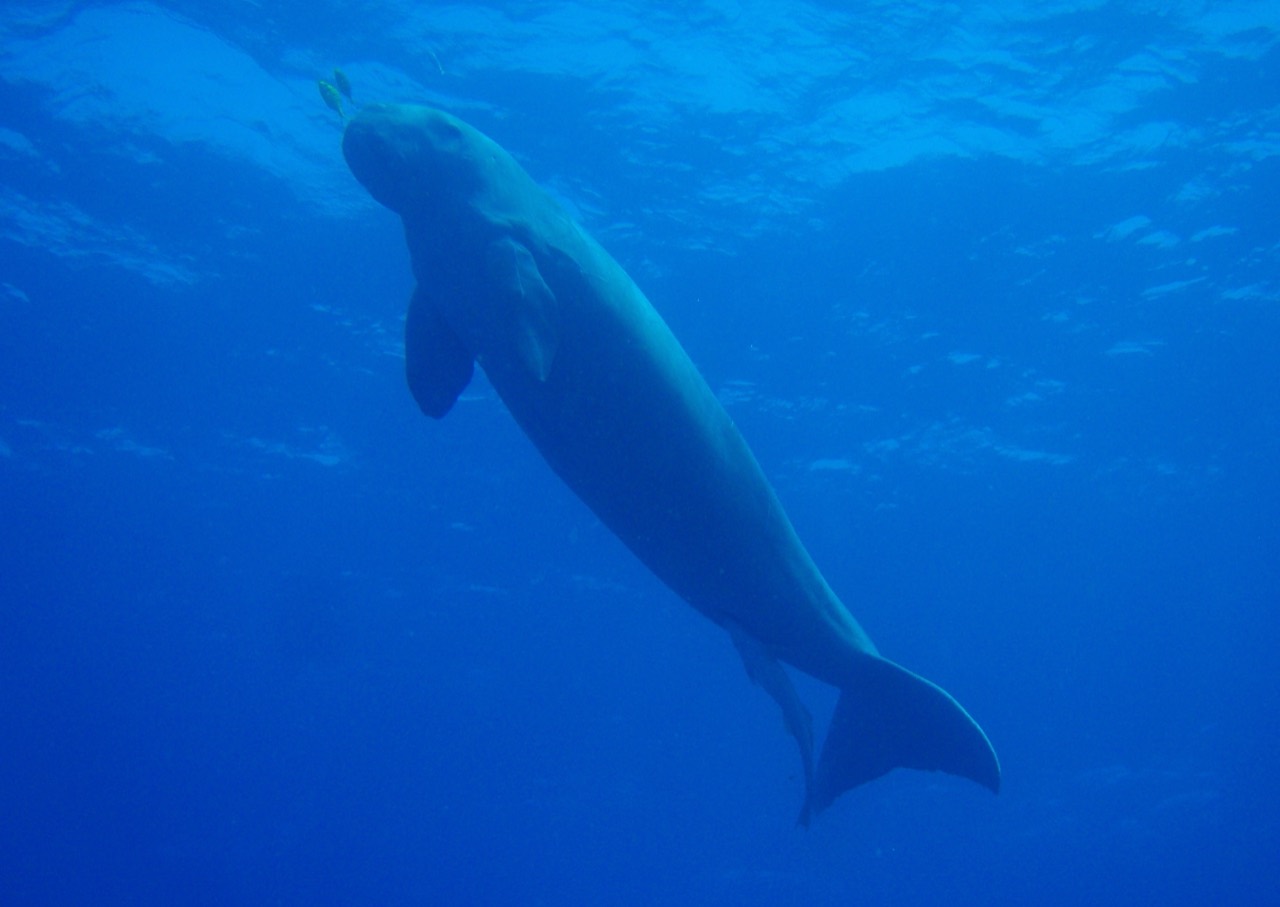
Source: Wikimedia Commons via Wikipedia “Dugong”
In brief
A dugong is a large, plant-eating marine mammal of the order Sirenia (the "sea cows"), reaching about 3 metres long, that lives entirely in warm coastal seas and feeds almost exclusively on seagrass.
Also in Animals A to Z · Animals that start with D
How you can help
You can symbolically adopt a sea turtle from £5 a month — a donation to WARN’s sea turtle appeal, with a personalised certificate you can keep or give as a gift — or give once to where it is needed most.
By WARN Research & Conservation TeamLast updated
The dugong (Dugong dugon) is a large, slow-moving marine mammal that spends its whole life at sea, grazing seagrass in the warm shallows of the Indian and Pacific Oceans. It is the only strictly herbivorous marine mammal and the sole surviving member of the family Dugongidae. Listed as Vulnerable on the IUCN Red List with a declining global population, it faces mounting pressure from fishing bycatch and the loss of the seagrass meadows it depends on.
Vulnerable
IUCN Red List status, global population decreasing (assessed 2019)
~3 m
Typical adult length; weight commonly 250–400 kg
~70 yrs
Lifespan; one female aged at 73 years
13–15 mo
Gestation, usually producing a single calf
Figures sourced from IUCN Red List — Dugong dugon (Vulnerable, 2019 assessment), CITES — Dugong dugon listing (Appendix I; Australian population Appendix II), CMS — Global dugong report 2025: status and conservation needs and other references on this page.
Dugong: Quick Facts
| Lifespan | ~70 years (oldest recorded 73) |
|---|---|
| Weight | Typically 250–400 kg; max ~1,016 kg |
| Length | Up to about 3 m |
| Diet | Herbivore — almost entirely seagrass |
| Gestation | 13–15 months |
| Young per birth | Usually 1 calf |
| Calving interval | Roughly every 2.4–7 years |
| Top speed | ~10 km/h (about 3 m/s) |
| Baby name | Calf |
| Group name | Herd (often solitary or in pairs) |
| CITES | Appendix I (Australian population on Appendix II) |
Scientific Classification
| Kingdom | Animalia |
|---|---|
| Phylum | Chordata |
| Class | Mammalia |
| Order | Sirenia |
| Family | Dugongidae |
| Genus | Dugong |
| Species | Dugong dugon (Müller, 1776) |
Conservation Status
- IUCN Status
- Vulnerable (IUCN Red List)
- Population
- No reliable global estimate; population decreasing. Northern Australia holds the largest numbers, while many Southeast Asian populations are small and poorly counted.
- Trend
- Decreasing
- Assessed
- 2019 (Marsh & Sobtzick; criteria A2bcd+4bcd)
- CITES
- Appendix I (all populations except the Australian population, which is on Appendix II)
The global Vulnerable rating masks far higher local risk: subpopulations are assessed Critically Endangered in East Africa and Japan's Nansei Islands and Endangered in New Caledonia.
Did you know?
Dugongs are widely thought to be the origin of mermaid legends — their order, Sirenia, is named after the Sirens of Greek myth, and sailors really did mistake these gentle grazers for "ladies of the sea."
Key Facts: Dugong
- The dugong is the only living member of the family Dugongidae and the only marine mammal that feeds almost entirely on plants — seagrass.
- It is globally Vulnerable, but several subpopulations are far worse off: Critically Endangered in East Africa and Japan's Nansei Islands and Endangered in New Caledonia.
- Unlike its manatee cousins, the dugong has a dolphin-like fluked tail and a sharply downturned snout built for grazing the seabed.
- Bycatch in gillnets and the loss of seagrass meadows to coastal development and pollution are the leading threats across Indonesia and Malaysia.
- Dugongs breed slowly — one calf every few years after 13–15 months' gestation — so populations recover very slowly from losses.
- Long associated with mermaid and 'lady of the sea' legends, the dugong belongs to the order Sirenia, named for the Sirens of myth.
Why the dugong is threatened
The IUCN lists the dugong as Vulnerable globally, with a decreasing population trend (assessed by Marsh and Sobtzick in 2019). That single global label hides a harsher reality: regional assessments rate the species Critically Endangered in East Africa and Japan's Nansei Islands and Endangered in New Caledonia, while only a few strongholds — notably northern Australia and the Persian Gulf — remain relatively secure. Across much of Southeast Asia, including Indonesian and Malaysian waters, populations are small, scattered and poorly counted, with only a couple of Asian sites confirmed to hold more than 100 animals. Because dugongs are long-lived and breed slowly, even modest losses each year can push a local population into decline that takes decades to reverse.
Life in the seagrass meadows
Dugongs are entirely marine and rarely stray from the shallow, sheltered coastal waters where seagrass grows. An adult eats tens of kilograms of seagrass a day, uprooting whole plants with its muscular, bristled snout and leaving distinctive feeding trails across the meadow. They are generally slow swimmers, cruising at around 10 km/h, and surface every few minutes to breathe. Mostly solitary or seen in pairs, they sometimes gather in larger herds where seagrass is abundant. Reproduction is unhurried: females give birth to a single calf after a 13–15 month gestation, nurse it for well over a year, and may wait several years between calves.
Threats: bycatch and vanishing seagrass
The two threats that matter most across the dugong's Southeast Asian range are entanglement and habitat loss. Gillnets set in shallow coastal waters drown dugongs as accidental bycatch — in Malaysia's Mersing area alone, numerous deaths, many of them calves and juveniles, were recorded over recent years. At the same time, the seagrass meadows dugongs cannot live without are being degraded by destructive fishing, coastal development, sedimentation from land clearing, and pollution. Seagrass covers only a fraction of the seafloor yet stores a disproportionate share of ocean carbon, so protecting it serves both dugongs and the climate. Vessel strikes, hunting and pollution add further pressure.
What dugong rescue and protection involve
Saving dugongs is less about rescuing individuals and more about protecting the meadows they graze and keeping nets out of their path. Effective work combines community-based patrols that deter destructive fishing and reduce gillnet entanglement, seagrass mapping and restoration, response to stranded or orphaned calves, and education so coastal fishers and tourists understand the animal's fragility. Because dugongs range across some 40 countries, lasting protection depends on local teams working meadow by meadow, bay by bay, supported by national protections and international agreements such as the CITES trade ban.
Dugong vs. manatee: telling the sea cows apart
| Feature | Dugong | Manatee |
|---|---|---|
| Family | Dugongidae | Trichechidae |
| Tail shape | Fluked, dolphin-like | Broad, rounded paddle |
| Snout | Sharply downturned for seabed grazing | Shorter, less downturned |
| Diet | Almost entirely seagrass | Seagrass and freshwater plants |
| Habitat | Strictly marine (coastal seas) | Marine, estuarine and freshwater |
| Range | Indo-West Pacific (~40 countries) | Atlantic — Americas and West Africa |
What WARN Does
WARN publishes this guide for education and is developing support through assessed animal-welfare grants. A species range, source citation or photograph does not establish a recipient or funding agreement. Check /about/where-your-money-goes/#grant-register for published grant and payment records; records not yet published must not be read as zero activity. Browse /appeals/ for the purposes currently available to support.
In Indonesia and Malaysia, dugongs survive in small, fragile groups where one gillnet can undo years of recovery. A gift to WARN helps fund the local partner teams patrolling these coasts and protecting the seagrass meadows dugongs depend on.
How can I help save the dugong?
Explore practical ways to support the dugong, from everyday choices and sharing reliable information to reviewing a related appeal before giving.
Explore ways to support
Read the related appeal’s purpose, recipient status and fund terms. Choose an affordable gift after checking what is proposed and what has been reported.
Ease the pressures
Avoid the wildlife trade and souvenirs, never buy wild animals as pets, and choose sustainable, habitat-friendly products — the threats behind the dugong's decline fall when demand does.
Spread the word
Share accurate, sourced information about the dugong. Wider awareness is what turns concern into lasting protection.
Dugong: Frequently Asked Questions
How can I help save the dugong?
What is a dugong?
How long do dugongs live?
What do dugongs eat?
How big do dugongs get?
Are dugongs dangerous to humans?
How many dugongs are left?
What is a baby dugong called?
Sources & References
Population figures, conservation status and biological facts on this page are drawn from authoritative scientific and intergovernmental sources.
- IUCN Red List — Dugong dugon (Vulnerable, 2019 assessment)
- CITES — Dugong dugon listing (Appendix I; Australian population Appendix II)
- CMS — Global dugong report 2025: status and conservation needs
- Animal Diversity Web — Dugong dugon (University of Michigan)
- IUCN — Dugong dugon (Eastern Africa subpopulation, Critically Endangered)
- Australian Government DCCEEW — Dugongs
Terms used on this page
Plain-English definitions, from our wildlife and conservation glossary.
Latest Dugong Stories
Quick, fact-checked reads on the dugong — amazing facts, key questions and the threats it faces.
Species
12 Amazing Facts About the Dugong, the Ocean's Only Vegetarian Sea Cow
From mermaid myths to tonnes of seagrass and 70-year lifespans, here are 12 remarkable facts about the dugong, the only marine mammal that lives entirely on plants.
Read the storySpecies
Dugong vs Manatee: How to Tell the Two Sea Cows Apart
Dugongs and manatees look almost identical at a glance, but their tails, snouts, diets and home waters tell them apart. Here is a clear, fact-checked guide.
Read the storySpecies
Why Are Dugongs Disappearing — and What's Being Done to Save Them?
Dugongs are vanishing from waters where they once thrived, declared functionally extinct in China and critically endangered in East Africa. Here's why — and the work that offers hope.
Read the storyExplore more animals
Discover more animals, their habitats and their conservation status in the WARN wildlife-guide library.