Wildlife Guide · Worldwide
Frog
Anura
More than 7,700 species, and one of the planet's clearest warning signs.
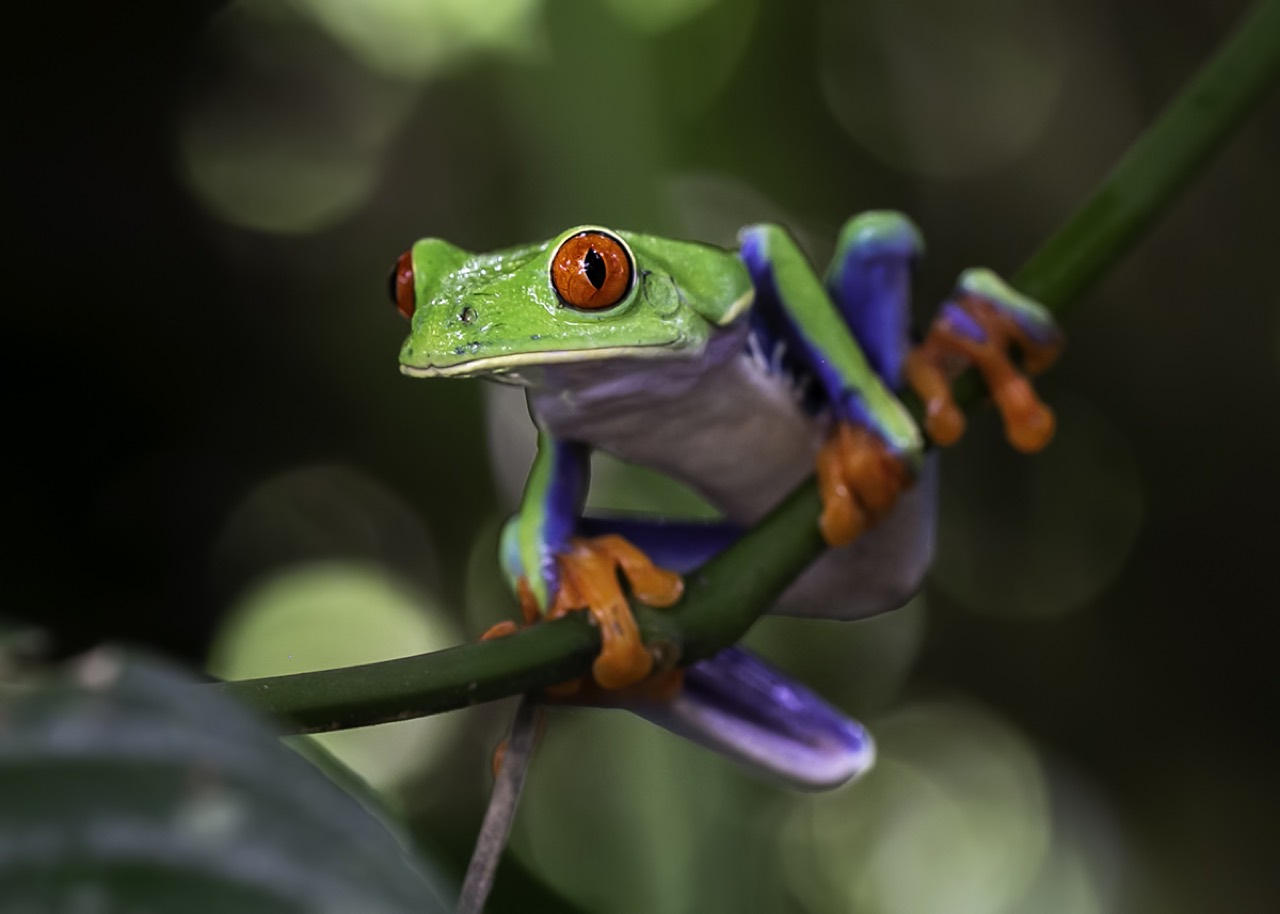
Source: Wikimedia Commons via Wikipedia “Frog”
In brief
A frog is a tailless amphibian of the order Anura, a group of over 7,700 species worldwide that begins life as an aquatic tadpole and is widely used as a bioindicator of environmental health.
Also in Animals A to Z · Animals that start with F
By WARN Research & Conservation TeamLast updated
Frogs are tailless amphibians in the order Anura, a group of more than 7,700 living species spread across nearly every continent and habitat except Antarctica. They range from frogs smaller than a fingernail to giants weighing several kilograms, and almost all begin life as water-dwelling tadpoles before transforming into air-breathing adults. Their thin, permeable skin makes them exquisitely sensitive to pollution, disease, and a changing climate, which is why scientists treat frogs as bioindicators: living gauges of ecosystem health. That same sensitivity has placed amphibians at the center of one of the most severe wildlife declines on record, driven by habitat loss and the spread of chytrid fungus. This guide explains what frogs are, how they live, and why their fate matters far beyond the pond.
7,700+
Known species in the order Anura
~41%
Of amphibian species threatened with extinction
120+
Anuran species believed extinct since the 1980s
7.7 mm
Length of the smallest known frog
Figures sourced from IUCN Red List: State of the World's Amphibians, AmphibiaWeb: Worldwide Amphibian Declines, Amphibian Species of the World (AMNH) and other references on this page.
Frog: Quick Facts
| Lifespan | Commonly 4-15 years in the wild; some species exceed 20 years |
|---|---|
| Weight | Under 1 g to about 3.3 kg (goliath frog) |
| Size | 7.7 mm to about 35 cm (0.3-14 in) in length |
| Diet | Adults carnivorous (insects, invertebrates); tadpoles often herbivorous |
| Incubation | Eggs typically hatch in a few days to a few weeks |
| Young | Hatch as aquatic tadpoles, then metamorphose into adults |
| Baby name | Tadpole (also called polliwog) |
| Group name | An army or colony of frogs; a knot of toads |
| Species count | More than 7,700 in the order Anura |
| CITES | Numerous species listed on Appendix I or II |
Scientific Classification
| Kingdom | Animalia |
|---|---|
| Phylum | Chordata |
| Class | Amphibia |
| Order | Anura |
| Species count | 7,700+ described species |
Conservation Status
- IUCN Status
- Varies by species (Least Concern to Critically Endangered; some recently Extinct)
- Population
- Not quantified as a single figure; trends assessed per species
- Trend
- Declining overall
- Assessed
- 2022
- CITES
- Numerous frog species listed on CITES Appendix I or II
Order-wide figure; the most recent global assessment estimates roughly 41% of amphibian species are threatened with extinction, with frogs the largest affected group.
Did you know?
Some frogs can essentially freeze in winter: species like the wood frog tolerate ice forming in their bodies, halting their heartbeat, then thaw out and revive in spring.
Key Facts: Frog
- Frogs form the order Anura, with more than 7,700 described species, making them by far the largest group of amphibians.
- Nearly all frogs hatch as tadpoles in water, then undergo metamorphosis into lunged, often land-going adults.
- Their permeable skin absorbs water, oxygen, and toxins, making frogs sensitive bioindicators of ecosystem health.
- Conservation status varies enormously by species, from Least Concern to Critically Endangered and recently extinct.
- Two of the biggest threats are habitat loss and chytridiomycosis, a fungal skin disease that has devastated populations worldwide.
- All toads are frogs: 'toad' usually refers to drier-skinned, warty species, especially the family Bufonidae, within Anura.
What is a frog?
Frogs are amphibians in the order Anura, a name meaning 'without a tail.' Adults are recognizable by their squat bodies, large eyes, and long, powerful hind legs built for jumping or swimming. The order is staggeringly diverse, with more than 7,700 species across roughly 59 families, from tiny rainforest frogs measuring under a centimeter to bulky species weighing more than 3 kilograms. Importantly, 'toad' is not a separate scientific category: all toads are frogs, with the word generally describing drier, warty, more terrestrial species, especially members of the family Bufonidae. Frogs live on every continent except Antarctica and occupy deserts, wetlands, forests, and high mountains alike.
Life cycle and behavior
Most frogs reproduce by laying eggs in or near water. These hatch into tadpoles: fully aquatic larvae with tails and gills that typically graze on algae and plankton. Through metamorphosis, a tadpole grows legs, absorbs its tail, develops lungs, and emerges as an adult, which is usually carnivorous and feeds on insects and other small invertebrates. Reproductive strategies vary widely: some species carry eggs on their backs, brood young in vocal sacs, or skip the tadpole stage entirely with direct development. Male frogs are famous for their calls, produced by inflating vocal sacs to attract mates and defend territory, and many species are most active at night.
Why frogs are bioindicators
A frog breathes and drinks partly through its skin, which is thin and highly permeable. This makes frogs unusually exposed to pollutants, pesticides, ultraviolet radiation, and pathogens in their environment. When frog populations crash or show deformities, it often signals broader problems in water quality or habitat, which is why ecologists describe amphibians as bioindicators or 'canaries in the coal mine.' Because frogs sit in the middle of food webs, eating vast numbers of insects and feeding birds, fish, and mammals in turn, their decline can ripple outward through entire ecosystems, affecting pest control and the species that depend on them.
Conservation: a global decline
Amphibians are among the most threatened groups of animals on Earth. The most recent global assessments estimate that roughly two in five amphibian species are threatened with extinction, and more than 120 frog species are believed to have vanished since the 1980s. Two forces dominate: habitat destruction from agriculture, logging, and development, and chytridiomycosis, a disease caused by the chytrid fungus Batrachochytrium that attacks frog skin and has driven catastrophic die-offs across the Americas, Australia, and beyond. Climate change, pollution, invasive species, and the wildlife trade compound the pressure. Many species are now Critically Endangered, and conservation responds with habitat protection, disease research, captive-breeding programs, and reintroductions.
Frog vs. Toad: How They Differ
| Feature | Frog | Toad |
|---|---|---|
| Scientific group | Order Anura (broad) | Anura, often family Bufonidae |
| Skin | Smooth, moist | Dry, bumpy, warty |
| Legs | Long, built for leaping | Shorter, built for hopping or walking |
| Habitat | In or near water | More terrestrial, ranges farther from water |
| Eggs | Often laid in clusters | Often laid in long chains |
| Taxonomy note | All toads are frogs; not all frogs are toads | A subset of frogs |
What WARN Does
Frogs are a globally distributed group, and this guide is educational rather than a description of a funded field program. At its current launch stage, the World Animal Rescue Network directly funds hands-on work across its partner network, so we do not claim to run dedicated frog or amphibian projects worldwide. We publish this guide to raise awareness of the amphibian decline crisis and to support our broader mission of protecting wildlife and the habitats they share. The most honest connection between this page and our work is habitat: wetlands, forests, and clean freshwater that frogs depend on are the same ecosystems our habitat-protection efforts aim to safeguard.
Frogs depend on healthy wetlands, forests, and clean freshwater, the very habitats our work aims to protect. While the World Animal Rescue Network does not yet fund dedicated frog projects, supporting our Habitat Protection appeal helps safeguard the ecosystems that countless species, amphibians included, rely on to survive.
Frog: Frequently Asked Questions
How many species of frogs are there?
What is the difference between a frog and a toad?
What is a baby frog called?
What do frogs eat?
Why are frogs important to the environment?
Where do frogs live?
Are frogs dangerous?
How long do frogs live?
How big is a frog?
Sources & References
Population figures, conservation status and biological facts on this page are drawn from authoritative scientific and intergovernmental sources.
Terms used on this page
Plain-English definitions, from our wildlife and conservation glossary.
Latest Frog Stories
Quick, fact-checked reads on the frog — amazing facts, key questions and the threats it faces.
Guides
Pet Adoption vs. Animal Rescue: How to Help When You Can't Adopt
Pet adoption, cat adoption, dog adoption, puppies for adoption — they all matter. But what about the animals you cannot bring home?
Read the storyGuides
Giving in Memory of a Pet: A Complete Guide to Tribute Donations and Pet Memorials
How to give in memory of a much-loved pet, what a tribute donation actually does, how memorial walls work, and how WARN matches your gift to the same species your animal belonged to.
Read the storySpecies
12 Amazing Facts About the Humpback Whale, the Ocean's Great Singer
From hours-long songs that only males sing to flippers longer than any other whale, here are 12 genuinely surprising facts about the humpback whale.
Read the storyExplore more animals
Discover more animals, their habitats and their conservation status in the WARN wildlife-guide library.