Wildlife Guide · Southwestern United States & Northwestern Mexico
Gila Monster
Heloderma suspectum
America's only venomous lizard — and an unlikely lifesaver for millions with diabetes.
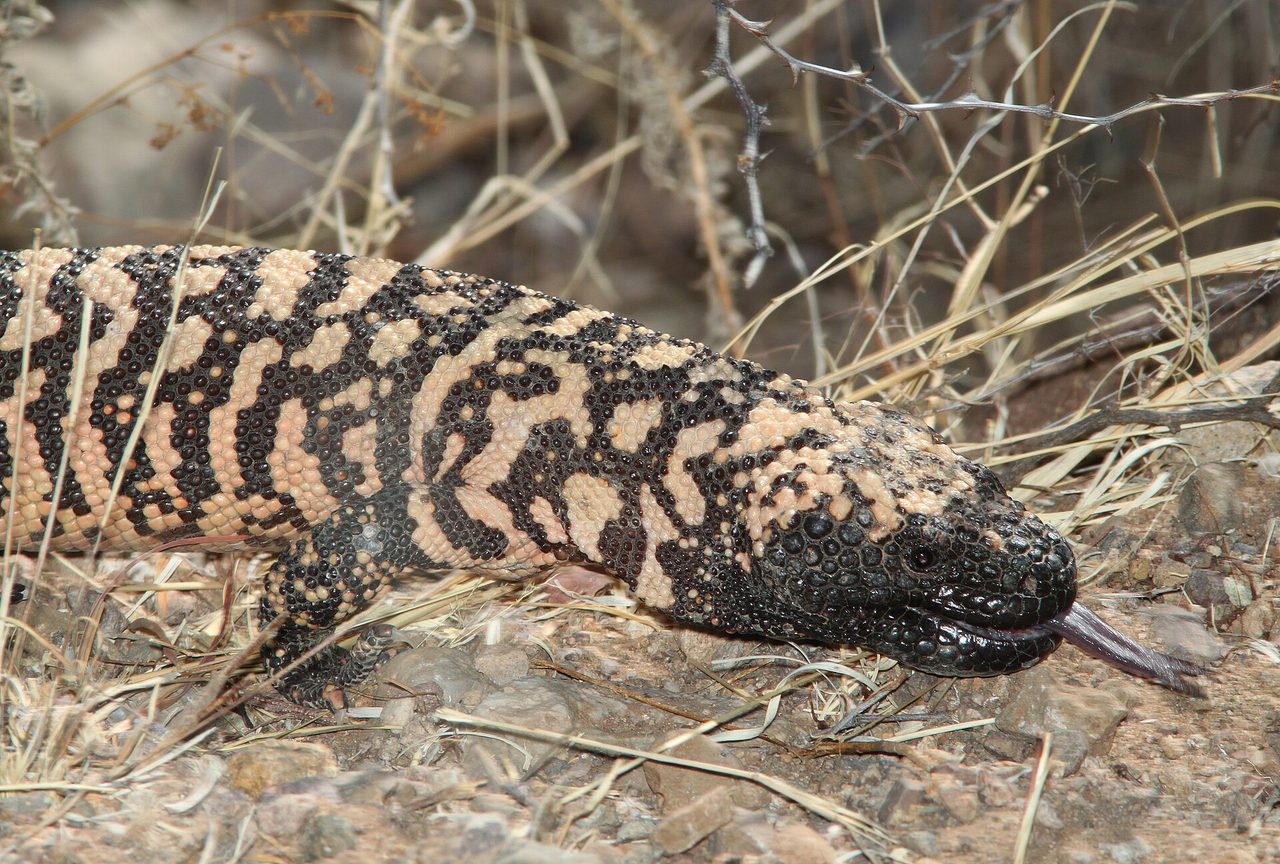
Photo: ALAN SCHMIERER / Wikimedia Commons (CC0)
In brief
The Gila monster is a heavy, slow-moving venomous lizard of the American Southwest, classified as Near Threatened by the IUCN due to habitat loss, road mortality, and climate-driven changes to its desert home.
Also in Animals A to Z · Animals that start with G
How you can help
You can support the related appeal — read its purpose, recipient status and fund terms first — or give once to where it is needed most. Sharing accurate information helps too.
By WARN Research & Conservation TeamLast updated
The Gila monster (Heloderma suspectum) is the only venomous lizard native to the United States and one of only two venomous lizard genera on Earth. Heavy-bodied and slow-moving, it roams the Sonoran and Mojave desert scrub of the American Southwest and the Mexican state of Sonora, spending up to 98% of its life sheltering underground. Its striking beaded skin — a mosaic of black, orange, and pink osteoderms — is both armour and advertisement, warning predators of the potent venom delivered through grooved teeth in its lower jaw. Revered and feared in equal measure for centuries, the Gila monster has more recently earned scientific acclaim: a compound isolated from its venom became the basis for exenatide (Byetta), a landmark drug for treating type 2 diabetes. Despite this remarkable contribution to human medicine, the species is classified as Near Threatened on the IUCN Red List, with populations quietly declining under pressure from urban sprawl, road mortality, illegal collection, and a shifting monsoon climate.
56 cm
Max body length
~98%
Life spent underground
20–30 yrs
Wild lifespan
2–12 eggs
Clutch size
Figures sourced from IUCN Red List — Heloderma suspectum (Hammerson et al., 2007), Animal Diversity Web — Heloderma suspectum, US Fish & Wildlife Service — Gila Monster species profile and other references on this page.
Gila Monster: Quick Facts
| Type | Venomous lizard (reptile) |
|---|---|
| Length | Up to 56 cm (22 in) |
| Weight | 550–800 g (1.2–1.8 lb) |
| Lifespan | 20–30 years in the wild |
| Active season | Primarily April–June |
| Clutch size | 2–12 eggs (average ~5) |
| Incubation | ~9 months |
| Subspecies | 2 (Reticulate and Banded) |
Scientific Classification
| Kingdom | Animalia |
|---|---|
| Phylum | Chordata |
| Class | Reptilia |
| Order | Squamata |
| Family | Helodermatidae |
| Genus | Heloderma |
| Species | Heloderma suspectum |
Conservation Status
- IUCN Status
- Near Threatened
- Population
- Unknown; no reliable global estimate; populations declining across most of US range
- Trend
- Decreasing
- Assessed
- 2007
- CITES
- Appendix II
Assessed as Near Threatened because the species is probably declining at a rate just below the Vulnerable threshold (30% over three generations), driven primarily by habitat loss from urbanisation and agricultural development. Illegal collection and road mortality are secondary threats. Climate change is an increasingly significant emerging threat not fully captured in the 2007 assessment.
Did you know?
A compound isolated from Gila monster venom — exendin-4 — led directly to exenatide (Byetta), the first GLP-1 receptor agonist approved for type 2 diabetes in 2005, a drug class now used by tens of millions of people worldwide.
Key Facts: Gila Monster
- The Gila monster is the only venomous lizard native to the United States, delivering venom through grooved lower-jaw teeth rather than hollow fangs.
- It spends as much as 98% of its life underground or in sheltered retreats, emerging mainly in spring to forage and mate.
- A compound in its venom — exendin-4 — led directly to exenatide (Byetta), the first GLP-1 receptor agonist approved for type 2 diabetes in 2005.
- The species is IUCN Near Threatened (assessed 2007), with populations declining primarily due to urban development, agricultural expansion, road mortality, and illegal collection.
- Climate change is now an acute threat: delayed monsoon seasons — even by just two weeks — can push individuals beyond their approximately 80-day dehydration tolerance window, and drought years are linked to a 20–30% drop in juvenile survival.
- Both its range states (USA and Mexico) protect the Gila monster by law, and international trade is regulated under CITES Appendix II.
What is a Gila Monster?
The Gila monster (Heloderma suspectum) is a large, heavily built lizard belonging to the ancient family Helodermatidae — a lineage whose fossil record extends back more than 98 million years to the Cretaceous period, making these lizards older than the mass-extinction event that ended the dinosaurs 66 million years ago. Adults typically measure 40–56 cm (16–22 in) in total length and weigh between 550 and 800 g (1.2–1.8 lb), making them among the heaviest lizards in North America. The species is instantly recognisable by its armour of rounded, bead-like scales — osteoderms, which contain small bones beneath the skin surface — arranged in vivid patterns of black and orange or pink. This pattern is not fixed: the two recognised subspecies differ visibly, with the Reticulate Gila monster (H. s. suspectum) showing a more mottled, network-like pattern across the Sonoran and Chihuahuan deserts, while the Banded Gila monster (H. s. cinctum) displays cleaner alternating bands across the back in the Mojave Desert and northwestern Arizona. The tail serves as a fat-storage organ, swelling during times of plenty and shrinking during drought or winter dormancy. Unlike venomous snakes, which inject toxin through hollow fangs, the Gila monster chews its prey, working venom along grooves in enlarged lower-jaw teeth via capillary action. The result can cause severe pain, a drop in blood pressure, and swelling in humans — though bites are rarely if ever fatal when appropriate care is received.
Where does the Gila Monster live?
Gila monsters are endemic to the arid and semi-arid zones of the American Southwest and northwestern Mexico. Their core range covers western and southern Arizona and extends into southern Sonora, Mexico, with peripheral populations in extreme southeastern California, southern Nevada, southwestern Utah, and southwestern New Mexico. They are most abundant in the Sonoran Desert, particularly in mountain foothills dominated by saguaro cacti and palo verde trees, and in rocky desert scrub where boulders, crevices, and pack-rat middens provide shelter. They also occupy semi-desert grasslands and venture along desert washes that channel seasonal runoff into valley floors. The lizard is fossorial by nature, retreating underground for the majority of the year. Activity above ground peaks between late April and mid-June, when temperatures are warm but not yet lethal, with occasional nocturnal activity following summer monsoon thunderstorms. Individuals rely on a mosaic of shelter sites within a well-defined home range, which in males can cover up to 60 hectares (150 acres). One long-term study recorded Gila monsters spending the equivalent of fewer than three months per year above the surface, making them among the most reclusive large reptiles in North America.
What does the Gila Monster eat — and how does its venom work?
Gila monsters are opportunistic carnivores that feed infrequently but consume large meals when prey is available. Their diet includes small mammals (young rabbits, mice, and ground squirrels), bird eggs, lizard eggs, snake eggs, turtle eggs, and occasionally nestling birds. Juveniles can consume food equivalent to 50% of their body weight in a single sitting; adults manage roughly 35%. This capacity to store energy in the tail means that three or four large meals can sustain an individual for an entire year — an extraordinary physiological adaptation to desert life where prey can be scarce and unpredictable. The Gila monster's venom is produced in modified salivary glands in the lower jaw and is not injected but rather chewed into wounds. The venom is not neurotoxic; it is dominated by kallikrein-like serine proteinases and phospholipase A2, which trigger the release of bradykinins that cause intense pain, hypotension, and oedema. Additional components include hyaluronidase and helodermin. Despite the venom's potency, Gila monsters rarely bite humans unprovoked; they are docile unless handled or cornered. Of far greater scientific interest is the peptide exendin-4, discovered in Gila monster venom in the 1990s. Exendin-4 shares roughly 53% structural similarity with human glucagon-like peptide-1 (GLP-1) and stimulates insulin release in a glucose-dependent manner. This discovery led directly to exenatide (brand name Byetta), approved by the US FDA in 2005 as the first GLP-1 receptor agonist for type 2 diabetes — a drug class that has since helped millions worldwide.
Why is the Gila Monster Near Threatened?
The IUCN Red List assessed the Gila monster as Near Threatened in 2007, noting that the species is probably in significant decline — though at a rate likely below the 30% threshold over three generations that would trigger Vulnerable status. The assessment authors (Hammerson, Frost, and Gadsden) identified habitat loss from urban and agricultural development as the primary driver, affecting the bulk of the species' US range where desert cities have expanded dramatically since the mid-twentieth century. Road mortality represents the second most significant threat: Gila monsters move deliberately across the landscape during their spring active season and are poorly equipped to avoid vehicles. Illegal collection for the pet trade remains a persistent pressure despite strong legal protections in all US range states; the animals are charismatic and command high prices. Climate change is now widely recognised as an acute and escalating threat. Research documents that delayed monsoon onset — even a shift of just two weeks — can push individuals beyond the approximately 80-day dehydration tolerance window provided by their urinary bladder water reserves, while drought years correlate with a 20–30% drop in juvenile survival. Modelling studies project that suitable Gila monster habitat in the Mojave Desert will shrink significantly under higher-emissions scenarios through 2070–2100, with the range slowly shifting northward. Their slow reproductive rate — sexual maturity at 3–5 years, clutches of only 2–12 eggs, and an approximately 9-month incubation period — means populations recover slowly from any localised setback.
How is the Gila Monster protected?
The Gila monster benefits from a robust but imperfect set of legal protections. In the United States, it is protected by state law in every state where it occurs: Arizona, Nevada, California, Utah, and New Mexico all prohibit take, possession, or harm without a special permit. At the federal level, the US Fish and Wildlife Service lists the Gila monster as a species of conservation concern, and the Banded subspecies (H. s. cinctum) has its own separate profile. In Mexico, the species is listed as Protected (Protección Especial) under the official wildlife standard NOM-059-SEMARNAT. Internationally, the Gila monster is listed on CITES Appendix II, meaning international commercial trade requires documentation to ensure it does not threaten wild populations. Conservation challenges persist nonetheless: enforcement in remote desert terrain is difficult, and legal loopholes in some jurisdictions have historically allowed captive-bred animals to mask wild-caught individuals in the trade. Ongoing research programmes — including long-term radio-telemetry studies tracking home range use, monsoon dependency, and body condition — continue to generate data that inform state-level management plans. Protected area coverage of the range is partial; much prime habitat in Arizona's Sonoran Desert falls within private ranchland or unprotected public land, making voluntary stewardship and landowner education important components of any meaningful conservation strategy.
What WARN Does
WARN does not currently run field projects for the Gila monster — its range lies entirely within the United States and Mexico, outside the countries where WARN's partners work in-network countries. This guide is offered as free educational content, because public understanding of threatened species everywhere is the foundation of a culture that values wildlife. When people learn why a desert lizard matters — medically, ecologically, and in its own right — that awareness strengthens the case for conservation investment worldwide.
The Gila monster is a reminder that the natural world holds solutions to human diseases we have not yet imagined — but those solutions depend on wild populations surviving long enough to be studied. Supporting WARN helps fund the kind of habitat protection and wildlife education work that keeps ecosystems intact, wherever threatened animals live.
How can I help save the gila monster?
Explore practical ways to support the gila monster, from everyday choices and sharing reliable information to reviewing a related appeal before giving.
Explore ways to support
Read the related appeal’s purpose, recipient status and fund terms. Choose an affordable gift after checking what is proposed and what has been reported.
Ease the pressures
Avoid the wildlife trade and souvenirs, never buy wild animals as pets, and choose sustainable, habitat-friendly products — the threats behind the gila monster's decline fall when demand does.
Spread the word
Share accurate, sourced information about the gila monster. Wider awareness is what turns concern into lasting protection.
Gila Monster: Frequently Asked Questions
How can I help save the gila monster?
Is the Gila monster dangerous to humans?
How did a Gila monster venom compound lead to a diabetes drug?
How long can a Gila monster go without eating?
Why does the Gila monster spend so much time underground?
Are Gila monsters legal to keep as pets?
How is climate change affecting Gila monsters?
What do Gila monsters eat?
Where do Gila monsters live?
How long do Gila monsters live?
How big is a Gila monster?
Sources & References
Population figures, conservation status and biological facts on this page are drawn from authoritative scientific and intergovernmental sources.
- IUCN Red List — Heloderma suspectum (Hammerson et al., 2007)
- Animal Diversity Web — Heloderma suspectum
- US Fish & Wildlife Service — Gila Monster species profile
- National Institute on Aging — Exendin-4: From Lizard to Laboratory and Beyond
- PMC — Climate and Dispersal Ability Limit Future Habitats for Gila Monsters in the Mojave Desert
- Journal of Experimental Biology — Urinary bladder as physiological reservoir in Heloderma suspectum
- Smithsonian's National Zoo — Gila Monster
Terms used on this page
Plain-English definitions, from our wildlife and conservation glossary.
Explore more animals
Discover more animals, their habitats and their conservation status in the WARN wildlife-guide library.