Wildlife Guide · United Kingdom & Continental Europe
Grass Snake
Natrix helvetica / Natrix natrix
Britain's largest snake — a harmless, water-loving hunter of frogs and toads.
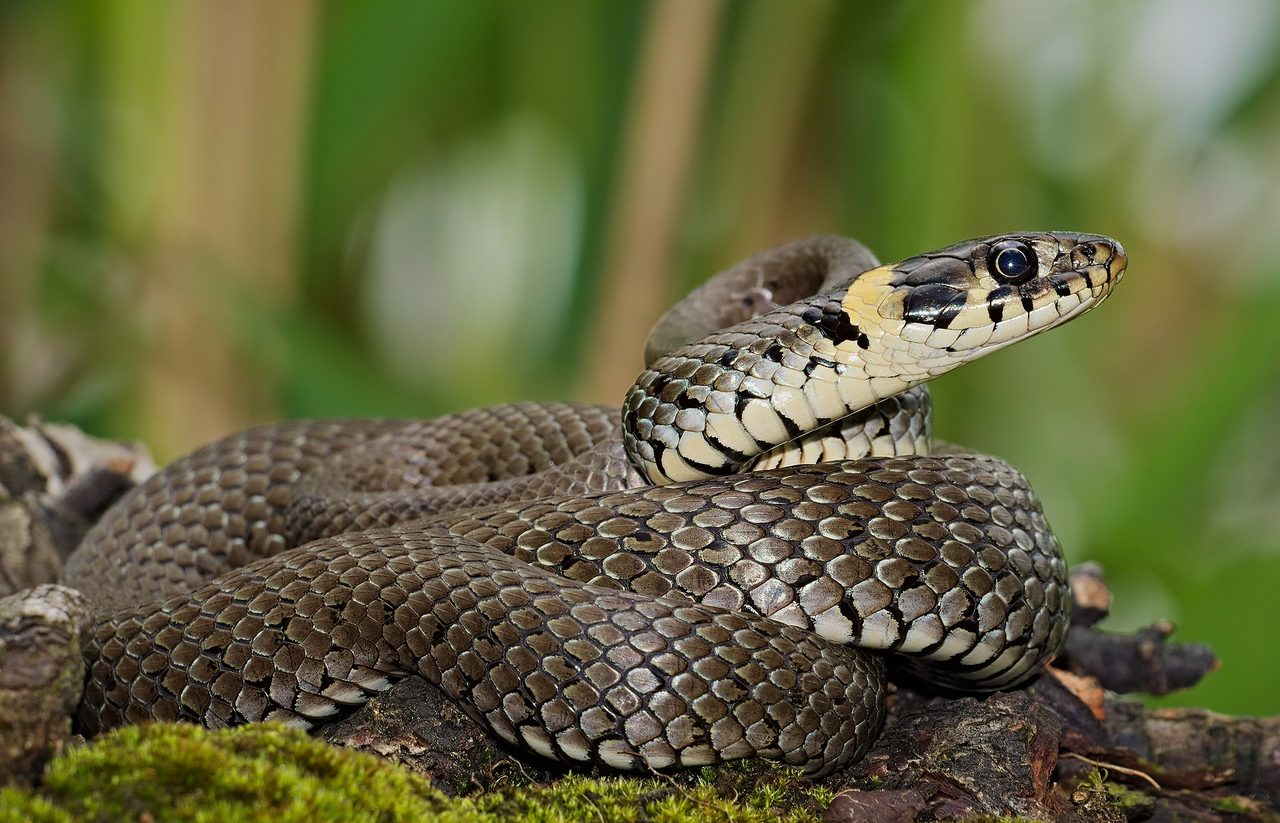
Photo: Andreas Eichler / Wikimedia Commons (CC BY-SA 4.0)
In brief
A grass snake is a large, harmless, non-venomous snake of Europe and western Asia (Natrix helvetica and Natrix natrix). It is Britain's largest snake, lives near water, swims well, eats mostly amphibians, and is recognised by a yellow-and-black collar behind the head.
Also in Animals A to Z · Animals that start with G
By WARN Research & Conservation TeamLast updated
The grass snake is a non-venomous, harmless snake found across much of Europe and into western Asia, and is the largest snake native to Britain. It is usually olive-green, grey or brownish, and most are identified by the yellow-and-black "collar" marking just behind the head. A keen swimmer, it lives close to ponds, ditches, marshes and slow rivers, where it hunts amphibians such as frogs, toads and newts. When cornered it relies on bluff rather than biting: it may hiss, release a foul-smelling musk, or convincingly feign death. In the UK it is a protected species, and like many wetland animals it depends on healthy, connected freshwater habitats.
Up to ~1.5 m
Length of the largest females — Britain's biggest snake
0 venom
Completely non-venomous and harmless to people
8–40+
Eggs laid in warm rotting vegetation in summer
Least Concern
Global IUCN status; protected in the UK
Figures sourced from Grass snake — Wikipedia, Barred grass snake (Natrix helvetica) — Wikipedia, Natrix natrix — IUCN Red List and other references on this page.
Grass Snake: Quick Facts
| Common name | Grass snake (also ringed snake, water snake) |
|---|---|
| Scientific name | Natrix helvetica / Natrix natrix |
| Family | Natricidae |
| Typical length | ~70–100 cm; large females can exceed 1 m, up to ~1.5 m |
| Diet | Mainly amphibians (frogs, toads, newts); also fish |
| Venom | None — non-venomous and harmless |
| Habitat | Ponds, marshes, ditches, wet grassland, gardens |
| Reproduction | Egg-laying; clutches in warm rotting vegetation |
| Defence | Hissing, foul musk, playing dead |
| UK status | Largest UK snake; legally protected |
Scientific Classification
| Kingdom | Animalia |
|---|---|
| Phylum | Chordata |
| Class | Reptilia |
| Order | Squamata |
| Family | Natricidae (formerly Colubridae) |
| Genus | Natrix |
| Species | Natrix helvetica (western) / Natrix natrix (barred) |
Conservation Status
- IUCN Status
- Least Concern on the IUCN Red List across its wide European and western Asian range. Populations are generally stable globally, though local declines occur where wetlands are drained, ponds are lost and habitats become fragmented. In the United Kingdom the grass snake is protected under the Wildlife and Countryside Act 1981, making it an offence to deliberately kill, injure or sell them.
- Population
- Not precisely quantified; widespread and locally common across much of Europe
- Trend
- Stable globally, with localised declines linked to habitat loss
- Assessed
- Assessed as Least Concern by the IUCN (Natrix natrix; the western grass snake N. helvetica was later recognised as a distinct species)
- CITES
- Not listed on the CITES Appendices
Healthy grass snake numbers depend on connected wetlands, abundant amphibian prey and undisturbed sites such as compost heaps for egg-laying.
Key Facts: Grass Snake
- The grass snake is non-venomous and harmless to humans — it has no venom and almost never bites.
- It is the UK's largest snake, with mature females reaching well over a metre and occasionally close to 1.5 m.
- Look for the yellow-and-black collar behind the head, plus dark bars or spots along the flanks.
- It is a strong swimmer that hunts amphibians — frogs, toads and newts — usually near ponds and wetlands.
- When threatened it bluffs: hissing, releasing a foul musk, or playing dead with its tongue lolling out.
- Grass snakes are protected in the UK and rely on healthy, well-connected freshwater and rough-grass habitats.
How do you identify a grass snake?
Grass snakes are typically olive-green, greyish or brownish above, often with rows of small black bars or spots running down each flank. The clearest field mark is the collar just behind the head — usually a band of yellow, cream or orange bordered by black — although it can be faint or, rarely, almost absent in some individuals. The underside is creamy or whitish with bold black, chequerboard-like markings. The pupil is round (not vertical), and the eye looks bright and alert. Adult females are noticeably larger than males; the biggest reach over a metre and can approach 1.5 m, making this Britain's largest snake. In the UK the grass snake is easily told from the adder (Vipera berus), which is shorter, has a vertical pupil and a bold dark zig-zag down its back, and from the legless slow worm, which is a lizard with a glossy, cylindrical body. If you find a snake near water in Britain that swims confidently and lacks a zig-zag, it is almost certainly a grass snake.
Where do grass snakes live, and what do they eat?
Grass snakes are strongly associated with water and damp habitats. They favour pond margins, ditches, marshes, wet meadows, canal banks, slow rivers and gardens with ponds, but also use woodland edges, hedgerows, rough grassland and compost heaps. Their range spans much of Europe and extends into western Asia and north-west Africa; the western grass snake (Natrix helvetica) occurs across western Europe including Britain, while the barred grass snake (Natrix natrix) occupies more eastern parts of the range. Amphibians dominate the diet — frogs, toads and newts — and grass snakes are excellent swimmers that will pursue prey into the water. They also take fish, tadpoles and occasionally small mammals or nestlings. Prey is swallowed whole and alive, as the snake has no venom to subdue it. Being cold-blooded, grass snakes are most active in warm weather and bask in sunshine to raise their body temperature, retreating to cover or hibernating underground through the cold months.
Are grass snakes dangerous, and how do they defend themselves?
Grass snakes are harmless to people. They are non-venomous and very reluctant to bite, relying instead on a memorable repertoire of bluffs to escape predators. A cornered grass snake may flatten its head and hiss loudly, or rear up in a mock-threatening posture. If that fails, it can release a foul-smelling fluid from its cloacal glands — a pungent musk that deters many predators. Most famously, the grass snake may feign death (thanatosis): it rolls onto its back, goes limp, lets its mouth gape and its tongue loll out, and may even emit musk and a little blood, presenting a thoroughly unappetising 'corpse'. Once the threat passes, it rights itself and slips away. Because they are shy and quick to flee, encounters are usually brief. The best response to finding one is simply to watch quietly and let it move on; in the UK it is an offence to deliberately kill, injure or harm them.
How do grass snakes breed?
Grass snakes are among the few egg-laying (oviparous) snakes in their northern range, which shapes how they reproduce. Mating takes place in spring after emergence from hibernation. In summer the female lays a clutch — commonly around eight to forty eggs, sometimes more — in a warm, moist site where decomposition generates heat, such as compost heaps, manure piles, rotting vegetation or leaf litter. This warmth incubates the eggs, since the climate alone is often too cool. Several females may use the same favoured site, occasionally producing large communal egg masses. The young hatch in late summer or early autumn as miniature replicas of the adults, complete with the collar marking, and are independent from the start. Grass snakes can be long-lived for a small reptile, and warm compost heaps in gardens can be valuable breeding sites — one reason gardeners are encouraged to leave undisturbed heaps and log piles where these snakes may be present.
Grass snake vs adder (UK)
| Feature | Grass snake | Adder |
|---|---|---|
| Venom | Non-venomous, harmless | Venomous (mildly, rarely serious) |
| Pupil | Round | Vertical, cat-like |
| Key marking | Yellow-and-black collar behind head | Dark zig-zag stripe down the back |
| Size | Larger; up to ~1.5 m | Shorter and stockier; usually under 70 cm |
| Habitat | Near water; strong swimmer | Heath, moor, woodland edge; drier ground |
| Defence | Musk, hissing, playing dead | Will bite if cornered |
What WARN Does
WARN does not run field projects specifically for the grass snake — it is widespread and classed as Least Concern, and most of its range lies outside the countries where WARN's partners work partner countries. This guide is part of WARN's free educational work, helping people recognise and value a misunderstood, harmless animal. The threats grass snakes face — loss and drainage of wetlands, fragmented habitats and the persecution of snakes through fear — are the same pressures of habitat loss and human conflict that affect the animals WARN does protect.
If this guide helped you see snakes a little more kindly, a small gift helps us keep producing free, science-based wildlife education and care for the animals in our partner countries.
Grass Snake: Frequently Asked Questions
Is a grass snake venomous or dangerous?
How big do grass snakes get?
What do grass snakes eat?
Why do grass snakes play dead?
How can I tell a grass snake from an adder?
Where do grass snakes lay their eggs?
Where do grass snakes live?
How long do grass snakes live?
Sources & References
Population figures, conservation status and biological facts on this page are drawn from authoritative scientific and intergovernmental sources.
Latest Grass Snake Stories
Quick, fact-checked reads on the grass snake — amazing facts, key questions and the threats it faces.
Guides
UK Animal Charities Explained: A Friendly Guide to 10 of the Biggest, and How They Differ
Who does what across UK animal welfare? A neutral, supporter-friendly guide to ten of the biggest UK animal charities — RSPCA, Dogs Trust, Battersea, Cats Protection, Blue Cross, PDSA, The Donkey Sanctuary, Brooke, Wood Green and Mayhew — with each charity's own donate link, and an honest section on where international field rescue fits in.
Read the storyGuides
What Is an Animal Sanctuary? How Sanctuaries Work, Who They Help, and How to Support One
Animal sanctuary, animal shelter, animal rescue — the terms are often used interchangeably, but they mean different things. This guide explains the difference, what life inside a sanctuary looks like, and how you can support sanctuaries in the UK and internationally.
Read the storyGuides
Fostering a Rescue Dog in the UK: A Complete Guide for New and Experienced Foster Carers
Fostering a rescue dog gives a dog in a shelter or rescue centre a temporary home while they wait for adoption — and it can make an enormous difference to their behaviour, health and chances of finding a permanent family. This guide covers how dog fostering works, what to expect, and how to get started.
Read the storyExplore more animals
Discover more animals, their habitats and their conservation status in the WARN wildlife-guide library.