Wildlife Guide · Brazil & Colombia
Harpy Eagle
Harpia harpyja
The rainforest's apex raptor, armed with talons longer than a grizzly bear's claws.
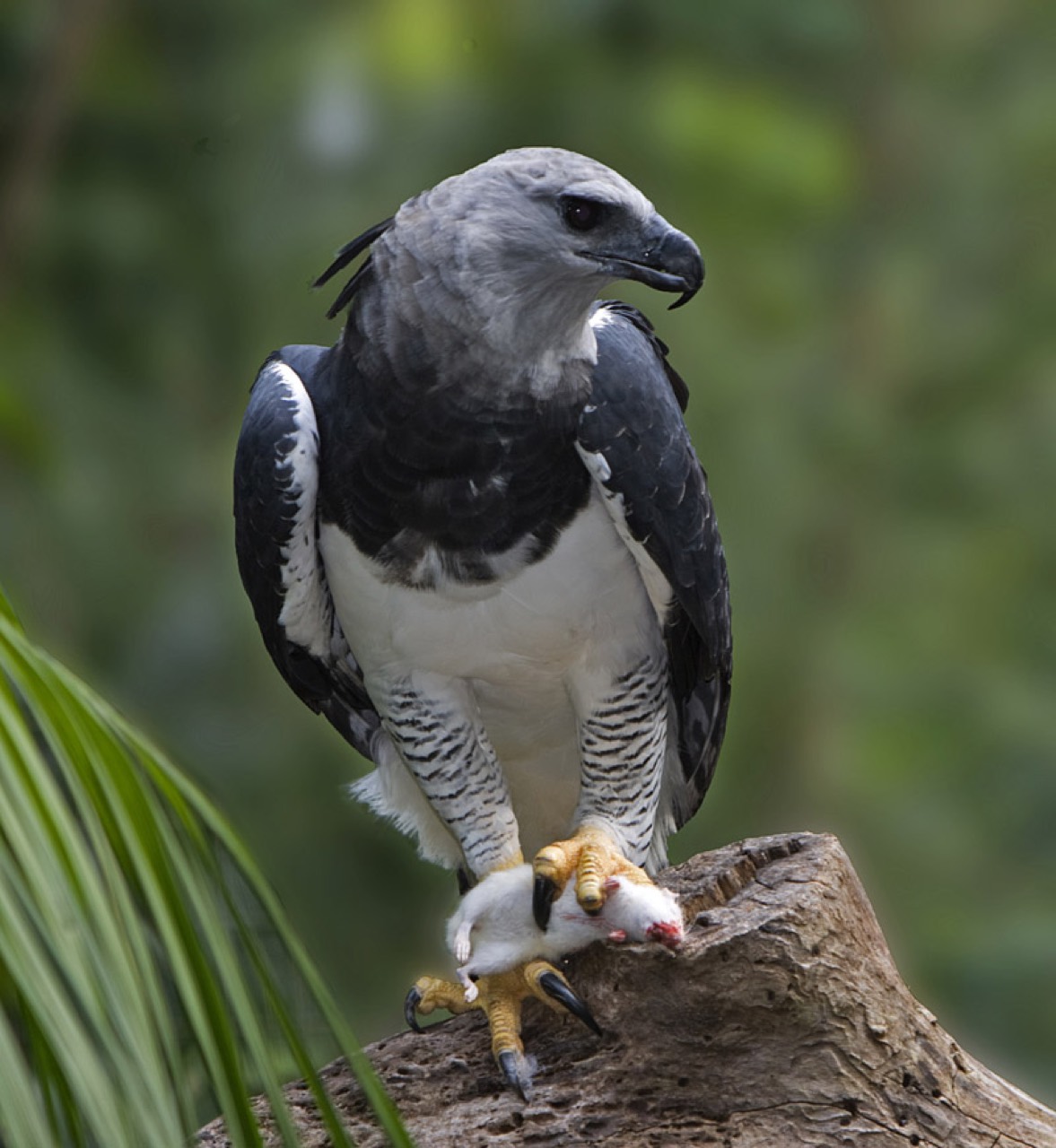
Source: Wikimedia Commons via Wikipedia “Harpy eagle”
In brief
A Harpy Eagle (Harpia harpyja) is the largest and most powerful bird of prey in the Americas, a rainforest eagle that hunts tree-dwelling mammals such as sloths and monkeys from the canopy of Central and South America; the IUCN classifies it as Vulnerable.
Also in Animals A to Z · Animals that start with H
How you can help
You can support the related appeal — read its purpose, recipient status and fund terms first — or give once to where it is needed most. Sharing accurate information helps too.
By WARN Research & Conservation TeamLast updated
The Harpy Eagle (Harpia harpyja) is the largest and most powerful raptor in the Americas, ruling the canopy of tropical lowland rainforests from southern Mexico to northern Argentina. With rear talons up to about 13 cm (5 in) long and a grip capable of crushing the bones of monkeys and sloths, it is an unmistakable apex predator. The IUCN lists the species as Vulnerable with a declining population, driven chiefly by deforestation and hunting.
~13 cm
Rear talon length — comparable to a grizzly bear's claws
Up to 9 kg
Weight of a large female, among the heaviest eagles alive
~2 m
Wingspan (about 176-224 cm)
Vulnerable
IUCN Red List status, declining (assessed 2021)
Figures sourced from IUCN Red List — Harpia harpyja (2021 assessment), BirdLife International DataZone — Harpy Eagle factsheet, CITES — Appendices (Harpia harpyja, Appendix I) and other references on this page.
Harpy Eagle: Quick Facts
| Lifespan | ~25-35 years |
|---|---|
| Weight | Female up to ~9 kg; male ~4-6 kg |
| Length | ~86-107 cm (34-42 in) |
| Wingspan | ~176-224 cm (about 2 m) |
| Diet | Carnivore — mainly sloths and monkeys |
| Incubation | ~53-56 days |
| Young per clutch | Usually 2 eggs, normally 1 chick reared |
| Talon length | Rear talons up to ~13 cm (5 in) |
| Baby name | Eaglet (nestling/chick) |
| CITES | Appendix I |
Scientific Classification
| Kingdom | Animalia |
|---|---|
| Phylum | Chordata |
| Class | Aves |
| Order | Accipitriformes |
| Family | Accipitridae |
| Subfamily | Harpiinae |
| Genus | Harpia |
| Species | Harpia harpyja (Linnaeus, 1758) |
Conservation Status
- IUCN Status
- Vulnerable
- Population
- Estimated ~100,000-250,000 mature individuals (2021 IUCN/BirdLife assessment), but with high uncertainty
- Trend
- Decreasing
- Assessed
- 2021
- CITES
- Appendix I
Listed as Vulnerable under criteria A3cd+4cd. The global estimate is broad and uncertain; the species has been extirpated from parts of its former range, and no precise total count exists.
Did you know?
A Harpy Eagle's rear talons can reach about 13 cm (5 in) — roughly the same length as a grizzly bear's claws.
Key Facts: Harpy Eagle
- The Harpy Eagle is the most powerful raptor in the Americas, with rear talons reaching about 13 cm (5 in) — similar in length to a grizzly bear's claws.
- Females are far larger than males, weighing up to roughly 9 kg versus about 4-6 kg for males.
- It is a canopy ambush hunter, preying mainly on arboreal mammals such as sloths and monkeys.
- Pairs typically raise only one chick every two to three years, making the species slow to recover from losses.
- The IUCN assessed the Harpy Eagle as Vulnerable in 2021, with a decreasing population trend.
- It is listed on CITES Appendix I, the strictest level of international trade protection.
Why the Harpy Eagle is the rainforest's apex raptor
The Harpy Eagle sits at the very top of the Neotropical rainforest food web. A large female can weigh up to about 9 kg, with hind talons reaching roughly 13 cm — longer than the claws of a grizzly bear — and legs as thick as a person's wrist. Rather than soaring over open country, it threads between trees on broad, rounded wings, using acute eyesight and hearing to detect prey in the canopy before striking with a grip strong enough to crush bone. Its diet is dominated by tree-dwelling mammals, especially sloths and monkeys, with the eagle capable of lifting prey approaching its own body weight.
Behaviour, breeding and ecology
Harpy Eagles are monogamous and intensely territorial, defending large home ranges of canopy forest. A pair builds a massive stick nest high in an emergent tree, often a kapok, and usually lays two eggs — but typically only one chick survives and is reared. Incubation lasts roughly 53-56 days, and the single eaglet depends on its parents for many months, fledging at around six months and staying near the nest well beyond that. Because a pair raises just one young every two to three years, the species has an exceptionally low reproductive rate, which makes every breeding territory and every adult bird disproportionately important to the population.
Threats: deforestation and persecution
The Harpy Eagle's decline is driven mainly by the loss and fragmentation of lowland tropical forest, which removes both nesting trees and the arboreal prey the eagle depends on. As large, slow-reproducing predators needing extensive intact forest, Harpy Eagles disappear quickly from logged and cleared landscapes. Direct persecution compounds the problem: because the birds are large, conspicuous and often unafraid of people, they are frequently shot out of curiosity, for trophies, or over fears about livestock. The combination of habitat loss and shooting has driven local extinctions across much of the species' former range in Central America and the southern Amazon.
What rescue and recovery involve
Protecting Harpy Eagles centres on keeping large blocks of rainforest standing, monitoring known nests, and reducing shooting through community education. Injured, orphaned or confiscated birds may pass through rescue and rehabilitation centres, where they receive veterinary care before release or, where release is impossible, contribute to managed breeding and education. Because each pair holds a vast territory and breeds slowly, on-the-ground work tends to focus on safeguarding individual nesting trees, supporting landowners who tolerate eagles, and building local pride in the species as a flagship for the wider forest.
Harpy Eagle vs Philippine Eagle: two giants of the canopy
| Feature | Harpy Eagle | Philippine Eagle |
|---|---|---|
| Scientific name | Harpia harpyja | Pithecophaga jefferyi |
| Range | Latin America (Mexico to Argentina) | Philippines (endemic) |
| Weight (female) | Up to ~9 kg | ~6-8 kg |
| Wingspan | ~176-224 cm | ~184-220 cm |
| Main prey | Sloths and monkeys | Monkeys, flying lemurs, other mammals |
| IUCN status | Vulnerable (2021) | Critically Endangered |
What WARN Does
WARN publishes this guide for education and is developing support through assessed animal-welfare grants. A species range, source citation or photograph does not establish a recipient or funding agreement. Check /about/where-your-money-goes/#grant-register for published grant and payment records; records not yet published must not be read as zero activity. Browse /appeals/ for the purposes currently available to support.
Every Harpy Eagle needs a vast stretch of standing rainforest to survive. Your gift helps fund WARN's local partners in Brazil and Colombia to protect canopy habitat and care for rescued birds of prey.
How can I help save the harpy eagle?
Explore practical ways to support the harpy eagle, from everyday choices and sharing reliable information to reviewing a related appeal before giving.
Explore ways to support
Read the related appeal’s purpose, recipient status and fund terms. Choose an affordable gift after checking what is proposed and what has been reported.
Ease the pressures
Avoid the wildlife trade and souvenirs, never buy wild animals as pets, and choose sustainable, habitat-friendly products — the threats behind the harpy eagle's decline fall when demand does.
Spread the word
Share accurate, sourced information about the harpy eagle. Wider awareness is what turns concern into lasting protection.
Harpy Eagle: Frequently Asked Questions
How can I help save the harpy eagle?
How long do Harpy Eagles live?
What do Harpy Eagles eat?
How big is a Harpy Eagle?
Are Harpy Eagles dangerous to humans?
How many Harpy Eagles are left?
Why is the Harpy Eagle endangered or threatened?
What is a baby Harpy Eagle called?
Where do harpy eagles live?
Sources & References
Population figures, conservation status and biological facts on this page are drawn from authoritative scientific and intergovernmental sources.
Terms used on this page
Plain-English definitions, from our wildlife and conservation glossary.
Latest Harpy Eagle Stories
Quick, fact-checked reads on the harpy eagle — amazing facts, key questions and the threats it faces.
Species
11 Amazing Facts About the Harpy Eagle, the Rainforest's Apex Raptor
From talons as long as a grizzly bear's claws to a single chick every two to three years, here are 11 fact-checked things that make the Harpy Eagle the most powerful bird of prey in the Americas.
Read the storySpecies
How Big, Strong and Fast Is a Harpy Eagle? The Numbers Explained
A Harpy Eagle can span two metres in wingspan, weigh up to 9 kg and grip with talons as long as a bear's claws. Here is what the science says about the most powerful raptor in the Americas.
Read the storySpecies
Harpy Eagle vs Philippine Eagle: How the World's Two Giant Forest Raptors Compare
They are the two largest forest eagles on Earth, but they live oceans apart and face very different odds. Here is how the Harpy Eagle and the Philippine Eagle compare on size, range, diet and survival.
Read the storyExplore more animals
Discover more animals, their habitats and their conservation status in the WARN wildlife-guide library.