Wildlife Guide · North America & Central America
Hummingbird
Family Trochilidae
The tiny, hovering jewels of the Americas — and the only birds that fly backwards.
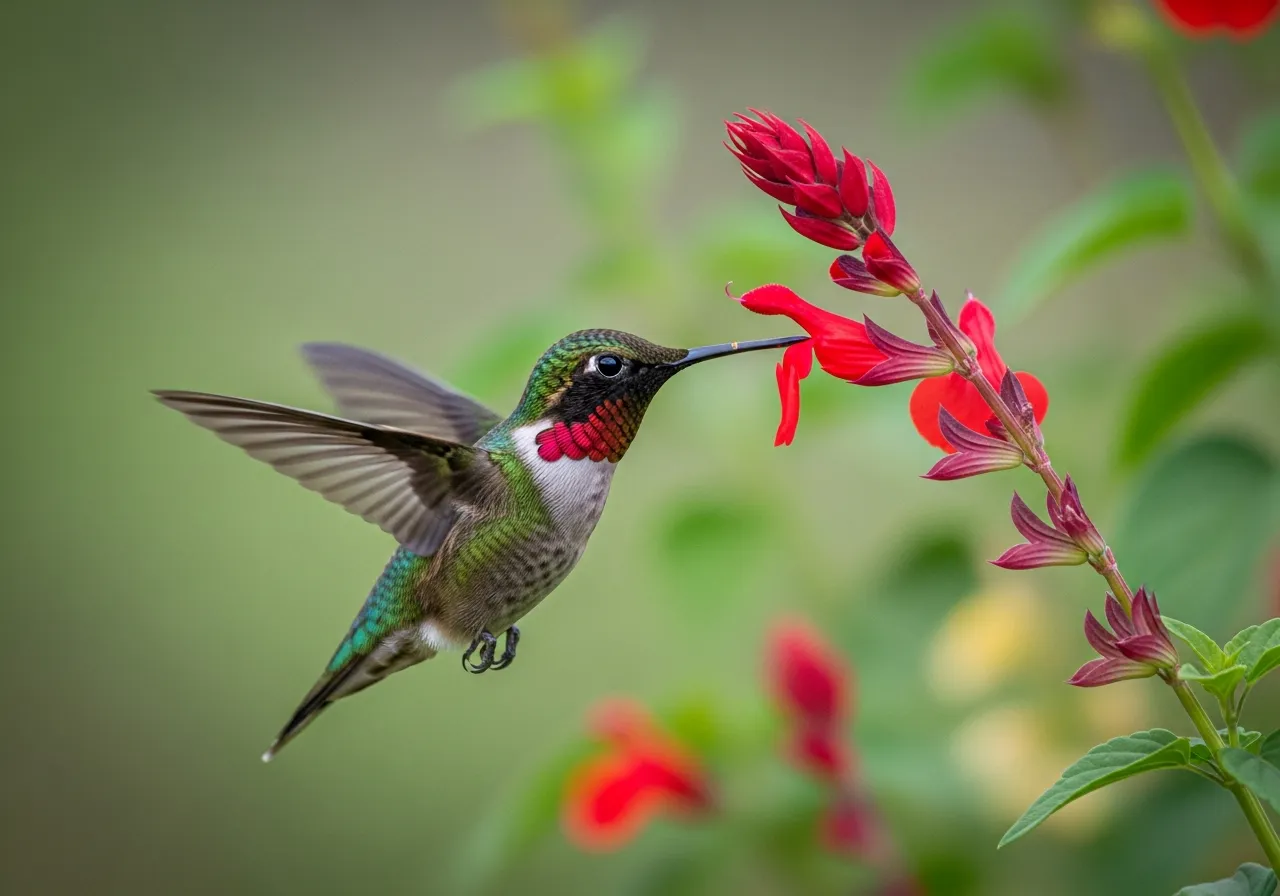
Source: Global Animal Guide (WARN)
In brief
A hummingbird is a very small, nectar-feeding bird in the family Trochilidae, found only in the Americas. With more than 360 species, they are the world's smallest birds and the only ones able to hover and fly backwards, beating their wings up to around 50 or more times a second.
Also in Animals A to Z · Animals that start with H
By WARN Research & Conservation TeamLast updated
Hummingbirds are a family of very small, fast-flying birds (Trochilidae) found only in the Americas, from Alaska and Canada to the southern tip of Chile and Argentina. With more than 360 species, they are the smallest birds on Earth and among the most acrobatic, able to hover in still air and even fly backwards. Their wings beat so quickly they blur into a faint hum — the sound that gives the group its name. Hummingbirds live on a fuel-hungry diet of flower nectar topped up with tiny insects, sustaining one of the highest metabolic rates of any animal. To survive cold nights they can enter torpor, a deep, energy-saving sleep that slows the heart and drops body temperature dramatically.
360+
species, all in the Americas
~5.5 cm
length of the tiny bee hummingbird
50+/sec
wingbeats in small species
1,000+ bpm
active heart rate
Figures sourced from Wikipedia — Hummingbird, Wikipedia — Bee hummingbird, IUCN Red List and other references on this page.
Hummingbird: Quick Facts
| Common name | Hummingbird |
|---|---|
| Family | Trochilidae |
| Number of species | More than 360 |
| Range | The Americas only (Alaska to southern South America) |
| Diet | Flower nectar plus small insects and spiders |
| Smallest species | Bee hummingbird, ~5.5 cm and under 2 g |
| Wingbeats | ~12/sec (large species) to 50+/sec (small species) |
| Active heart rate | Can exceed 1,000 beats per minute |
| Special abilities | Hovering, backward flight, nightly torpor |
| CITES | Whole family on Appendix II |
Scientific Classification
| Kingdom | Animalia |
|---|---|
| Phylum | Chordata |
| Class | Aves |
| Order | Apodiformes |
| Family | Trochilidae |
| Species | More than 360 species |
Conservation Status
- IUCN Status
- Varies by species. Most hummingbirds are assessed by the IUCN as Least Concern, but several are Critically Endangered, with others Endangered, Vulnerable or Near Threatened — typically those with very small geographic ranges. The family as a whole is not assigned a single category.
- Population
- No single overall figure; varies enormously by species, from abundant and widespread to a few hundred individuals for the rarest.
- Trend
- Mixed; many species stable, but a large number are declining, mainly due to habitat loss.
- Assessed
- Assessed species-by-species; figures here reflect recent IUCN Red List assessments.
- CITES
- Entire family Trochilidae listed on CITES Appendix II.
Because Trochilidae contains more than 360 species, conservation status must be read at the species level rather than for the family overall. Habitat loss, pesticide use and climate change are the most widespread threats.
Key Facts: Hummingbird
- Hummingbirds (family Trochilidae) number more than 360 species and live only in the Americas, from Alaska to southern South America.
- They are the smallest birds in the world, with the bee hummingbird of Cuba measuring roughly 5.5 cm long and weighing under 2 grams.
- They are the only birds that can hover precisely in place and fly backwards, beating their wings up to around 50 or more times per second in small species.
- Their diet is mostly flower nectar plus small insects, fuelling one of the highest metabolic rates of any vertebrate.
- On cold nights many enter torpor, slowing the heart and lowering body temperature to save energy.
- Conservation status varies by species: most are of Least Concern, but several are Critically Endangered, and the whole family is listed on CITES Appendix II.
Why can hummingbirds hover and fly backwards?
Hummingbirds are the only birds that can hover steadily in mid-air and fly backwards, sideways and even briefly upside down. The secret is in the shoulder joint and wing motion. Where most birds flap their wings up and down, hummingbirds rotate their wings in a figure-of-eight pattern, generating lift on both the forward and backward strokes. This lets them stay almost motionless in front of a flower while they feed. To power this, their flight muscles are unusually large — making up around a quarter to a third of their body weight — and their wings beat extremely fast, ranging from roughly 12 beats per second in the largest species to many tens of beats per second in the smallest. The blur of these beats produces the characteristic humming sound. Hovering is metabolically expensive, so hummingbirds pair it with rapid, darting flight to move between flowers efficiently. Top flight speeds can exceed 50 km/h, and males of some species reach even higher speeds in dramatic courtship dives. This combination of precision hovering and bursts of speed is unmatched among birds.
What do hummingbirds eat and why is their metabolism so high?
Hummingbirds run on sugar. Their main food is nectar, the energy-rich liquid produced by flowers, which they reach with long, slender bills and a forked, tube-like tongue that laps fuel up many times a second. Nectar provides quick carbohydrate energy, but little protein, so hummingbirds also catch small insects and spiders to supply the building blocks for muscle and feathers. Feeding this way supports an extraordinary metabolism: hummingbird hearts can beat well over 1,000 times a minute during activity, and they may visit hundreds of flowers in a single day to keep up with their energy demands. As they probe each bloom, pollen sticks to their head and bill, making them important pollinators of many native plants. Their high energy needs also explain their survival strategy on cold nights. Rather than burn precious reserves keeping warm, many hummingbirds enter torpor, a state of suspended activity in which the heart rate and body temperature fall sharply until dawn. By morning they warm back up and resume feeding, ready to refuel.
Where do hummingbirds live, and do they migrate?
Hummingbirds are found exclusively in the Americas, which makes them one of the most distinctive bird families of the New World. Their range stretches from Alaska and Canada in the north, through the United States, Mexico, Central America and the Caribbean, down to the southern tip of South America. The greatest diversity by far is in the tropics, especially the forests and mountain slopes of the Andes and Central America, where dozens of species can share a region. Many tropical hummingbirds stay put year-round, but several temperate species are long-distance migrants. The ruby-throated hummingbird, for example, breeds across eastern North America and winters in Central America, with many individuals crossing the Gulf of Mexico in a single non-stop flight — a remarkable feat for so small a bird. The rufous hummingbird undertakes one of the longest migrations relative to body size of any bird, travelling thousands of kilometres between Alaska and Mexico. To prepare, migrating hummingbirds lay down fat reserves, sometimes nearly doubling their body weight before setting off.
How threatened are hummingbirds?
Because Trochilidae is such a large family, conservation status varies enormously from one species to the next. Many widespread hummingbirds are assessed by the IUCN as Least Concern and remain common within their ranges. However, a number of species — often those restricted to a small island, valley or mountain — are at serious risk, and several are listed as Critically Endangered. The main pressures are habitat loss and degradation, as forests and flower-rich habitats are cleared for farming and development, alongside the growing effects of a changing climate, which can shift the timing of flowering that migratory species rely on. Pesticides reduce the insect prey hummingbirds need for protein. To help curb international trade, the entire hummingbird family is listed on Appendix II of CITES, the global wildlife-trade convention. For gardeners and landowners, planting native nectar-rich flowers, avoiding pesticides and providing clean feeders can offer real, local support to the hummingbirds that pass through.
Hummingbird vs hawk moth: telling them apart
| Feature | Hummingbird | Hawk moth (e.g. hummingbird hawk-moth) |
|---|---|---|
| Group | Bird (family Trochilidae) | Insect (moth, family Sphingidae) |
| Body covering | Feathers | Scales and hairs |
| Legs | Two small legs | Six legs |
| Antennae | None | Prominent antennae |
| Feeding | Tube-like tongue laps nectar | Long coiled proboscis sips nectar |
| Where found | Americas only | Worldwide, including Europe and Asia |
What WARN Does
World Animal Rescue Network does not run field projects specifically for hummingbirds, which live across the Americas — outside the countries where WARN's hands-on rescue work is based. This guide is part of WARN's free educational library, written to help people understand and value wildlife. The threats that put some hummingbirds at risk — habitat loss, pesticide use and a changing climate — are the same pressures that harm the animals WARN does protect, which is why clear, science-based education matters everywhere.
If you value free, carefully sourced wildlife guides like this one, a small gift helps WARN keep producing them and care for the animals in its hands-on programmes.
Hummingbird: Frequently Asked Questions
What is the smallest hummingbird in the world?
How fast do hummingbirds beat their wings?
What do hummingbirds eat?
Do hummingbirds sleep, and what is torpor?
Where are hummingbirds found?
Where do hummingbirds live?
Are hummingbirds dangerous?
How long do hummingbirds live?
How big is a hummingbird?
Sources & References
Population figures, conservation status and biological facts on this page are drawn from authoritative scientific and intergovernmental sources.
Terms used on this page
Plain-English definitions, from our wildlife and conservation glossary.
Latest Hummingbird Stories
Quick, fact-checked reads on the hummingbird — amazing facts, key questions and the threats it faces.
Species
12 Amazing Facts About the Jaguar, the Americas' Biggest Cat
From a skull-piercing bite to a love of swimming, here are 12 fascinating, fact-checked things that make the jaguar the most powerful cat in the Americas.
Read the storySpecies
11 Amazing Facts About the Pink River Dolphin (the Amazon's Blushing Boto)
From a head that swivels 90 degrees to a blush built from battle scars, here are 11 true facts about the Amazon's pink river dolphin, the largest freshwater dolphin on Earth.
Read the storySpecies
Pink River Dolphin vs Tucuxi: How to Tell the Two Amazon Dolphins Apart
Both swim the same Amazon waters, but the pink boto and the grey tucuxi are only distant cousins. Here is how to tell them apart at a glance.
Read the storyExplore more animals
Discover more animals, their habitats and their conservation status in the WARN wildlife-guide library.