Wildlife Guide · Indonesia
Komodo Dragon
Varanus komodoensis
The world's largest living lizard, cornered onto a handful of Indonesian islands.
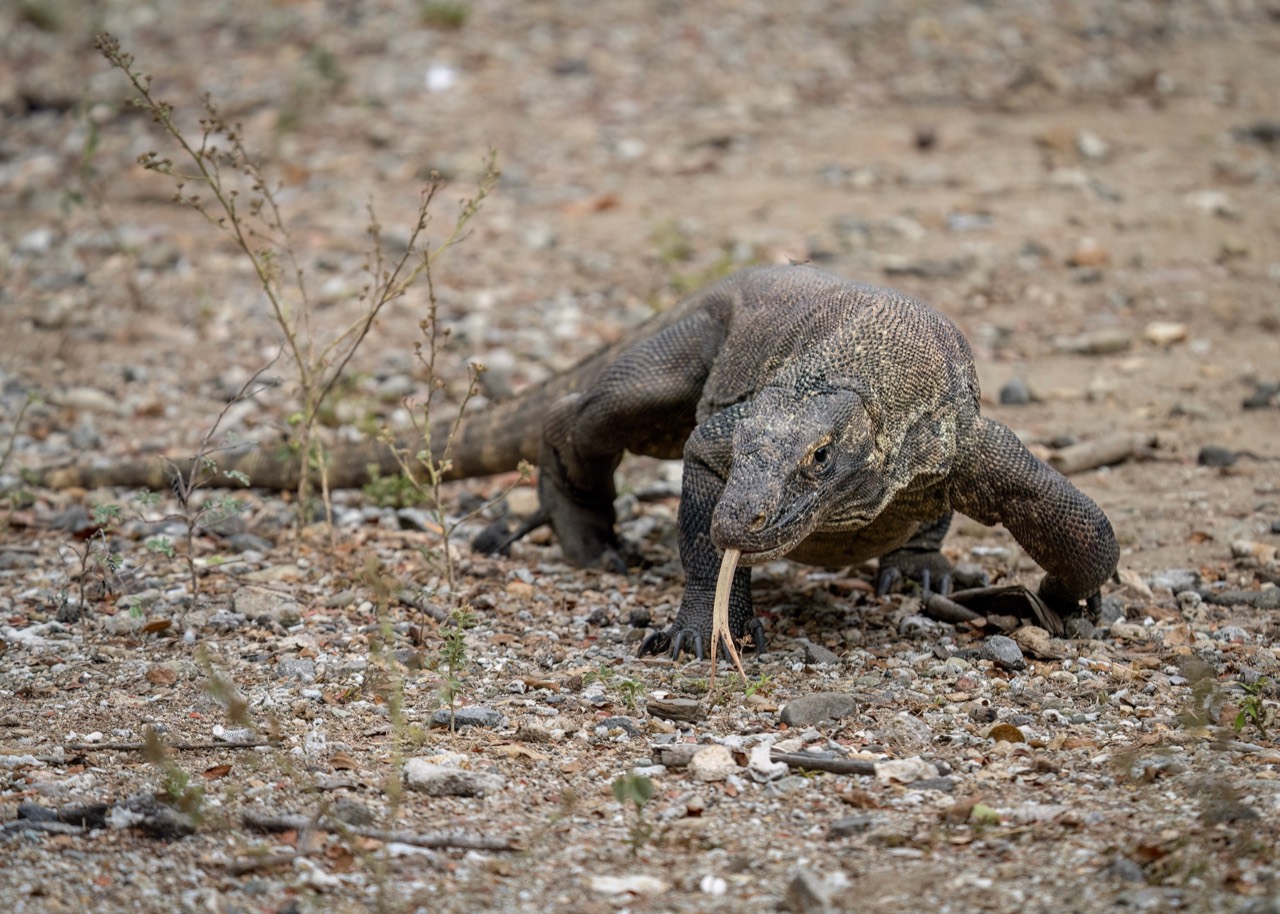
Source: Wikimedia Commons via Wikipedia “Komodo dragon”
In brief
A Komodo dragon (Varanus komodoensis) is the world's largest living lizard, a venomous monitor species native to a few islands in eastern Indonesia that can grow to about 3 metres long and 70-90 kilograms.
Also in Animals A to Z · Animals that start with K
How you can help
You can support the related appeal — read its purpose, recipient status and fund terms first — or give once to where it is needed most. Sharing accurate information helps too.
By WARN Research & Conservation TeamLast updated
The Komodo dragon is the largest lizard alive today, a heavyweight monitor that can exceed three metres in length and ambush prey as large as deer and water buffalo. It survives only on a few small islands in eastern Indonesia, where a shrinking, fragmented population now numbers in the low thousands. Backed by a venomous bite and a fearsome reputation, it is nonetheless one of the planet's most range-restricted large predators.
~3 m
Maximum length (largest living lizard)
166 kg
Heaviest verified weight
~1,383
Mature individuals (IUCN, 2021)
5 islands
Entire wild range, all in Indonesia
Figures sourced from IUCN Red List - Varanus komodoensis (Endangered, 2021), CITES - Varanus komodoensis (Appendix I), Smithsonian's National Zoo - Komodo dragon and other references on this page.
Komodo Dragon: Quick Facts
| Lifespan | ~30 years in the wild; longer in managed care |
|---|---|
| Weight | Typically 70-90 kg; up to 166 kg |
| Length | Up to ~3 m (largest living lizard) |
| Diet | Carnivore - deer, boar, carrion; juveniles eat insects and small prey |
| Incubation | ~7-8 months |
| Eggs per clutch | ~20 eggs |
| Top speed | ~20 km/h in short bursts |
| Baby name | Hatchling |
| Group name | Bask (also informally bank) |
| CITES | Appendix I |
Scientific Classification
| Kingdom | Animalia |
|---|---|
| Phylum | Chordata |
| Class | Reptilia |
| Order | Squamata |
| Family | Varanidae |
| Genus | Varanus |
| Species | Varanus komodoensis (Ouwens, 1912) |
Conservation Status
- IUCN Status
- Endangered
- Population
- Fewer than ~1,400 mature individuals (a few thousand including juveniles)
- Trend
- Decreasing
- Assessed
- 2021
- CITES
- Appendix I
Reassessed from Vulnerable to Endangered in 2021. Population is fragmented across island subpopulations, none holding more than ~500 individuals; climate-driven habitat loss is a key long-term threat.
Did you know?
Female Komodo dragons can occasionally reproduce without any male, through facultative parthenogenesis - and because of how their sex chromosomes work, those fatherless clutches hatch out entirely male.
Key Facts: Komodo Dragon
- It is the largest living lizard on Earth, reaching roughly 3 metres and up to 166 kg.
- The entire wild population lives on just a few Indonesian islands - Komodo, Rinca, Flores, Gili Motang and Nusa Kode.
- The IUCN reassessed it from Vulnerable to Endangered in 2021, citing a small, declining population and climate-driven habitat loss.
- Fewer than about 1,400 mature individuals are estimated to remain in the wild.
- Komodo dragons have venom glands that produce anticoagulant venom, causing prey to bleed and go into shock.
- Females can occasionally reproduce without a mate through facultative parthenogenesis, producing only male offspring.
Why it is endangered
In 2021 the IUCN moved the Komodo dragon from Vulnerable to Endangered. The decision reflected a tiny global range, a fragmented population spread across several island subpopulations, and an estimate of fewer than 1,400 mature individuals, with no single subpopulation holding more than around 500. The biggest emerging concern is climate change: rising sea levels and warming are projected to shrink the low-lying coastal savanna habitat the species depends on, with modelling suggesting steep habitat loss in the coming decades. Because the dragon cannot simply move to new ground, this island confinement that once protected it now leaves it acutely exposed.
Behaviour and ecology
Komodo dragons are apex predators of their islands. Adults are ambush hunters that take large mammals such as Timor deer and wild boar, while also scavenging carrion detected with their forked tongues from kilometres away. A bite delivers venom from glands in the lower jaw that prevents blood clotting and lowers blood pressure, helping bring down prey far larger than the dragon itself. Juveniles, vulnerable to being eaten by adults, spend their early years up in trees eating insects, small lizards and birds. Females lay roughly 20 eggs, often in megapode mounds or self-dug nests, which incubate for around seven to eight months.
Threats on the ground
The most direct pressures are loss and degradation of habitat, declines in the wild prey the dragons hunt, and human disturbance across a range that overlaps with growing tourism and development. Poaching of prey species such as deer reduces the food base, and the dragon's small, isolated subpopulations make any local loss hard to reverse. Layered on top is the longer-term threat of sea-level rise eroding coastal feeding grounds. With so few animals and such a confined range, even modest additional losses carry outsized risk.
What rescue and protection involve
Protecting Komodo dragons centres on safeguarding their habitat and prey within and around their island range, monitoring subpopulations, reducing human-wildlife conflict, and supporting the local communities who share these islands. Practical conservation work includes patrolling against poaching of prey animals, managing tourism pressure, caring for injured or displaced wildlife, and habitat restoration. Because the species exists nowhere else on Earth, on-the-ground stewardship in Indonesia - led by local teams - is the front line for its survival.
Komodo dragon vs. other large monitor lizards
| Feature | Komodo dragon | Asian water monitor | Crocodile monitor |
|---|---|---|---|
| Scientific name | Varanus komodoensis | Varanus salvator | Varanus salvadorii |
| Max length | ~3 m | ~2-3 m | ~2.5 m (very long tail) |
| Typical weight | 70-90 kg (up to 166 kg) | up to ~20 kg | up to ~20 kg |
| Range | A few Indonesian islands only | South & Southeast Asia (wide) | New Guinea |
| Venom glands | Yes | Yes (genus-wide) | Yes (genus-wide) |
| IUCN status | Endangered | Least Concern | Least Concern |
What WARN Does
WARN publishes this guide for education and is developing support through assessed animal-welfare grants. A species range, source citation or photograph does not establish a recipient or funding agreement. Check /about/where-your-money-goes/#grant-register for published grant and payment records; records not yet published must not be read as zero activity. Browse /appeals/ for the purposes currently available to support.
Komodo dragons exist nowhere on Earth but a few Indonesian islands - one of the countries where our network funds local rescue and conservation partners. A gift toward habitat protection helps the people on the ground keep their islands, prey and predators intact.
How can I help save the komodo dragon?
Explore practical ways to support the komodo dragon, from everyday choices and sharing reliable information to reviewing a related appeal before giving.
Explore ways to support
Read the related appeal’s purpose, recipient status and fund terms. Choose an affordable gift after checking what is proposed and what has been reported.
Ease the pressures
Avoid the wildlife trade and souvenirs, never buy wild animals as pets, and choose sustainable, habitat-friendly products — the threats behind the komodo dragon's decline fall when demand does.
Spread the word
Share accurate, sourced information about the komodo dragon. Wider awareness is what turns concern into lasting protection.
Komodo Dragon: Frequently Asked Questions
How can I help save the komodo dragon?
How big do Komodo dragons get?
How long do Komodo dragons live?
What do Komodo dragons eat?
Are Komodo dragons dangerous to humans?
How many Komodo dragons are left in the wild?
What is a baby Komodo dragon called?
Where do komodo dragons live?
Sources & References
Population figures, conservation status and biological facts on this page are drawn from authoritative scientific and intergovernmental sources.
Terms used on this page
Plain-English definitions, from our wildlife and conservation glossary.
Latest Komodo Dragon Stories
Quick, fact-checked reads on the komodo dragon — amazing facts, key questions and the threats it faces.
Species
12 Amazing Facts About the Komodo Dragon, the World's Largest Lizard
Venomous bites, virgin births, tree-dwelling babies and a range of just a few islands - the wildest true facts about the world's largest living lizard.
Read the storySpecies
How Big, Fast and Strong Is a Komodo Dragon?
Up to 3 metres long, 166 kg at its heaviest, capable of 20 km/h sprints and armed with a venomous bite - here is what the world's largest lizard can really do.
Read the storySpecies
Komodo Dragon vs Monitor Lizard vs Crocodile: Key Differences
A Komodo dragon is a giant monitor lizard - not a crocodile. Here is how to tell these confusable reptiles apart by size, family, range and how they hunt.
Read the storyExplore more animals
Discover more animals, their habitats and their conservation status in the WARN wildlife-guide library.