Lemur Species · Madagascar (far north tip)
Crowned Lemur
Confined to the northern tip of Madagascar — chestnut 'crown' on males.
By WARN Research & Conservation TeamLast updated
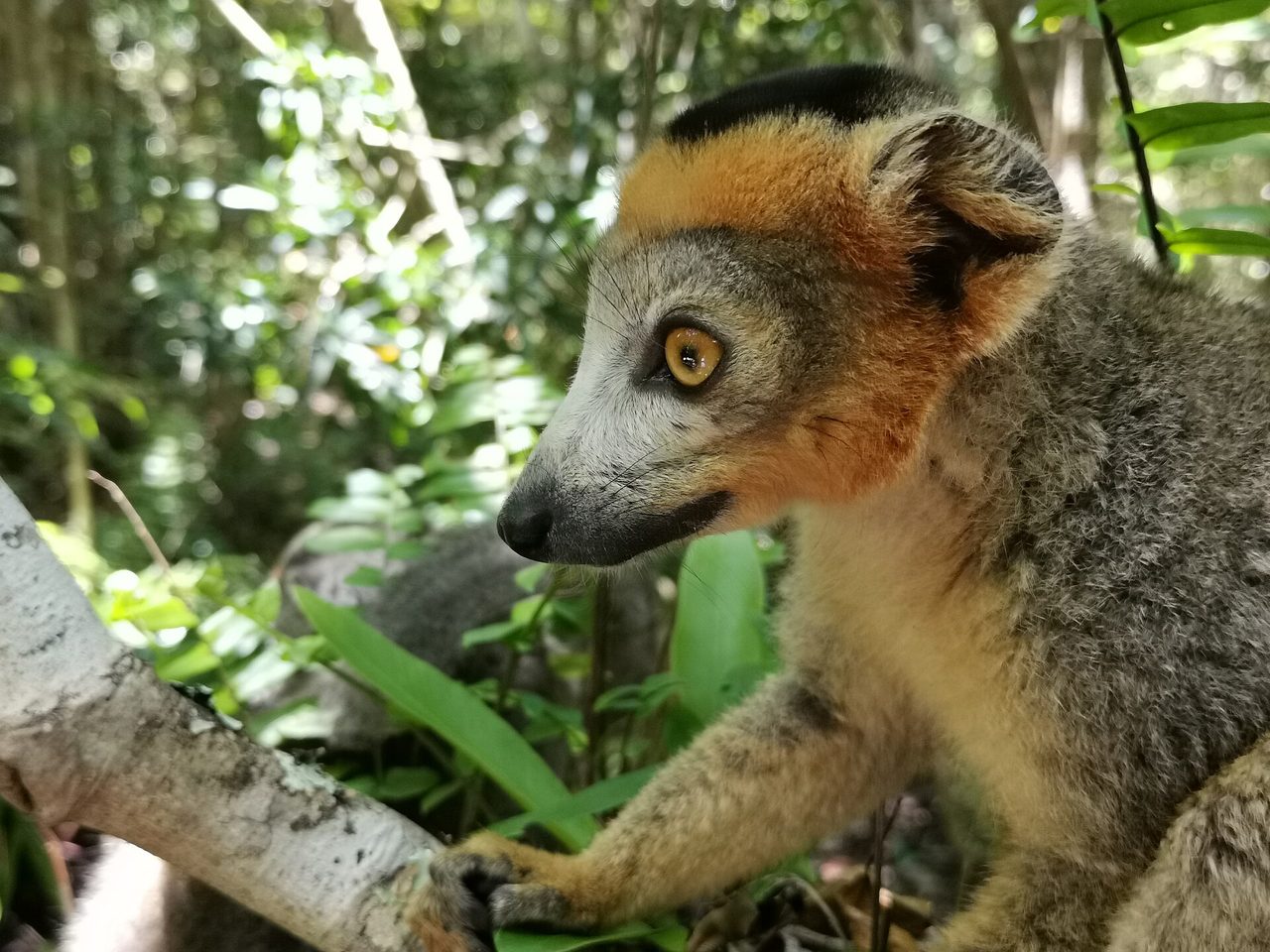
Photo: Z thomas / Wikimedia Commons (CC BY-SA 4.0)
In brief
The Crowned Lemur is a small, sexually dimorphic lemur confined to the northernmost tip of Madagascar — males wear a chestnut 'crown' while females are greyer overall. Its defining trait is one of the smallest geographic ranges of any Eulemur species, now under pressure from mining and charcoal production. Endangered and CITES Appendix I listed, it must never be kept as a pet.
What are the key facts about a Crowned Lemur?
The Crowned Lemur is a lemur species from Madagascar (far north tip): small (1.5 kg), social, sexually dimorphic. Confined to the northern tip of Madagascar — chestnut 'crown' on males.
| Origin | Madagascar (far north tip) |
|---|---|
| Size | Small (1.5 kg) |
| Typical weight | 1.5–1.8 kg (3.3–4 lb); compact with pronounced sexual dimorphism in coat colour |
| Lifespan | 15–20 years |
| Coat & markings | Males: grey body with chestnut crown, cheeks and beard giving a 'crowned' appearance. Females: greyer overall with less rufous colouration. Both sexes have pale faces with dark eye patches and tufted ears. Fur is suited to dry forest at Madagascar's northern extremity — less dense than rainforest lemur pelage. |
| Temperament | Social, sexually dimorphic |
| Conservation note | Wild conservation only — crowned lemurs are CITES Appendix I listed with a range smaller than most Eulemur species. They require dry forest at Madagascar's northern tip and social groups. Support Montagne d'Ambre and Ankarana protected areas, and resist mining projects that fragment the last forest patches. |
Should you keep a Crowned Lemur as a pet?
No. A Crowned Lemur is a wild lemur from Madagascar (far north tip), not a companion animal. Private keeping usually means an infant taken from a troop, a lifetime of unmet social needs, and often a legal offence.
People search this page because the Crowned Lemur looks small, clever or “manageable” in photos. That is the trap. Wild primates need a troop, a range, and a diet that is not human leftovers. The Crowned Lemur is from Madagascar (far north tip); its conservation note on this page is wild conservation only — crowned lemurs are cites appendix i listed with a range smaller than most eulemur species. they require dry forest at madagascar's northern tip and social groups. support montagne d'ambre and ankarana protected areas, and resist mining projects that fragment the last forest patches..
If you met a Crowned Lemur in a selfie setting or a roadside stall, walk away and do not pay. Paying creates the next capture. Read this as a species briefing, then use the wildlife guide and the appeals linked at the bottom if you want to help the wild population.
What is a Crowned Lemur?
Confined to the northern tip of Madagascar — chestnut 'crown' on males. Origin is Madagascar (far north tip); coat or markings are described as Males: grey body with chestnut crown, cheeks and beard giving a 'crowned' appearance. Females: greyer overall with less rufous colouration. Both sexes have pale faces with dark eye patches and tufted ears. Fur is suited to dry forest at Madagascar's northern extremity — less dense than rainforest lemur pelage..
Treat “species” here as a library label for a wild species or distinct form, not as a kennel-club product.
Where does the Crowned Lemur come from?
Crowned Lemurs come from Madagascar (far north tip). Crowned lemurs (Eulemur coronatus) live in dry forest and limestone tsingy at the northernmost tip of Madagascar — primarily Montagne d'Ambre National Park, Ankarana Reserve and surrounding fragments.
Groups of five to fifteen individuals forage for fruit, flowers and leaves, travelling through forest and across limestone outcrops. Sexual dimorphism in coat colour is among the most striking in true lemurs — males' chestnut crowns contrast with females' uniform grey. Mining for sapphires and other minerals, charcoal production and forest clearance for agriculture threaten the tiny range. Crowned lemurs cannot relocate to new forest — the northern tip offers no alternative habitat. The species is Endangered on the IUCN Red List and CITES Appendix I listed. Ecotourism at Montagne d'Ambre provides income linking forest protection to community benefit, though mining pressure continues in buffer zones.
What does a Crowned Lemur actually need?
A wild Crowned Lemur needs the habitat and social system of Madagascar (far north tip), not a spare room. Size (Small (1.5 kg)) and a social, sexually dimorphic life history are why private keeping fails.
In the wild that means connected habitat, a diet the species evolved with, and distance from the pet and selfie trades. Captive “care sheets” for wild lemurs are how trafficking gets laundered as husbandry.
If you already work in accredited rescue, follow specialist protocols and licensing. Everyone else: do not acquire a Crowned Lemur. Support habitat and anti-trafficking work instead.
What surprises people about the Crowned Lemur?
A few details about the breed, alongside the practical care information in this guide.
- Crowned lemurs are named for the male's chestnut cap — females lack the prominent 'crown'.
- They live at the northernmost tip of Madagascar — one of the most restricted ranges of any Eulemur.
- Groups travel through limestone tsingy formations at Ankarana as well as dry forest at Montagne d'Ambre.
- They share habitat with Sanford's brown lemur in some areas, with niche separation reducing direct competition.
What health issues should you know about in a Crowned Lemur?
Health concerns to discuss with your vet, including changes to watch for and everyday care. This is general guidance, not veterinary advice — always speak to your vet.
Habitat loss (wild)
Forest clearance and mining at Madagascar's northern tip remove the only habitat crowned lemurs can occupy — there is no alternative range.
Care: Support Montagne d'Ambre and Ankarana protected area expansion. Challenge mining permits in forest buffer zones through conservation advocacy.
Mining pressure
Sapphire and mineral extraction in northern Madagascar fragments forest and introduces human disturbance into crowned lemur territories.
Care: Fund environmental impact monitoring and community advocacy for forest protection over short-term mining revenue.
Hunting
Crowned lemurs are hunted in unprotected forest patches despite legal protection, particularly near mining camps where bushmeat demand rises.
Care: Protected area patrols and community conservation agreements. Ecotourism revenue linking forest protection to local income.
Who should skip a Crowned Lemur?
Skip a Crowned Lemur if you are anyone hoping to keep a Crowned Lemur as a pet or photo prop. This Madagascar (far north tip) lemur is small (1.5 kg) and social, sexually dimorphic — the mismatch is usually lifestyle, not a missing accessory.
This page is allowed to say no. Skip if you are anyone hoping to keep a Crowned Lemur as a pet or photo prop. Skip if you are anyone who will pay for a wild-caught or roadside animal. Skip if you are tourists looking for handling or selfies.
A different lemur species on this site may fit. Wanting “a Crowned Lemur” after a film or a colour photo is not a reason to ignore the skip list.
What are the hidden catches with a Crowned Lemur?
The hidden cost of a Crowned Lemur is usually not the purchase price. It is years of care, the health list on this page, and the mismatch between a social, sexually dimorphic animal and a busy home.
The pet-trade catch
Cute infant Crowned Lemurs in ads were usually taken from wild families. The adult you cannot house is then dumped, euthanised, or passed on. Do not create that demand.
The tourism catch
Paying to hold, ride, or selfie with a Crowned Lemur funds the next capture or a stressed ambassador animal. Distance and accredited viewing are the ethical default.
The habitat loss (wild) catch
Forest clearance and mining at Madagascar's northern tip remove the only habitat crowned lemurs can occupy — there is no alternative range. Support Montagne d'Ambre and Ankarana protected area expansion. Challenge mining permits in forest buffer zones through conservation advocacy.
The mining pressure catch
Sapphire and mineral extraction in northern Madagascar fragments forest and introduces human disturbance into crowned lemur territories. Fund environmental impact monitoring and community advocacy for forest protection over short-term mining revenue.
How does a Crowned Lemur compare with Sportive Lemur and Ring-tailed Lemur?
A Crowned Lemur is not interchangeable with Sportive Lemur and Ring-tailed Lemur. Compare origin, size, lifespan and temperament before you choose — those four lines prevent most regret.
| Lemur fact | Crowned Lemur | Sportive Lemur | Ring-tailed Lemur |
|---|---|---|---|
| Origin | Madagascar (far north tip) | Madagascar (widespread) | Madagascar (south & south-west) |
| Size | Small (1.5 kg) | Small (0.7 kg) | Medium (2.2 kg) |
| Lifespan | 15–20 years | 15–20 years | 15–25 years (varies; mouse lemurs shorter) |
| Temperament | Social, sexually dimorphic | Nocturnal, vertical clinger, solitary | Diurnal, social, female-dominant |
What is the verdict on the Crowned Lemur?
A Crowned Lemur is a wild lemur to understand and protect, not a pet to acquire. If you came here to buy one, the verdict is no. If you came here to learn, use the species guide next.
Help looks like habitat, enforcement and refusing the trade — not a cage in a spare room. WARN is a CIC, not a charity; donate only if you want to fund partner work in our network countries, and do not expect Gift Aid.
Lemurs belong in Madagascar's forests
Every lemur species is CITES Appendix I and most are Endangered or Critically Endangered. Habitat protection — not the pet trade — is their only path to survival.