Wildlife Guide · Brazil
Maned Wolf
Chrysocyon brachyurus
The tallest wild dog on Earth — a fox-faced ghost of the Brazilian grasslands.
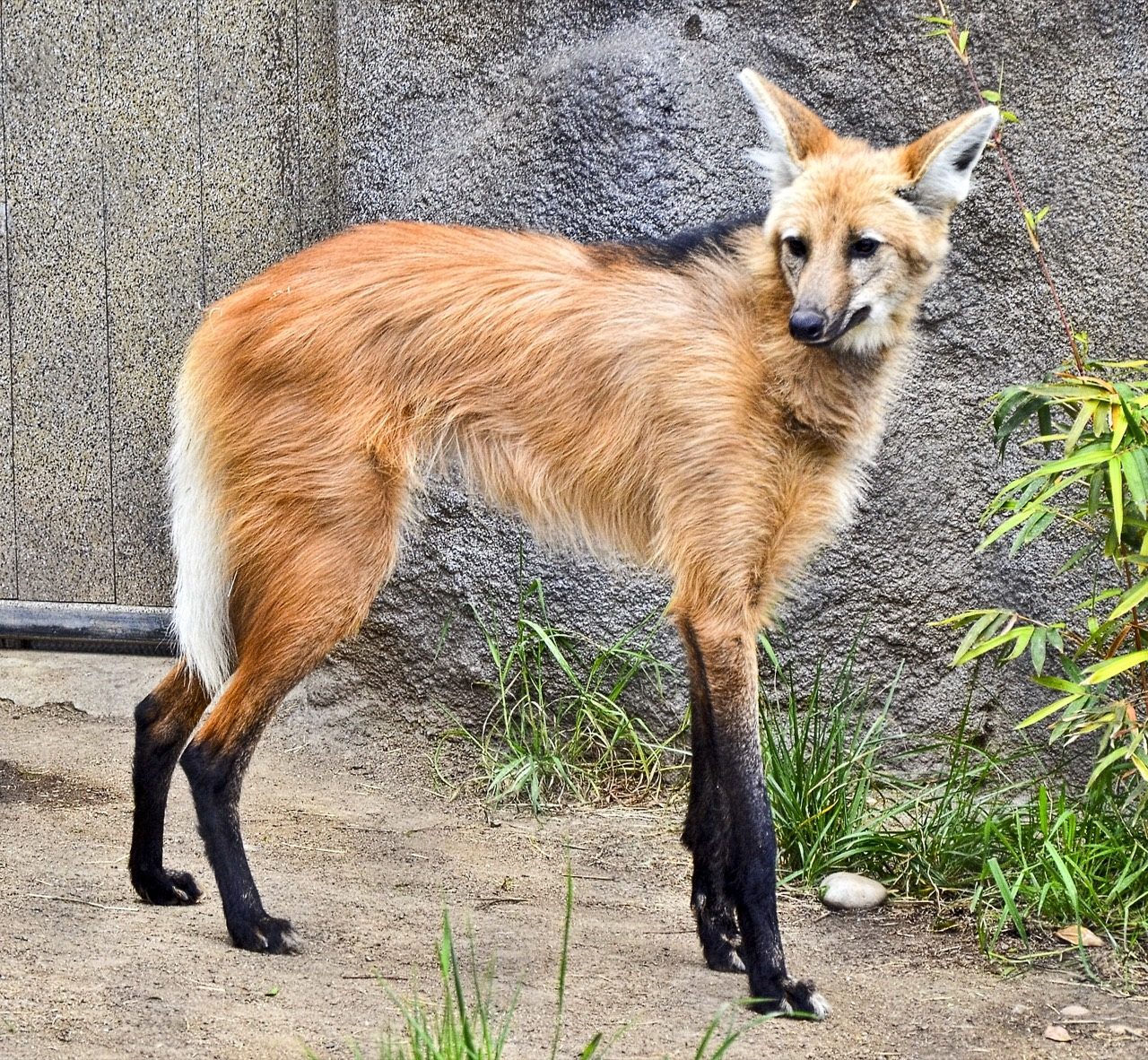
Source: Wikimedia Commons via Wikipedia “Maned wolf”
In brief
A maned wolf is the tallest wild canid in the world, a long-legged, reddish-coated omnivore native to the grasslands of central South America — especially Brazil's Cerrado — that despite its name is neither a true wolf nor a fox but the only species in the genus Chrysocyon.
Also in Animals A to Z · Animals that start with M
How you can help
You can support the related appeal — read its purpose, recipient status and fund terms first — or give once to where it is needed most. Sharing accurate information helps too.
By WARN Research & Conservation TeamLast updated
The maned wolf (Chrysocyon brachyurus) is the tallest wild canid in the world and the largest in South America, instantly recognisable by the long black legs that earned it the nickname "fox on stilts." Despite the name, it is neither a true wolf nor a fox but the sole living member of its genus, roaming the open savannas of the Cerrado. The IUCN lists it as Near Threatened, with Brazil holding more than 90% of the global population.
~110 cm
Shoulder height — tallest wild canid
20–30 kg
Adult weight
~17,000
Mature individuals (IUCN, 2015)
>90%
Of the population lives in Brazil
Figures sourced from IUCN Red List — Chrysocyon brachyurus (Maned Wolf), 2015 assessment, Smithsonian's National Zoo & Conservation Biology Institute — Maned wolf, CITES — Appendix II listing (Canidae) and other references on this page.
Maned Wolf: Quick Facts
| Lifespan | ~6–7 yr median in captivity; up to 12–15 yr |
|---|---|
| Weight | 20–30 kg (44–66 lb) |
| Shoulder height | Up to ~110 cm (43 in) — tallest wild canid |
| Body length | ~100 cm head-and-body, plus ~45 cm tail |
| Diet | Omnivore — ~50% fruit (lobeira) plus small animals |
| Gestation | ~65 days |
| Young per birth | 2–3 pups average (range 1–5) |
| Baby name | Pup |
| Social/group name | Largely solitary; monogamous breeding pair |
| CITES | Appendix II |
Scientific Classification
| Kingdom | Animalia |
|---|---|
| Phylum | Chordata |
| Class | Mammalia |
| Order | Carnivora |
| Family | Canidae |
| Genus | Chrysocyon (monotypic — the only species) |
| Species | Chrysocyon brachyurus (Illiger, 1815) |
Conservation Status
- IUCN Status
- Near Threatened
- Population
- ~17,000 mature individuals (IUCN, 2015); over 90% in Brazil
- Trend
- Unknown / likely declining
- Assessed
- 2015
- CITES
- Appendix II
Listed Near Threatened on the IUCN Red List in 2015. Brazil's Cerrado is the species' stronghold; ongoing habitat conversion, roadkill and disease from domestic dogs drive concern about future declines.
Did you know?
Maned wolf urine smells so strongly of skunk-like compounds that zookeepers can recognise the species by scent alone — and one such pungent enclosure at a Dutch zoo was once investigated as a suspected cannabis leak.
Key Facts: Maned Wolf
- It is the tallest wild canid on the planet, standing up to about 110 cm at the shoulder, yet weighs only 20–30 kg.
- Despite the name it is neither a wolf nor a fox — it is the only living species in the genus Chrysocyon.
- Its disproportionately long legs are an adaptation for seeing over and moving through tall Cerrado grasses, earning it the nickname 'fox on stilts.'
- It is an omnivore: roughly half its diet is fruit, especially the tomato-like lobeira, alongside small mammals, birds and insects.
- The IUCN classifies it as Near Threatened (2015), with an estimated 17,000 mature individuals and Brazil as its stronghold.
- Main threats are Cerrado habitat loss to agriculture, road collisions, persecution and diseases caught from domestic dogs.
Why it matters and why it's threatened
The maned wolf is the flagship mammal of the Cerrado, the vast tropical savanna that covers much of central Brazil. The Cerrado is one of the world's most biodiverse savannas, yet it has been reduced to a fraction of its original extent as land is converted to soy, sugarcane and cattle pasture. As habitat is fragmented, wolves are forced across roads — where vehicle collisions are a leading cause of death — and into closer contact with farms, where they are sometimes killed in retaliation for taking poultry and where they catch diseases such as parvovirus and distemper from domestic dogs. The IUCN assessed the species as Near Threatened in 2015, estimating roughly 17,000 mature individuals with an uncertain, likely declining trend driven by this ongoing habitat loss.
Behaviour and ecology
Maned wolves are largely solitary and crepuscular, most active at dusk and through the night. A breeding pair shares and defends a territory of around 30 square kilometres but the two animals typically forage alone rather than as a pack. They are true omnivores: fruit makes up about half the diet, with the lobeira ('wolf's fruit') a favourite, supplemented by rodents, rabbits, armadillos, birds, reptiles and insects. To hunt, a wolf rotates its tall ears to pinpoint prey in the grass, then taps the ground with a forefoot to flush it before pouncing. Their long-distance 'roar-bark' calls and pungent, skunk-like scent marks let widely spaced individuals communicate across the open landscape.
Reproduction and life cycle
Maned wolves are monogamous. After a gestation of about 65 days, the female gives birth to a litter averaging two to three pups (range one to five), usually during the dry season. Pups are born dark-coated and helpless; they nurse for around four weeks before being weaned onto regurgitated and brought food, with the male known to provision the litter in both wild and captive settings. Young typically disperse at about one year old. In captivity the median life expectancy is roughly 6 to 7 years, with some individuals reaching 12 to 15 years; lifespan in the wild is shorter and poorly documented because of roadkill and disease.
What rescue and conservation involve
Protecting maned wolves is less about removing animals from the wild and more about keeping the Cerrado intact and survivable. Effective work combines safeguarding and connecting blocks of savanna habitat, reducing road mortality with wildlife crossings and signage, vaccinating and managing domestic dogs near wolf range to cut disease spillover, and easing conflict with farmers so wolves are not killed. Rescue in the literal sense usually means treating animals injured on roads or orphaned pups, then rehabilitating and releasing them where possible. Because the species ranges across several countries, the most durable gains come from supporting local teams who monitor populations and work directly with the communities sharing the landscape.
Maned wolf vs. red fox: why the 'fox on stilts' is neither
| Feature | Maned wolf | Red fox |
|---|---|---|
| Scientific name | Chrysocyon brachyurus | Vulpes vulpes |
| Shoulder height | Up to ~110 cm | ~35–50 cm |
| Weight | 20–30 kg | 3–7 kg |
| Closest relatives | Sole member of genus Chrysocyon | True foxes (genus Vulpes) |
| Range | Cerrado of central South America | Across the Northern Hemisphere |
| IUCN status | Near Threatened | Least Concern |
What WARN Does
WARN publishes this guide for education and is developing support through assessed animal-welfare grants. A species range, source citation or photograph does not establish a recipient or funding agreement. Check /about/where-your-money-goes/#grant-register for published grant and payment records; records not yet published must not be read as zero activity. Browse /appeals/ for the purposes currently available to support.
If you would like to help, read /appeals/ and choose a purpose that matches your intentions. WARN is raising funds towards assessed support; donations do not guarantee a treatment or rescue. Sharing accurate information is another welcome way to help.
How can I help save the maned wolf?
Explore practical ways to support the maned wolf, from everyday choices and sharing reliable information to reviewing a related appeal before giving.
Explore ways to support
Read the related appeal’s purpose, recipient status and fund terms. Choose an affordable gift after checking what is proposed and what has been reported.
Ease the pressures
Avoid the wildlife trade and souvenirs, never buy wild animals as pets, and choose sustainable, habitat-friendly products — the threats behind the maned wolf's decline fall when demand does.
Spread the word
Share accurate, sourced information about the maned wolf. Wider awareness is what turns concern into lasting protection.
Maned Wolf: Frequently Asked Questions
How can I help save the maned wolf?
How long do maned wolves live?
What do maned wolves eat?
How big is a maned wolf?
Are maned wolves dangerous to humans?
How many maned wolves are left?
Why is the maned wolf endangered or threatened?
What is a baby maned wolf called?
Where do maned wolfs live?
Sources & References
Population figures, conservation status and biological facts on this page are drawn from authoritative scientific and intergovernmental sources.
- IUCN Red List — Chrysocyon brachyurus (Maned Wolf), 2015 assessment
- Smithsonian's National Zoo & Conservation Biology Institute — Maned wolf
- CITES — Appendix II listing (Canidae)
- U.S. Fish & Wildlife Service — Maned Wolf species profile
- Animal Diversity Web — Chrysocyon brachyurus
- IUCN/SSC Canid Specialist Group — Maned wolf
Terms used on this page
Plain-English definitions, from our wildlife and conservation glossary.
Latest Maned Wolf Stories
Quick, fact-checked reads on the maned wolf — amazing facts, key questions and the threats it faces.
Species
12 Amazing Facts About the Maned Wolf, the 'Fox on Stilts'
It is not a wolf, not a fox, and it loves fruit. Meet the maned wolf — the tallest wild dog on Earth and the spindly-legged icon of Brazil's grasslands.
Read the storySpecies
How Big Is a Maned Wolf? Meet the Tallest Wild Dog on Earth
Taller at the shoulder than a grey wolf, yet barely heavier than a medium dog — here is exactly how big the maned wolf gets, and why its measurements are so surprising.
Read the storySpecies
What Do Maned Wolves Eat? Inside the Diet of the Fruit-Loving 'Wolf'
About half of a maned wolf's diet is fruit — making this long-legged canid one of the most surprising omnivores in the dog family. Here is what is really on the menu.
Read the storyExplore more animals
Discover more animals, their habitats and their conservation status in the WARN wildlife-guide library.