Wildlife Guide · South Asia & South-east Asia
Mongoose
Herpestes javanicus (É. Geoffroy Saint-Hilaire, 1818)
Swift snake hunters of the tropics — from Pakistani scrub to Malaysian rainforest edge.
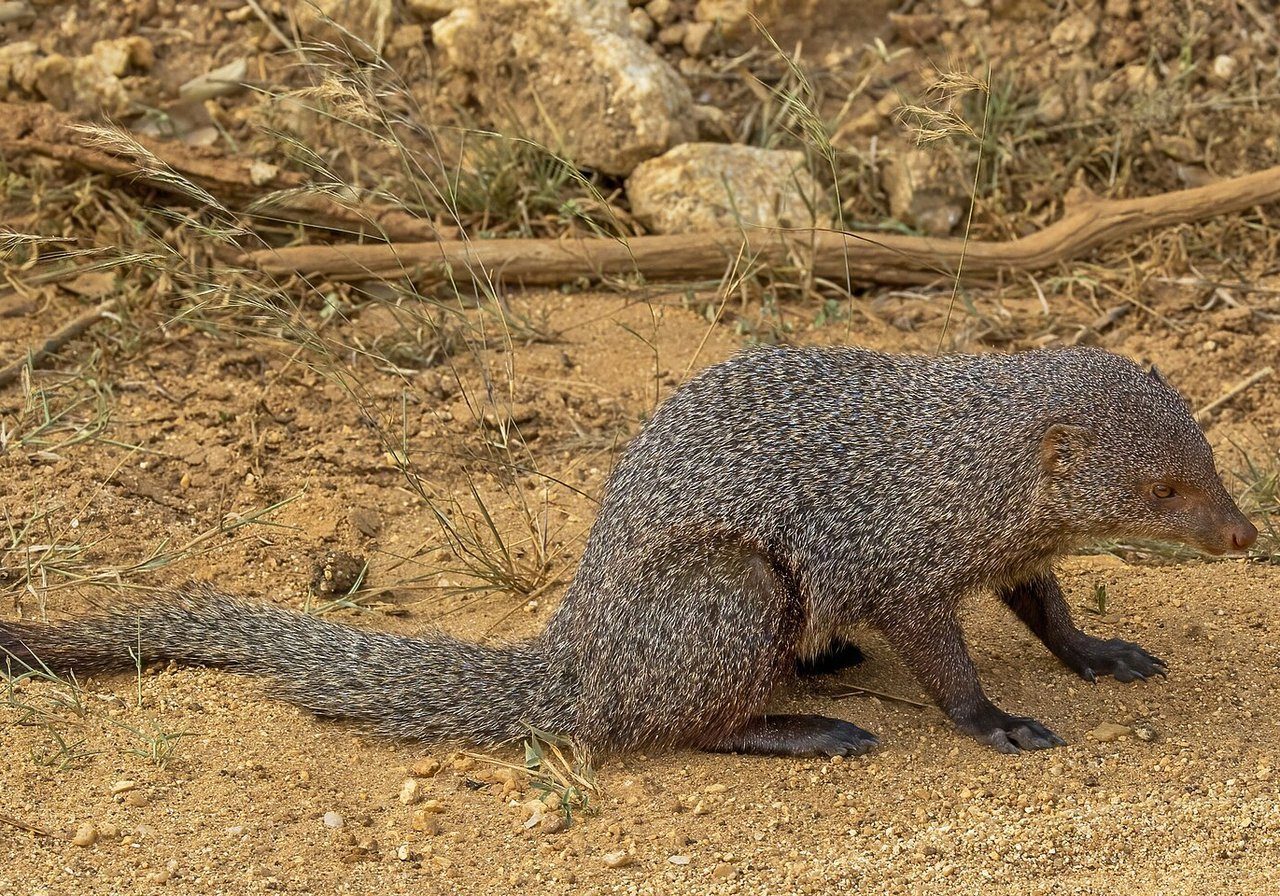
Source: Wikimedia Commons
In brief
Mongooses are small carnivorans of family Herpestidae — roughly 34 species across Africa and Asia; the small Asian mongoose (Herpestes javanicus) is Least Concern and native from Pakistan to Indonesia, famous for hunting snakes.
Also in Animals A to Z · Animals that start with M
How you can help
You can symbolically adopt an orangutan from £5 a month — a donation to WARN’s orangutan welfare and conservation appeal, with a personalised certificate you can keep or give as a gift — or give once to where it is needed most.
By WARN Research & Conservation TeamLast updated
Mongooses are small carnivorans of the family Herpestidae, found across Africa, Asia and parts of Europe. Roughly 34 species occupy grassland, forest, scrub and rocky terrain. The small Asian mongoose (Herpestes javanicus) is among the most widespread, native from Iran and Pakistan through India and South-east Asia to Indonesia and Malaysia. Mongooses are famous for attacking snakes, including cobras, though they are omnivorous generalists. Listed as Least Concern, the small Asian mongoose is abundant in native range but problematic where introduced. In Malaysia and Indonesia, native mongoose species share rainforest edge habitat with primates and slow lorises that WARN partners protect.
Least Concern
IUCN status — small Asian mongoose (2016)
~34
Mongoose species in family Herpestidae
0.5–5 kg
Size range across mongoose species
Appendix III
CITES listing (India — H. edwardsii)
Figures sourced from IUCN Red List — Herpestes javanicus, Encyclopaedia Britannica — mongoose, National Geographic — mongoose .
Mongoose: Quick Facts
| Species | ~34 mongoose species in Herpestidae |
|---|---|
| Famous behaviour | Snake hunting — including cobras |
| Diet | Omnivorous — rodents, snakes, insects, fruit, eggs |
| Activity | Mainly diurnal |
| Native range | Pakistan to Indonesia (small Asian mongoose) |
| CITES | Appendix III (India — some Herpestes species) |
Scientific Classification
| Kingdom | Animalia |
|---|---|
| Phylum | Chordata |
| Class | Mammalia |
| Order | Carnivora |
| Family | Herpestidae |
| Genus | Herpestes |
| Species | Herpestes javanicus (É. Geoffroy Saint-Hilaire, 1818) |
Conservation Status
- IUCN Status
- Least Concern (IUCN, 2016) for small Asian mongoose. Liberian mongoose Endangered.
- Population
- No global count; abundant across native South and South-east Asian range
- Trend
- Stable in native range; invasive populations established on many islands
- Assessed
- 2016
- CITES
- Appendix III (India — Herpestes edwardsii)
Key Facts: Mongoose
- Mongooses belong to Herpestidae — distinct from mustelids and viverrids.
- The small Asian mongoose ranges from Pakistan through Malaysia and Indonesia.
- Mongooses are famous for attacking venomous snakes including cobras.
- Introduced mongooses have devastated native birds and reptiles in Hawaii and the Caribbean.
- Meerkats are mongooses — the most social species, living in cooperative groups.
- Malaysia and Indonesia hold native mongoose species in rainforest edge habitat.
Mongooses across Africa and Asia
Mongooses belong to the family Herpestidae — a carnivore lineage separate from mustelids (weasels) and viverrids (civets). Roughly 34 species in 14 genera range across Africa, Asia and southern Europe. They share a general body plan: slender body, short legs, pointed snout, small rounded ears and often banded or grizzled fur.
The small Asian mongoose (Herpestes javanicus) is native from Iran, Afghanistan and Pakistan through India, Nepal, South-east Asia, Malaysia and Indonesia. It inhabits open country, scrub, forest edge and agricultural land. Other notable species include the Egyptian mongoose, the white-tailed mongoose of Africa and the meerkat (Suricata suricatta) — the social sentinel of the Kalahari.
In Malaysia and Indonesia, mongooses occupy rainforest margins and disturbed forest — habitats overlapping with orangutan and slow loris range where WARN partners work on habitat protection.
Snake hunting and diet
Mongooses are renowned for confronting venomous snakes. They attack with quick reflexes, thick loose skin that resists shallow bites and some tolerance to snake venom — though they are not immune. Indian grey mongooses regularly kill cobras and kraits. This behaviour made mongooses popular in nineteenth-century travelling shows.
Diet is broader than snake hunting suggests. Mongooses eat rodents, birds, eggs, insects, crustaceans, fruit and carrion. The small Asian mongoose raids poultry yards, drawing persecution from farmers across its range. They are mainly diurnal — unlike many carnivorans — and patrol territories with scent marking and vocalisations.
Meerkats specialise in scorpions and insects in arid Kalahari scrub, with sentinel behaviour that has made them among the most studied social carnivorans.
Introductions and ecological damage
The small Asian mongoose is one of the world's most successful invasive mammals. Introduced to Fiji, Hawaii, Jamaica, Puerto Rico and dozens of other islands to control rats in sugar plantations, it became a devastating predator of native birds, reptiles and amphibians.
In Hawaii, mongoose introductions in the 1880s contributed to the decline of endemic ground-nesting birds and the extinction of several species. Mongooses raid nests, eat hatchling sea turtles and compete with native predators. Island ecosystems with no evolutionary history of mammalian predators suffer disproportionate losses.
In native range from Pakistan to Indonesia, mongoose populations are stable and natural. The conservation lesson is stark: species that are harmless or beneficial in native ecosystems can become destructive when introduced to islands or regions without equivalent predators.
Conservation across species
The IUCN lists the small Asian mongoose as Least Concern with a stable population across its vast native range. Most African mongoose species are also Least Concern. The Liberian mongoose (Liberiictis kuhni) of West African rainforest is Endangered with a restricted range.
Threats in native range include habitat loss from agricultural expansion, persecution as poultry predators and hunting for fur. In South-east Asia, deforestation removes forest edge habitat mongooses exploit. CITES Appendix III in India regulates some Herpestes exports.
Protecting rainforest edge habitat in Malaysia and Indonesia benefits native mongooses alongside primates, hornbills and civets. Preventing further mongoose introductions to islands remains an urgent biosecurity priority.
What WARN Does
WARN publishes this guide for education and is developing support through assessed animal-welfare grants. A species range, source citation or photograph does not establish a recipient or funding agreement. Check /about/where-your-money-goes/#grant-register for published grant and payment records; records not yet published must not be read as zero activity. Browse /appeals/ for the purposes currently available to support.
If this guide helps you understand wildlife and the pressures it faces, a gift to WARN supports habitat protection and free public education in our partner countries.
Mongoose: Frequently Asked Questions
Are mongooses immune to snake venom?
Is a meerkat a mongoose?
Where do mongooses live?
Are mongooses endangered?
Why were mongooses introduced to Hawaii?
What do mongooses eat?
Are mongooses dangerous?
How long do mongooses live?
How big is a mongoose?
Sources & References
Population figures, conservation status and biological facts on this page are drawn from authoritative scientific and intergovernmental sources.
Terms used on this page
Plain-English definitions, from our wildlife and conservation glossary.
Latest Mongoose Stories
Quick, fact-checked reads on the mongoose — amazing facts, key questions and the threats it faces.
Guides
Pangolin Species Explained: All Eight of the World's Most Trafficked Mammal
There are eight pangolin species — four in Africa and four in Asia. All eight are trafficked. Here is the briefing.
Read the storySpecies
Tiger vs Lion: 7 Key Differences Between the Two Biggest Cats
Tigers are bigger, stripier and solitary; lions are social and live in prides. Here's how the two largest cats really differ in size, habitat and behaviour.
Read the storySpecies
Asian vs African Elephant: 7 Key Differences
Ears, back shape, tusks and size all set Asian and African elephants apart. Here is a clear, science-backed guide to telling the world's three elephant species apart.
Read the storyExplore more animals
Discover more animals, their habitats and their conservation status in the WARN wildlife-guide library.