Wildlife Guide · Worldwide (alongside humans) & Europe
House Mouse
Mus musculus
The small, adaptable rodent that lives wherever people do — and ancestor of every pet and laboratory mouse.
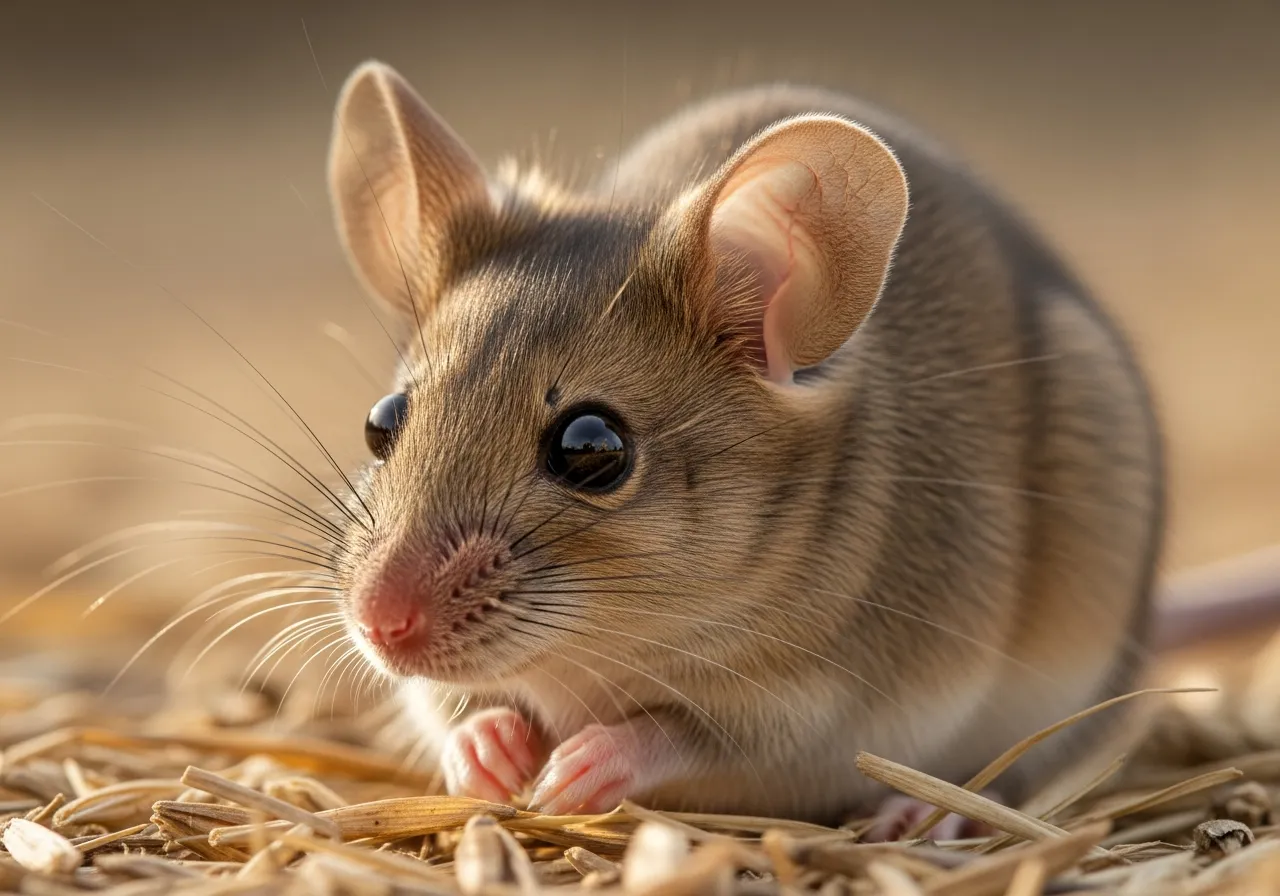
Source: Global Animal Guide (WARN)
In brief
A house mouse (Mus musculus) is a small grey-brown rodent in the family Muridae, typically 7.5–10 cm long with a long tail and large ears. Native to Asia, it now lives worldwide alongside humans, breeds prolifically, and is the ancestor of pet and laboratory mice.
Also in Animals A to Z · Animals that start with H
By WARN Research & Conservation TeamLast updated
The house mouse (Mus musculus) is a small rodent in the family Muridae and one of the most abundant and widespread mammals on Earth. Originally native to Asia, it spread across the world by living alongside humans, thriving in homes, farms, warehouses and fields wherever food and shelter are found. Rarely heavier than a £1 coin, it is curious, agile and a prolific breeder, with several litters a year. The species is the wild ancestor of the familiar pet mouse and the laboratory mouse, making it one of the most studied animals in science. The IUCN lists it as Least Concern, reflecting its enormous, stable global population.
11–30 g
Typical adult body weight
3–14
Young per litter (average 6–8)
5–10
Litters a female can raise per year
<1 yr
Typical lifespan in the wild
Figures sourced from Wikipedia — House mouse, IUCN Red List — Mus musculus, Encyclopaedia Britannica — Mouse and other references on this page.
House Mouse: Quick Facts
| Common name | House mouse |
|---|---|
| Scientific name | Mus musculus |
| Family | Muridae (rodents) |
| Body length | 7.5–10 cm (plus a 5–10 cm tail) |
| Weight | 11–30 g |
| Diet | Omnivorous; mainly seeds and grains |
| Lifespan | Under 1 year wild; 2–3 years protected |
| Distribution | Worldwide, alongside humans |
| Activity | Mainly nocturnal |
| IUCN status | Least Concern |
Scientific Classification
| Kingdom | Animalia |
|---|---|
| Phylum | Chordata |
| Class | Mammalia |
| Order | Rodentia |
| Family | Muridae |
| Genus | Mus |
| Species | Mus musculus |
Conservation Status
- IUCN Status
- Least Concern (IUCN Red List). The house mouse is one of the most abundant and widespread mammals in the world, occurring on every inhabited continent in close association with humans. Its population is enormous and stable, and it faces no conservation threats; where it is managed at all, it is usually treated as a pest rather than a species at risk.
- Population
- Not quantified, but among the most numerous mammals on Earth — many hundreds of millions to billions worldwide.
- Trend
- Stable
- Assessed
- 2016
- CITES
- Not listed under CITES.
As a commensal species that thrives wherever humans live, the house mouse benefits from, rather than suffers from, human activity, and requires no conservation intervention.
Key Facts: House Mouse
- The house mouse is one of the most abundant and widespread mammals on Earth, found wherever humans live.
- It is small and light — usually 7.5–10 cm in body length and just 11–30 g in weight, with a tail roughly as long as its body.
- Mice breed prolifically: females mature at around six weeks and can raise several litters a year.
- Most wild mice live less than a year because of heavy predation, though protected mice can reach two to three years.
- Mus musculus is the wild ancestor of both pet and laboratory mice, making it one of science's most important animals.
- The IUCN classifies the house mouse as Least Concern, with a huge and stable global population; it is not CITES-listed.
What does a house mouse look like?
A house mouse is a small, slender rodent built for squeezing through tight spaces. The body measures roughly 7.5–10 cm from nose to the base of the tail, with a near-hairless tail of similar length, 5–10 cm. Adults typically weigh between 11 and 30 grams — lighter than a £1 coin. The fur is usually grey-brown above and paler beneath, though colour varies. The most distinctive features are the large, rounded, sparsely furred ears and the prominent dark eyes, which give the mouse keen senses in low light. Long whiskers help it feel its way along walls and through burrows in the dark. The front paws have four clawed digits and the hind paws five, well suited to climbing, gnawing and grooming. Mice see relatively poorly but have an acute sense of smell and hearing, including ultrasonic frequencies humans cannot detect, which they use to communicate. Their continuously growing incisors — a hallmark of all rodents — must be worn down by constant gnawing, which is why mice readily chew through packaging, wood and soft materials.
Where do house mice live and what do they eat?
House mice are commensal animals, meaning they live in close association with people. Although the species originated in Asia, it travelled with human trade and settlement to become established on every inhabited continent. Mice colonise houses, barns, granaries, shops and warehouses, but also live independently in fields, hedgerows and grassland, especially in warmer months. They are adaptable nest-builders, shredding paper, fabric and plant material to make snug nests in wall cavities, under floors or in burrows. Mice are largely nocturnal and stay close to shelter, typically foraging within a small home range. They are omnivorous but feed mainly on plant matter — seeds, grains, roots and stems — supplemented by insects and almost any human food they encounter. A mouse needs very little water and can obtain much of its moisture from food, which helps it survive in dry stored-grain environments. This close relationship with people brings the species into frequent conflict with humans over stored food and property, but it is also the reason the house mouse has become so extraordinarily successful and widespread.
How do house mice breed and how long do they live?
The house mouse is famous for its rapid reproduction. Females reach sexual maturity at around six weeks of age and males at about eight weeks. After a short gestation of roughly 19–21 days, a female gives birth to a litter of 3–14 young, with six to eight being typical. The pups are born blind, hairless and helpless, but develop quickly and are weaned within about three weeks. A single female can produce 5 to 10 litters in a year under good conditions, so populations can grow explosively when food and shelter are plentiful. This high reproductive rate is balanced by heavy losses: in the wild, most mice live less than a year because of intense predation by owls, hawks, foxes, cats, snakes and many other animals, making the house mouse a key link in many food chains. In protected conditions, such as a home cage or laboratory, mice commonly live two to three years. The species' fast life cycle, small size and ease of care are exactly why it became the foundation of the pet mouse and the laboratory mouse.
Are house mice the same as pet and lab mice?
Yes — pet mice ('fancy mice') and laboratory mice are domesticated strains of the wild house mouse, Mus musculus. Over many generations, selective breeding has produced an enormous variety of coat colours, patterns and temperaments in fancy mice, and highly standardised, genetically defined strains in laboratory animals. The laboratory mouse is one of the most important model organisms in biology and medicine: its short life cycle, small size and close genetic similarity to humans have made it central to research on genetics, immunology, cancer and countless diseases. It is worth distinguishing the house mouse from other small rodents people often confuse it with. Mice are generally smaller and more slender than rats, with proportionally larger ears and thinner tails. They differ too from voles, which have blunter snouts, smaller ears and shorter tails, and from shrews, which are not rodents at all but insect-eaters with long pointed noses. Understanding these differences helps people identify the animals sharing their environment — and appreciate that the unassuming house mouse underpins both a popular pet and a cornerstone of modern science.
Mouse vs rat: how to tell them apart
| Feature | House mouse | Rat |
|---|---|---|
| Body size | Small, 7.5–10 cm | Larger, 15–25 cm |
| Weight | 11–30 g | Often 200–500 g |
| Ears | Large relative to head | Smaller relative to head |
| Tail | Thin, hair-like, body-length | Thick, scaly, shorter than body |
| Droppings | Small, rice-grain sized | Larger, capsule-shaped |
| Family | Muridae | Muridae |
What WARN Does
WARN does not run field conservation projects for the house mouse — it is an abundant, Least Concern species that needs no rescue effort, and this guide is part of WARN's free educational work to help people understand the animals around them. The same forces that shape mouse populations, especially habitat change and the loss of natural predators, also affect the wild species WARN does help protect, which is why understanding common animals matters for conservation as a whole.
If this free guide helped you, a small gift helps WARN keep producing clear, science-based animal education and care for the wildlife that genuinely needs our help.
House Mouse: Frequently Asked Questions
What is the difference between a mouse and a rat?
How long do house mice live?
How fast do mice breed?
What do house mice eat?
Are pet mice and laboratory mice the same as house mice?
Are house mice endangered?
Where do house mouses live?
Are house mouses dangerous?
How big is a house mouse?
Sources & References
Population figures, conservation status and biological facts on this page are drawn from authoritative scientific and intergovernmental sources.
Terms used on this page
Plain-English definitions, from our wildlife and conservation glossary.
Latest House Mouse Stories
Quick, fact-checked reads on the house mouse — amazing facts, key questions and the threats it faces.
Species
Slow Loris: Why the Internet's Favourite Pet Is a Conservation Disaster
The slow loris looks like a cartoon character — and that has nearly destroyed the species. Here is the truth behind the viral videos.
Read the storySpecies
The Snow Leopard: Why the Ghost of the Mountains Is Still Vulnerable
The snow leopard is one of the most elusive big cats on earth, with an estimated 4,000-6,500 individuals across twelve range states — including Pakistan, where WARN is preparing to operate. This briefing explains why the species was downlisted from Endangered to Vulnerable in 2017 and why that is not the success story it sounds like.
Read the storyGuides
Sun Bear vs Moon Bear: The Two Most Trafficked Asian Bears
The sun bear and the Asiatic black bear (moon bear) are the two most commonly trafficked bears in Asia — for the pet trade, for traditional medicine and for bear-bile farming. Here is how to tell them apart.
Read the storyExplore more animals
Discover more animals, their habitats and their conservation status in the WARN wildlife-guide library.