Wildlife Guide · Europe & North America
Newt
Subfamily Pleurodelinae
The pond-dwelling salamanders that regrow their own limbs.
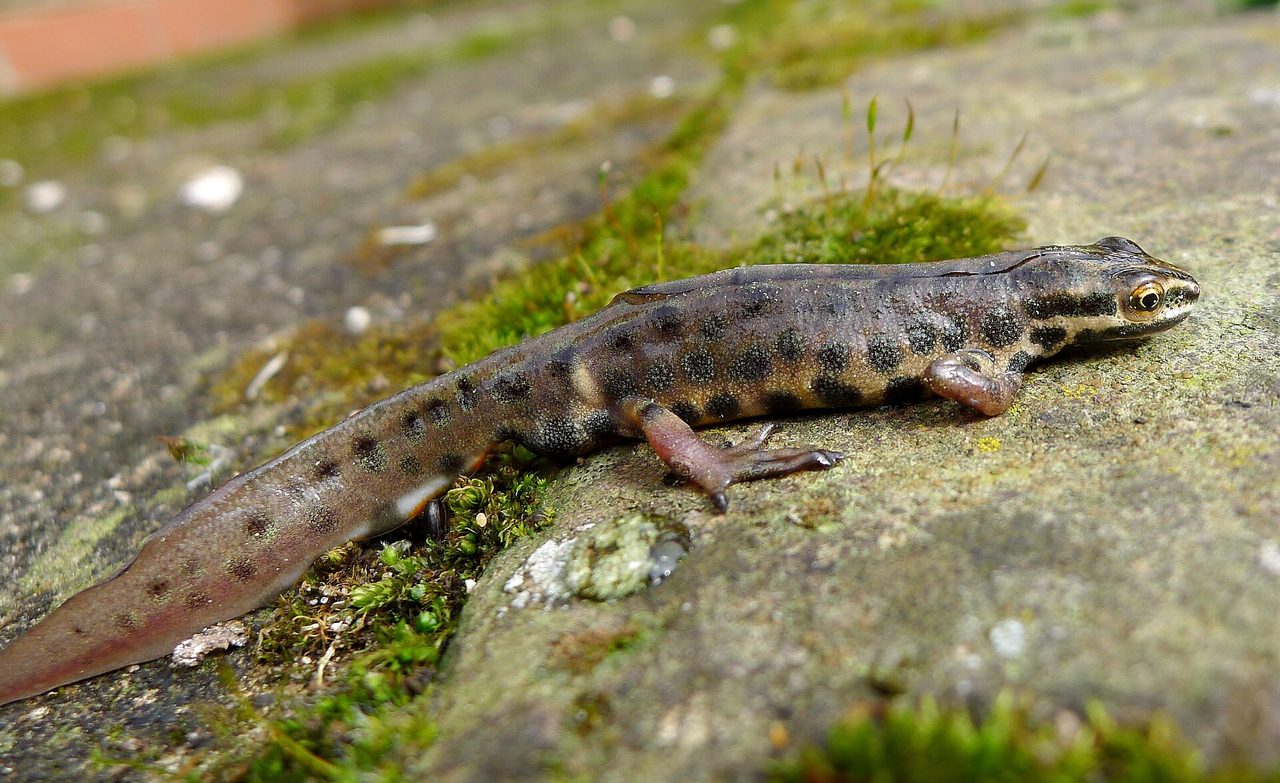
Photo: gailhampshire from Cradley, Malvern, U.K / Wikimedia Commons (CC BY 2.0)
In brief
A newt is a small semi-aquatic salamander in the subfamily Pleurodelinae. Newts alternate between water and land, breeding in ponds in spring and feeding on insects and other invertebrates. They are famous for regenerating lost limbs and organs, and many produce defensive skin toxins.
Also in Animals A to Z · Animals that start with N
By WARN Research & Conservation TeamLast updated
Newts are small, semi-aquatic salamanders in the subfamily Pleurodelinae, with more than 100 species found across Europe, Asia, North Africa and North America. They split their lives between water and land: most return to ponds each spring to breed, then spend much of the year hunting on damp ground nearby. Newts are best known for a near-magical talent — the ability to regrow lost limbs, tails and even parts of vital organs. Many also carry skin toxins for defence. In the UK two species are familiar: the common smooth newt and the larger great crested newt, which is strictly protected by law. This guide explains what newts are, how they live and why they matter.
100+
species worldwide
4
continents inhabited
3
life stages: larva, eft, adult
200-300
eggs a female may lay
Figures sourced from Newt — Wikipedia, Great crested newt — Wikipedia, Smooth newt — Wikipedia and other references on this page.
Newt: Quick Facts
| Common name | Newt |
|---|---|
| Group | Subfamily Pleurodelinae (salamanders) |
| Number of species | More than 100 |
| Distribution | Europe, Asia, North Africa, North America |
| Habitat | Ponds and ditches; damp land nearby |
| Adult length | About 7-16 cm (common European species) |
| Diet | Insects, worms, slugs, snails, aquatic invertebrates |
| Life stages | Aquatic larva, terrestrial eft, adult |
| Special ability | Regenerates limbs, tail and parts of organs |
| Defence | Skin toxins; tetrodotoxin in some Pacific species |
Scientific Classification
| Kingdom | Animalia |
|---|---|
| Phylum | Chordata |
| Class | Amphibia |
| Order | Urodela (Caudata) |
| Family | Salamandridae |
| Subfamily | Pleurodelinae |
| Genera | About 16, including Triturus, Lissotriton, Taricha, Notophthalmus |
Conservation Status
- IUCN Status
- Varies by species. Many newts, including the common smooth newt, are assessed as Least Concern by the IUCN. Some species are threatened or have declined severely, and the Yunnan lake newt has been considered extinct since the 1970s. The great crested newt is Least Concern globally but is declining in parts of its range and is strictly protected in the UK and the European Union.
- Population
- Not quantified globally; varies enormously between species and is unknown for many
- Trend
- Mixed; several species declining, chiefly due to loss of ponds and wetland habitat
- Assessed
- Assessments vary by species (IUCN Red List)
- CITES
- Not generally listed on CITES; some salamandrids are subject to regional protections
Newts breathe partly through their permeable skin and depend on clean water, making them sensitive indicators of a healthy landscape. The chief threats are the loss and pollution of breeding ponds, wetland drainage, habitat fragmentation and amphibian disease.
Key Facts: Newt
- Newts are salamanders in the subfamily Pleurodelinae, with over 100 species across Europe, Asia, North Africa and North America.
- They are semi-aquatic, breeding in ponds in spring and living on damp land for much of the year.
- Newts can regenerate lost limbs, tails and parts of organs — a rare ability among vertebrates.
- Many species produce skin toxins; the most potent, in some Pacific newts, contain tetrodotoxin.
- The smooth newt is common and Least Concern; the great crested newt is strictly protected in the UK.
- Healthy ponds and connected wetlands are essential, so habitat loss is the chief threat to newt populations.
What is a newt and how does it differ from a salamander?
A newt is a type of salamander — every newt is a salamander, but not every salamander is a newt. Newts make up the subfamily Pleurodelinae within the salamander family Salamandridae, comprising roughly 100 species in around sixteen genera. They are distinguished mainly by their lifestyle: newts are strongly semi-aquatic, typically returning to water each breeding season, whereas many other salamanders are fully terrestrial or fully aquatic. Newt skin tends to be rougher and less slimy than that of other salamanders, and during the breeding season the males of some species develop showy crests and bright colours. Like all amphibians, newts have permeable skin and lay shell-less eggs, tying them closely to clean, damp habitats. They have lizard-like bodies with four limbs and a long tail, but unlike reptiles they have no scales or claws. Adults of common European species are small, generally around 7 to 16 centimetres long including the tail. This blend of aquatic and terrestrial living, combined with their delicate skin, makes newts useful indicators of the health of ponds and the wider countryside.
How do newts live and reproduce?
Most newts follow an annual rhythm tied to water. In spring, adults migrate to ponds to breed; in the Northern Hemisphere the main breeding season falls around late spring and early summer. Males of many species court females with elaborate displays, fanning scent toward them with their tails. Females then lay eggs — sometimes hundreds, with the great crested newt producing roughly 200 to 300 — often carefully folding each egg inside a leaf of pondweed for protection. The young hatch as aquatic larvae with feathery external gills, feeding on tiny invertebrates. After several weeks they undergo metamorphosis and leave the water as juveniles called efts, which spend a year or more on land before maturing. Adults split their time between water and damp terrestrial cover such as log piles, leaf litter and long grass, hunting insects, worms, slugs and other small prey, mostly after dark. In colder regions newts hibernate over winter, sheltering under logs, stones or in burrows. European species such as the smooth newt can live several years in the wild, and great crested newts may reach well over a decade.
Why can newts regrow body parts?
Newts are among the very few vertebrates that can regenerate complex body parts throughout adult life. If a newt loses a limb or part of its tail — or even damages tissue in its eye, heart or spinal cord — specialised cells near the wound can revert to a flexible, immature state, multiply, and then re-form the missing structure. This process produces a functional replacement rather than mere scar tissue. Such regeneration is exceptional: most adult mammals, including humans, cannot regrow lost limbs at all. Because of this, newts have long been studied by scientists hoping to understand the biology of healing and tissue repair. Their other striking defence is chemical. Many newts secrete toxins through the skin to deter predators, and a few are remarkably potent: some Pacific newts of the genus Taricha contain tetrodotoxin, the same powerful poison found in pufferfish. The rough-skinned newt can carry enough toxin to be dangerous if eaten, and some garter snakes have evolved resistance in a long-running predator-prey arms race. Bright belly colours often warn predators of this hidden toxicity.
Are newts endangered, and what threatens them?
Newts vary widely in status. Many familiar species are common and listed as Least Concern by the IUCN — the smooth newt, for example, remains widespread across Europe. Others are far rarer, and some have suffered severe declines; the Yunnan lake newt of China has been considered extinct since the 1970s. The great crested newt is assessed globally as Least Concern but is declining in places and is strictly protected in the UK and across the European Union as a European Protected Species. In Britain it is illegal to capture, kill, disturb or trade great crested newts, or to damage their habitat, without a licence — protections that can require careful surveys and mitigation before building work proceeds. The broad threats to newts are the loss and pollution of breeding ponds, the draining of wetlands, the fragmentation of land that newts must cross between water and shelter, and the spread of amphibian diseases. Because newts breathe partly through their skin and depend on clean water, they are sensitive to environmental change, which is one reason their presence is taken as a sign of a healthy landscape.
Smooth newt vs great crested newt
| Feature | Smooth newt | Great crested newt |
|---|---|---|
| Scientific name | Lissotriton vulgaris | Triturus cristatus |
| Typical adult length | About 7-11 cm | About 13-16 cm, occasionally larger |
| Skin | Smooth, olive-brown | Rough, warty, dark with white-flecked flanks |
| Belly | Orange with dark spots | Bright yellow-orange with black blotches |
| Breeding male crest | Wavy, continuous | Tall, jagged crest with a break at the tail base |
| UK legal status | Limited protection | Strictly protected; can affect development planning |
| IUCN status | Least Concern | Least Concern (declining in places) |
What WARN Does
WARN does not run dedicated field projects for newts, which live largely outside the countries where our partners work; this guide is part of our free educational work to help people understand and value wildlife. The threats newts face — habitat loss, pollution and the draining of wetlands — are the same pressures that harm the amphibians and other animals WARN does protect, so caring about one helps all.
If this guide deepened your wonder at the natural world, a small gift helps keep our educational work free and supports the animals in our care.
Newt: Frequently Asked Questions
What is the difference between a newt and a salamander?
Are newts poisonous to humans or pets?
Can newts really regrow their limbs?
Where do newts live?
What do newts eat?
Are newts protected by law in the UK?
Are newts dangerous?
How long do newts live?
How big is a newt?
Sources & References
Population figures, conservation status and biological facts on this page are drawn from authoritative scientific and intergovernmental sources.
Terms used on this page
Plain-English definitions, from our wildlife and conservation glossary.
Latest Newt Stories
Quick, fact-checked reads on the newt — amazing facts, key questions and the threats it faces.
Species
Slow Loris: Why the Internet's Favourite Pet Is a Conservation Disaster
The slow loris looks like a cartoon character — and that has nearly destroyed the species. Here is the truth behind the viral videos.
Read the storySpecies
The Snow Leopard: Why the Ghost of the Mountains Is Still Vulnerable
The snow leopard is one of the most elusive big cats on earth, with an estimated 4,000-6,500 individuals across twelve range states — including Pakistan, where WARN is preparing to operate. This briefing explains why the species was downlisted from Endangered to Vulnerable in 2017 and why that is not the success story it sounds like.
Read the storyGuides
Sun Bear vs Moon Bear: The Two Most Trafficked Asian Bears
The sun bear and the Asiatic black bear (moon bear) are the two most commonly trafficked bears in Asia — for the pet trade, for traditional medicine and for bear-bile farming. Here is how to tell them apart.
Read the storyExplore more animals
Discover more animals, their habitats and their conservation status in the WARN wildlife-guide library.