Wildlife Guide · Mexico & Central America
Ocelot
Leopardus pardalis (Linnaeus, 1758)
The spotted cat of the Neotropics — once common as a fur coat, now fighting habitat loss.
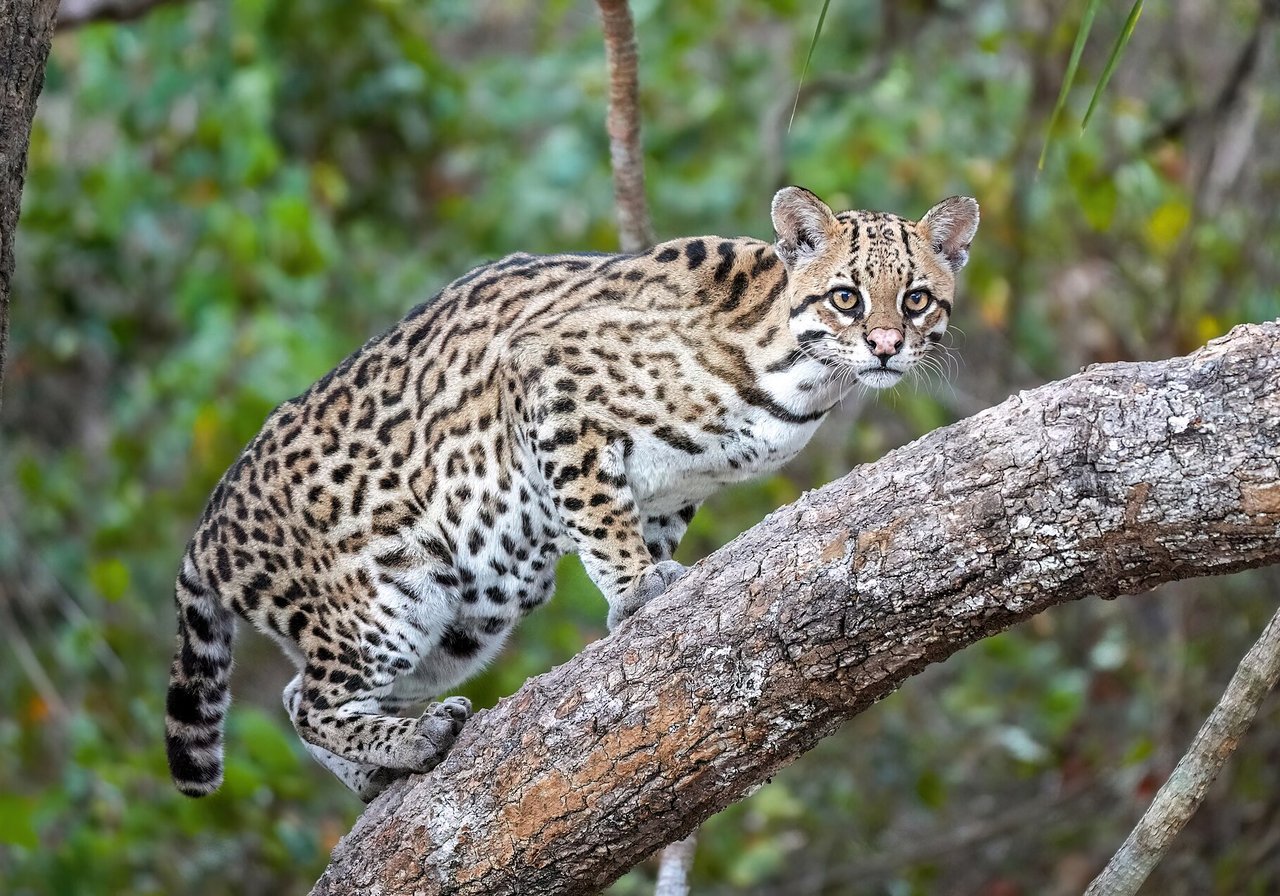
Source: Wikimedia Commons
In brief
The ocelot (Leopardus pardalis) is a spotted wild cat of the Americas, listed as Least Concern by the IUCN but declining locally due to habitat loss and historical over-trapping; a small population persists in southern Texas.
Also in Animals A to Z · Animals that start with O
By WARN Research & Conservation TeamLast updated
The ocelot is a medium-sized spotted cat of Central and South America, and the only wild cat with a breeding population in the United States — a remnant group in southern Texas. Its striking rosetted coat made it one of the most heavily traded cats in the twentieth-century fur industry; millions of pelts were exported before international protection. Today the ocelot is Least Concern globally, but populations are declining in many areas due to deforestation, road mortality and illegal trade. Ocelots are solitary, mainly nocturnal forest hunters, feeding on rodents, birds, reptiles and small deer.
Least Concern
IUCN Red List status (2014 assessment)
11–16 kg
Typical adult weight
Appendix I
CITES listing — commercial trade banned
2 subspecies
In North/Central America and South America
Figures sourced from IUCN Red List — Leopardus pardalis, CITES — Checklist of CITES Species, U.S. Fish and Wildlife Service — ocelot .
Ocelot: Quick Facts
| Weight | 11–16 kg |
|---|---|
| Coat | Golden with black rosettes and spots |
| Activity | Mainly nocturnal |
| Diet | Rodents, birds, reptiles, small deer |
| Lifespan | Up to ~20 years in captivity; ~10–13 in the wild |
| CITES | Appendix I — commercial trade banned |
Scientific Classification
| Kingdom | Animalia |
|---|---|
| Phylum | Chordata |
| Class | Mammalia |
| Order | Carnivora |
| Family | Felidae |
| Genus | Leopardus |
| Species | Leopardus pardalis (Linnaeus, 1758) |
Conservation Status
- IUCN Status
- Least Concern globally (IUCN, 2014) but decreasing locally. Texas population Endangered under US Endangered Species Act.
- Population
- No global estimate; Texas population fewer than 100 individuals
- Trend
- Decreasing in many areas; stable where large forest blocks remain
- Assessed
- 2014
- CITES
- Appendix I
Key Facts: Ocelot
- Ocelots are medium-sized spotted cats native to the Neotropics and southern Texas.
- Their coat was once the most traded cat fur in the world — CITES now bans commercial trade.
- Ocelots are mainly nocturnal forest hunters, feeding on small to medium prey.
- Habitat loss from agriculture and roads is the main current threat.
- Texas ocelots number fewer than 100 — among the rarest mammals in the United States.
- Ocelots were once kept as pets by Salvador Dalí — they are poor domestic companions.
Appearance and identification
Ocelots have a golden to grey coat marked with black rosettes, spots and stripes — each pattern unique, like a fingerprint. They are twice the size of a domestic cat, with a long tail, rounded ears and large front paws.
The margay and oncilla are smaller spotted relatives; jaguars and jaguarundis share their range but differ in size and build. In Texas, ocelots are associated with thornscrub and coastal brush — habitat that has shrunk dramatically. Camera-trap studies show ocelots using dense cover corridors to move between remnant patches.
Ecology and behaviour
Ocelots are solitary and territorial. Males patrol ranges of roughly 3–30 km² depending on prey density; female ranges are smaller and may overlap. They hunt mainly on the ground but climb well when pursuing monkeys or birds.
Diet includes rodents, rabbits, iguanas, fish, crabs and occasional deer fawns. Ocelots are adaptable — found from sea level to 3,000 m elevation — but depend on dense cover for ambush hunting. Females den in hollow trees or caves, raising one to three kittens.
History of the fur trade
From the 1960s to the 1980s, ocelot pelts were among the most valuable in the international fur trade. Annual exports from Latin America exceeded 100,000 skins at the peak. CITES listed the ocelot on Appendix I in 1975, banning commercial international trade. Domestic laws in range countries further restricted hunting. Populations partially recovered where forest remained, but the legacy of trapping combined with ongoing habitat loss keeps many regional populations vulnerable. Vintage ocelot coats still appear in illegal trade.
Conservation today
The IUCN lists the ocelot as Least Concern globally, but notes a decreasing trend in parts of its range. The Texas population is Endangered under US law, with fewer than 100 individuals isolated by highways and development. Protected areas and wildlife crossings are critical for its survival. Across Latin America, deforestation for cattle ranching and soy expansion removes the forest cover ocelots require. CITES Appendix I protection remains essential. Connecting forest fragments and enforcing anti-trafficking law are the most effective conservation measures.
What WARN Does
WARN publishes this guide for education and is developing support through assessed animal-welfare grants. A species range, source citation or photograph does not establish a recipient or funding agreement. Check /about/where-your-money-goes/#grant-register for published grant and payment records; records not yet published must not be read as zero activity. Browse /appeals/ for the purposes currently available to support.
If this guide helps you understand wildlife and the pressures it faces, a gift to WARN supports habitat protection and free public education in our partner countries.
Ocelot: Frequently Asked Questions
Where do ocelots live?
Are ocelots endangered?
Can you keep an ocelot as a pet?
What is the difference between an ocelot and a leopard?
What do ocelots eat?
Why were ocelots hunted?
Are ocelots dangerous?
How long do ocelots live?
How big is an ocelot?
Sources & References
Population figures, conservation status and biological facts on this page are drawn from authoritative scientific and intergovernmental sources.
Terms used on this page
Plain-English definitions, from our wildlife and conservation glossary.
Latest Ocelot Stories
Quick, fact-checked reads on the ocelot — amazing facts, key questions and the threats it faces.
Species
12 Amazing Facts About the Jaguar, the Americas' Biggest Cat
From a skull-piercing bite to a love of swimming, here are 12 fascinating, fact-checked things that make the jaguar the most powerful cat in the Americas.
Read the storySpecies
11 Amazing Facts About the Pink River Dolphin (the Amazon's Blushing Boto)
From a head that swivels 90 degrees to a blush built from battle scars, here are 11 true facts about the Amazon's pink river dolphin, the largest freshwater dolphin on Earth.
Read the storySpecies
Pink River Dolphin vs Tucuxi: How to Tell the Two Amazon Dolphins Apart
Both swim the same Amazon waters, but the pink boto and the grey tucuxi are only distant cousins. Here is how to tell them apart at a glance.
Read the storyExplore more animals
Discover more animals, their habitats and their conservation status in the WARN wildlife-guide library.