Wildlife Guide · Indonesia & Malaysia
Pangolin
Order Pholidota, family Manidae — eight living species across three genera (Manis, Smutsia, Phataginus)
The world's most trafficked wild mammal — more than a million taken in a single decade.
In brief
Pangolins are the world's most heavily trafficked wild mammals; all eight species are threatened by illegal trade in their keratin scales, used in traditional medicine across Asia, with the Chinese and Sunda pangolins now Critically Endangered.
Also in Animals A to Z · Animals that start with P
How you can help
You can symbolically adopt a pangolin from £5 a month — a donation to WARN’s pangolin appeal, with a personalised certificate you can keep or give as a gift — or give once to where it is needed most.
By WARN Research & Conservation TeamLast updated
Pangolins are widely described as the world's most heavily trafficked wild mammals. All eight species are protected under international law, yet an estimated one million or more were taken from the wild over the past decade to supply black markets — chiefly in China and Vietnam — where their keratin scales are used in traditional medicine and their meat is sold as a luxury. The eight species are not equally threatened: the Chinese and Sunda pangolins are Critically Endangered, the Indian and Philippine pangolins are Endangered, and the four African species are Vulnerable. Every one of them is declining, and they are vanishing largely unseen.
1M+
Estimated pangolins poached in a decade
8
Species — every one listed as threatened
Appendix I
CITES protection — commercial trade banned
~200,000
Insects a pangolin can eat in a day
Figures sourced from IUCN Red List — Chinese pangolin (Manis pentadactyla), IUCN Red List — Sunda pangolin (Manis javanica), IUCN SSC Pangolin Specialist Group and other references on this page.
Pangolin: Quick Facts
| Order / Family | Pholidota / Manidae (8 species) |
|---|---|
| Diet | Myrmecophage — ants and termites; up to ~200,000 insects per day |
| Body length | 30–90 cm head and body, plus tail (varies by species) |
| Weight | ~1.6 kg (black-bellied) up to ~33 kg (giant ground pangolin) |
| Tongue length | Up to ~25–40 cm; in large species longer than the body |
| Lifespan | Unknown in the wild; up to ~20 years recorded in captivity |
| Gestation | ~70–140 days (African species); about 6–7 months (Chinese pangolin) |
| Young per birth | Usually a single pup (occasionally 2–3 in Asian species) |
| Baby name | Pangopup |
| CITES | Appendix I (all 8 species; in force since January 2017) |
Scientific Classification
| Kingdom | Animalia |
|---|---|
| Phylum | Chordata |
| Class | Mammalia |
| Order | Pholidota |
| Family | Manidae |
| Genera | Manis (Asia), Smutsia & Phataginus (Africa) |
| Species | Eight living species (e.g. Chinese pangolin, Manis pentadactyla Linnaeus, 1758) |
Conservation Status
- IUCN Status
- Varies by species: Vulnerable to Critically Endangered
- Population
- No reliable global estimate; all eight species assessed as declining
- Trend
- Decreasing (all eight species)
- Assessed
- 2019 (Chinese & Sunda); African species 2019; group threatened since 2014
- CITES
- Appendix I (all species; in force from 2 January 2017)
Chinese and Sunda pangolins are Critically Endangered, Indian and Philippine are Endangered, and the four African species are Vulnerable — so a single group-wide IUCN category is misleading.
Did you know?
A pangolin has no teeth at all. It swallows small stones and keratin spines inside its stomach that grind up the ants and termites for it — and its sticky tongue, anchored deep near its pelvis, can be longer than its entire body.
Key Facts: Pangolin
- Eight species exist — four in Asia (Chinese, Sunda, Indian, Philippine) and four in Africa (Temminck's ground, giant ground, white-bellied/tree, black-bellied/long-tailed).
- They are not uniformly Critically Endangered: Chinese and Sunda pangolins are Critically Endangered, Indian and Philippine are Endangered, and the four African species are Vulnerable — but all eight are declining.
- Pangolin scales are made of keratin — the same protein as human fingernails and hair — yet sell for hundreds of dollars per kilogram in traditional medicine markets despite having no proven medicinal value.
- Pangolins are toothless myrmecophages: they use a long, sticky tongue to eat ants and termites almost exclusively, consuming on the order of 200,000 insects a day.
- When threatened, a pangolin curls into a tight, scaled ball — effective armour against lions and leopards, but useless against poachers, who simply pick the animal up.
- No program has yet bred pangolins in captivity and released them back to the wild at meaningful scale, which is why protecting wild populations is the priority.
- China and Vietnam are the principal demand markets, and Africa has increasingly become the source as Asian populations collapse.
Why Are Pangolin Scales So Valuable?
Pangolin scales are composed entirely of keratin — the same structural protein found in human fingernails, hair and rhino horn — and have no scientifically proven medicinal properties. Despite this, they command high prices in traditional Chinese and Vietnamese medicine, where they are claimed to treat conditions from poor circulation to lactation problems. Scales are typically dried, roasted and ground into powder. Demand has been driven by rising middle-class incomes in China and Vietnam, which turned luxury wildlife products — including pangolin meat in high-end restaurants — into aspirational goods. Consumer-awareness campaigns and tighter law have begun to shift attitudes, and in 2020 China removed pangolin scales from the approved ingredient list of its official pharmacopoeia, but enforcement remains inconsistent.
The Shift to African Pangolins
As Asian pangolin populations collapsed, criminal networks pivoted to Africa. The two African ground pangolins (Temminck's in East and Southern Africa, and the giant ground pangolin in Central Africa) and the two tree-dwelling species in West and Central Africa are now poached at industrial scale and shipped to Asia. Nigeria, Cameroon, the Democratic Republic of Congo and East African ports appear repeatedly in major seizure records. The Africa-to-Asia trade typically runs through multiple transshipment points, using shipping containers and falsified customs paperwork, and individual multi-tonne scale seizures have been recorded.
Can Rescued Pangolins Survive?
Pangolins are notoriously hard to keep alive in captivity. They are specialist feeders dependent on particular ant and termite species, and they are easily stressed by handling and unnatural environments — leaving them prone to respiratory infection and digestive failure. A handful of programs have bred pangolins (a Sunda population to a third generation, and Chinese pangolins at zoos in Taipei and Prague), but none has yet bred and released animals back to the wild at meaningful scale. Rehabilitation can succeed when animals arrive in good condition and are held in semi-wild enclosures with natural forage, but success rates stay low. Prevention — stopping poaching before it happens — is the most effective intervention, which is why WARN concentrates on anti-poaching patrol support, community reporting and faster seizure response.
Distribution & Habitat
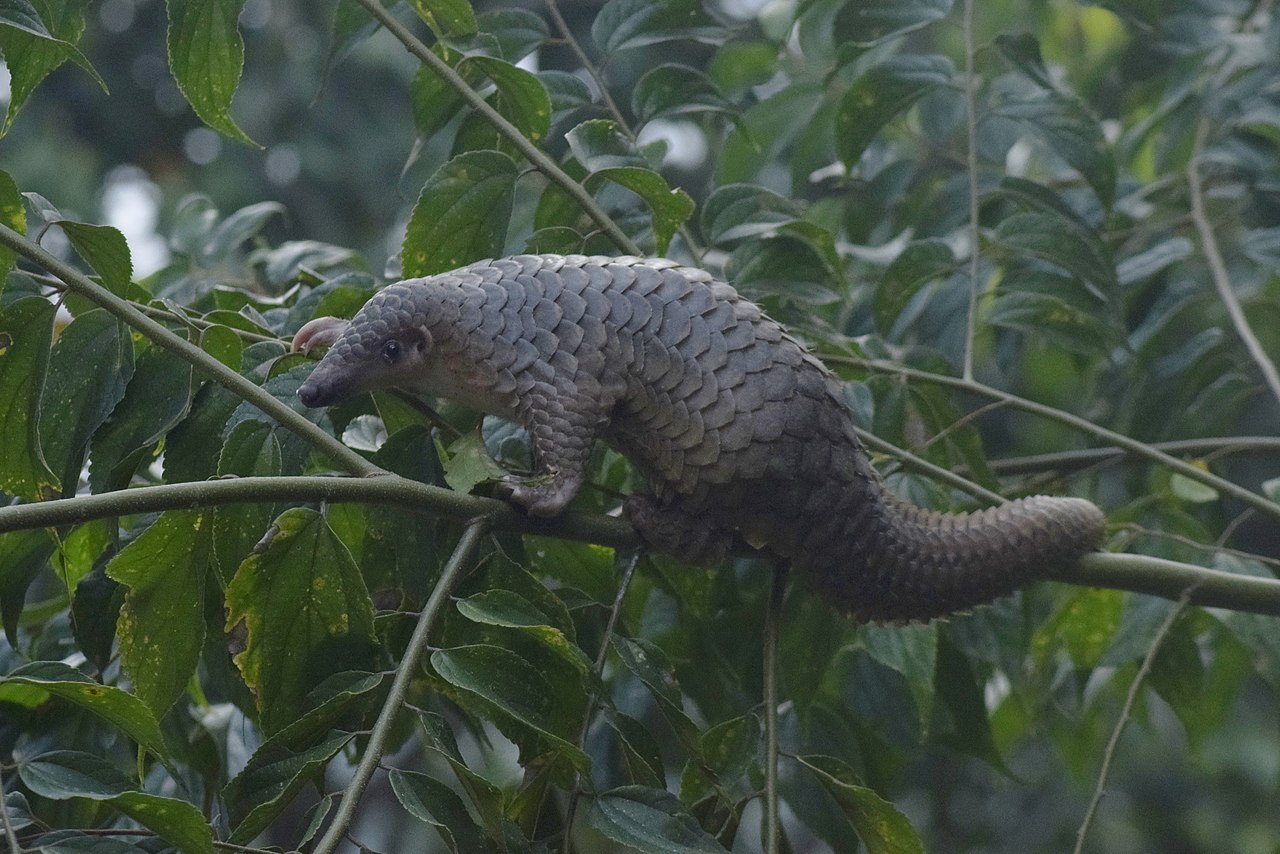
Pangolins live across Asia and sub-Saharan Africa. The four Asian species range through South and Southeast Asia and southern China: the Chinese pangolin across southern China and the eastern Himalayas, the Sunda pangolin through mainland Southeast Asia and the Greater Sunda islands, the Indian pangolin across the subcontinent, and the Philippine pangolin only on Palawan. The four African species occupy forests and savannahs from West Africa to Southern Africa. Some, like the two Smutsia ground pangolins, are terrestrial burrowers; others, like the white-bellied and black-bellied pangolins, are arboreal and use a prehensile tail to climb.
The eight pangolin species at a glance
| Species | Region | IUCN status | Habit |
|---|---|---|---|
| Chinese pangolin (Manis pentadactyla) | Southern China, Himalayas | Critically Endangered | Ground-dwelling |
| Sunda pangolin (Manis javanica) | SE Asia, Sunda islands | Critically Endangered | Ground & climbing |
| Indian pangolin (Manis crassicaudata) | Indian subcontinent | Endangered | Ground-dwelling |
| Philippine pangolin (Manis culionensis) | Palawan, Philippines | Endangered | Ground & climbing |
| Temminck's ground pangolin (Smutsia temminckii) | East & Southern Africa | Vulnerable | Ground-dwelling |
| Giant ground pangolin (Smutsia gigantea) | Central & West Africa | Vulnerable | Ground-dwelling |
| White-bellied / tree pangolin (Phataginus tricuspis) | West & Central Africa | Vulnerable | Arboreal |
| Black-bellied / long-tailed pangolin (Phataginus tetradactyla) | West & Central Africa | Vulnerable | Arboreal |
What WARN Does
WARN focuses current pangolin rescue funding on Indonesia, Malaysia and Pakistan, while keeping Vietnam, China and the African trade-route context live so supporters researching the wider pangolin crisis find accurate information. Because no captive-breeding-for-release program works at scale, that funding goes to protecting wild animals at source — anti-poaching patrols, community reporting networks and seizure-response teams in partner range countries.
Because pangolins can't be reliably bred and returned to the wild, every animal still out there is irreplaceable — and protecting them at source is everything. Your gift helps fund the anti-poaching patrols, community reporting networks and seizure-response teams WARN supports across its pangolin range countries, stopping the trafficking before it starts.
Pangolin: Frequently Asked Questions
What are pangolin scales made of?
How many pangolins are left in the wild?
Why are pangolins so hard to save in captivity?
Is the pangolin trade legal?
What do pangolins eat?
Where do pangolins live?
Are pangolins dangerous?
How long do pangolins live?
How big is a pangolin?
Sources & References
Population figures, conservation status and biological facts on this page are drawn from authoritative scientific and intergovernmental sources.
Related Rescue Guides
Selected guides that explain this animal’s rescue, habitat needs or ways to help. Check each appeal for its current funding status.
Malaysia · Wildlife trafficking
Pangolin Rescue in Malaysia
Pangolin rescue in Malaysia focuses on intercepting trafficked Sunda pangolins, stabilising seized animals, and releasing suitable survivors into protected habitat through specialist rehabilitation partners.
Pangolin rescue · Seizure response
What Happens to Seized Pangolins?
Seized pangolins are assessed by specialist teams, stabilised in quiet quarantine, treated for stress or injury, and released only if they are healthy, wild-behaving and have safe habitat available.
Wildlife rescue · Pangolins
Donate to Pangolin Rescue
You can donate to pangolin rescue through WARN at /appeals/pangolins — gifts are intended to support partner-led seizure triage, low-stress rehabilitation and release monitoring for Sunda pangolins in Malaysia and Indonesia and Indian pangolins in regional trafficking context.
Terms used on this page
Plain-English definitions, from our wildlife and conservation glossary.
Latest Pangolin Stories
Quick, fact-checked reads on the pangolin — amazing facts, key questions and the threats it faces.
Species
12 Astonishing Facts About the Pangolin, the World's Only Scaly Mammal
From a tongue anchored near its pelvis to scales that weigh a fifth of its body, the pangolin is one of nature's strangest mammals. Here are 12 facts that explain why.
Read the storySpecies
How Big Is a Pangolin — and How Long Is Its Tongue?
Pangolins range from house-cat size to over 30 kg, and the largest have a tongue longer than their entire body. Here are the real numbers.
Read the storySpecies
Why Are Pangolins Endangered — and What's Being Done to Save Them?
An estimated million-plus pangolins were stripped from the wild in a decade for their keratin scales. Here's why it happened, where the trade moved, and what actually helps.
Read the storyExplore more animals
Discover more animals, their habitats and their conservation status in the WARN wildlife-guide library.