Wildlife Guide · Uganda & South Sudan
Shoebill
Balaeniceps rex
The prehistoric swamp sentinel — Africa's shoe-billed giant that waits like a statue for lungfish
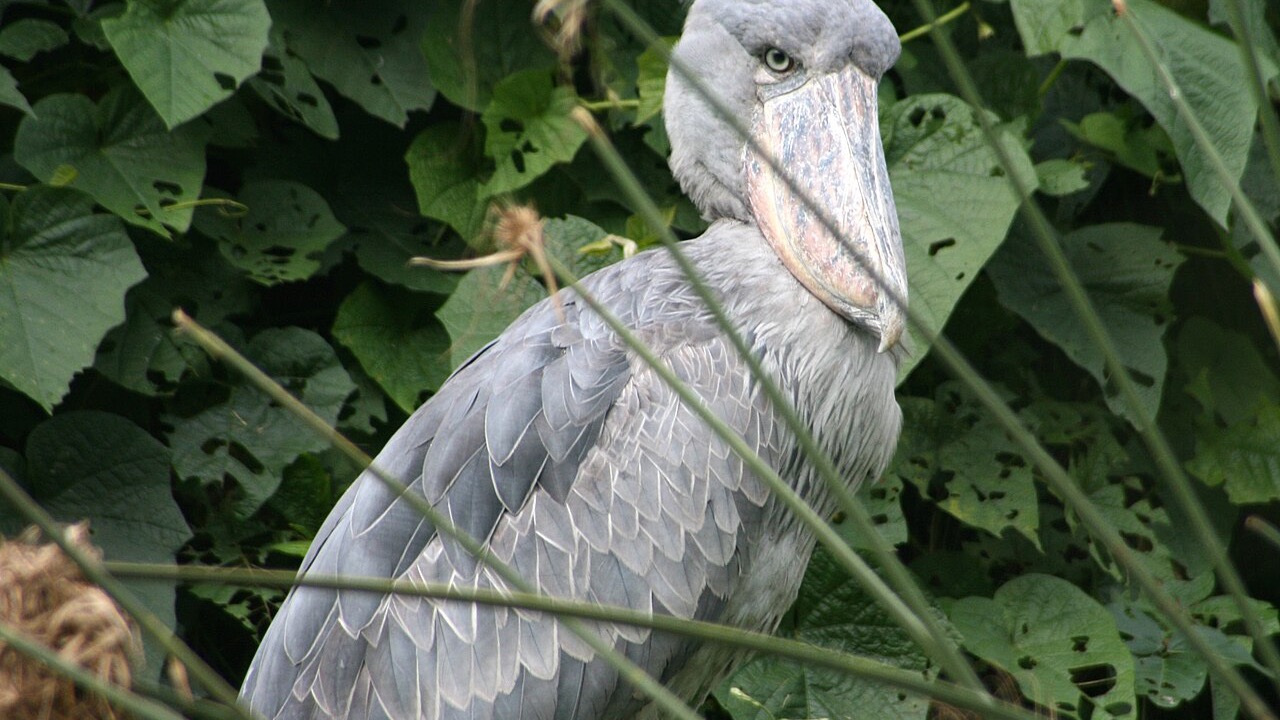
Photo: Eric Inafuku / Wikimedia Commons (CC BY 2.0)
In brief
The shoebill (Balaeniceps rex) is a Vulnerable African swamp bird famous for its massive shoe-shaped bill and motionless hunting posture; roughly 5,000–8,000 individuals remain in Central and East African wetlands.
Also in Animals A to Z · Animals that start with S
How you can help
You can support the related appeal — read its purpose, recipient status and fund terms first — or give once to where it is needed most. Sharing accurate information helps too.
By WARN Research & Conservation TeamLast updated
The shoebill (Balaeniceps rex) is one of Africa's most unmistakable birds — a tall, grey, stork-like waterbird with an enormous shoe-shaped bill and a patient, almost unnerving stillness. Standing up to 1.4 m tall with a wingspan near 2.5 m, it hunts in papyrus swamps and floating wetlands of Central and East Africa, spearing lungfish, catfish and juvenile crocodiles with a bill that can exceed 19 cm in length. Listed as Vulnerable on the IUCN Red List with an estimated 5,000–8,000 individuals and a decreasing population trend, the shoebill faces habitat drainage, nest disturbance, illegal capture for zoos and drowning in fishing nets. Uganda's Mabamba Swamp and Zambia's Bangweulu Wetlands are among the best-known strongholds — but the species needs intact wetland corridors across South Sudan, DRC and Tanzania to survive long term.
5,000–8,000
Estimated global population (IUCN)
1.4 m
Maximum standing height
19 cm
Bill length on large adults
Vulnerable
IUCN Red List status (2018)
Figures sourced from IUCN Red List — Balaeniceps rex, BirdLife DataZone — Shoebill species factsheet, CITES Appendices — Balaenicipitidae .
Shoebill: Quick Facts
| Height | Up to 1.4 m (4 ft 7 in) |
|---|---|
| Wingspan | Up to 2.5 m |
| Weight | Roughly 4–7 kg |
| Bill length | Up to 19 cm |
| Diet | Lungfish, catfish, frogs, snakes, small crocodiles |
| Habitat | Papyrus swamps and floating wetlands |
| Clutch size | Usually 2 eggs — often one chick survives |
| IUCN status | Vulnerable (2018 assessment) |
| Population | Estimated 5,000–8,000 individuals |
| CITES | Appendix II — international trade regulated |
Scientific Classification
| Kingdom | Animalia |
|---|---|
| Phylum | Chordata |
| Class | Aves |
| Order | Pelecaniformes |
| Family | Balaenicipitidae |
| Genus | Balaeniceps |
| Species | Balaeniceps rex (Gould, 1850) |
Conservation Status
- IUCN Status
- Vulnerable
- Population
- 5,000–8,000 individuals (IUCN 2018)
- Trend
- Decreasing
- Assessed
- 2018
- CITES
- Appendix II
Wetland drainage, nest disturbance, illegal live trade and fishing-net mortality are the leading documented threats.
Did you know?
Shoebills sometimes bill-clap during display — a loud, hollow percussion that carries across swamp — and may defecate on their legs to cool down, similar to storks.
Key Facts: Shoebill
- The shoebill's bill is one of the largest among living birds — adapted to grasp lungfish and other swamp prey.
- Shoebills hunt by standing motionless for long periods, then striking with explosive speed.
- Vulnerable on the IUCN Red List — wetland drainage and nest disturbance are primary threats.
- Central and East African papyrus swamps — Uganda, South Sudan, Zambia, Rwanda — hold most populations.
- Illegal capture for zoos and drowning in fishing nets add mortality beyond habitat loss.
What is a shoebill?
The shoebill is the sole living species in genus Balaeniceps and family Balaenicipitidae — phylogenetically placed among pelicans and hamerkops despite its stork-like appearance. Adults are mostly grey with a small crest, pale eyes and long black legs. Juveniles are browner. The bill is broad, hooked at the tip and deeply keeled — shaped to grip slippery lungfish (Protopterus) and other swamp vertebrates. Shoebills are largely silent except for bill-clapping displays and rare low murmurs at the nest. They can live 35 years or more in captivity; wild lifespan is less documented but likely decades with sufficient wetland food.
Where does the shoebill live?
Shoebills inhabit freshwater swamps with papyrus, reeds and floating vegetation — especially where lungfish and catfish abound. Range spans South Sudan, Uganda, western Tanzania, Rwanda, eastern DRC, northern Zambia and patchily Central African Republic. They are absent from coastal mangroves and arid zones. Home ranges are large and tied to ephemeral flood cycles — birds move as water levels rise and fall. Mabamba Bay on Lake Victoria (Uganda) and Bangweulu Wetlands (Zambia) support tourism that funds local guards — when nest disturbance is controlled, breeding success improves.
How does a shoebill hunt?
Shoebills are ambush predators — they stand frozen for minutes or hours, then lunge forward with wings spread for balance, snapping the bill shut on prey. Lungfish are a staple; frogs, snakes, monitor lizards, juvenile crocodiles and small waterbirds are also taken. Prey is decapitated or shaken before swallowing. Shoebills are solitary outside breeding — pairs defend nesting territories on floating platforms or papyrus mats. Two eggs are typical; siblicide often leaves one fledgling — a slow reproductive strategy that magnifies population sensitivity to disturbance.
Why is the shoebill Vulnerable?
The IUCN lists the shoebill as Vulnerable — population estimated at 5,000–8,000 and decreasing. Wetland conversion for agriculture, rice schemes and oil exploration drains core habitat. Nest trampling by cattle and disturbance from poorly managed tourism reduce breeding output. Illegal live capture for Middle Eastern and Asian zoos removes wild birds — CITES Appendix II regulates international trade but enforcement is weak. Bycatch and entanglement in fishing nets drown birds in shared waterways. Climate-driven shifts in flood timing may desynchronise shoebill breeding from lungfish availability — research ongoing.
What WARN Does
WARN publishes this guide for education and is developing support through assessed animal-welfare grants. A species range, source citation or photograph does not establish a recipient or funding agreement. Check /about/where-your-money-goes/#grant-register for published grant and payment records; records not yet published must not be read as zero activity. Browse /appeals/ for the purposes currently available to support.
Wetland habitats that sustain shoebills face the same drainage and fragmentation pressures as freshwater ecosystems worldwide. Supporting WARN habitat protection helps fund partner-led work keeping critical landscapes intact for wildlife and communities.
How can I help save the shoebill?
Explore practical ways to support the shoebill, from everyday choices and sharing reliable information to reviewing a related appeal before giving.
Explore ways to support
Read the related appeal’s purpose, recipient status and fund terms. Choose an affordable gift after checking what is proposed and what has been reported.
Ease the pressures
Avoid the wildlife trade and souvenirs, never buy wild animals as pets, and choose sustainable, habitat-friendly products — the threats behind the shoebill's decline fall when demand does.
Spread the word
Share accurate, sourced information about the shoebill. Wider awareness is what turns concern into lasting protection.
Shoebill: Frequently Asked Questions
How can I help save the shoebill?
Why is it called a shoebill?
Is the shoebill a stork or a pelican?
How many shoebills are left?
Where can you see shoebills in the wild?
Are shoebills dangerous?
What do shoebills eat?
Where do shoebills live?
How long do shoebills live?
How big is a shoebill?
Sources & References
Population figures, conservation status and biological facts on this page are drawn from authoritative scientific and intergovernmental sources.
Terms used on this page
Plain-English definitions, from our wildlife and conservation glossary.
Latest Shoebill Stories
Quick, fact-checked reads on the shoebill — amazing facts, key questions and the threats it faces.
Briefings
Bushmeat and the Selous–Niassa Corridor: A Quiet Wildlife Emergency
The forest corridor connecting Tanzania's southern reserves with Mozambique is one of Africa's most ecologically important. It is also one of its most heavily snared.
Read the storySpecies
The African Lion: Vulnerable, Declining, and Disappearing From Most of Africa
African lion numbers have fallen by an estimated 43% over three generations, and the species is now extinct across more than 90% of its historic range. Kenya and Tanzania — two countries WARN plans to expand into — hold some of the last strongholds.
Read the storySpecies
The African Elephant: Two Species, One Crisis
The IUCN now recognises two African elephant species: the African savanna elephant (Endangered) and the African forest elephant (Critically Endangered). Both are in steep decline, driven by ivory poaching and habitat loss.
Read the storyExplore more animals
Discover more animals, their habitats and their conservation status in the WARN wildlife-guide library.