Wildlife Guide · North America & Central America
Skunk
Mephitis mephitis (striped skunk); Family Mephitidae
Nature's chemical engineer — armed with one of the animal kingdom's most effective defences
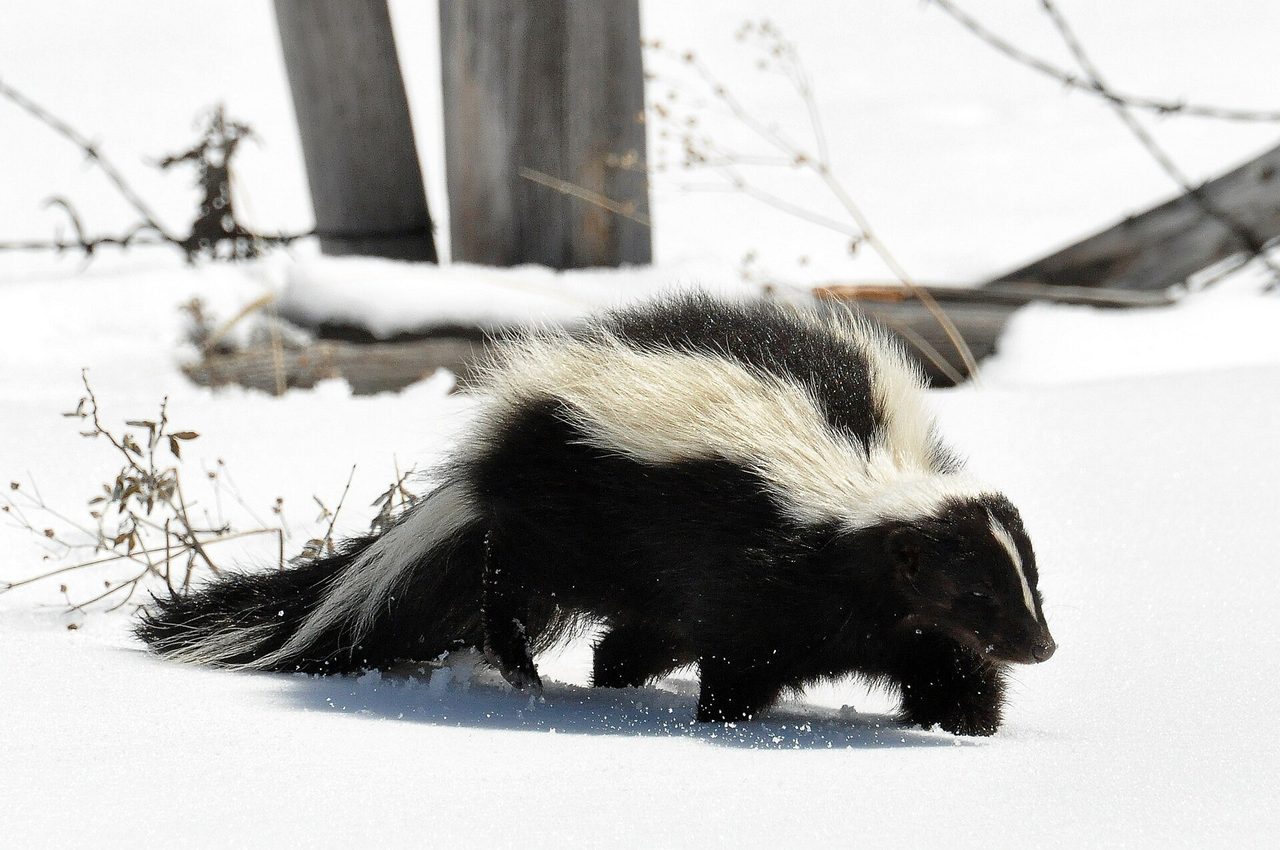
Photo: Dan & Lin Dzurisin / Wikimedia Commons (CC BY 2.0)
In brief
The skunk (family Mephitidae) is a small-to-medium omnivorous mammal found throughout the Americas, best known for its powerful sulphur-compound defensive spray, which it can aim accurately at threats up to six metres away.
Also in Animals A to Z · Animals that start with S
By WARN Research & Conservation TeamLast updated
Skunks belong to the family Mephitidae, a group of small-to-medium mammals best known for the remarkable sulphur-based spray they deploy against threats. The family includes 16 species across four genera — Mephitis, Conepatus, Spilogale, and Mydaus — found mainly in the Americas, with two stink badger species in South-East Asia. The most familiar is the striped skunk (Mephitis mephitis), whose bold black-and-white pattern has become a globally recognised warning signal. Far from being merely a nuisance, skunks are keystone insectivores whose digging aerates soil and keeps grub populations in check. Adaptable enough to thrive from dense forest to urban parks, they are among North America's most ecologically valuable yet least appreciated mammals.
6 m
Maximum spray range
16
Species in family Mephitidae
59–77 days
Gestation period (striped skunk)
7 years
Maximum wild lifespan
Figures sourced from IUCN Red List — Mephitis mephitis, Animal Diversity Web — Mephitis mephitis, Smithsonian's National Zoo — Striped Skunk and other references on this page.
Skunk: Quick Facts
| Body length | 40–94 cm depending on species |
|---|---|
| Weight | 0.5–8.2 kg depending on species |
| Diet | Omnivore — insects, grubs, small vertebrates, eggs, fruit |
| Lifespan | 2–7 years wild; up to 10 years in captivity |
| Litter size | 2–10 kits (average 6–7) |
| Activity pattern | Crepuscular and nocturnal |
| Spray range | Up to 6 metres (striped skunk) |
| Number of species | 16 in family Mephitidae |
Scientific Classification
| Kingdom | Animalia |
|---|---|
| Phylum | Chordata |
| Class | Mammalia |
| Order | Carnivora |
| Family | Mephitidae |
| Genus (primary) | Mephitis |
| Species (striped) | Mephitis mephitis |
Conservation Status
- IUCN Status
- Least Concern
- Population
- Abundant across North America; no global estimate established
- Trend
- Stable
- Assessed
- 2016
- CITES
- Not listed (Conepatus humboldtii listed on Appendix I)
Most mephitid species are stable; eastern spotted skunk has declined sharply in parts of the US Midwest due to habitat loss
Did you know?
A skunk always warns before it sprays — it stomps its front feet, raises its tail like a flag, and arches its body so both its eyes and scent glands face the threat simultaneously. If you see those three signals, back away slowly: the animal is giving you every chance to leave peacefully.
Key Facts: Skunk
- Skunks are not true hibernators — they enter a lighter torpor state in winter and can emerge on warm days to forage.
- Skunk spray is a cocktail of thiols, principally trans-2-butene-1-thiol; tomato juice does not neutralise it — hydrogen peroxide and baking soda do.
- Striped skunks are listed as Least Concern by the IUCN (assessed 2016) with a stable population across most of North America.
- Skunks are valuable pest controllers, with insects and grubs making up 52–96% of their diet depending on the season.
- Vehicle collisions and rabies are the leading documented causes of skunk mortality, not predation.
- The bold black-and-white colouration of skunks is a classic example of aposematism — a warning signal that predators learn to respect.
What is a skunk, and how many species are there?
Skunks are carnivoran mammals placed in their own family, Mephitidae, after genetic research in the 1990s separated them from the weasel family Mustelidae. The family contains 16 living species in four genera. The genus Mephitis holds the striped skunk (Mephitis mephitis) and the hooded skunk (Mephitis macroura). Spilogale contains eight species of spotted skunks, the smallest members of the family, while Conepatus comprises four hog-nosed skunk species ranging from the south-western United States to Patagonia. The stink badgers of South-East Asia — placed in Mydaus — complete the family. Body size ranges enormously: spotted skunks can weigh as little as 0.5 kg, while some hog-nosed skunks exceed 8 kg. The striped skunk, the most studied species, averages 1.4–6.6 kg and roughly 68 cm in total length. All mephitids share the family's defining feature — paired anal scent glands capable of projecting a noxious secretion — and all display warning colouration in black, white, brown, or cream patterns, even from birth.
Where do skunks live, and what habitats do they prefer?
The striped skunk occupies the widest range of any mephitid, spanning southern Canada from British Columbia to Nova Scotia, all contiguous US states, and northern Mexico. Other Mephitis and Conepatus species extend through Central America into Patagonia, while spotted skunks cover much of the same North American range at smaller, patchier scales. Skunks are habitat generalists. They favour mixed woodland with brushy edges, open grassland interspersed with wooded ravines, farmland margins, and rocky outcrops where den sites are plentiful. Their adaptability to human-modified landscapes is pronounced: striped skunks are common in suburban gardens, parks, and even city centres, where food is abundant and natural predator pressure is reduced. Dens are often appropriated burrows of other animals, hollow logs, rock crevices, or spaces beneath buildings. During the coldest winter months in northern parts of the range, skunks enter communal dens and reduce activity, sometimes sharing space with several individuals to conserve warmth — an unusual degree of sociality for an otherwise solitary animal.
How does a skunk's spray work, and can it really blind you?
The skunk's spray is produced by two walnut-sized anal glands flanking the rectum, each connected to a nipple the animal can aim with muscular control. The striped skunk can project its secretion accurately at targets up to six metres away. The chemical cocktail consists primarily of volatile thiols — sulphur-containing organic molecules including trans-2-butene-1-thiol and 3-methyl-1-butanethiol — which have an extraordinarily low odour threshold detectable by humans at concentrations of parts per billion. A third major component, trans-2-butenyl thioacetate, is less immediately odorous but breaks down slowly into thiols, which explains why the smell lingers for days on porous surfaces. Direct eye contact with the spray can cause temporary intense irritation and, in rare cases, brief vision impairment, but permanent eye damage is not documented in healthy individuals. Before spraying, skunks give clear warnings: they stomp their front feet, raise and fan their tail, and arch their body into a U-shape so both eyes and the gland can face the threat simultaneously. The popular tomato-juice remedy is a myth — it only masks the odour through olfactory fatigue. Oxidising agents such as hydrogen peroxide combined with baking soda chemically break down the thiol bonds and genuinely neutralise the smell.
What do skunks eat, and what role do they play in their ecosystem?
Skunks are opportunistic omnivores whose diet shifts markedly with season. In warmer months, insects and larvae — beetles, crickets, grasshoppers, caterpillars, and especially soil-dwelling grubs — can constitute 52–96% of intake by volume, making skunks some of the most productive insectivores in temperate North America. They supplement this with small vertebrates, bird eggs, berries, seeds, fungi, and carrion. Their powerful front claws make them efficient diggers capable of excavating larvae from compacted soil, and this digging aerates ground and cycles nutrients. Skunks are also effective controllers of pest species, consuming large numbers of agricultural insects and rodents. As prey animals themselves — primarily taken by great horned owls, which appear largely immune to the spray's deterrent effect, and occasionally by coyotes, foxes, and bobcats — skunks contribute energy to upper trophic levels. In winter, northern populations enter torpor (not full hibernation), reducing their metabolic rate and relying on fat reserves, though they may emerge on mild days. Females give birth to litters of two to ten kits after a gestation of 59–77 days, with young weaning at around six to seven weeks.
What are the main threats facing skunks today?
The striped skunk is listed as Least Concern by the IUCN with a stable overall population trend, a status last formally assessed in 2016 that remains current. However, not all mephitids share this security. Humboldt's hog-nosed skunk (Conepatus humboldtii) of southern South America is listed on CITES Appendix I, reflecting genuine concern over its restricted Patagonian range. Eastern spotted skunks have undergone local declines exceeding 90% in some parts of the US Midwest since the mid-twentieth century, attributed to loss of grassland and forest-edge habitat. For the striped skunk, vehicle collisions represent a significant documented mortality source across the range, particularly during spring dispersal of juveniles. Rabies is another major pressure: skunks are among the most important wildlife reservoirs of terrestrial rabies in North America, and periodic epizootic outbreaks can drive sharp local population crashes. Secondary poisoning from rodenticide use, particularly first and second-generation anticoagulants, is an emerging concern. Habitat fragmentation from urban sprawl continues to reduce connectivity between populations, and fur trapping — though much reduced from historical levels — still occurs in some jurisdictions. Despite these pressures, the striped skunk's reproductive flexibility and dietary adaptability make large-scale decline unlikely in the near term.
What WARN Does
WARN does not currently run projects for skunks — our rescue and conservation partnerships focus on wildlife in its partner-network countries. This guide is offered as free educational content because an informed public is the first line of defence for all wildlife: understanding a species' ecological value is what shifts it from pest to protected neighbour in the minds of local communities worldwide.
Every wild animal — from the dramatic big cats to the quietly industrious skunk — depends on healthy, connected habitat. Supporting WARN's habitat protection work helps safeguard the ecosystems that make coexistence between wildlife and people possible.
Skunk: Frequently Asked Questions
Are skunks dangerous to humans?
Do skunks hibernate in winter?
How many times can a skunk spray before running out?
Why does the striped skunk have black and white markings?
Is it legal to keep a skunk as a pet?
What do striped skunks eat?
Where do striped skunks live?
How long do striped skunks live?
How big is a striped skunk?
Sources & References
Population figures, conservation status and biological facts on this page are drawn from authoritative scientific and intergovernmental sources.
- IUCN Red List — Mephitis mephitis
- Animal Diversity Web — Mephitis mephitis
- Smithsonian's National Zoo — Striped Skunk
- PBS NOVA — The Chemistry of Skunk Spray
- Britannica — Does Tomato Juice Neutralise Skunk Odour?
- Journal of Mammalogy — Seasonal Survival of Urban and Rural Striped Skunks
- CITES Species Checklist — Mephitidae
Terms used on this page
Plain-English definitions, from our wildlife and conservation glossary.
Latest Skunk Stories
Quick, fact-checked reads on the skunk — amazing facts, key questions and the threats it faces.
Species
12 Amazing Facts About the Jaguar, the Americas' Biggest Cat
From a skull-piercing bite to a love of swimming, here are 12 fascinating, fact-checked things that make the jaguar the most powerful cat in the Americas.
Read the storySpecies
11 Amazing Facts About the Pink River Dolphin (the Amazon's Blushing Boto)
From a head that swivels 90 degrees to a blush built from battle scars, here are 11 true facts about the Amazon's pink river dolphin, the largest freshwater dolphin on Earth.
Read the storySpecies
Pink River Dolphin vs Tucuxi: How to Tell the Two Amazon Dolphins Apart
Both swim the same Amazon waters, but the pink boto and the grey tucuxi are only distant cousins. Here is how to tell them apart at a glance.
Read the storyExplore more animals
Discover more animals, their habitats and their conservation status in the WARN wildlife-guide library.