Wildlife Guide · Brazil & Colombia
Sloth
Bradypus & Choloepus spp.
The slowest mammal on Earth, moving so little that algae grows in its fur.
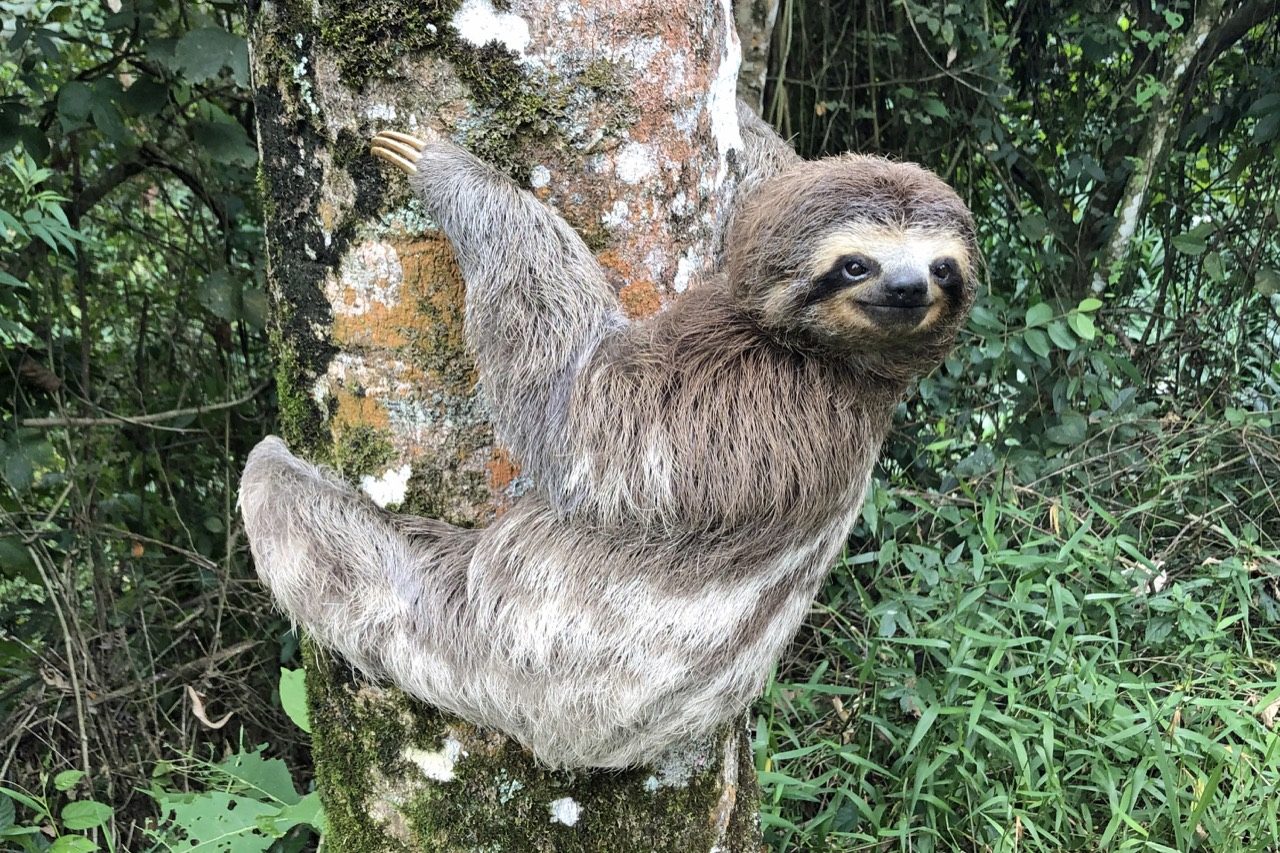
Source: Wikimedia Commons via Wikipedia “Sloth”
In brief
A sloth is a slow-moving, leaf-eating mammal that lives hanging upside down in the trees of Central and South American rainforests. There are six living species in two groups, the three-toed sloths (Bradypus) and two-toed sloths (Choloepus), and they are the slowest mammals on Earth.
Also in Animals A to Z · Animals that start with S
By WARN Research & Conservation TeamLast updated
Sloths are slow-moving, tree-dwelling mammals of Central and South American rainforests, split into two living groups: three-toed sloths (genus Bradypus) and two-toed sloths (genus Choloepus). They spend almost their entire lives hanging upside down in the canopy, digesting leaves at one of the lowest metabolic rates of any mammal. Most of the six living species are still widespread, but two are threatened and the pet trade and road deaths put growing pressure on populations in countries such as Brazil and Colombia.
6 species
Living sloths in two groups (three-toed and two-toed)
~3 m/min
Top speed on the ground, the slowest of any mammal
40-45%
Of the metabolic rate expected for their body size
2
Species threatened: maned sloth (EN) and pygmy three-toed sloth (CR)
Figures sourced from IUCN Red List - Bradypus variegatus (brown-throated three-toed sloth), IUCN Red List - Bradypus pygmaeus (pygmy three-toed sloth), IUCN Red List - Bradypus torquatus (maned sloth) and other references on this page.
Sloth: Quick Facts
| Lifespan | ~16 years median in care; some two-toed sloths reach 30-49 years |
|---|---|
| Weight | Two-toed ~4-9 kg (9-20 lb); three-toed ~3.5-6 kg |
| Length | ~50-75 cm (about 20-30 in) |
| Diet | Folivore; leaves and buds (two-toed also fruit, occasionally small animals) |
| Gestation | Three-toed ~6 months; two-toed ~10-12 months |
| Young per birth | Usually a single cub |
| Top speed | ~3 m per minute on the ground (slowest mammal); faster swimming |
| Baby name | Cub or pup |
| Group name | Largely solitary; no standard collective noun |
| CITES | Bradypus and Choloepus species listed on CITES Appendix II |
Scientific Classification
| Kingdom | Animalia |
|---|---|
| Phylum | Chordata |
| Class | Mammalia |
| Order | Pilosa |
| Suborder | Folivora (sloths) |
| Families | Bradypodidae (three-toed) and Choloepodidae (two-toed) |
| Genera | Bradypus Linnaeus, 1758 and Choloepus Illiger, 1811 |
| Species | 6 living species (group entry, not a single species) |
Conservation Status
- IUCN Status
- Mixed by species: 4 of 6 living species Least Concern; maned sloth Endangered; pygmy three-toed sloth Critically Endangered
- Population
- No single reliable total for all sloths; pygmy three-toed sloth estimated at only a few hundred to a few thousand individuals
- Trend
- Stable for widespread species; decreasing for the threatened maned and pygmy three-toed sloths
- Assessed
- 2022-2024 (species assessed individually by the IUCN)
- CITES
- Appendix II (Bradypus and Choloepus species)
The IUCN does not assess "sloth" as one taxon; each species has its own status, so a single category would be misleading.
Did you know?
Sloths move so slowly that algae grows in their fur, turning them faintly green and giving their own species of moth a place to live.
Key Facts: Sloth
- "Sloth" covers six living species in two genera: three-toed sloths (Bradypus, four species) and two-toed sloths (Choloepus, two species).
- They are the slowest mammals on Earth, with a metabolism only 40-45% of what is expected for their size, an adaptation to a low-energy leaf diet.
- Their fur hosts symbiotic green algae and specialised sloth moths, giving older animals a greenish tinge that aids camouflage.
- Most sloth species are Least Concern, but the maned sloth (Bradypus torquatus) is Endangered and the pygmy three-toed sloth (Bradypus pygmaeus) is Critically Endangered.
- In Brazil and Colombia, the main pressures are Atlantic Forest loss, the illegal pet trade, and road and power-line deaths.
- Despite their slowness in trees, sloths are surprisingly capable swimmers and can hold their breath for long periods.
What a sloth is and how it lives
Sloths belong to the order Pilosa, the same group as anteaters, and form the suborder Folivora ("leaf-eaters"). Six living species are recognised, divided between the three-toed sloths of the genus Bradypus and the two-toed sloths of the genus Choloepus. Despite the common names, all sloths have three toes on their hind limbs; the difference is in the forelimbs, where three-toed sloths have three front claws and two-toed sloths have two. They spend almost their whole lives suspended in the rainforest canopy, gripping branches with long, curved claws, and descend to the ground only about once a week, usually to defecate. Their leaf-heavy diet yields very little energy, so sloths conserve it through low body temperatures, long digestion times, and minimal movement.
Behaviour, ecology and the algae in their fur
A sloth's slowness is its survival strategy. Moving little makes it almost invisible to predators such as harpy eagles and big cats that hunt by detecting movement. Their coarse outer fur grows the opposite way to most mammals, running from belly to back so rain sheds off while they hang upside down, and it provides a home for symbiotic green algae and specialised sloth moths. The algae can give the coat a greenish cast that improves camouflage and may even offer a minor nutritional supplement. Three-toed sloths are almost entirely leaf-eaters, while two-toed sloths are more omnivorous, also taking fruit and occasionally small animals. Both groups are surprisingly strong swimmers, using their long arms to cross rivers far faster than they ever move on land.
Why some sloths are threatened
At the group level sloths are not assessed as a single unit, and four of the six living species are listed as Least Concern. The picture is far more serious for two species. The maned sloth (Bradypus torquatus), endemic to Brazil's heavily fragmented Atlantic Forest, is assessed as Endangered, with a small and declining area of suitable forest. The pygmy three-toed sloth (Bradypus pygmaeus) is Critically Endangered, restricted to a single tiny island off Panama with an estimated population of only a few hundred to a few thousand animals. Across the wider range, habitat loss, the illegal pet trade, electrocution on power lines, and road traffic are recurring threats, particularly where forest meets expanding towns and farmland.
What sloth rescue involves
Rescue and rehabilitation work focuses on animals orphaned, injured, or seized from the illegal pet trade, as well as those electrocuted on power lines or hit by vehicles where forest is fragmented. Care is slow and specialised: sloths need precise diets, careful handling of stress-prone infants, and gradual reconditioning before any release into protected forest. Longer-term protection depends on keeping forest connected, installing wildlife crossings and insulating power lines, and reducing demand for sloths as pets and tourist photo props. Because so much sloth habitat lies in countries with limited conservation funding, local shelters and rescue teams are often the front line.
Three-toed vs two-toed sloths
| Feature | Three-toed sloth (Bradypus) | Two-toed sloth (Choloepus) |
|---|---|---|
| Front claws | Three on each forelimb | Two on each forelimb |
| Living species | Four | Two |
| Diet | Almost entirely leaves | More omnivorous: leaves, fruit, occasional small animals |
| Activity | Mainly active by day | Mainly active at night |
| Gestation | About 6 months | About 10-12 months |
| Most threatened member | Pygmy three-toed sloth (Critically Endangered) | Both Choloepus species currently Least Concern |
What WARN Does
WARN publishes this guide for education and is developing support through assessed animal-welfare grants. A species range, source citation or photograph does not establish a recipient or funding agreement. Check /about/where-your-money-goes/#grant-register for published grant and payment records; records not yet published must not be read as zero activity. Browse /appeals/ for the purposes currently available to support.
A donation to WARN helps fund the local partner shelters in Brazil and Colombia that rescue, treat and rehome sloths orphaned by deforestation or taken from the illegal pet trade.
Sloth: Frequently Asked Questions
How long do sloths live?
What do sloths eat?
How big are sloths?
Are sloths dangerous?
How many sloths are left?
What is a baby sloth called and how are sloths grouped?
Where do sloths live?
Sources & References
Population figures, conservation status and biological facts on this page are drawn from authoritative scientific and intergovernmental sources.
- IUCN Red List - Bradypus variegatus (brown-throated three-toed sloth)
- IUCN Red List - Bradypus pygmaeus (pygmy three-toed sloth)
- IUCN Red List - Bradypus torquatus (maned sloth)
- IUCN SSC Anteater, Sloth and Armadillo Specialist Group
- Smithsonian's National Zoo - Two-toed sloth
- CITES species database
- Britannica - Sloth
Terms used on this page
Plain-English definitions, from our wildlife and conservation glossary.
Latest Sloth Stories
Quick, fact-checked reads on the sloth — amazing facts, key questions and the threats it faces.
Species
12 Amazing Facts About Sloths You Probably Didn't Know
From algae gardens growing in their fur to digesting a single leaf for weeks, here are twelve genuinely surprising, science-backed facts about the world's slowest mammal.
Read the storySpecies
How Slow Is a Sloth? The Science Behind the World's Slowest Mammal
Sloths crawl about 3 metres a minute and can spend a month digesting one leaf. Here's exactly how slow they are, in numbers, and why their slowness keeps them alive.
Read the storySpecies
Two-Toed vs Three-Toed Sloth: What's the Difference?
They look alike hanging in the trees, but two-toed and three-toed sloths differ in claws, diet, behaviour and conservation status. Here's how to tell them apart.
Read the storyExplore more animals
Discover more animals, their habitats and their conservation status in the WARN wildlife-guide library.